I was milling around on the Internets last night when a headline scrolled across the top of my screen that said something like "Ant-American Cleric Flees to Iran". When I clicked on the link, the story told me that the "anti-American cleric" in question was Al-Sadr, one of the most influential Shiite leaders in Iraq.
Wow, I thought, this has to be considered good news, right? Highly interested in this development, I surfed the liberal swamp of dirty, commie hippy web-blogs for further info but no one had anything to say yet, given how recent the story appeared to be. Even Juan Cole hadn't reported or analyzed this report yet.
Then this morning I see a headline that provides a twist to last night's original account. Now the headline was saying that the U.S. military was asserting that Al-Sadr had indeed fled to Iran even though there were now some counter-reports disputing this claim.
Oh.
And then I turn to Juan Cole who had by this time gotten on the story.
And it seems that, with a little depth of investigating, things may be a little more complicated than they at first appeared:
This USG report about Muqtada broke after midnight Baghdad time, so there has not been time for the Arabic or Persian press to react. I'll know more Thursday morning.
Sadr aides denied to the LA Times that Muqtada is in Iran, saying he is in hiding in Iraq.
Some are taking exception to the word "fled."
The press record I assembled, below, does not support Muqtada's disappearance to Iran. It is possible but not likely that Muqtada would go to Iran. He and his family have endlessly made fun of the al-Hakim clerical leaders for fleeing to Iran to escape persecution by Saddam Hussein, when the al-Sadrs insisted on staying in Iraq. Muqtada's father was killed in 1999 by Saddam's agents because he stayed and gave defiant sermons. So it would be a lot of crow to eat for Muqtada to go to Iran to escape the Americans. Plus, there is nothing in the Iranian press about him showing up in Qom, and an Iranian diplomat denied the story. Without more and better evidence, this account strikes me as suspect, and I would guess that if Muqtada disappeared, it is inside Iraq.
It might be useful to construct a timeline for Muqtada's recent activities.
Read the whole thing.
Aren't you glad there are people besides the Very Serious People in our Media Elite to evaluate this kind of stuff?
Wednesday, February 14, 2007


Sunday, February 11, 2007
Off to a Good Start
So Obama went live this weekend, with thousands of Illini and other fans and interested observers packing the Illinois state-house lawn in Springfield in single-digit weather to hear the first-term Senator launch his bid for the WH.
And to cap it all off, it appears Obama has signed on Australian PM John Howard to support his campaign. How else to explain this perfect set-up? (h/t Atrios)
Senator Obama, who is aiming to become the first black US president, has introduced a bill to remove US combat forces from Iraq by March 31 next year.
But the legislation has virtually no chance of becoming law while George W. Bush is president, and the presidential election is not until November 2008.
Australia's Prime Minister John Howard blasted Senator Obama's policy on the Iraq war and said al-Qaeda would "be praying as many times as possible for a victory for not only Obama but also for the Democrats".
And just so you don't think Obama's all bland platitudes and bipartisanship, he took the opportunity provided by Howard's challenge to layeth the smacketh down, the Chicago Way:
"If Prime Minister Howard truly believes what he says, perhaps his country should find its way to contribute more than just 1,400 troops so some American troops can come home," [Obama spokesman Robert Gibbs] said. "It's easy to talk tough when it's not your country or your troops making the sacrifices."
Damn. Wonder how much the Obama campaign paid Howard to serve up that softball.
Next?
Bring it on.
And to cap it all off, it appears Obama has signed on Australian PM John Howard to support his campaign. How else to explain this perfect set-up? (h/t Atrios)
Senator Obama, who is aiming to become the first black US president, has introduced a bill to remove US combat forces from Iraq by March 31 next year.
But the legislation has virtually no chance of becoming law while George W. Bush is president, and the presidential election is not until November 2008.
Australia's Prime Minister John Howard blasted Senator Obama's policy on the Iraq war and said al-Qaeda would "be praying as many times as possible for a victory for not only Obama but also for the Democrats".
And just so you don't think Obama's all bland platitudes and bipartisanship, he took the opportunity provided by Howard's challenge to layeth the smacketh down, the Chicago Way:
"If Prime Minister Howard truly believes what he says, perhaps his country should find its way to contribute more than just 1,400 troops so some American troops can come home," [Obama spokesman Robert Gibbs] said. "It's easy to talk tough when it's not your country or your troops making the sacrifices."
Damn. Wonder how much the Obama campaign paid Howard to serve up that softball.
Next?
Bring it on.
Thursday, February 08, 2007
Pretty Weak
John Edwards today
The tone and the sentiment of some of Amanda Marcotte's and Melissa McEwan's posts personally offended me. It's not how I talk to people, and it's not how I expect the people who work for me to talk to people. Everyone is entitled to their opinion, but that kind of intolerant language will not be permitted from anyone on my campaign, whether it's intended as satire, humor, or anything else. But I also believe in giving everyone a fair shake. I've talked to Amanda and Melissa; they have both assured me that it was never their intention to malign anyone's faith, and I take them at their word. We're beginning a great debate about the future of our country, and we can't let it be hijacked. It will take discipline, focus, and courage to build the America we believe in.
And therefore....?????
It sounds like Edwards is keeping them on but took them to the woodshed in agreeing to do so.
Democrats need to learn how Republicans "apologize": issue a non-apology-apology that attacks the messenger. Edwards needed to do an "up-yours" here, and whiffed.
While I'm glad that Amanda and Melissa were not thrown overboard for the sake of a balding, pompous, in-your-face loudmouth who I can only describe as thoroughly contemptible, this just won't cut it. The Bill Donahue's of the world are bullies who need to be cut down to size.
The tone and the sentiment of some of Amanda Marcotte's and Melissa McEwan's posts personally offended me. It's not how I talk to people, and it's not how I expect the people who work for me to talk to people. Everyone is entitled to their opinion, but that kind of intolerant language will not be permitted from anyone on my campaign, whether it's intended as satire, humor, or anything else. But I also believe in giving everyone a fair shake. I've talked to Amanda and Melissa; they have both assured me that it was never their intention to malign anyone's faith, and I take them at their word. We're beginning a great debate about the future of our country, and we can't let it be hijacked. It will take discipline, focus, and courage to build the America we believe in.
And therefore....?????
It sounds like Edwards is keeping them on but took them to the woodshed in agreeing to do so.
Democrats need to learn how Republicans "apologize": issue a non-apology-apology that attacks the messenger. Edwards needed to do an "up-yours" here, and whiffed.
While I'm glad that Amanda and Melissa were not thrown overboard for the sake of a balding, pompous, in-your-face loudmouth who I can only describe as thoroughly contemptible, this just won't cut it. The Bill Donahue's of the world are bullies who need to be cut down to size.
Is "The Catholic League" an Astro-Turf Group?
From AmericaBlog
Check out who this "Catholic group" is affiliated with.
Members of the Catholic League's board of advisers include conservative author and media analyst L. Brent Bozell III; conservative radio host and syndicated columnist Linda Chavez; right-wing pundit and author Dinesh D'Souza; former Republican presidential and senatorial candidate Alan Keyes; and National Review Washington editor Kate O'Beirne.
Yeah, some Catholic group. It reads like the board of the Heritage Foundation.
So what really happened here is that the Associated Press got a call from a bunch of conservative longtime Republican party activists criticizing a lead Democratic candidate, but didn't suspect a partisan motive, and didn't bother informing its readers.
---------
And among Bill Donahue's greatest hits list are
Hollywood is controlled by secular Jews who hate Christianity in general and Catholicism in particular. It's not a secret, OK? And I'm not afraid to say it. That's why they hate this movie. It's about Jesus Christ, and it's about truth. It's about the messiah. Hollywood likes anal sex.
I don't know what about -- the queer-bashing is all about. I'm pretty good about picking out who queers are and I didn't see any in the movie. I'm usually pretty good at that.
Catholic League president Bill Donohue said lesbians were "something I'd expect to see in an asylum, frankly" when he spoke to Justice Sunday, a gathering of far-right evangelical Christian activists.
h/t to AmericaBlog and Atrios for the above gems. Keep 'em comin'.
Meanwhile, the Edwards campaign still hasn't said what it intends to do regarding the employment of Amanda and Melissa. There are, however, already a number of diaries on the Edwards website imploring the campaign not to let the right-wing determine its personnel policies or its policies period.
What's worse is, apparently Donahue's astro-turf hate group has punked the Democrats before, as recently as 2004 when Edwards was the VP nominee:
A more recent -- and relevant -- example was when the Kerry-Edwards '04 campaign pushed aside the DNC's religious outreach coordinator in response to pressure from -- wait for it -- Bill Donohue's Catholic League. The National Catholic Reporter's 2004 assessment of that situation:
The Kerry campaign has a gang-that-can’t-shoot-straight quality when it comes to outreach to the religious community, the net result of which is that they hurt their friends and give credibility to their critics.
The August 4 resignation of Rev. Brenda Bartella Peterson from her post as Director of Religious Outreach at the Democratic National Committee (DNC) is the most recent example. Soon after her appointment, the New York-based Catholic League for Civil and Religious Rights revealed that Peterson had joined 31 other religious leaders in filing a friend of the court brief in support of removing “under God” from the Pledge of Allegiance. (Kerry, by the way, supports keeping “under God” in the Pledge.)
Officially Peterson jumped, telling Religious News Service that it was “no longer possible for me to do my job effectively.” But it sure sounds like she was pushed.
Previously, the Kerry campaign silenced religious outreach coordinator Mara Vanderslice after the Catholic League issued press releases which labeled her soft on anti-Catholicism because she had engaged in civil disobedience with, among others, the AIDS activist organization, Act-UP.
Perhaps the DNC and the Kerry campaign should have never hired Peterson or Vanderslice. And, God knows, there’s truth to the idea that Kerry doesn’t need more distractions related to religion. But to give the press-release-machine of the Catholic League veto power over Democratic campaign staff strikes some as, at best, an overreaction; to others, it represents a fundamental misunderstanding about the Catholic community and its influential players.
No one who signs up for a presidential campaign should be surprised if they get turned into an issue, and no one hiring people for such a campaign should be surprised if staffers get attacked. That's how things roll. Also: No one should be surprised that Donohue is again creating a controversy about a Democratic staffer, since it worked out so well for him just two and a half years ago. The issue is whether Democrats can figure out how to fight off such attacks.
In the meantime, why not drop the Edwards campaign a line supporting Amanda and Melissa, and letting the campaign know if it doesn't already, who the person is who's demanding the campaign bow to its wishes.
Check out who this "Catholic group" is affiliated with.
Members of the Catholic League's board of advisers include conservative author and media analyst L. Brent Bozell III; conservative radio host and syndicated columnist Linda Chavez; right-wing pundit and author Dinesh D'Souza; former Republican presidential and senatorial candidate Alan Keyes; and National Review Washington editor Kate O'Beirne.
Yeah, some Catholic group. It reads like the board of the Heritage Foundation.
So what really happened here is that the Associated Press got a call from a bunch of conservative longtime Republican party activists criticizing a lead Democratic candidate, but didn't suspect a partisan motive, and didn't bother informing its readers.
---------
And among Bill Donahue's greatest hits list are
Hollywood is controlled by secular Jews who hate Christianity in general and Catholicism in particular. It's not a secret, OK? And I'm not afraid to say it. That's why they hate this movie. It's about Jesus Christ, and it's about truth. It's about the messiah. Hollywood likes anal sex.
I don't know what about -- the queer-bashing is all about. I'm pretty good about picking out who queers are and I didn't see any in the movie. I'm usually pretty good at that.
Catholic League president Bill Donohue said lesbians were "something I'd expect to see in an asylum, frankly" when he spoke to Justice Sunday, a gathering of far-right evangelical Christian activists.
h/t to AmericaBlog and Atrios for the above gems. Keep 'em comin'.
Meanwhile, the Edwards campaign still hasn't said what it intends to do regarding the employment of Amanda and Melissa. There are, however, already a number of diaries on the Edwards website imploring the campaign not to let the right-wing determine its personnel policies or its policies period.
What's worse is, apparently Donahue's astro-turf hate group has punked the Democrats before, as recently as 2004 when Edwards was the VP nominee:
A more recent -- and relevant -- example was when the Kerry-Edwards '04 campaign pushed aside the DNC's religious outreach coordinator in response to pressure from -- wait for it -- Bill Donohue's Catholic League. The National Catholic Reporter's 2004 assessment of that situation:
The Kerry campaign has a gang-that-can’t-shoot-straight quality when it comes to outreach to the religious community, the net result of which is that they hurt their friends and give credibility to their critics.
The August 4 resignation of Rev. Brenda Bartella Peterson from her post as Director of Religious Outreach at the Democratic National Committee (DNC) is the most recent example. Soon after her appointment, the New York-based Catholic League for Civil and Religious Rights revealed that Peterson had joined 31 other religious leaders in filing a friend of the court brief in support of removing “under God” from the Pledge of Allegiance. (Kerry, by the way, supports keeping “under God” in the Pledge.)
Officially Peterson jumped, telling Religious News Service that it was “no longer possible for me to do my job effectively.” But it sure sounds like she was pushed.
Previously, the Kerry campaign silenced religious outreach coordinator Mara Vanderslice after the Catholic League issued press releases which labeled her soft on anti-Catholicism because she had engaged in civil disobedience with, among others, the AIDS activist organization, Act-UP.
Perhaps the DNC and the Kerry campaign should have never hired Peterson or Vanderslice. And, God knows, there’s truth to the idea that Kerry doesn’t need more distractions related to religion. But to give the press-release-machine of the Catholic League veto power over Democratic campaign staff strikes some as, at best, an overreaction; to others, it represents a fundamental misunderstanding about the Catholic community and its influential players.
No one who signs up for a presidential campaign should be surprised if they get turned into an issue, and no one hiring people for such a campaign should be surprised if staffers get attacked. That's how things roll. Also: No one should be surprised that Donohue is again creating a controversy about a Democratic staffer, since it worked out so well for him just two and a half years ago. The issue is whether Democrats can figure out how to fight off such attacks.
In the meantime, why not drop the Edwards campaign a line supporting Amanda and Melissa, and letting the campaign know if it doesn't already, who the person is who's demanding the campaign bow to its wishes.
Tuesday, February 06, 2007
How Does This Stuff Get Printed?
Several people have already commented on the David Broder column in which he repeats Republican talking points about Democrats and the military. Here is the money paragraph in what is otherwise a rather vanilla "I'm mailin' this in" article:
One of the losers in the weekend oratorical marathon was retired Gen. Wesley Clark, who repeatedly invoked the West Point motto of "Duty, Honor, Country," forgetting that few in this particular audience have much experience with, or sympathy for, the military. The larger disaster was the long harangue of former Alaska senator Mike Gravel, a strident critic of almost everything and promoter of a folly -- a national initiative process -- that not even a deranged blogger could love. Someone has to give him the hook before the real debates begin.
So, "few" in this Democratic crowd have much "experience" with the military? What kind of ass-clown do you have to be to type this and not be struck by the ludicrous irony; I mean how many times do we keep having to go to the well and report the fact that among Democratics in Congress, for starters, a far greater share of them have military "experience" than their Republican colleagues? And, um, how about those brave souls sitting in the WH who have no trouble sending other people's kids off to war but couldn't find time themselves to serve when there was a war going on in their prime-war years, and when there was a draft no less?
Broder used to be a "journalist". In the old days that involved, you know, investigating and stuff about what was going on. Today, all J-school grads have to do is go to Google. Apparently Broder feels himself beyond the need to stoop to such low levels of drudgery.
And then he references someone I've never heard of, Mike Gravel, and his apparently loony idea of a national initiative process, which, as Broder summarizes, is so goofy that not even a "deranged blogger" could love it. WTF?
Meanwhile, I'm sure Broder continues to think that Very Serious people like Joe Lieberman and John McCain are Still Serious and constitute the only people who's ideas are worth offering the public.
Yes, we're deranged alright.
One of the losers in the weekend oratorical marathon was retired Gen. Wesley Clark, who repeatedly invoked the West Point motto of "Duty, Honor, Country," forgetting that few in this particular audience have much experience with, or sympathy for, the military. The larger disaster was the long harangue of former Alaska senator Mike Gravel, a strident critic of almost everything and promoter of a folly -- a national initiative process -- that not even a deranged blogger could love. Someone has to give him the hook before the real debates begin.
So, "few" in this Democratic crowd have much "experience" with the military? What kind of ass-clown do you have to be to type this and not be struck by the ludicrous irony; I mean how many times do we keep having to go to the well and report the fact that among Democratics in Congress, for starters, a far greater share of them have military "experience" than their Republican colleagues? And, um, how about those brave souls sitting in the WH who have no trouble sending other people's kids off to war but couldn't find time themselves to serve when there was a war going on in their prime-war years, and when there was a draft no less?
Broder used to be a "journalist". In the old days that involved, you know, investigating and stuff about what was going on. Today, all J-school grads have to do is go to Google. Apparently Broder feels himself beyond the need to stoop to such low levels of drudgery.
And then he references someone I've never heard of, Mike Gravel, and his apparently loony idea of a national initiative process, which, as Broder summarizes, is so goofy that not even a "deranged blogger" could love it. WTF?
Meanwhile, I'm sure Broder continues to think that Very Serious people like Joe Lieberman and John McCain are Still Serious and constitute the only people who's ideas are worth offering the public.
Yes, we're deranged alright.
Monday, February 05, 2007
Rethinking the Afghanistan War
It's an almost common article of faith among liberals that while we opposed the invasion of Iraq we humbly submit that the American invasion of Afghanistan was justified. The Taliban was harboring Al Qaeda. Al Qaeda attacked us on 911. So we're not against all wars, we're really not soft, we don't just automatically reject the extension of American military power and the use of force, and so on.
But was the invasion of Afghanistan a risk free choice, an option without more troubling and widespread implications?
I'm beginning to think not. Or at least not in the manner it was executed and especially in the form of authorization it gave the administration.
Consider the administration's rationale in the on-going treatment of detainees. In particular, consider the case of Ali al-Marri, who was in the news last week.
A Bush administration lawyer urged the panel to dismiss al-Marri's appeal, arguing that under the Military Commissions Act, the courts have no jurisdiction to hear cases of detained aliens who are declared enemy combatants.
David B. Salmons, assistant to the solicitor general, also argued that the government properly classified al-Marri as an enemy combatant, citing what the government said is evidence that he trained at an al-Qaida camp and met with Osama bin Laden and suspected Sept. 11 mastermind Khalid Sheik Mohammed.
Judge Diana G. Motz asked Salmons what would stop the president from declaring anyone an enemy combatant, including those who are citizens of nations not at war with the U.S., including al-Marri.
"What I don't understand is how you make one an enemy combatant," she said. "What did the president look to, to call someone an enemy combatant?"
Salmons said that Congress and the Supreme Court have given the president the authority to fight terrorism and prevent additional attacks on the nation, including declaring those with suspected al-Qaida links as enemy combatants. Furthermore, Salmons argued, al-Marri is "clearly an al-Qaida operative and qualifies as an enemy combatant."
"If the U.S. can do this, it's contrary to the Constitution," Motz said. "It would give other nations the ability to do that by declaring a U.S. citizen an enemy combatant."
Salmons responded: "It's different; we're responding to the attacks of September 11." He added that the government doesn't make such declarations lightly and that al-Marri will receive a combatant status review tribunal in the District of Columbia federal court.
So, the assistant to the U.S. Solicitor General, who's arguing the federal government's case with regards to al-Marri, says "Congress" gave the president "the authority to fight terrorism...". And when might that authority have been given? Certainly long before the vote to authorize force against Iraq. In other words, according to the administration, "Congress" ceded this authority to the president in the initial package of legislative responses to 911. And included in this legislative package and central to the treatment of "detainees" was the invasion of Afghanistan.
I recognize I'm not the first liberal or concerned citizen to express concern about this. But in the weeks and months after 911, Congress ceded to the president not just the authority to invade another country, but also the authority to conduct a global war on terrorism with extra-Constitutional implications at home as well as abroad. Obviously, the many Democrats who supported the invasion of Afghanistan and the overthrow of the Taliban probably didn't believe they were also granting such unique, troubling, and wide-ranging authority to the president in regards to the imprisonment of those who would soon be called "enemy combatants". Nonetheless, in the rush to allow the invasion of Afghanistan to proceed with their blessing (and no doubt faced with the demand for action by voters), much else was also "allowed".
And we are still in the midst of trying to ascertain, much less evaluate and undo, the damaging implications for civil liberties and Constitutional protections that resulted from the seemingly "no-brainer" dimensions of the vote to authorize the war in Afghanistan the broader global war on terrorism.
But was the invasion of Afghanistan a risk free choice, an option without more troubling and widespread implications?
I'm beginning to think not. Or at least not in the manner it was executed and especially in the form of authorization it gave the administration.
Consider the administration's rationale in the on-going treatment of detainees. In particular, consider the case of Ali al-Marri, who was in the news last week.
A Bush administration lawyer urged the panel to dismiss al-Marri's appeal, arguing that under the Military Commissions Act, the courts have no jurisdiction to hear cases of detained aliens who are declared enemy combatants.
David B. Salmons, assistant to the solicitor general, also argued that the government properly classified al-Marri as an enemy combatant, citing what the government said is evidence that he trained at an al-Qaida camp and met with Osama bin Laden and suspected Sept. 11 mastermind Khalid Sheik Mohammed.
Judge Diana G. Motz asked Salmons what would stop the president from declaring anyone an enemy combatant, including those who are citizens of nations not at war with the U.S., including al-Marri.
"What I don't understand is how you make one an enemy combatant," she said. "What did the president look to, to call someone an enemy combatant?"
Salmons said that Congress and the Supreme Court have given the president the authority to fight terrorism and prevent additional attacks on the nation, including declaring those with suspected al-Qaida links as enemy combatants. Furthermore, Salmons argued, al-Marri is "clearly an al-Qaida operative and qualifies as an enemy combatant."
"If the U.S. can do this, it's contrary to the Constitution," Motz said. "It would give other nations the ability to do that by declaring a U.S. citizen an enemy combatant."
Salmons responded: "It's different; we're responding to the attacks of September 11." He added that the government doesn't make such declarations lightly and that al-Marri will receive a combatant status review tribunal in the District of Columbia federal court.
So, the assistant to the U.S. Solicitor General, who's arguing the federal government's case with regards to al-Marri, says "Congress" gave the president "the authority to fight terrorism...". And when might that authority have been given? Certainly long before the vote to authorize force against Iraq. In other words, according to the administration, "Congress" ceded this authority to the president in the initial package of legislative responses to 911. And included in this legislative package and central to the treatment of "detainees" was the invasion of Afghanistan.
I recognize I'm not the first liberal or concerned citizen to express concern about this. But in the weeks and months after 911, Congress ceded to the president not just the authority to invade another country, but also the authority to conduct a global war on terrorism with extra-Constitutional implications at home as well as abroad. Obviously, the many Democrats who supported the invasion of Afghanistan and the overthrow of the Taliban probably didn't believe they were also granting such unique, troubling, and wide-ranging authority to the president in regards to the imprisonment of those who would soon be called "enemy combatants". Nonetheless, in the rush to allow the invasion of Afghanistan to proceed with their blessing (and no doubt faced with the demand for action by voters), much else was also "allowed".
And we are still in the midst of trying to ascertain, much less evaluate and undo, the damaging implications for civil liberties and Constitutional protections that resulted from the seemingly "no-brainer" dimensions of the vote to authorize the war in Afghanistan the broader global war on terrorism.
Four Wars
Mo Dowd:
At a Pentagon briefing yesterday, Bob Gates rebuffed the idea of a civil war, saying: “I think that the words ‘civil war’ oversimplify a very complex situation in Iraq. I believe that there are essentially four wars going on in Iraq. One is Shia on Shia, principally in the south. The second is sectarian conflict, principally in Baghdad, but not solely. Third is the insurgency, and fourth is Al Qaeda.”
That’s a relief, all right — we’re in four wars in Iraq and threatening another with Iran.
I intended to add something to this, but I am at a loss.
At a Pentagon briefing yesterday, Bob Gates rebuffed the idea of a civil war, saying: “I think that the words ‘civil war’ oversimplify a very complex situation in Iraq. I believe that there are essentially four wars going on in Iraq. One is Shia on Shia, principally in the south. The second is sectarian conflict, principally in Baghdad, but not solely. Third is the insurgency, and fourth is Al Qaeda.”
That’s a relief, all right — we’re in four wars in Iraq and threatening another with Iran.
I intended to add something to this, but I am at a loss.
Saturday, February 03, 2007
2008 and Iran
In his most recent NYT column last Thursday, David Brooks said this:
Today, Americans are disillusioned with the war in Iraq, and many around the world predict that an exhausted America will turn inward again. Some see a nation in permanent decline and an end to American hegemony. At Davos, some Europeans apparently envisioned a post-American world.
Forget about it. Americans are having a debate about how to proceed in Iraq, but we are not having a strategic debate about retracting American power and influence...
As Robert Kagan writes in his masterful book “Dangerous Nation,” America has never really been an isolationist or aloof nation. The United States has always exercised as much power as it could. It has always coupled that power with efforts to spread freedom. And Americans have always fought over how best to fulfill their mission as the vanguard of progress...
What’s happening today is just another chapter in that long expansionist story...
When you look further into the future, you see that the next president’s big efforts will not be about retrenchment, but about expansion. They’ll be about expanding the U.S. military, expanding the diplomatic corps, asking for more shared sacrifice, creating new interagency bureaus that will give America more nation-building capacity.
While you might have spit up your orange juice after reading "asking for more shared sacrifice", and while you might disagree with Brooks' reading of history, and while you might not share Brooks' reading of the American mind, he does point out something that, as Glenn Greenwald notes, is both "true and important" --
Look at the leaders emerging amid this crisis. The two major Republican presidential contenders are John McCain and Rudy Giuliani, the most aggressive internationalists in a party that used to have an isolationist wing.
The Democrats, meanwhile, campaigned for Congress in 2006 by promising to increase the size of the military. The presidential front-runner, Hillary Clinton, is the leader of the party’s hawkish wing and recently called for a surge of U.S. troops into Afghanistan. John Edwards, the most “leftward” major presidential contender, just delivered a bare-knuckled speech in which he castigated the Bush administration for not being tough enough with Iran. “To ensure that Iran never gets nuclear weapons, we need to keep all options on the table,” Edwards warned.
Meanwhile Greenwald's been reading the NYCity tabloids which reported and discussed a recent suck-up fest to the American Israeli Political Action Committee attended by Hilary! and John Edwards. And apparently, Hilary!'s idea of engaging in diplomacy with Iran before dropping the bombs didn't go over well.
Sen. Hillary Rodham Clinton drew grumbles at a pro-Israel dinner in Times Square last night when she encouraged "engaging" with Iran before taking stronger action to keep it nuke-free. . .
Clinton's remarks at the Marriott Marquis were met with little applause, and after she left the stage, several people said they were put off by the presidential candidate. "This is the wrong crowd to do that with," said one person at the dinner, noting the pro-Israel crowd wanted to hear tougher rhetoric...
Heather Robinson, who attended the AIPAC event [sic] is angry over Hillary's suggestion that war with Iran may not be necessary: "But while Hillary’s rhetoric of 'engagement' may sound good, the community of anti-terror activists and Israel-supporters must realize that, at the most basic level, engaging with people who wish your destruction–and are actively working to achieve it–means strengthening a pernicious enemy."
Fabulous.
Of course the whole whoring after campaign dollars from the self-described "ATM for American politicians" that is NYC's Jewish and particularly AIPAC community is in inverse proportion to the views of large majorities of American Jews.
So, we're left with the most troubling of all questions in American politics today: how is it that Big Money continues to exercise a role disproportionate to its popular support?
If three-quarters of the Jewish community voted for John Kerry, and if there is money to be had from other donors, both small and large, one wonders why presidential candidates, especially Democratic ones that are supposed to care about public opinion, continue to prostitute themselves in front of audiences and on behalf of causes that are both demonstratably foolhardy as well as unpopular (or at least unsought by the American public)?
Meanwhile, although I hate to speak ill of other liberal bloggers, two popular netroots folks of our persuasion have joined the John Edwards campaign. Here is what Shakespeare's Sister, one of said netrooters, had to say about that:
As for The Big Question: Why Edwards? A lot of reasons, none of which I've been too shy about sharing as my personal support for him has increased over the last months, although you can read more in my first Edwards blog post here. I will, however, mention the three little words that ultimately got me: "I was wrong." That's how John Edwards started his Nov. 13 op-ed in the Washington Post, referring to his Iraq war vote. "I was wrong," he said, and more than that: "I take responsibility for that mistake. It has been hard to say these words because those who didn't make a mistake—the men and women of our armed forces and their families—have performed heroically and paid a dear price. … [A] key part of restoring America's moral leadership is acknowledging when we've made mistakes or been proven wrong—and showing that we have the creativity and guts to make it right." I don't need a president who never makes mistakes; those don't even exist. I need a president who's willing to admit them. Those have been in short order as of late, you may have noticed.
Quite some time ago, a staffer for another then-potential presidential candidate called me to pick my brain about what it would take to get my support. One of the things about which I was most adamant was that the candidate had to say, quite plainly, that s/he was wrong on Iraq. The staffer ran a couple of options by me: "What if s/he said this? What if s/he said that?" I said what I wanted to hear was "I was wrong."
John Edwards gave me what I wanted. And I believe he offers America what it needs.
So Shakes, as she is affectionately called, heard the magic words about one war and felt good enough to sign on. But what about Iran? And what about the broader question of, as David Brooks referred to it, the "strategic debate about [sic] American power and influence"?
Well, Shakes has responded, sort of --
Earlier today, Ezra interviewed him, with an evident objective of getting some clarification on that speech—and enough people had specifically referenced it here that I thought the follow-up warranted posting here, too, particularly since, as Ezra notes, "His position here is more thoughtful and nuanced than his comments at the Herzliya conference revealed." [emphasis mine--Bulworth]
Anyway, Hilary! and Edwards have already sucked up to the war lobby's next ingenius idea and as Glenn Greenwald sadly documents, one other potential contender, Wes Clark, has already been taken to the woodshed for his attempt to address the issue honestly and competently and has returned very much the worse for wear after his penance.
So as Greenwald asks, what's left for us, and what Democratic candidates, if any, are going to rebuff the siren's call of war with Iran, given all that's transpired and continues to transpire in Iraq?
Well, TPM tells us that James Fallows says forget challenging the surge in Congress and concentrate on denying the Administration any wiggle room for warring on Iran.
It would be nice if our presidential candidates would, after they've fallen all over themselves repenting of their Iraq-war vote, which is now a politically safe call to make, and demonstrate they've actually learned something over the past four years by calling bullshit ahead of time in the already emerging propaganda designed to lure us into bombing another Muslim country that hasn't attacked us or anyone else yet, and which is not a "clear and present danger" to the United States or our allies.
Today, Americans are disillusioned with the war in Iraq, and many around the world predict that an exhausted America will turn inward again. Some see a nation in permanent decline and an end to American hegemony. At Davos, some Europeans apparently envisioned a post-American world.
Forget about it. Americans are having a debate about how to proceed in Iraq, but we are not having a strategic debate about retracting American power and influence...
As Robert Kagan writes in his masterful book “Dangerous Nation,” America has never really been an isolationist or aloof nation. The United States has always exercised as much power as it could. It has always coupled that power with efforts to spread freedom. And Americans have always fought over how best to fulfill their mission as the vanguard of progress...
What’s happening today is just another chapter in that long expansionist story...
When you look further into the future, you see that the next president’s big efforts will not be about retrenchment, but about expansion. They’ll be about expanding the U.S. military, expanding the diplomatic corps, asking for more shared sacrifice, creating new interagency bureaus that will give America more nation-building capacity.
While you might have spit up your orange juice after reading "asking for more shared sacrifice", and while you might disagree with Brooks' reading of history, and while you might not share Brooks' reading of the American mind, he does point out something that, as Glenn Greenwald notes, is both "true and important" --
Look at the leaders emerging amid this crisis. The two major Republican presidential contenders are John McCain and Rudy Giuliani, the most aggressive internationalists in a party that used to have an isolationist wing.
The Democrats, meanwhile, campaigned for Congress in 2006 by promising to increase the size of the military. The presidential front-runner, Hillary Clinton, is the leader of the party’s hawkish wing and recently called for a surge of U.S. troops into Afghanistan. John Edwards, the most “leftward” major presidential contender, just delivered a bare-knuckled speech in which he castigated the Bush administration for not being tough enough with Iran. “To ensure that Iran never gets nuclear weapons, we need to keep all options on the table,” Edwards warned.
Meanwhile Greenwald's been reading the NYCity tabloids which reported and discussed a recent suck-up fest to the American Israeli Political Action Committee attended by Hilary! and John Edwards. And apparently, Hilary!'s idea of engaging in diplomacy with Iran before dropping the bombs didn't go over well.
Sen. Hillary Rodham Clinton drew grumbles at a pro-Israel dinner in Times Square last night when she encouraged "engaging" with Iran before taking stronger action to keep it nuke-free. . .
Clinton's remarks at the Marriott Marquis were met with little applause, and after she left the stage, several people said they were put off by the presidential candidate. "This is the wrong crowd to do that with," said one person at the dinner, noting the pro-Israel crowd wanted to hear tougher rhetoric...
Heather Robinson, who attended the AIPAC event [sic] is angry over Hillary's suggestion that war with Iran may not be necessary: "But while Hillary’s rhetoric of 'engagement' may sound good, the community of anti-terror activists and Israel-supporters must realize that, at the most basic level, engaging with people who wish your destruction–and are actively working to achieve it–means strengthening a pernicious enemy."
Fabulous.
Of course the whole whoring after campaign dollars from the self-described "ATM for American politicians" that is NYC's Jewish and particularly AIPAC community is in inverse proportion to the views of large majorities of American Jews.
So, we're left with the most troubling of all questions in American politics today: how is it that Big Money continues to exercise a role disproportionate to its popular support?
If three-quarters of the Jewish community voted for John Kerry, and if there is money to be had from other donors, both small and large, one wonders why presidential candidates, especially Democratic ones that are supposed to care about public opinion, continue to prostitute themselves in front of audiences and on behalf of causes that are both demonstratably foolhardy as well as unpopular (or at least unsought by the American public)?
Meanwhile, although I hate to speak ill of other liberal bloggers, two popular netroots folks of our persuasion have joined the John Edwards campaign. Here is what Shakespeare's Sister, one of said netrooters, had to say about that:
As for The Big Question: Why Edwards? A lot of reasons, none of which I've been too shy about sharing as my personal support for him has increased over the last months, although you can read more in my first Edwards blog post here. I will, however, mention the three little words that ultimately got me: "I was wrong." That's how John Edwards started his Nov. 13 op-ed in the Washington Post, referring to his Iraq war vote. "I was wrong," he said, and more than that: "I take responsibility for that mistake. It has been hard to say these words because those who didn't make a mistake—the men and women of our armed forces and their families—have performed heroically and paid a dear price. … [A] key part of restoring America's moral leadership is acknowledging when we've made mistakes or been proven wrong—and showing that we have the creativity and guts to make it right." I don't need a president who never makes mistakes; those don't even exist. I need a president who's willing to admit them. Those have been in short order as of late, you may have noticed.
Quite some time ago, a staffer for another then-potential presidential candidate called me to pick my brain about what it would take to get my support. One of the things about which I was most adamant was that the candidate had to say, quite plainly, that s/he was wrong on Iraq. The staffer ran a couple of options by me: "What if s/he said this? What if s/he said that?" I said what I wanted to hear was "I was wrong."
John Edwards gave me what I wanted. And I believe he offers America what it needs.
So Shakes, as she is affectionately called, heard the magic words about one war and felt good enough to sign on. But what about Iran? And what about the broader question of, as David Brooks referred to it, the "strategic debate about [sic] American power and influence"?
Well, Shakes has responded, sort of --
Earlier today, Ezra interviewed him, with an evident objective of getting some clarification on that speech—and enough people had specifically referenced it here that I thought the follow-up warranted posting here, too, particularly since, as Ezra notes, "His position here is more thoughtful and nuanced than his comments at the Herzliya conference revealed." [emphasis mine--Bulworth]
Anyway, Hilary! and Edwards have already sucked up to the war lobby's next ingenius idea and as Glenn Greenwald sadly documents, one other potential contender, Wes Clark, has already been taken to the woodshed for his attempt to address the issue honestly and competently and has returned very much the worse for wear after his penance.
So as Greenwald asks, what's left for us, and what Democratic candidates, if any, are going to rebuff the siren's call of war with Iran, given all that's transpired and continues to transpire in Iraq?
Well, TPM tells us that James Fallows says forget challenging the surge in Congress and concentrate on denying the Administration any wiggle room for warring on Iran.
It would be nice if our presidential candidates would, after they've fallen all over themselves repenting of their Iraq-war vote, which is now a politically safe call to make, and demonstrate they've actually learned something over the past four years by calling bullshit ahead of time in the already emerging propaganda designed to lure us into bombing another Muslim country that hasn't attacked us or anyone else yet, and which is not a "clear and present danger" to the United States or our allies.
Friday, February 02, 2007




Thursday, February 01, 2007
Tom Menino, Ed Markey, and Fox "News": Just Shut Up
We have another winner(s).
I'm still trying to get my head around what all the fuss was about in Boston over the "signs".
So these "suspicious packages" were actually "magnetic lights" placed in ten different cities on behalf of a cartoon company? (h/t Steve Gilliard)
And Edward Markey (among others) is being a dope.
...Massachusetts Representative Ed Markey placed the blame on Adult Swim. "Scaring an entire region, tying up the T and major roadways, and forcing first responders to spend 12 hours chasing down trinkets instead of terrorists is marketing run amok," Markey, a Democrat, said in a written statement. "It would be hard to dream up a more appalling publicity stunt." The problem with this is that it was the paranoia of the police department that created the crisis, not Aqua Teen's creators down at Williams Street in Atlanta.
Ed Markey, you are a suck-up to the "we have everything to fear including fear itself" crowd.
And once again, perhaps spurring on and spurred on by the budding, if rapidly extinguished "crisis" the freepers went wild.
As Pollack says,
1. Attorney General Martha Coakley needs to shut up and stop using the word "hoax." There was no hoax. Hoax implies Turner Networks and the ATHF people were trying to defraud or confuse people as to what they were doing. Hoax implies they were trying to make their signs look like bombs. They weren't. They made Lite-Brite signs of a cartoon character giving the finger.
2. It bears repeating again that Turner, and especially Berdovsky, did absolutely nothing illegal. The devices were not bombs. They did not look like bombs. They were all placed in public spaces and caused no obstruction to traffic or commerce. At most, Berdovsky is guilty of littering or illegal flyering.
3. The "devices" were placed in ten cities, and have been there for over two weeks. No other city managed to freak out and commit an entire platoon of police officers to scaring their own city claiming they might be bombs. No other mayor agreed to talk to Fox News with any statement beyond "no comment" when spending the day asking if this was a "terrorist dry run."
4. There is nothing, not a single thing, remotely suggesting that Turner or the guerilla marketing firm they hired intended to cause a public disturbance. Many have claimed the signs were "like saying 'fire' in a crowded theater." Wrong. This was like taping a picture of a fire to the wall of a theater and someone freaked out and called the fire department.
So, please, Tom Menino, Ed Markey, Shepherd Smith, Just Shut Up.
I'm still trying to get my head around what all the fuss was about in Boston over the "signs".
So these "suspicious packages" were actually "magnetic lights" placed in ten different cities on behalf of a cartoon company? (h/t Steve Gilliard)
And Edward Markey (among others) is being a dope.
...Massachusetts Representative Ed Markey placed the blame on Adult Swim. "Scaring an entire region, tying up the T and major roadways, and forcing first responders to spend 12 hours chasing down trinkets instead of terrorists is marketing run amok," Markey, a Democrat, said in a written statement. "It would be hard to dream up a more appalling publicity stunt." The problem with this is that it was the paranoia of the police department that created the crisis, not Aqua Teen's creators down at Williams Street in Atlanta.
Ed Markey, you are a suck-up to the "we have everything to fear including fear itself" crowd.
And once again, perhaps spurring on and spurred on by the budding, if rapidly extinguished "crisis" the freepers went wild.
As Pollack says,
1. Attorney General Martha Coakley needs to shut up and stop using the word "hoax." There was no hoax. Hoax implies Turner Networks and the ATHF people were trying to defraud or confuse people as to what they were doing. Hoax implies they were trying to make their signs look like bombs. They weren't. They made Lite-Brite signs of a cartoon character giving the finger.
2. It bears repeating again that Turner, and especially Berdovsky, did absolutely nothing illegal. The devices were not bombs. They did not look like bombs. They were all placed in public spaces and caused no obstruction to traffic or commerce. At most, Berdovsky is guilty of littering or illegal flyering.
3. The "devices" were placed in ten cities, and have been there for over two weeks. No other city managed to freak out and commit an entire platoon of police officers to scaring their own city claiming they might be bombs. No other mayor agreed to talk to Fox News with any statement beyond "no comment" when spending the day asking if this was a "terrorist dry run."
4. There is nothing, not a single thing, remotely suggesting that Turner or the guerilla marketing firm they hired intended to cause a public disturbance. Many have claimed the signs were "like saying 'fire' in a crowded theater." Wrong. This was like taping a picture of a fire to the wall of a theater and someone freaked out and called the fire department.
So, please, Tom Menino, Ed Markey, Shepherd Smith, Just Shut Up.
Wednesday, January 31, 2007
"Conservativism Wasn't Rejected; It Was Betrayed"
Maybe by now you've heard how Jeb! brought a recent GOP gathering cheering to its feet by declaring--
"Don't take offense personally if I get mad at Congress," the Republican former Florida governor began. "It's important for us to realize we lost, and there are significant reasons that happened, but it isn't because conservatives were rejected. But it's because we rejected the conservative philosophy in this country."
He added, “If the promise of pork and more programs is the way Republicans think they’ll regain the majority, then they’ve got a problem.”
Bush's speech prompted three standing ovations from the audience of hundreds at the National Review Institute's conference at the JW Marriott Hotel, reflecting the widespread concern among conservatives that exorbitant government spending led to the loss of majorities in the House and Senate and concern about whether Republicans would again embrace the traditional principles.
If so, you might want to read Glenn Greenwald's response to this claim, as well as to the claim recently put forward by Andrew Sullivan amounting more or less to the same.
When he was popular, George Bush was the Embodiment of Conservatism. Now that he is rejected on a historic scale, he is the Betrayer of Conservatism. That is because "Conservatism" -- while definable on a theoretical plane -- has come to have no practical meaning in this country other than a quest for ever-expanding government power for its own sake. When George Bush enabled those ends, he was The Great Conservative. Now that he impedes them, he is the Judas of the Conservative Movement. It is just that simple and transparent.
(snip)
All of the attributes which have made the Bush presidency so disastrous are not in conflict with political conservatism as it exists in reality. Those attributes -- vast expansions of federal power to implement moralistic agendas and to perpetuate political power, along with authoritarian faith in the Leader -- are not violations of "conservative principles." Those have become the defining attributes of the Conservative Movement in this country.
That is why the warnings from Sullivan and others that the Republican Party was acting in violation of "conservative principles" fell on deaf ears and even prompted such hostility -- until, that is, Bush's popularity collapsed. "Conservative principles" are marketing props used by the Conservative Movement to achieve political power, not actual beliefs. Sullivan's principal argument that the Bush presidency never adhered to conservative principles is true enough, but the same can be said of the entire American conservative political movement. That is why they bred and elevated George Bush for six years, and suddenly "realized" that he was "not a conservative" only once political expediency required it.
But now, from the files of "when you're at the bottom of a hole, stop digging" comes this set of "principles" from the geniuses at RedState.org (h/t LG&M):
In an age when so much of what is called conservatism seems to consist of a tenacious defense of the structures of thought which have ushered in our decline — when, in short, conservatives make their boldest efforts to conserve the Liberalism that paralyzes us — there is just cause in adopting the label “reactionary.”
(snip)
Below is A Reactionary’s Shorter Catechism, hammered out by myself and long-time Redstate reader Maximos, with input from many others. It is offered in the spirit of More’s further remarks: “If any young man, feeling now within himself the power of accomplishment, hesitates to be called a reactionary . . . let him take courage. The world is not contradicted with impunity, and he who sets himself against the world’s belief will have need of all a man’s endurance and all a man’s strength.” Herewith, we contradict the world:
[selections--ed]
¶ A healthy polity will have a majority population and culture; contemporary orthodoxy on diversity tends towards anarchy and strife.
¶ The right of a community to maintain its identity, autonomy, and independence is among the first principles of a free polity.[...]
¶ Tradition and custom need not constantly explain or justify themselves as practice or policy. The presumption is in their favor. To drag them before the bar of a rigid rationalism is profound impiety.
¶ Men, and societies of men, are ultimately more apt to maintain loyalties among those who are like them. This is natural and not to be either deplored or extirpated, but rather disciplined by civic virtue.[...]
¶ Indiscriminate blending of cultures is thus undesirable, and more often than not an at least implicit act of aggression against the existing majority culture.[...]
¶ Voting is not a right but a privilege. Its abuse is rampant, and to contain it is a valid object of public policy. More damaging to a republic than corrupt politicians are corrupt voters.[...]
¶ The American traditions of federalism, states’ rights, and localism deserve the deepest respect and cultivation: for in them is the truest protection of liberty.
The folks at RedState miss the good-ole-days of Segregation.
More of this please. Maybe Sean Hannity will include this in his latest cable teevee act.
"Don't take offense personally if I get mad at Congress," the Republican former Florida governor began. "It's important for us to realize we lost, and there are significant reasons that happened, but it isn't because conservatives were rejected. But it's because we rejected the conservative philosophy in this country."
He added, “If the promise of pork and more programs is the way Republicans think they’ll regain the majority, then they’ve got a problem.”
Bush's speech prompted three standing ovations from the audience of hundreds at the National Review Institute's conference at the JW Marriott Hotel, reflecting the widespread concern among conservatives that exorbitant government spending led to the loss of majorities in the House and Senate and concern about whether Republicans would again embrace the traditional principles.
If so, you might want to read Glenn Greenwald's response to this claim, as well as to the claim recently put forward by Andrew Sullivan amounting more or less to the same.
When he was popular, George Bush was the Embodiment of Conservatism. Now that he is rejected on a historic scale, he is the Betrayer of Conservatism. That is because "Conservatism" -- while definable on a theoretical plane -- has come to have no practical meaning in this country other than a quest for ever-expanding government power for its own sake. When George Bush enabled those ends, he was The Great Conservative. Now that he impedes them, he is the Judas of the Conservative Movement. It is just that simple and transparent.
(snip)
All of the attributes which have made the Bush presidency so disastrous are not in conflict with political conservatism as it exists in reality. Those attributes -- vast expansions of federal power to implement moralistic agendas and to perpetuate political power, along with authoritarian faith in the Leader -- are not violations of "conservative principles." Those have become the defining attributes of the Conservative Movement in this country.
That is why the warnings from Sullivan and others that the Republican Party was acting in violation of "conservative principles" fell on deaf ears and even prompted such hostility -- until, that is, Bush's popularity collapsed. "Conservative principles" are marketing props used by the Conservative Movement to achieve political power, not actual beliefs. Sullivan's principal argument that the Bush presidency never adhered to conservative principles is true enough, but the same can be said of the entire American conservative political movement. That is why they bred and elevated George Bush for six years, and suddenly "realized" that he was "not a conservative" only once political expediency required it.
But now, from the files of "when you're at the bottom of a hole, stop digging" comes this set of "principles" from the geniuses at RedState.org (h/t LG&M):
In an age when so much of what is called conservatism seems to consist of a tenacious defense of the structures of thought which have ushered in our decline — when, in short, conservatives make their boldest efforts to conserve the Liberalism that paralyzes us — there is just cause in adopting the label “reactionary.”
(snip)
Below is A Reactionary’s Shorter Catechism, hammered out by myself and long-time Redstate reader Maximos, with input from many others. It is offered in the spirit of More’s further remarks: “If any young man, feeling now within himself the power of accomplishment, hesitates to be called a reactionary . . . let him take courage. The world is not contradicted with impunity, and he who sets himself against the world’s belief will have need of all a man’s endurance and all a man’s strength.” Herewith, we contradict the world:
[selections--ed]
¶ A healthy polity will have a majority population and culture; contemporary orthodoxy on diversity tends towards anarchy and strife.
¶ The right of a community to maintain its identity, autonomy, and independence is among the first principles of a free polity.[...]
¶ Tradition and custom need not constantly explain or justify themselves as practice or policy. The presumption is in their favor. To drag them before the bar of a rigid rationalism is profound impiety.
¶ Men, and societies of men, are ultimately more apt to maintain loyalties among those who are like them. This is natural and not to be either deplored or extirpated, but rather disciplined by civic virtue.[...]
¶ Indiscriminate blending of cultures is thus undesirable, and more often than not an at least implicit act of aggression against the existing majority culture.[...]
¶ Voting is not a right but a privilege. Its abuse is rampant, and to contain it is a valid object of public policy. More damaging to a republic than corrupt politicians are corrupt voters.[...]
¶ The American traditions of federalism, states’ rights, and localism deserve the deepest respect and cultivation: for in them is the truest protection of liberty.
The folks at RedState miss the good-ole-days of Segregation.
More of this please. Maybe Sean Hannity will include this in his latest cable teevee act.
Thursday, January 25, 2007
Sullivan on Faith
I think Andrew Sullivan puts it quite well here, in his response to Sam Harris.
My response rests on an understanding of truth that is not exhausted by empiricism or materialism. I do not believe, in short, that all truth rests on scientific premises and can be 'proven' by empirical or scientific methods. I believe science is one, important, valuable and respectable mode of thinking about the whole. But there are truth questions it has not answered and cannot answer. What I found insightful about your book was your openness to this possibility. You repeat that openness in your recent posting:
"While I spend a fair amount of time thinking about the brain (as I am finishing my doctorate in neuroscience), I do not think that the utter reducibility of consciousness to matter has been established. It may be that the very concepts of mind and matter are fundamentally misleading us."
So you allow for a space where the logic of science and of materialism does not lead us toward truth, but may even mislead us about it, and lead us away from it. This is a big concession, and it undermines the certainty of your entire case. Such an argument must rest on a notion of ultimate truth that is deeper than science, beyond science. It must rest on a notion that allows for the rational legitimacy of my faith.
It might even include an appreciation of other modes of rational discourse that are not empirical in origin or form. Take, for example, the question of historical truth. You rely in your books on a lot of historical facts to buttress your empirical case. But these facts are not true - and could never be proven true - by the scientific method that is your benchmark. There are no control groups in history. There are no experiments. But there is a form of truth. Discovering that historical truth is the vocation of a historian - and it is a different truth than science, and reached by a different methodology and logic.
Similarly, mathematics can achieve a proof that has no interaction with the physical world. It may even be the closest to divine truth that human beings can achieve. But it is still logically separate from empirically verified truth, from historical truth, and even from the realm of human consciousness that includes aesthetic truth, the truths we find in contemplation of art or of nature.
(snip)
But that is not the sum of your argument. You argue further that even if you concede the possibility of a legitimate form of religious truth-seeking, the content of various, competing revelations renders them dangerous. They are dangerous because they logically contradict each other. And since their claims are the most profound that we can imagine, human beings will often be compelled to fight for them. For if these profound matters are not worth fighting for, what is?
I agree that this is a central problem for religion in the world. It has always been so. it will always be so. This is not a new problem. It is arguably the oldest human debate. Whether one reads Pascal or Spinoza, Locke or Montaigne, Hobbes or Leo Strauss, the religious question always prompts a political question. I think the problem is eased - if never fully solved - by a critical move that I unpack in my book, "The Conservative Soul." That move is rooted in skepticism.
(snip)
In my book, excerpted in Time Magazine here, I put it this way:
If God really is God, then God must, by definition, surpass our human understanding. Not entirely. We have Scripture; we have reason; we have religious authority; we have our own spiritual experiences of the divine. But there is still something we will never grasp, something we can never know - because God is beyond our human categories. And if God is beyond our categories, then God cannot be captured for certain. We cannot know with the kind of surety that allows us to proclaim truth with a capital T. There will always be something that eludes us. If there weren't, it would not be God.
I don't think you're far away from this. That's why you've gone on retreats, explored Buddhism, experimented with psyclocybin, as I have. You see: we are closer than you might think. But you differ with me on how this translates into life. You ask legitimately: how can I, convinced of this truth, resist imposing it on others? The answer is: humility and doubt. I may believe these things, but I am aware that others may not; and I respect their own existential decision to believe something else. I respect their decision because I respect my own, and realize it is indescribable to those who have not directly experienced it. That's why I am such a dogged defender of pluralism and secularism - because I believe secularism alone does justice to the profundity of the claims of religion. The attempt to force or even rig laws to encourage others to share my faith defeats the point of my faith - which is that it is both freely chosen and definitionally dealing with matters that cannot be subject to common consensus.
My response rests on an understanding of truth that is not exhausted by empiricism or materialism. I do not believe, in short, that all truth rests on scientific premises and can be 'proven' by empirical or scientific methods. I believe science is one, important, valuable and respectable mode of thinking about the whole. But there are truth questions it has not answered and cannot answer. What I found insightful about your book was your openness to this possibility. You repeat that openness in your recent posting:
"While I spend a fair amount of time thinking about the brain (as I am finishing my doctorate in neuroscience), I do not think that the utter reducibility of consciousness to matter has been established. It may be that the very concepts of mind and matter are fundamentally misleading us."
So you allow for a space where the logic of science and of materialism does not lead us toward truth, but may even mislead us about it, and lead us away from it. This is a big concession, and it undermines the certainty of your entire case. Such an argument must rest on a notion of ultimate truth that is deeper than science, beyond science. It must rest on a notion that allows for the rational legitimacy of my faith.
It might even include an appreciation of other modes of rational discourse that are not empirical in origin or form. Take, for example, the question of historical truth. You rely in your books on a lot of historical facts to buttress your empirical case. But these facts are not true - and could never be proven true - by the scientific method that is your benchmark. There are no control groups in history. There are no experiments. But there is a form of truth. Discovering that historical truth is the vocation of a historian - and it is a different truth than science, and reached by a different methodology and logic.

Similarly, mathematics can achieve a proof that has no interaction with the physical world. It may even be the closest to divine truth that human beings can achieve. But it is still logically separate from empirically verified truth, from historical truth, and even from the realm of human consciousness that includes aesthetic truth, the truths we find in contemplation of art or of nature.
(snip)
But that is not the sum of your argument. You argue further that even if you concede the possibility of a legitimate form of religious truth-seeking, the content of various, competing revelations renders them dangerous. They are dangerous because they logically contradict each other. And since their claims are the most profound that we can imagine, human beings will often be compelled to fight for them. For if these profound matters are not worth fighting for, what is?
I agree that this is a central problem for religion in the world. It has always been so. it will always be so. This is not a new problem. It is arguably the oldest human debate. Whether one reads Pascal or Spinoza, Locke or Montaigne, Hobbes or Leo Strauss, the religious question always prompts a political question. I think the problem is eased - if never fully solved - by a critical move that I unpack in my book, "The Conservative Soul." That move is rooted in skepticism.
(snip)
In my book, excerpted in Time Magazine here, I put it this way:
If God really is God, then God must, by definition, surpass our human understanding. Not entirely. We have Scripture; we have reason; we have religious authority; we have our own spiritual experiences of the divine. But there is still something we will never grasp, something we can never know - because God is beyond our human categories. And if God is beyond our categories, then God cannot be captured for certain. We cannot know with the kind of surety that allows us to proclaim truth with a capital T. There will always be something that eludes us. If there weren't, it would not be God.
I don't think you're far away from this. That's why you've gone on retreats, explored Buddhism, experimented with psyclocybin, as I have. You see: we are closer than you might think. But you differ with me on how this translates into life. You ask legitimately: how can I, convinced of this truth, resist imposing it on others? The answer is: humility and doubt. I may believe these things, but I am aware that others may not; and I respect their own existential decision to believe something else. I respect their decision because I respect my own, and realize it is indescribable to those who have not directly experienced it. That's why I am such a dogged defender of pluralism and secularism - because I believe secularism alone does justice to the profundity of the claims of religion. The attempt to force or even rig laws to encourage others to share my faith defeats the point of my faith - which is that it is both freely chosen and definitionally dealing with matters that cannot be subject to common consensus.
On Autonomy
Lawyers, Guns and Money flags this quote from Paul at Powerline:
My Hill experience gave me a startling insight: Liberals and conservatives seemed to have mirror-image approaches to paternalism. Liberals made intrusive laws for the competent while conservatives preferred to rely on individuals to make their own decisions. Conversely, conservatives preferred intrusive laws for the incompetnet [sic] to whom liberals applied a hands-off policy. Liberals were comfortable with public health paternalism: intrusive nonsmoking laws, taxes on unhealthy products, strict risk-averse EPA and FDA regulations. . . . Yet, when a person was incoherent, defecating in the streets, or freezing a limb off in the part [sic], than [sic] -- and only then -- did the principles of autonomy apply.
If Paul is right, what explains the need by conservatives to regulate teh gay and abortion?
Are teh gay and women incoherent or incompetent?
My Hill experience gave me a startling insight: Liberals and conservatives seemed to have mirror-image approaches to paternalism. Liberals made intrusive laws for the competent while conservatives preferred to rely on individuals to make their own decisions. Conversely, conservatives preferred intrusive laws for the incompetnet [sic] to whom liberals applied a hands-off policy. Liberals were comfortable with public health paternalism: intrusive nonsmoking laws, taxes on unhealthy products, strict risk-averse EPA and FDA regulations. . . . Yet, when a person was incoherent, defecating in the streets, or freezing a limb off in the part [sic], than [sic] -- and only then -- did the principles of autonomy apply.
If Paul is right, what explains the need by conservatives to regulate teh gay and abortion?
Are teh gay and women incoherent or incompetent?
Robert Novak is such a Chucklehead
Conservative columnist Robert Novak:
When President Bush called for a bipartisan "special advisory council" of congressional leaders on the war against terrorism in his State of the Union address, he had in his pocket a rude rejection from Democratic leaders. Thank you very much, said House Speaker Nancy Pelosi and Senate Majority Leader Harry Reid, but no thank you.
Three days earlier, Reid and Pelosi wrote a letter to the president turning down his offer (which was contained in his Jan. 10 speech on Iraq) to establish a council consisting of Democratic chairmen and ranking Republican members of the relevant committees. "We believe that Congress already has bipartisan structures in place," they said, adding: "We look forward to working with you within existing structures."
(snip)
Courtesy aside, it shows that the self-confident Democratic leadership is uninterested in being cut into potentially disastrous outcomes in Iraq. It wants to function as a coordinate branch of government, not as friendly colleagues in the spirit of bipartisanship. Pelosi and several Democratic committee chairmen are leaving for Iraq on Friday.
In his Jan. 10 speech, Bush called for a "new, bipartisan working group that will help us come together across party lines to win the war on terror." That prompted the Pelosi-Reid letter of Jan. 19 rejecting the offer.
Bush made a mistake in attributing the idea to Connecticut Sen. Joe Lieberman, who as the Senate's only self-identified Independent Democrat is estranged from his colleagues who are unmodified Democrats. These former comrades are not charmed by the prospect of Lieberman pontificating as a member of the "working group" by virtue of his chairmanship of the Senate Homeland Security Committee.
But Lieberman was not the reason for the speaker and majority leader's rebuff. The Democratic leadership is beyond consultation on Iraq, as demonstrated by the selection of Sen. Jim Webb to deliver the party's response to the president Tuesday night. Webb, whose unexpected election in Virginia last year gave Democrats a Senate majority, is a hard-edged critic of the war not interested in bipartisanship. Discarding staff-written talking points, professional writer Webb declared: "The president took us into this war recklessly."
If there's one thing that's been made perfectly clear in the past six years it is that the Administration has no regard for Congress--even when it was run by its own party. Congress was not invited to "consult" in the lead up to the war, and wasn't invited to consult in the last two months, when the escalation "plan" was cooked up.
So, thanks for the invitation on January 10 after the decision to escalate the war was already made, to appear in a war "council" but no thanks.
When President Bush called for a bipartisan "special advisory council" of congressional leaders on the war against terrorism in his State of the Union address, he had in his pocket a rude rejection from Democratic leaders. Thank you very much, said House Speaker Nancy Pelosi and Senate Majority Leader Harry Reid, but no thank you.
Three days earlier, Reid and Pelosi wrote a letter to the president turning down his offer (which was contained in his Jan. 10 speech on Iraq) to establish a council consisting of Democratic chairmen and ranking Republican members of the relevant committees. "We believe that Congress already has bipartisan structures in place," they said, adding: "We look forward to working with you within existing structures."
(snip)
Courtesy aside, it shows that the self-confident Democratic leadership is uninterested in being cut into potentially disastrous outcomes in Iraq. It wants to function as a coordinate branch of government, not as friendly colleagues in the spirit of bipartisanship. Pelosi and several Democratic committee chairmen are leaving for Iraq on Friday.
In his Jan. 10 speech, Bush called for a "new, bipartisan working group that will help us come together across party lines to win the war on terror." That prompted the Pelosi-Reid letter of Jan. 19 rejecting the offer.
Bush made a mistake in attributing the idea to Connecticut Sen. Joe Lieberman, who as the Senate's only self-identified Independent Democrat is estranged from his colleagues who are unmodified Democrats. These former comrades are not charmed by the prospect of Lieberman pontificating as a member of the "working group" by virtue of his chairmanship of the Senate Homeland Security Committee.
But Lieberman was not the reason for the speaker and majority leader's rebuff. The Democratic leadership is beyond consultation on Iraq, as demonstrated by the selection of Sen. Jim Webb to deliver the party's response to the president Tuesday night. Webb, whose unexpected election in Virginia last year gave Democrats a Senate majority, is a hard-edged critic of the war not interested in bipartisanship. Discarding staff-written talking points, professional writer Webb declared: "The president took us into this war recklessly."
If there's one thing that's been made perfectly clear in the past six years it is that the Administration has no regard for Congress--even when it was run by its own party. Congress was not invited to "consult" in the lead up to the war, and wasn't invited to consult in the last two months, when the escalation "plan" was cooked up.
So, thanks for the invitation on January 10 after the decision to escalate the war was already made, to appear in a war "council" but no thanks.
Wednesday, January 24, 2007
Big Business Republicans Demand More Appeasement
What Ezra says:
PRIORITIES. In a display of savage corporatism, Senate Republicans are filibustering the minimum wage increase until Democrats lard the bill with tax cuts for businesses. Over the last six years, of course, businesses have gotten, literally, hundreds of billions in tax breaks. Congress hasn't raised the minimum wage in a decade.
Of course, there are 21 GOP Senate seats up the next time around.
Chris Bowers says:
Republicans continuing to suck up to business interests like this is going to give Democrats a big trifecta in 2008. Just look at the list of Republicans up for election in 2008 who voted against a clean minimum wage bill: Cornyn, Dole,. Domenici, McCain, Smith and Sununu. I don't care how red your state is--voting against the minimum wage isn't popular anywhere. The only place it is popular is among business interests who will be donating to the election campaigns of these Republicans. Even in defeat, Republicans treat government as basically a way to reward the key figures of their election machinery.
This bill will pass eventually. There is no way Republicans can hold out on this one indefinitely, considering how popular it is. Democrats need to keep pushing this as long and hard as possible until five more Republicans are forced to cave, even if that means the bill won't pass until 2009.
PRIORITIES. In a display of savage corporatism, Senate Republicans are filibustering the minimum wage increase until Democrats lard the bill with tax cuts for businesses. Over the last six years, of course, businesses have gotten, literally, hundreds of billions in tax breaks. Congress hasn't raised the minimum wage in a decade.
Of course, there are 21 GOP Senate seats up the next time around.
Chris Bowers says:
Republicans continuing to suck up to business interests like this is going to give Democrats a big trifecta in 2008. Just look at the list of Republicans up for election in 2008 who voted against a clean minimum wage bill: Cornyn, Dole,. Domenici, McCain, Smith and Sununu. I don't care how red your state is--voting against the minimum wage isn't popular anywhere. The only place it is popular is among business interests who will be donating to the election campaigns of these Republicans. Even in defeat, Republicans treat government as basically a way to reward the key figures of their election machinery.
This bill will pass eventually. There is no way Republicans can hold out on this one indefinitely, considering how popular it is. Democrats need to keep pushing this as long and hard as possible until five more Republicans are forced to cave, even if that means the bill won't pass until 2009.
The Messenger
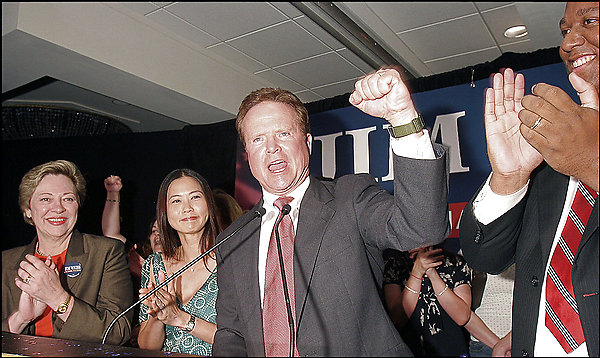
"In the early days of our republic, President Andrew Jackson established an important principle of American-style democracy - that we should measure the health of our society not at its apex, but at its base. Not with the numbers that come out of Wall Street, but with the living conditions that exist on Main Street. We must recapture that spirit today.
And under the leadership of the new Democratic Congress, we are on our way to doing so. The House just passed a minimum wage increase, the first in ten years, and the Senate will soon follow. We've introduced a broad legislative package designed to regain the trust of the American people. We've established a tone of cooperation and consensus that extends beyond party lines. We're working to get the right things done, for the right people and for the right reasons."
Damn, Andrew Jackson and the minimum wage. In just two paragraphs.
See Democrats, it isn't that hard.
More of this, please.
Tuesday, January 23, 2007
Longer Bill Kristol/Joe Lieberman
It's true we've been wrong about everything related to Iraq, but the new plan to escalate the war means you should nevertheless shut up until we know whether it will succeed or not, which we probably won't know for another six to nine months. After we know whether it succeeds or not, you can offer your negative resolutions and criticize it. If it does fail, though, which we know it won't, we'll offer another new "plan" after which we'll again expect you to shut up, as is your duty in a Constitutional democracy and as is only fitting since everything related to this war has worked out so swimmingly.
Monday, January 22, 2007
The Best Thing About This Year's NFL Playoffs
After the first weekend, we were spared any more features, quotes, soundbites, photos and rumors about this man.
Uh oh. May have spoken too soon. Parcells retires himself again, after four years in Big D. How the new coach will handle this man soon to be main story.
Uh oh. May have spoken too soon. Parcells retires himself again, after four years in Big D. How the new coach will handle this man soon to be main story.
Just Shut Up award winner
I'm announcing the formation of an explor--check that, I'm announcing the inauguration of the first ever weekly, daily, annually, whatever, Just Shut Up award, to the politician, media personality, or institution that so qualifies.
And today I am handing out the very firstest Just Shut Up award to (envelope please)--
CNN, for it's repetitive, gratuitously self-serving promo about the auctioning off of it's Iraq hummer for charity.
CNN, come on down.
And Just Shut Up already.
I mean, 100+ plus more people have died in Iraq today. Do we need your hummer auction on the headline bar and all over the teevee like it was this weekend?
And today I am handing out the very firstest Just Shut Up award to (envelope please)--
CNN, for it's repetitive, gratuitously self-serving promo about the auctioning off of it's Iraq hummer for charity.
CNN, come on down.
And Just Shut Up already.
I mean, 100+ plus more people have died in Iraq today. Do we need your hummer auction on the headline bar and all over the teevee like it was this weekend?
Da Colts
I didn't even make it to the end of the first half of last night's Pat-Colts game. It was already 14-3 and I couldn't "bear" to watch anymore of it. I knew how it would end. By the time I clicked off the Internets last night and retired to bed for some good reading, it was 21-6.
I didn't find out the Colts stormed back for the win in the NFL's answer to Oklahoma-Boise State until this morning.
Well. Obviously a big "getting the monkey off his back" win for Peyton. But it was a big win for someone else, too: Tony Dungy. Dungy, you'll remember, put together several winning, playoff-competing seasons in Tampa, only to get canned when the owners tired of not winning the "big one", which they promptly did the very next year when they landed Jon Gruden from Oakland and beat the Raiders in the next year's Super Bowl. But Dungy landed on his feet quickly enough by taking over for Jim Mora senior in Indy. And in Indy, as in Tampa, Dungy had Da Colts winning and in the playoffs on a regular basis. But the big playoff win, especially when the game involved Bill Belichek's Pats, eluded him in the Hoosier state, too. Then after last year's monumental regular season, the Colts lost a heartbreaker--at home--to the future Super Bowl winning Steelers. Compounding the professional disappointment for Dungy was a far more serious human tragedy, as Dungy's son committed suicide in December 2005.
And even though Dungy, through Peyton, went on the conquer the Patriots during the regular season last year and this year (both in Foxboro), as well as go into Denver and beat the Broncos when that team was riding high, the Colts seemed thoughout much of their games this year to just be squeaking by, a sense that was amplified when they were routed by Dallas on Thanksgiving Day and later run over by the Jaguars.
In many ways, this Colts team is similar to Da Bears team they'll be facing. Both teams carry the label of underdog to a certain effect. Both had strong regular seasons in terms of wins and losses, but both were dogged by perceptions of softness on defense (Chicago's mostly due to injury depletions), under-achievement more generally, and overshadowed by more exciting teams in their conferences; for the Colts, there were the Ravens and Chargers; for the Bears, there were the resurgent Eagles and the Saints. And both teams present a two-headed running back tandem: the Colts with Joseph Addai and Dominic Rhodes; the Bears have Thomas Jones and the second-year man, Cedric Benson. And while Peyton Manning overshadows Rex Grossman, both team's QB's struggled this year with doubts as to their being able to come through when their teams needed them the most.
I like the Colts chances here, but not by much. I think the Bears will again need a big day from Rex Grossman and need to do what they did against the Saints--create turnovers. The challenge for the Colts on defense will be to again slow down their opponent's running attack. With their first two opponents, the Colts faced all-star running backs in Larry Johnson and Jamal Lewis. But for the Chiefs and Ravens, their running-back attack was largely centered on one man. The Pats presented a more rigorous challenge in some ways than either the Chiefs or Ravens in that they could come with both Corey Dillon and Mahoney. That will be a good test for what they will face with the Bears.
Both the Colts and Bears faced friendly environments Sunday. Both were at home. And especially for the Bears, and I know I'll get some hate-mail for this, they benefitted from the snow and slop on Soldier Field. Despite their running attack, the Saints like to pass the ball and the weather and field made that difficult. And that failure played into the hands of the Bears, defense-centered, turnover needing, run-first mentality.
I don't think the Bears will have the same privileges in Miami. We can guess there won't be any snow. But it won't be a dome either, something Peyton usually thrives in.
This is a hard game to predict, but here goes--
Colts 30, Bears 21
It'll be a close game throughout but the Colts will tack on a score at the end to put the game out of reach and make it appear less competitive that what it was.
I didn't find out the Colts stormed back for the win in the NFL's answer to Oklahoma-Boise State until this morning.
Well. Obviously a big "getting the monkey off his back" win for Peyton. But it was a big win for someone else, too: Tony Dungy. Dungy, you'll remember, put together several winning, playoff-competing seasons in Tampa, only to get canned when the owners tired of not winning the "big one", which they promptly did the very next year when they landed Jon Gruden from Oakland and beat the Raiders in the next year's Super Bowl. But Dungy landed on his feet quickly enough by taking over for Jim Mora senior in Indy. And in Indy, as in Tampa, Dungy had Da Colts winning and in the playoffs on a regular basis. But the big playoff win, especially when the game involved Bill Belichek's Pats, eluded him in the Hoosier state, too. Then after last year's monumental regular season, the Colts lost a heartbreaker--at home--to the future Super Bowl winning Steelers. Compounding the professional disappointment for Dungy was a far more serious human tragedy, as Dungy's son committed suicide in December 2005.
And even though Dungy, through Peyton, went on the conquer the Patriots during the regular season last year and this year (both in Foxboro), as well as go into Denver and beat the Broncos when that team was riding high, the Colts seemed thoughout much of their games this year to just be squeaking by, a sense that was amplified when they were routed by Dallas on Thanksgiving Day and later run over by the Jaguars.
In many ways, this Colts team is similar to Da Bears team they'll be facing. Both teams carry the label of underdog to a certain effect. Both had strong regular seasons in terms of wins and losses, but both were dogged by perceptions of softness on defense (Chicago's mostly due to injury depletions), under-achievement more generally, and overshadowed by more exciting teams in their conferences; for the Colts, there were the Ravens and Chargers; for the Bears, there were the resurgent Eagles and the Saints. And both teams present a two-headed running back tandem: the Colts with Joseph Addai and Dominic Rhodes; the Bears have Thomas Jones and the second-year man, Cedric Benson. And while Peyton Manning overshadows Rex Grossman, both team's QB's struggled this year with doubts as to their being able to come through when their teams needed them the most.
I like the Colts chances here, but not by much. I think the Bears will again need a big day from Rex Grossman and need to do what they did against the Saints--create turnovers. The challenge for the Colts on defense will be to again slow down their opponent's running attack. With their first two opponents, the Colts faced all-star running backs in Larry Johnson and Jamal Lewis. But for the Chiefs and Ravens, their running-back attack was largely centered on one man. The Pats presented a more rigorous challenge in some ways than either the Chiefs or Ravens in that they could come with both Corey Dillon and Mahoney. That will be a good test for what they will face with the Bears.
Both the Colts and Bears faced friendly environments Sunday. Both were at home. And especially for the Bears, and I know I'll get some hate-mail for this, they benefitted from the snow and slop on Soldier Field. Despite their running attack, the Saints like to pass the ball and the weather and field made that difficult. And that failure played into the hands of the Bears, defense-centered, turnover needing, run-first mentality.
I don't think the Bears will have the same privileges in Miami. We can guess there won't be any snow. But it won't be a dome either, something Peyton usually thrives in.
This is a hard game to predict, but here goes--
Colts 30, Bears 21
It'll be a close game throughout but the Colts will tack on a score at the end to put the game out of reach and make it appear less competitive that what it was.
Wednesday, January 17, 2007
Sam Harris, Andrew Sullivan Blogalogue
This should be interesting.
I imagine this will come up later, but allow me to state what I believe to be Sam Harris's point about, and problem with, religious moderates and religious moderation:
The great theistic religions: Judaism; Christianity; and Islam base their authority and legitimacy on sacred texts. And these texts do not convey any sense of religious moderation and in many cases, appear to flatly condemn it.
Furthermore, and consequently, religious moderation is essentially the process whereby a religious adherent dilutes his or her faith with the increases in knowledge and human sympathy garnered from two centuries of human and material experience, and not a posture born from a reading of the texts themselves.
As a sort of religious moderate, I have to concede that this argument is pretty valid. I've "coped" with this issue by assuming that the religious experiences I've had are valid, even if the sometimes literal intellectual assumptions I once made about the text are not. There tends to be a lot of all-or-nothing thinking in the worlds of religion and politics (maybe you've noticed). The religious moderate, or religious liberal, or post-modern Christian (we come in a variety of appearances and terminologies) basically rejects this paradigm completely. As such the Bible is one text among many that contribute to our spiritual experiences and sense of community. And like any other text, writer or institution, it is assumed to be, and in our experience does in fact demonstrate itself to be, a book that reflects many of the usual subjective human understandings, attitudes and wishes, which in turn require our careful examination.
It's not a perfectly rational answer. But life doesn't always lend itself to neat, rational answers. And in fact it rarely does.
In this vein, here are some religious sites you might find interesting.
An interview with the pastor of my church.
A post-modernish exploration of Christianity and other religious faiths.
A self-described progressive Christian blog.
I imagine this will come up later, but allow me to state what I believe to be Sam Harris's point about, and problem with, religious moderates and religious moderation:
The great theistic religions: Judaism; Christianity; and Islam base their authority and legitimacy on sacred texts. And these texts do not convey any sense of religious moderation and in many cases, appear to flatly condemn it.
Furthermore, and consequently, religious moderation is essentially the process whereby a religious adherent dilutes his or her faith with the increases in knowledge and human sympathy garnered from two centuries of human and material experience, and not a posture born from a reading of the texts themselves.
As a sort of religious moderate, I have to concede that this argument is pretty valid. I've "coped" with this issue by assuming that the religious experiences I've had are valid, even if the sometimes literal intellectual assumptions I once made about the text are not. There tends to be a lot of all-or-nothing thinking in the worlds of religion and politics (maybe you've noticed). The religious moderate, or religious liberal, or post-modern Christian (we come in a variety of appearances and terminologies) basically rejects this paradigm completely. As such the Bible is one text among many that contribute to our spiritual experiences and sense of community. And like any other text, writer or institution, it is assumed to be, and in our experience does in fact demonstrate itself to be, a book that reflects many of the usual subjective human understandings, attitudes and wishes, which in turn require our careful examination.
It's not a perfectly rational answer. But life doesn't always lend itself to neat, rational answers. And in fact it rarely does.
In this vein, here are some religious sites you might find interesting.
An interview with the pastor of my church.
A post-modernish exploration of Christianity and other religious faiths.
A self-described progressive Christian blog.
Media Propaganda and The Carnage of War
Judea Pearl, the mother of journalist Daniel Pearl, has an op-ed in today's NYT.
In it, Pearl warns of the dangers posed by the Arabic news-station, Al Jazeera, particularly its latest manifestation in English and carried over American satellite television.
She cites in particular the air-time provided to a Muslim cleric who has given religious sanction to suicide bombers and Islamic terrorist organizations and campaigns, the kind of which were responsible for the killing of her son in 2002.
Considering the depth of her loss, Pearl's column is a rather measured response to the threat she believes terrorist-sanctioning and celebrating media represents.
Still, she references a few anecdotes about Al Jazeera's coverage of the Middle East that I think are applicable to American cable television and are as such worthy of further discussion:
But what should concern Westerners is that the ideology of men like Sheik Qaradawi saturates many of the network’s programs, and is gaining wider acceptance among Muslim youths in the West. In its “straight” news coverage on its Arabic TV broadcasts and Web sites, Al Jazeera’s reports consistently amplify radical Islamist sentiments (although without endorsing violence explicitly).
For example, the phrase “war on terror” is invariably preceded by the contemptuous prefix “so-called.” The words “terror” and “insurgency” are rarely uttered with a straight face, usually replaced with “resistance” or “struggle.” The phrase “war in Iraq” is often replaced by “war on Iraq” or “war against Iraq.” A suicide bombing is called a “commando attack” or, occasionally, a “paradise operation.”
Al Jazeera’s Web site can be less subtle. On Dec. 12, after religious leaders and heads of state all over the world condemned President Mahmoud Ahmadinejad of Iran for staging a Holocaust denial conference in Tehran, the headline on the site read, “Ahmadinejad Praised by Participants of the Holocaust Conference in Tehran, but Condemned by Zionists in Europe.”
In short, Al Jazeera’s editors choreograph a worldview in which an irreconcilable struggle rages between an evil-meaning Western oppressor and its helpless, righteous Arab victims. Most worrisome, perhaps, it often reports on supposed Western conspiracies behind most Arab hardships or failings, thus fueling the sense of helplessness, humiliation and anger among Muslim youths and helping turn them into potential recruits for terrorist organizations.
While Pearl is probably right to point out the lack of "straight news" on Al Jazeera, let's take a trip back in time to the pre-Iraq invasion coverage by CNN, "The Most Trusted Name in News" (from Glenn Greenwald):
On January 26, 2003, Wolf Blitzer held a panel discussion on CNN to discuss [Scott] Ritter’s war opposition. Ritter was not present, but Peter Beinert, the pro-war Editor of The New Republic, and Jonah Goldberg, the pro-war pundit from National Review, were invited to urge the invasion of Iraq, mock Ritter’s anti-war arguments, and smear him with a series of personal attacks.
Neither of these young, great “experts” who were urging the country to war had any experience with the weapons inspection process or with Iraq. Joining them was Democratic strategist Donna Brazile and Robert George of The New York Post, both of whom also supported the war and whose level of expertise on these matters was equal to Beinert’s and Goldberg’s.
Blitzer began the segment on Ritter by describing him as “an outspoken critic of a possible war against Iraq [who] was arrested in 2001 for allegedly communicating over the internet with an undercover police officer who was posing as a 16 year old girl.” Blitzer's question for the panel: “Is Scott Ritter's credibility now destroyed?” Brazille’s answer: “Absolutely. It shows that he has poor judgment.”
George went next and accused Ritter of having been paid “hundreds of thousands of dollars from Saddam Hussein's regime,” so everyone could safely ignore anything Ritter said because he was an agent of Saddam – “a pro-Saddam guy,” in George’s words. George was referring to a documentary produced by Ritter that was financed by an American citizen of Iraqi descent and which contended, correctly as it turns out, that the U.N. inspection process had “defanged” Iraq’s weapons program.
But the fact that Ritter’s film was financed by an American business man of Iraqi origin – and, more to the point, that Ritter then became an outspoken opponent of the war -- was continuously used by war advocates to smear the former Marine as an agent of Saddam Hussien’s. Thus, with the smear on Ritter’s loyalty firmly in place, arguments by Ritter that there was no convincing evidence of Iraqi WMDs, and that Iraq could not pose a threat to the U.S., could be easily ignored.
Beinert followed George and immediately said:
Yes, I agree. I think that he didn't have any credibility to begin with. I mean, this is the guy who never really explained, as Jonah said, why he flipped 180 degrees and became a Saddam mouthpiece. So for me it's irrelevant. I never listened to what he had to say on Iraq to begin with.
Once the Great Iraqi expert, Peter Beinert, was done smearing Ritter’s credibility and making clear that he could be safely ignored on the issue of Iraqi WMDs, Goldberg uttered: “Yes, I agree with everybody,” and then added:
He's now just basically joined Pete Townsend on the Magic School Bus. . . . Pete Townsend of the WHO has also been implicated in child porn and things of that nature. But as everybody said, Ritter's credibility, just on the basics of Iraq, was completely shot and now there's even less reason to listen to him.
The brilliant work of this expert panel complete, Blitzer decreed: “Let's move on now.”
Pearl goes on to question Al Jazeera's attachment of the prefix "so-called" to the "war on terror", and the changing of "war in Iraq" to "war on Iraq", again as if American media is any less guilty for carefully manipulating the use of words and images to put foward a certain "choreographed" world view.
Pearl also worries that Al Jazeera transmits a Manichean, us-against-them, good-against-evil view of the world to its listeners.
Well, it's hard to imagine she keyed in those words without recognizing the irony of an American president who has framed the Iraq war, domestic surveilance programs, overseas detentions and torture strategies, and other questionable efforts in precisely those terms and an American media that has largely taken that craftsmanship to heart.
Finally, at the bottom of Pearl's concern is the media's role in the promotion of views that lead explicitly to the devaluing of human life. But again, when American leaders and American media promote wars (or "liberations") on, against, or in Middle Eastern lands, unconcerned with the loss of civilian life (justified or minimized by the us-against-them, good-versus-evil framing), it's hard to exactly demand that Al Jazeera and the people of those lands not resort to the form of violence that works to their advantage.
Pearl is aghast that terrorist promoting clerics are given air time by seemingly oblivious media managers. But as Glenn Greenwald discusses today, Americans' view of war has changed considerably in the last several decades. In short, because our wars have largely been high tech, low risk affairs, Americans have become largely sheltered from their brutality and destructiveness. And naturally, this is why suicide bombings are so offensive to the western mind, and why the us-against-them, good-against-evil meme continues to be used and play out on both sides of the world and everywhere in between.
In it, Pearl warns of the dangers posed by the Arabic news-station, Al Jazeera, particularly its latest manifestation in English and carried over American satellite television.
She cites in particular the air-time provided to a Muslim cleric who has given religious sanction to suicide bombers and Islamic terrorist organizations and campaigns, the kind of which were responsible for the killing of her son in 2002.
Considering the depth of her loss, Pearl's column is a rather measured response to the threat she believes terrorist-sanctioning and celebrating media represents.
Still, she references a few anecdotes about Al Jazeera's coverage of the Middle East that I think are applicable to American cable television and are as such worthy of further discussion:
But what should concern Westerners is that the ideology of men like Sheik Qaradawi saturates many of the network’s programs, and is gaining wider acceptance among Muslim youths in the West. In its “straight” news coverage on its Arabic TV broadcasts and Web sites, Al Jazeera’s reports consistently amplify radical Islamist sentiments (although without endorsing violence explicitly).
For example, the phrase “war on terror” is invariably preceded by the contemptuous prefix “so-called.” The words “terror” and “insurgency” are rarely uttered with a straight face, usually replaced with “resistance” or “struggle.” The phrase “war in Iraq” is often replaced by “war on Iraq” or “war against Iraq.” A suicide bombing is called a “commando attack” or, occasionally, a “paradise operation.”
Al Jazeera’s Web site can be less subtle. On Dec. 12, after religious leaders and heads of state all over the world condemned President Mahmoud Ahmadinejad of Iran for staging a Holocaust denial conference in Tehran, the headline on the site read, “Ahmadinejad Praised by Participants of the Holocaust Conference in Tehran, but Condemned by Zionists in Europe.”
In short, Al Jazeera’s editors choreograph a worldview in which an irreconcilable struggle rages between an evil-meaning Western oppressor and its helpless, righteous Arab victims. Most worrisome, perhaps, it often reports on supposed Western conspiracies behind most Arab hardships or failings, thus fueling the sense of helplessness, humiliation and anger among Muslim youths and helping turn them into potential recruits for terrorist organizations.
While Pearl is probably right to point out the lack of "straight news" on Al Jazeera, let's take a trip back in time to the pre-Iraq invasion coverage by CNN, "The Most Trusted Name in News" (from Glenn Greenwald):
On January 26, 2003, Wolf Blitzer held a panel discussion on CNN to discuss [Scott] Ritter’s war opposition. Ritter was not present, but Peter Beinert, the pro-war Editor of The New Republic, and Jonah Goldberg, the pro-war pundit from National Review, were invited to urge the invasion of Iraq, mock Ritter’s anti-war arguments, and smear him with a series of personal attacks.
Neither of these young, great “experts” who were urging the country to war had any experience with the weapons inspection process or with Iraq. Joining them was Democratic strategist Donna Brazile and Robert George of The New York Post, both of whom also supported the war and whose level of expertise on these matters was equal to Beinert’s and Goldberg’s.
Blitzer began the segment on Ritter by describing him as “an outspoken critic of a possible war against Iraq [who] was arrested in 2001 for allegedly communicating over the internet with an undercover police officer who was posing as a 16 year old girl.” Blitzer's question for the panel: “Is Scott Ritter's credibility now destroyed?” Brazille’s answer: “Absolutely. It shows that he has poor judgment.”
George went next and accused Ritter of having been paid “hundreds of thousands of dollars from Saddam Hussein's regime,” so everyone could safely ignore anything Ritter said because he was an agent of Saddam – “a pro-Saddam guy,” in George’s words. George was referring to a documentary produced by Ritter that was financed by an American citizen of Iraqi descent and which contended, correctly as it turns out, that the U.N. inspection process had “defanged” Iraq’s weapons program.
But the fact that Ritter’s film was financed by an American business man of Iraqi origin – and, more to the point, that Ritter then became an outspoken opponent of the war -- was continuously used by war advocates to smear the former Marine as an agent of Saddam Hussien’s. Thus, with the smear on Ritter’s loyalty firmly in place, arguments by Ritter that there was no convincing evidence of Iraqi WMDs, and that Iraq could not pose a threat to the U.S., could be easily ignored.
Beinert followed George and immediately said:
Yes, I agree. I think that he didn't have any credibility to begin with. I mean, this is the guy who never really explained, as Jonah said, why he flipped 180 degrees and became a Saddam mouthpiece. So for me it's irrelevant. I never listened to what he had to say on Iraq to begin with.
Once the Great Iraqi expert, Peter Beinert, was done smearing Ritter’s credibility and making clear that he could be safely ignored on the issue of Iraqi WMDs, Goldberg uttered: “Yes, I agree with everybody,” and then added:
He's now just basically joined Pete Townsend on the Magic School Bus. . . . Pete Townsend of the WHO has also been implicated in child porn and things of that nature. But as everybody said, Ritter's credibility, just on the basics of Iraq, was completely shot and now there's even less reason to listen to him.
The brilliant work of this expert panel complete, Blitzer decreed: “Let's move on now.”
Pearl goes on to question Al Jazeera's attachment of the prefix "so-called" to the "war on terror", and the changing of "war in Iraq" to "war on Iraq", again as if American media is any less guilty for carefully manipulating the use of words and images to put foward a certain "choreographed" world view.
Pearl also worries that Al Jazeera transmits a Manichean, us-against-them, good-against-evil view of the world to its listeners.
Well, it's hard to imagine she keyed in those words without recognizing the irony of an American president who has framed the Iraq war, domestic surveilance programs, overseas detentions and torture strategies, and other questionable efforts in precisely those terms and an American media that has largely taken that craftsmanship to heart.
Finally, at the bottom of Pearl's concern is the media's role in the promotion of views that lead explicitly to the devaluing of human life. But again, when American leaders and American media promote wars (or "liberations") on, against, or in Middle Eastern lands, unconcerned with the loss of civilian life (justified or minimized by the us-against-them, good-versus-evil framing), it's hard to exactly demand that Al Jazeera and the people of those lands not resort to the form of violence that works to their advantage.
Pearl is aghast that terrorist promoting clerics are given air time by seemingly oblivious media managers. But as Glenn Greenwald discusses today, Americans' view of war has changed considerably in the last several decades. In short, because our wars have largely been high tech, low risk affairs, Americans have become largely sheltered from their brutality and destructiveness. And naturally, this is why suicide bombings are so offensive to the western mind, and why the us-against-them, good-against-evil meme continues to be used and play out on both sides of the world and everywhere in between.
Tuesday, January 16, 2007
Why, No, Now That You Mentioned, I Haven't
Josh Marshall:
You've probably already seen some of the news about the Bush White House engaging in a seemingly unprecedented spree of firings of US Attorneys across the cou[n]try.
Nope. Nada. Please keep us informed.
Here's more. Some more. And some more.
And gosh, that Atrios sure is funny. He's such a kidder.
You've probably already seen some of the news about the Bush White House engaging in a seemingly unprecedented spree of firings of US Attorneys across the cou[n]try.
Nope. Nada. Please keep us informed.
Here's more. Some more. And some more.
And gosh, that Atrios sure is funny. He's such a kidder.
Monday, January 15, 2007
Born Again
I'm grateful and encouraged when conservatives such as Rod Dreher openly express their disgust with the Bush Administration, when formerly loyal allies in the press and pundit worlds who have slavishly backed God's Own Party and its Leader finally begin to react to the chaos and craziness their devotion has helped spawn and enable.
It's especially revealing that said dissenters are now employing words like "fraud" and "mendacity" in addition to words such as "haplessness" and "incompetence". It's even more riveting when the Republic Party's ground-troops are going so far as to wonder if those dirty, commy hippies they long criticized might end being right after all, or at least worthy of engagement and consideration instead of blanket condemnations and concentration-camp style imprisonment.
But I do worry, at least a little, that this change of heart on the part of some conservative spokespersons is the product of the Iraq war now being seen as a "failure" for America and by Americans. In other words, I wonder whether their political awakening stems from their embarassment over America's image.
I wonder, though, if, let's say 150,000 Iraqi's had been killed in the invasion and the WMD's had not turned up, but within a few months or even within a year a reasonably stabile coalition government had been set up in Baghdad that was sufficiently, publically grateful for America's war of choice, would these arm-chair warriors feel the same disappointment? Is the growing disenchantment with the Iraq war a reflection of Americans' shameful of the fact that America has launched a war it is now destined to "lose"? Do we care more about winning or losing or how our acts have affected ordinary Iraqis?
It's especially revealing that said dissenters are now employing words like "fraud" and "mendacity" in addition to words such as "haplessness" and "incompetence". It's even more riveting when the Republic Party's ground-troops are going so far as to wonder if those dirty, commy hippies they long criticized might end being right after all, or at least worthy of engagement and consideration instead of blanket condemnations and concentration-camp style imprisonment.
But I do worry, at least a little, that this change of heart on the part of some conservative spokespersons is the product of the Iraq war now being seen as a "failure" for America and by Americans. In other words, I wonder whether their political awakening stems from their embarassment over America's image.
I wonder, though, if, let's say 150,000 Iraqi's had been killed in the invasion and the WMD's had not turned up, but within a few months or even within a year a reasonably stabile coalition government had been set up in Baghdad that was sufficiently, publically grateful for America's war of choice, would these arm-chair warriors feel the same disappointment? Is the growing disenchantment with the Iraq war a reflection of Americans' shameful of the fact that America has launched a war it is now destined to "lose"? Do we care more about winning or losing or how our acts have affected ordinary Iraqis?
NFL Report Cards
Another weekend of NFL playoff football is over, but let's talk about what I want to talk about: the broadcast crews.
In keeping with apparent NFL tradition, we got Fox's and CBS's "B" crews on Saturday and the "A" teams on Sunday, saving the best for last.
Colts/Ravens, CBS
Broadcast Team: Greg Gumbel, play by play; Dan Dierdorf, color
Grade: C
Greg is a better play by play guy than his NFL Network brother, Bryant, but at one point Peyton Manning is being chased by the Ravens defense (which ought to shut up and play sometime) and on the run throws a pass towards the sideline which Gumbel immediately decrees to be incomplete all the while the national televised audience is watching the ball being caught at the sidelines by a Colts receiver. What a maroon. To his credit, though, Gumbell catches his gaffe and apologizes profusely.
At another point, as Ravens' QB Steve McNair is about to be sacked he throws the ball into the ground. Don't they usually call this "intentional grounding"? No flag is thrown and our CBS crew doesn't make any comment.
Eagles/Saints, FOX
Broadcast Team: Dick Stockton, play by play; Darryl "Moose" Johnston, color; Tony "Goose" Siragusa, sideline reporter
Grade: Stockton/Johnston B
Siragusa A
Stockton and Johnston are serviceable and unremarkable. But the Goose criticizes the Saints for having Drew Brees throw three straight times in route to a three and out while their running game led by Deuce McAllister has just been shredding the Iggles. Why not just run the Deuce says the Goose? Even though McAllister did end up piling up the yards, the Goose was correct and insightful here. The Goose also later pointed out how more successful the Saints and McAllister were running the ball when they were running behind fullback John Carney.
Seahawks/Da Bears, FOX
Broadcast Team: Joe Buck, play by play; Troy Aikman, color
Grade: A
These guys are just money.
Patriots/Chargers, CBS
Broadcast Team: Jim Nantz, play by play; Phil Simms, color
Grade: A-
These guys are just money, too.
Overall Grade: B
Generally good coverage but low babe quotient. Where is Bonnie Bernstein these days? And since this wasn't ESPN, no Rachel Nichols or Suzie Kolber.
In keeping with apparent NFL tradition, we got Fox's and CBS's "B" crews on Saturday and the "A" teams on Sunday, saving the best for last.
Colts/Ravens, CBS
Broadcast Team: Greg Gumbel, play by play; Dan Dierdorf, color
Grade: C
Greg is a better play by play guy than his NFL Network brother, Bryant, but at one point Peyton Manning is being chased by the Ravens defense (which ought to shut up and play sometime) and on the run throws a pass towards the sideline which Gumbel immediately decrees to be incomplete all the while the national televised audience is watching the ball being caught at the sidelines by a Colts receiver. What a maroon. To his credit, though, Gumbell catches his gaffe and apologizes profusely.
At another point, as Ravens' QB Steve McNair is about to be sacked he throws the ball into the ground. Don't they usually call this "intentional grounding"? No flag is thrown and our CBS crew doesn't make any comment.
Eagles/Saints, FOX
Broadcast Team: Dick Stockton, play by play; Darryl "Moose" Johnston, color; Tony "Goose" Siragusa, sideline reporter
Grade: Stockton/Johnston B
Siragusa A
Stockton and Johnston are serviceable and unremarkable. But the Goose criticizes the Saints for having Drew Brees throw three straight times in route to a three and out while their running game led by Deuce McAllister has just been shredding the Iggles. Why not just run the Deuce says the Goose? Even though McAllister did end up piling up the yards, the Goose was correct and insightful here. The Goose also later pointed out how more successful the Saints and McAllister were running the ball when they were running behind fullback John Carney.
Seahawks/Da Bears, FOX
Broadcast Team: Joe Buck, play by play; Troy Aikman, color
Grade: A
These guys are just money.
Patriots/Chargers, CBS
Broadcast Team: Jim Nantz, play by play; Phil Simms, color
Grade: A-
These guys are just money, too.
Overall Grade: B
Generally good coverage but low babe quotient. Where is Bonnie Bernstein these days? And since this wasn't ESPN, no Rachel Nichols or Suzie Kolber.
Thursday, January 11, 2007
Marshall Wittman (ID-CT)
Even with all I know about Holy Joe I still had a hard time believing he penned this silly paean to Bush's escalation plan. I thought it might be someone's idea of a joke, especially since I first noticed it on a Tbogg-link to NRO.
So I went to Holy Joe's website to confirm. And sure enough, it's there, in all its infamous glory.
But this time I noticed the by-line in the top right hand corner--the former BullMoose, the former Christian Coalitionist of the Willing, Marshall Wittman, Holy Joe's new grandpoobah of communication.
Quite naturally, the remarks contained within bare a striking similarity to what the BullMoose used to post on his blog, as well as an op-ed that helped encourage a Democratic primary challenger, Ned Lamont, last year.
Anyway--
I know there are deep differences of opinion about what the President has proposed tonight. In the coming days and weeks, we should undertake respectful debate and deliberation over this new plan.
Why? What would be the purpose of "respectful debate and deliberation"? The deliberation was already done, and it failed to take account of the fact that, as that shrill Tom Shaller reminded us, elections have consequences. And over what are we supposed to engage in "respectful debate"? What's there to debate? And if that 'fatalist' pansy, quitting coward, former Marine John Murtha succeeds in locking up any additional escalation funds, but does it nice and respectful-like, will that be OK with Joe?
So I went to Holy Joe's website to confirm. And sure enough, it's there, in all its infamous glory.
But this time I noticed the by-line in the top right hand corner--the former BullMoose, the former Christian Coalitionist of the Willing, Marshall Wittman, Holy Joe's new grandpoobah of communication.
Quite naturally, the remarks contained within bare a striking similarity to what the BullMoose used to post on his blog, as well as an op-ed that helped encourage a Democratic primary challenger, Ned Lamont, last year.
Anyway--
I know there are deep differences of opinion about what the President has proposed tonight. In the coming days and weeks, we should undertake respectful debate and deliberation over this new plan.
Why? What would be the purpose of "respectful debate and deliberation"? The deliberation was already done, and it failed to take account of the fact that, as that shrill Tom Shaller reminded us, elections have consequences. And over what are we supposed to engage in "respectful debate"? What's there to debate? And if that 'fatalist' pansy, quitting coward, former Marine John Murtha succeeds in locking up any additional escalation funds, but does it nice and respectful-like, will that be OK with Joe?
Apocalypse Iran
Glenn Greenwald:
As Think Progress notes, the White House took multiple steps yesterday to elevate dramatically the threat rhetoric against Iran. Bush included what The New York Times described as “some of his sharpest words of warning to Iran” yet. But those words could really be described more accurately not as “threats” but as a declaration of war.
(snip)
More importantly, a war with Iran can happen in many ways other than by some grand announcement by the President that he wants to start a war, followed by a debate in Congress as to whether such a war should be authorized. That is the least likely way for such a confrontation to occur.
We have 140,000 troops (soon to be 20,000 more) sitting in a country that borders Iran and where Iran is operating, with an announced military build-up in the Persian Gulf imminent, increased war rhetoric from all sides, the beginning of actual skirmishes already, a reduction (if not elimination) on the existing constraints with which our military operates in Iraq, and a declaration by the President that Iran is our enemy in the current war.
That makes unplanned -- or seemingly unplanned -- confrontations highly likely, whether through miscalculation, miscommunication, misperception, or affirmative deceit. Whatever else is true, given the stakes involved -- the unimaginable, impossible-to-overstate stakes -- and the fact that we are unquestionably moving forward on this confrontational path quite deliberately, this issue is receiving nowhere near the attention in our political discussions and media reports that it so urgently demands.
For all the pious talk about the need to be "seriously concerned" and give "thoughtful consideration" to what will happen if we leave Iraq, there is a very compelling -- and neglected -- need to ponder what will happen if we stay and if we escalate. And the need for "serious concern" and "thoughtful consideration" extends to consequences not just in Iraq but beyond.
Indeed.
As Think Progress notes, the White House took multiple steps yesterday to elevate dramatically the threat rhetoric against Iran. Bush included what The New York Times described as “some of his sharpest words of warning to Iran” yet. But those words could really be described more accurately not as “threats” but as a declaration of war.
(snip)
More importantly, a war with Iran can happen in many ways other than by some grand announcement by the President that he wants to start a war, followed by a debate in Congress as to whether such a war should be authorized. That is the least likely way for such a confrontation to occur.
We have 140,000 troops (soon to be 20,000 more) sitting in a country that borders Iran and where Iran is operating, with an announced military build-up in the Persian Gulf imminent, increased war rhetoric from all sides, the beginning of actual skirmishes already, a reduction (if not elimination) on the existing constraints with which our military operates in Iraq, and a declaration by the President that Iran is our enemy in the current war.
That makes unplanned -- or seemingly unplanned -- confrontations highly likely, whether through miscalculation, miscommunication, misperception, or affirmative deceit. Whatever else is true, given the stakes involved -- the unimaginable, impossible-to-overstate stakes -- and the fact that we are unquestionably moving forward on this confrontational path quite deliberately, this issue is receiving nowhere near the attention in our political discussions and media reports that it so urgently demands.
For all the pious talk about the need to be "seriously concerned" and give "thoughtful consideration" to what will happen if we leave Iraq, there is a very compelling -- and neglected -- need to ponder what will happen if we stay and if we escalate. And the need for "serious concern" and "thoughtful consideration" extends to consequences not just in Iraq but beyond.
Indeed.
Apocalypse Iraq
Everyone gets everything he wants.
I wanted a mission, and for my sins, they gave me one.
Brought it up to me like room service.
It was a real choice mission, and when it was over, I never wanted another.
I wanted a mission, and for my sins, they gave me one.
Brought it up to me like room service.
It was a real choice mission, and when it was over, I never wanted another.
Wednesday, January 10, 2007
Tuesday, January 09, 2007
Taking Back the Car Keys
BooMan (via Atrios)
Friends do not let friends drive drunk. In the case of George W. Bush and the neo-conservatives, they not only are insisting on driving intoxicated, they won't let us out of the car and they respond to all requests to slow down by stomping on the accelerator. In this situation the only rational thing to do is to wait for them to come to a halt at a stop sign (if they are sober enough to avoid running it) and smack them in the head with a sock full of pennies. We need to take away the car keys, Mr. Klein.
Friends do not let friends drive drunk. In the case of George W. Bush and the neo-conservatives, they not only are insisting on driving intoxicated, they won't let us out of the car and they respond to all requests to slow down by stomping on the accelerator. In this situation the only rational thing to do is to wait for them to come to a halt at a stop sign (if they are sober enough to avoid running it) and smack them in the head with a sock full of pennies. We need to take away the car keys, Mr. Klein.
Friday, January 05, 2007
Bring It On
I'm glad Senators McCain and Lieberman have hitched their horses to the Escalation Plan laid out by Kagan and Keane because
1) Senators McCain and Lieberman have been wrong about everything else related to this war, so why stop now and
2) It has the benefit of putting M&L behind a genuine Escalation Plan, not some sissy, temporary, minor change in troop levels (i.e. a surge).
That M&L back this Escalation Plan and have been wrong about everything related to this war up till now, and that the Escalation Plan they back is really an Escalation and not a "surge" means that Democrats, in theory at least, occupy both the moral as well as the practical, common sensical high-ground.
And I almost wrote that with a straight-face.
1) Senators McCain and Lieberman have been wrong about everything else related to this war, so why stop now and
2) It has the benefit of putting M&L behind a genuine Escalation Plan, not some sissy, temporary, minor change in troop levels (i.e. a surge).
That M&L back this Escalation Plan and have been wrong about everything related to this war up till now, and that the Escalation Plan they back is really an Escalation and not a "surge" means that Democrats, in theory at least, occupy both the moral as well as the practical, common sensical high-ground.
And I almost wrote that with a straight-face.
Subscribe to:
Posts (Atom)