Conservative columnist Robert Novak:
When President Bush called for a bipartisan "special advisory council" of congressional leaders on the war against terrorism in his State of the Union address, he had in his pocket a rude rejection from Democratic leaders. Thank you very much, said House Speaker Nancy Pelosi and Senate Majority Leader Harry Reid, but no thank you.
Three days earlier, Reid and Pelosi wrote a letter to the president turning down his offer (which was contained in his Jan. 10 speech on Iraq) to establish a council consisting of Democratic chairmen and ranking Republican members of the relevant committees. "We believe that Congress already has bipartisan structures in place," they said, adding: "We look forward to working with you within existing structures."
(snip)
Courtesy aside, it shows that the self-confident Democratic leadership is uninterested in being cut into potentially disastrous outcomes in Iraq. It wants to function as a coordinate branch of government, not as friendly colleagues in the spirit of bipartisanship. Pelosi and several Democratic committee chairmen are leaving for Iraq on Friday.
In his Jan. 10 speech, Bush called for a "new, bipartisan working group that will help us come together across party lines to win the war on terror." That prompted the Pelosi-Reid letter of Jan. 19 rejecting the offer.
Bush made a mistake in attributing the idea to Connecticut Sen. Joe Lieberman, who as the Senate's only self-identified Independent Democrat is estranged from his colleagues who are unmodified Democrats. These former comrades are not charmed by the prospect of Lieberman pontificating as a member of the "working group" by virtue of his chairmanship of the Senate Homeland Security Committee.
But Lieberman was not the reason for the speaker and majority leader's rebuff. The Democratic leadership is beyond consultation on Iraq, as demonstrated by the selection of Sen. Jim Webb to deliver the party's response to the president Tuesday night. Webb, whose unexpected election in Virginia last year gave Democrats a Senate majority, is a hard-edged critic of the war not interested in bipartisanship. Discarding staff-written talking points, professional writer Webb declared: "The president took us into this war recklessly."
If there's one thing that's been made perfectly clear in the past six years it is that the Administration has no regard for Congress--even when it was run by its own party. Congress was not invited to "consult" in the lead up to the war, and wasn't invited to consult in the last two months, when the escalation "plan" was cooked up.
So, thanks for the invitation on January 10 after the decision to escalate the war was already made, to appear in a war "council" but no thanks.
Thursday, January 25, 2007


Wednesday, January 24, 2007
Big Business Republicans Demand More Appeasement
What Ezra says:
PRIORITIES. In a display of savage corporatism, Senate Republicans are filibustering the minimum wage increase until Democrats lard the bill with tax cuts for businesses. Over the last six years, of course, businesses have gotten, literally, hundreds of billions in tax breaks. Congress hasn't raised the minimum wage in a decade.
Of course, there are 21 GOP Senate seats up the next time around.
Chris Bowers says:
Republicans continuing to suck up to business interests like this is going to give Democrats a big trifecta in 2008. Just look at the list of Republicans up for election in 2008 who voted against a clean minimum wage bill: Cornyn, Dole,. Domenici, McCain, Smith and Sununu. I don't care how red your state is--voting against the minimum wage isn't popular anywhere. The only place it is popular is among business interests who will be donating to the election campaigns of these Republicans. Even in defeat, Republicans treat government as basically a way to reward the key figures of their election machinery.
This bill will pass eventually. There is no way Republicans can hold out on this one indefinitely, considering how popular it is. Democrats need to keep pushing this as long and hard as possible until five more Republicans are forced to cave, even if that means the bill won't pass until 2009.
PRIORITIES. In a display of savage corporatism, Senate Republicans are filibustering the minimum wage increase until Democrats lard the bill with tax cuts for businesses. Over the last six years, of course, businesses have gotten, literally, hundreds of billions in tax breaks. Congress hasn't raised the minimum wage in a decade.
Of course, there are 21 GOP Senate seats up the next time around.
Chris Bowers says:
Republicans continuing to suck up to business interests like this is going to give Democrats a big trifecta in 2008. Just look at the list of Republicans up for election in 2008 who voted against a clean minimum wage bill: Cornyn, Dole,. Domenici, McCain, Smith and Sununu. I don't care how red your state is--voting against the minimum wage isn't popular anywhere. The only place it is popular is among business interests who will be donating to the election campaigns of these Republicans. Even in defeat, Republicans treat government as basically a way to reward the key figures of their election machinery.
This bill will pass eventually. There is no way Republicans can hold out on this one indefinitely, considering how popular it is. Democrats need to keep pushing this as long and hard as possible until five more Republicans are forced to cave, even if that means the bill won't pass until 2009.
The Messenger
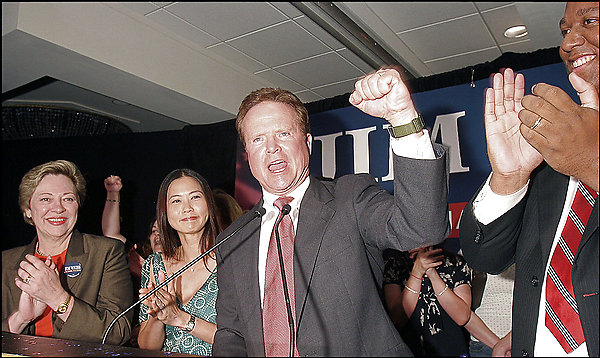
"In the early days of our republic, President Andrew Jackson established an important principle of American-style democracy - that we should measure the health of our society not at its apex, but at its base. Not with the numbers that come out of Wall Street, but with the living conditions that exist on Main Street. We must recapture that spirit today.
And under the leadership of the new Democratic Congress, we are on our way to doing so. The House just passed a minimum wage increase, the first in ten years, and the Senate will soon follow. We've introduced a broad legislative package designed to regain the trust of the American people. We've established a tone of cooperation and consensus that extends beyond party lines. We're working to get the right things done, for the right people and for the right reasons."
Damn, Andrew Jackson and the minimum wage. In just two paragraphs.
See Democrats, it isn't that hard.
More of this, please.
Tuesday, January 23, 2007
Longer Bill Kristol/Joe Lieberman
It's true we've been wrong about everything related to Iraq, but the new plan to escalate the war means you should nevertheless shut up until we know whether it will succeed or not, which we probably won't know for another six to nine months. After we know whether it succeeds or not, you can offer your negative resolutions and criticize it. If it does fail, though, which we know it won't, we'll offer another new "plan" after which we'll again expect you to shut up, as is your duty in a Constitutional democracy and as is only fitting since everything related to this war has worked out so swimmingly.
Monday, January 22, 2007
The Best Thing About This Year's NFL Playoffs
After the first weekend, we were spared any more features, quotes, soundbites, photos and rumors about this man.
Uh oh. May have spoken too soon. Parcells retires himself again, after four years in Big D. How the new coach will handle this man soon to be main story.
Uh oh. May have spoken too soon. Parcells retires himself again, after four years in Big D. How the new coach will handle this man soon to be main story.
Just Shut Up award winner
I'm announcing the formation of an explor--check that, I'm announcing the inauguration of the first ever weekly, daily, annually, whatever, Just Shut Up award, to the politician, media personality, or institution that so qualifies.
And today I am handing out the very firstest Just Shut Up award to (envelope please)--
CNN, for it's repetitive, gratuitously self-serving promo about the auctioning off of it's Iraq hummer for charity.
CNN, come on down.
And Just Shut Up already.
I mean, 100+ plus more people have died in Iraq today. Do we need your hummer auction on the headline bar and all over the teevee like it was this weekend?
And today I am handing out the very firstest Just Shut Up award to (envelope please)--
CNN, for it's repetitive, gratuitously self-serving promo about the auctioning off of it's Iraq hummer for charity.
CNN, come on down.
And Just Shut Up already.
I mean, 100+ plus more people have died in Iraq today. Do we need your hummer auction on the headline bar and all over the teevee like it was this weekend?
Da Colts
I didn't even make it to the end of the first half of last night's Pat-Colts game. It was already 14-3 and I couldn't "bear" to watch anymore of it. I knew how it would end. By the time I clicked off the Internets last night and retired to bed for some good reading, it was 21-6.
I didn't find out the Colts stormed back for the win in the NFL's answer to Oklahoma-Boise State until this morning.
Well. Obviously a big "getting the monkey off his back" win for Peyton. But it was a big win for someone else, too: Tony Dungy. Dungy, you'll remember, put together several winning, playoff-competing seasons in Tampa, only to get canned when the owners tired of not winning the "big one", which they promptly did the very next year when they landed Jon Gruden from Oakland and beat the Raiders in the next year's Super Bowl. But Dungy landed on his feet quickly enough by taking over for Jim Mora senior in Indy. And in Indy, as in Tampa, Dungy had Da Colts winning and in the playoffs on a regular basis. But the big playoff win, especially when the game involved Bill Belichek's Pats, eluded him in the Hoosier state, too. Then after last year's monumental regular season, the Colts lost a heartbreaker--at home--to the future Super Bowl winning Steelers. Compounding the professional disappointment for Dungy was a far more serious human tragedy, as Dungy's son committed suicide in December 2005.
And even though Dungy, through Peyton, went on the conquer the Patriots during the regular season last year and this year (both in Foxboro), as well as go into Denver and beat the Broncos when that team was riding high, the Colts seemed thoughout much of their games this year to just be squeaking by, a sense that was amplified when they were routed by Dallas on Thanksgiving Day and later run over by the Jaguars.
In many ways, this Colts team is similar to Da Bears team they'll be facing. Both teams carry the label of underdog to a certain effect. Both had strong regular seasons in terms of wins and losses, but both were dogged by perceptions of softness on defense (Chicago's mostly due to injury depletions), under-achievement more generally, and overshadowed by more exciting teams in their conferences; for the Colts, there were the Ravens and Chargers; for the Bears, there were the resurgent Eagles and the Saints. And both teams present a two-headed running back tandem: the Colts with Joseph Addai and Dominic Rhodes; the Bears have Thomas Jones and the second-year man, Cedric Benson. And while Peyton Manning overshadows Rex Grossman, both team's QB's struggled this year with doubts as to their being able to come through when their teams needed them the most.
I like the Colts chances here, but not by much. I think the Bears will again need a big day from Rex Grossman and need to do what they did against the Saints--create turnovers. The challenge for the Colts on defense will be to again slow down their opponent's running attack. With their first two opponents, the Colts faced all-star running backs in Larry Johnson and Jamal Lewis. But for the Chiefs and Ravens, their running-back attack was largely centered on one man. The Pats presented a more rigorous challenge in some ways than either the Chiefs or Ravens in that they could come with both Corey Dillon and Mahoney. That will be a good test for what they will face with the Bears.
Both the Colts and Bears faced friendly environments Sunday. Both were at home. And especially for the Bears, and I know I'll get some hate-mail for this, they benefitted from the snow and slop on Soldier Field. Despite their running attack, the Saints like to pass the ball and the weather and field made that difficult. And that failure played into the hands of the Bears, defense-centered, turnover needing, run-first mentality.
I don't think the Bears will have the same privileges in Miami. We can guess there won't be any snow. But it won't be a dome either, something Peyton usually thrives in.
This is a hard game to predict, but here goes--
Colts 30, Bears 21
It'll be a close game throughout but the Colts will tack on a score at the end to put the game out of reach and make it appear less competitive that what it was.
I didn't find out the Colts stormed back for the win in the NFL's answer to Oklahoma-Boise State until this morning.
Well. Obviously a big "getting the monkey off his back" win for Peyton. But it was a big win for someone else, too: Tony Dungy. Dungy, you'll remember, put together several winning, playoff-competing seasons in Tampa, only to get canned when the owners tired of not winning the "big one", which they promptly did the very next year when they landed Jon Gruden from Oakland and beat the Raiders in the next year's Super Bowl. But Dungy landed on his feet quickly enough by taking over for Jim Mora senior in Indy. And in Indy, as in Tampa, Dungy had Da Colts winning and in the playoffs on a regular basis. But the big playoff win, especially when the game involved Bill Belichek's Pats, eluded him in the Hoosier state, too. Then after last year's monumental regular season, the Colts lost a heartbreaker--at home--to the future Super Bowl winning Steelers. Compounding the professional disappointment for Dungy was a far more serious human tragedy, as Dungy's son committed suicide in December 2005.
And even though Dungy, through Peyton, went on the conquer the Patriots during the regular season last year and this year (both in Foxboro), as well as go into Denver and beat the Broncos when that team was riding high, the Colts seemed thoughout much of their games this year to just be squeaking by, a sense that was amplified when they were routed by Dallas on Thanksgiving Day and later run over by the Jaguars.
In many ways, this Colts team is similar to Da Bears team they'll be facing. Both teams carry the label of underdog to a certain effect. Both had strong regular seasons in terms of wins and losses, but both were dogged by perceptions of softness on defense (Chicago's mostly due to injury depletions), under-achievement more generally, and overshadowed by more exciting teams in their conferences; for the Colts, there were the Ravens and Chargers; for the Bears, there were the resurgent Eagles and the Saints. And both teams present a two-headed running back tandem: the Colts with Joseph Addai and Dominic Rhodes; the Bears have Thomas Jones and the second-year man, Cedric Benson. And while Peyton Manning overshadows Rex Grossman, both team's QB's struggled this year with doubts as to their being able to come through when their teams needed them the most.
I like the Colts chances here, but not by much. I think the Bears will again need a big day from Rex Grossman and need to do what they did against the Saints--create turnovers. The challenge for the Colts on defense will be to again slow down their opponent's running attack. With their first two opponents, the Colts faced all-star running backs in Larry Johnson and Jamal Lewis. But for the Chiefs and Ravens, their running-back attack was largely centered on one man. The Pats presented a more rigorous challenge in some ways than either the Chiefs or Ravens in that they could come with both Corey Dillon and Mahoney. That will be a good test for what they will face with the Bears.
Both the Colts and Bears faced friendly environments Sunday. Both were at home. And especially for the Bears, and I know I'll get some hate-mail for this, they benefitted from the snow and slop on Soldier Field. Despite their running attack, the Saints like to pass the ball and the weather and field made that difficult. And that failure played into the hands of the Bears, defense-centered, turnover needing, run-first mentality.
I don't think the Bears will have the same privileges in Miami. We can guess there won't be any snow. But it won't be a dome either, something Peyton usually thrives in.
This is a hard game to predict, but here goes--
Colts 30, Bears 21
It'll be a close game throughout but the Colts will tack on a score at the end to put the game out of reach and make it appear less competitive that what it was.
Wednesday, January 17, 2007
Sam Harris, Andrew Sullivan Blogalogue
This should be interesting.
I imagine this will come up later, but allow me to state what I believe to be Sam Harris's point about, and problem with, religious moderates and religious moderation:
The great theistic religions: Judaism; Christianity; and Islam base their authority and legitimacy on sacred texts. And these texts do not convey any sense of religious moderation and in many cases, appear to flatly condemn it.
Furthermore, and consequently, religious moderation is essentially the process whereby a religious adherent dilutes his or her faith with the increases in knowledge and human sympathy garnered from two centuries of human and material experience, and not a posture born from a reading of the texts themselves.
As a sort of religious moderate, I have to concede that this argument is pretty valid. I've "coped" with this issue by assuming that the religious experiences I've had are valid, even if the sometimes literal intellectual assumptions I once made about the text are not. There tends to be a lot of all-or-nothing thinking in the worlds of religion and politics (maybe you've noticed). The religious moderate, or religious liberal, or post-modern Christian (we come in a variety of appearances and terminologies) basically rejects this paradigm completely. As such the Bible is one text among many that contribute to our spiritual experiences and sense of community. And like any other text, writer or institution, it is assumed to be, and in our experience does in fact demonstrate itself to be, a book that reflects many of the usual subjective human understandings, attitudes and wishes, which in turn require our careful examination.
It's not a perfectly rational answer. But life doesn't always lend itself to neat, rational answers. And in fact it rarely does.
In this vein, here are some religious sites you might find interesting.
An interview with the pastor of my church.
A post-modernish exploration of Christianity and other religious faiths.
A self-described progressive Christian blog.
I imagine this will come up later, but allow me to state what I believe to be Sam Harris's point about, and problem with, religious moderates and religious moderation:
The great theistic religions: Judaism; Christianity; and Islam base their authority and legitimacy on sacred texts. And these texts do not convey any sense of religious moderation and in many cases, appear to flatly condemn it.
Furthermore, and consequently, religious moderation is essentially the process whereby a religious adherent dilutes his or her faith with the increases in knowledge and human sympathy garnered from two centuries of human and material experience, and not a posture born from a reading of the texts themselves.
As a sort of religious moderate, I have to concede that this argument is pretty valid. I've "coped" with this issue by assuming that the religious experiences I've had are valid, even if the sometimes literal intellectual assumptions I once made about the text are not. There tends to be a lot of all-or-nothing thinking in the worlds of religion and politics (maybe you've noticed). The religious moderate, or religious liberal, or post-modern Christian (we come in a variety of appearances and terminologies) basically rejects this paradigm completely. As such the Bible is one text among many that contribute to our spiritual experiences and sense of community. And like any other text, writer or institution, it is assumed to be, and in our experience does in fact demonstrate itself to be, a book that reflects many of the usual subjective human understandings, attitudes and wishes, which in turn require our careful examination.
It's not a perfectly rational answer. But life doesn't always lend itself to neat, rational answers. And in fact it rarely does.
In this vein, here are some religious sites you might find interesting.
An interview with the pastor of my church.
A post-modernish exploration of Christianity and other religious faiths.
A self-described progressive Christian blog.
Media Propaganda and The Carnage of War
Judea Pearl, the mother of journalist Daniel Pearl, has an op-ed in today's NYT.
In it, Pearl warns of the dangers posed by the Arabic news-station, Al Jazeera, particularly its latest manifestation in English and carried over American satellite television.
She cites in particular the air-time provided to a Muslim cleric who has given religious sanction to suicide bombers and Islamic terrorist organizations and campaigns, the kind of which were responsible for the killing of her son in 2002.
Considering the depth of her loss, Pearl's column is a rather measured response to the threat she believes terrorist-sanctioning and celebrating media represents.
Still, she references a few anecdotes about Al Jazeera's coverage of the Middle East that I think are applicable to American cable television and are as such worthy of further discussion:
But what should concern Westerners is that the ideology of men like Sheik Qaradawi saturates many of the network’s programs, and is gaining wider acceptance among Muslim youths in the West. In its “straight” news coverage on its Arabic TV broadcasts and Web sites, Al Jazeera’s reports consistently amplify radical Islamist sentiments (although without endorsing violence explicitly).
For example, the phrase “war on terror” is invariably preceded by the contemptuous prefix “so-called.” The words “terror” and “insurgency” are rarely uttered with a straight face, usually replaced with “resistance” or “struggle.” The phrase “war in Iraq” is often replaced by “war on Iraq” or “war against Iraq.” A suicide bombing is called a “commando attack” or, occasionally, a “paradise operation.”
Al Jazeera’s Web site can be less subtle. On Dec. 12, after religious leaders and heads of state all over the world condemned President Mahmoud Ahmadinejad of Iran for staging a Holocaust denial conference in Tehran, the headline on the site read, “Ahmadinejad Praised by Participants of the Holocaust Conference in Tehran, but Condemned by Zionists in Europe.”
In short, Al Jazeera’s editors choreograph a worldview in which an irreconcilable struggle rages between an evil-meaning Western oppressor and its helpless, righteous Arab victims. Most worrisome, perhaps, it often reports on supposed Western conspiracies behind most Arab hardships or failings, thus fueling the sense of helplessness, humiliation and anger among Muslim youths and helping turn them into potential recruits for terrorist organizations.
While Pearl is probably right to point out the lack of "straight news" on Al Jazeera, let's take a trip back in time to the pre-Iraq invasion coverage by CNN, "The Most Trusted Name in News" (from Glenn Greenwald):
On January 26, 2003, Wolf Blitzer held a panel discussion on CNN to discuss [Scott] Ritter’s war opposition. Ritter was not present, but Peter Beinert, the pro-war Editor of The New Republic, and Jonah Goldberg, the pro-war pundit from National Review, were invited to urge the invasion of Iraq, mock Ritter’s anti-war arguments, and smear him with a series of personal attacks.
Neither of these young, great “experts” who were urging the country to war had any experience with the weapons inspection process or with Iraq. Joining them was Democratic strategist Donna Brazile and Robert George of The New York Post, both of whom also supported the war and whose level of expertise on these matters was equal to Beinert’s and Goldberg’s.
Blitzer began the segment on Ritter by describing him as “an outspoken critic of a possible war against Iraq [who] was arrested in 2001 for allegedly communicating over the internet with an undercover police officer who was posing as a 16 year old girl.” Blitzer's question for the panel: “Is Scott Ritter's credibility now destroyed?” Brazille’s answer: “Absolutely. It shows that he has poor judgment.”
George went next and accused Ritter of having been paid “hundreds of thousands of dollars from Saddam Hussein's regime,” so everyone could safely ignore anything Ritter said because he was an agent of Saddam – “a pro-Saddam guy,” in George’s words. George was referring to a documentary produced by Ritter that was financed by an American citizen of Iraqi descent and which contended, correctly as it turns out, that the U.N. inspection process had “defanged” Iraq’s weapons program.
But the fact that Ritter’s film was financed by an American business man of Iraqi origin – and, more to the point, that Ritter then became an outspoken opponent of the war -- was continuously used by war advocates to smear the former Marine as an agent of Saddam Hussien’s. Thus, with the smear on Ritter’s loyalty firmly in place, arguments by Ritter that there was no convincing evidence of Iraqi WMDs, and that Iraq could not pose a threat to the U.S., could be easily ignored.
Beinert followed George and immediately said:
Yes, I agree. I think that he didn't have any credibility to begin with. I mean, this is the guy who never really explained, as Jonah said, why he flipped 180 degrees and became a Saddam mouthpiece. So for me it's irrelevant. I never listened to what he had to say on Iraq to begin with.
Once the Great Iraqi expert, Peter Beinert, was done smearing Ritter’s credibility and making clear that he could be safely ignored on the issue of Iraqi WMDs, Goldberg uttered: “Yes, I agree with everybody,” and then added:
He's now just basically joined Pete Townsend on the Magic School Bus. . . . Pete Townsend of the WHO has also been implicated in child porn and things of that nature. But as everybody said, Ritter's credibility, just on the basics of Iraq, was completely shot and now there's even less reason to listen to him.
The brilliant work of this expert panel complete, Blitzer decreed: “Let's move on now.”
Pearl goes on to question Al Jazeera's attachment of the prefix "so-called" to the "war on terror", and the changing of "war in Iraq" to "war on Iraq", again as if American media is any less guilty for carefully manipulating the use of words and images to put foward a certain "choreographed" world view.
Pearl also worries that Al Jazeera transmits a Manichean, us-against-them, good-against-evil view of the world to its listeners.
Well, it's hard to imagine she keyed in those words without recognizing the irony of an American president who has framed the Iraq war, domestic surveilance programs, overseas detentions and torture strategies, and other questionable efforts in precisely those terms and an American media that has largely taken that craftsmanship to heart.
Finally, at the bottom of Pearl's concern is the media's role in the promotion of views that lead explicitly to the devaluing of human life. But again, when American leaders and American media promote wars (or "liberations") on, against, or in Middle Eastern lands, unconcerned with the loss of civilian life (justified or minimized by the us-against-them, good-versus-evil framing), it's hard to exactly demand that Al Jazeera and the people of those lands not resort to the form of violence that works to their advantage.
Pearl is aghast that terrorist promoting clerics are given air time by seemingly oblivious media managers. But as Glenn Greenwald discusses today, Americans' view of war has changed considerably in the last several decades. In short, because our wars have largely been high tech, low risk affairs, Americans have become largely sheltered from their brutality and destructiveness. And naturally, this is why suicide bombings are so offensive to the western mind, and why the us-against-them, good-against-evil meme continues to be used and play out on both sides of the world and everywhere in between.
In it, Pearl warns of the dangers posed by the Arabic news-station, Al Jazeera, particularly its latest manifestation in English and carried over American satellite television.
She cites in particular the air-time provided to a Muslim cleric who has given religious sanction to suicide bombers and Islamic terrorist organizations and campaigns, the kind of which were responsible for the killing of her son in 2002.
Considering the depth of her loss, Pearl's column is a rather measured response to the threat she believes terrorist-sanctioning and celebrating media represents.
Still, she references a few anecdotes about Al Jazeera's coverage of the Middle East that I think are applicable to American cable television and are as such worthy of further discussion:
But what should concern Westerners is that the ideology of men like Sheik Qaradawi saturates many of the network’s programs, and is gaining wider acceptance among Muslim youths in the West. In its “straight” news coverage on its Arabic TV broadcasts and Web sites, Al Jazeera’s reports consistently amplify radical Islamist sentiments (although without endorsing violence explicitly).
For example, the phrase “war on terror” is invariably preceded by the contemptuous prefix “so-called.” The words “terror” and “insurgency” are rarely uttered with a straight face, usually replaced with “resistance” or “struggle.” The phrase “war in Iraq” is often replaced by “war on Iraq” or “war against Iraq.” A suicide bombing is called a “commando attack” or, occasionally, a “paradise operation.”
Al Jazeera’s Web site can be less subtle. On Dec. 12, after religious leaders and heads of state all over the world condemned President Mahmoud Ahmadinejad of Iran for staging a Holocaust denial conference in Tehran, the headline on the site read, “Ahmadinejad Praised by Participants of the Holocaust Conference in Tehran, but Condemned by Zionists in Europe.”
In short, Al Jazeera’s editors choreograph a worldview in which an irreconcilable struggle rages between an evil-meaning Western oppressor and its helpless, righteous Arab victims. Most worrisome, perhaps, it often reports on supposed Western conspiracies behind most Arab hardships or failings, thus fueling the sense of helplessness, humiliation and anger among Muslim youths and helping turn them into potential recruits for terrorist organizations.
While Pearl is probably right to point out the lack of "straight news" on Al Jazeera, let's take a trip back in time to the pre-Iraq invasion coverage by CNN, "The Most Trusted Name in News" (from Glenn Greenwald):
On January 26, 2003, Wolf Blitzer held a panel discussion on CNN to discuss [Scott] Ritter’s war opposition. Ritter was not present, but Peter Beinert, the pro-war Editor of The New Republic, and Jonah Goldberg, the pro-war pundit from National Review, were invited to urge the invasion of Iraq, mock Ritter’s anti-war arguments, and smear him with a series of personal attacks.
Neither of these young, great “experts” who were urging the country to war had any experience with the weapons inspection process or with Iraq. Joining them was Democratic strategist Donna Brazile and Robert George of The New York Post, both of whom also supported the war and whose level of expertise on these matters was equal to Beinert’s and Goldberg’s.
Blitzer began the segment on Ritter by describing him as “an outspoken critic of a possible war against Iraq [who] was arrested in 2001 for allegedly communicating over the internet with an undercover police officer who was posing as a 16 year old girl.” Blitzer's question for the panel: “Is Scott Ritter's credibility now destroyed?” Brazille’s answer: “Absolutely. It shows that he has poor judgment.”
George went next and accused Ritter of having been paid “hundreds of thousands of dollars from Saddam Hussein's regime,” so everyone could safely ignore anything Ritter said because he was an agent of Saddam – “a pro-Saddam guy,” in George’s words. George was referring to a documentary produced by Ritter that was financed by an American citizen of Iraqi descent and which contended, correctly as it turns out, that the U.N. inspection process had “defanged” Iraq’s weapons program.
But the fact that Ritter’s film was financed by an American business man of Iraqi origin – and, more to the point, that Ritter then became an outspoken opponent of the war -- was continuously used by war advocates to smear the former Marine as an agent of Saddam Hussien’s. Thus, with the smear on Ritter’s loyalty firmly in place, arguments by Ritter that there was no convincing evidence of Iraqi WMDs, and that Iraq could not pose a threat to the U.S., could be easily ignored.
Beinert followed George and immediately said:
Yes, I agree. I think that he didn't have any credibility to begin with. I mean, this is the guy who never really explained, as Jonah said, why he flipped 180 degrees and became a Saddam mouthpiece. So for me it's irrelevant. I never listened to what he had to say on Iraq to begin with.
Once the Great Iraqi expert, Peter Beinert, was done smearing Ritter’s credibility and making clear that he could be safely ignored on the issue of Iraqi WMDs, Goldberg uttered: “Yes, I agree with everybody,” and then added:
He's now just basically joined Pete Townsend on the Magic School Bus. . . . Pete Townsend of the WHO has also been implicated in child porn and things of that nature. But as everybody said, Ritter's credibility, just on the basics of Iraq, was completely shot and now there's even less reason to listen to him.
The brilliant work of this expert panel complete, Blitzer decreed: “Let's move on now.”
Pearl goes on to question Al Jazeera's attachment of the prefix "so-called" to the "war on terror", and the changing of "war in Iraq" to "war on Iraq", again as if American media is any less guilty for carefully manipulating the use of words and images to put foward a certain "choreographed" world view.
Pearl also worries that Al Jazeera transmits a Manichean, us-against-them, good-against-evil view of the world to its listeners.
Well, it's hard to imagine she keyed in those words without recognizing the irony of an American president who has framed the Iraq war, domestic surveilance programs, overseas detentions and torture strategies, and other questionable efforts in precisely those terms and an American media that has largely taken that craftsmanship to heart.
Finally, at the bottom of Pearl's concern is the media's role in the promotion of views that lead explicitly to the devaluing of human life. But again, when American leaders and American media promote wars (or "liberations") on, against, or in Middle Eastern lands, unconcerned with the loss of civilian life (justified or minimized by the us-against-them, good-versus-evil framing), it's hard to exactly demand that Al Jazeera and the people of those lands not resort to the form of violence that works to their advantage.
Pearl is aghast that terrorist promoting clerics are given air time by seemingly oblivious media managers. But as Glenn Greenwald discusses today, Americans' view of war has changed considerably in the last several decades. In short, because our wars have largely been high tech, low risk affairs, Americans have become largely sheltered from their brutality and destructiveness. And naturally, this is why suicide bombings are so offensive to the western mind, and why the us-against-them, good-against-evil meme continues to be used and play out on both sides of the world and everywhere in between.
Tuesday, January 16, 2007
Why, No, Now That You Mentioned, I Haven't
Josh Marshall:
You've probably already seen some of the news about the Bush White House engaging in a seemingly unprecedented spree of firings of US Attorneys across the cou[n]try.
Nope. Nada. Please keep us informed.
Here's more. Some more. And some more.
And gosh, that Atrios sure is funny. He's such a kidder.
You've probably already seen some of the news about the Bush White House engaging in a seemingly unprecedented spree of firings of US Attorneys across the cou[n]try.
Nope. Nada. Please keep us informed.
Here's more. Some more. And some more.
And gosh, that Atrios sure is funny. He's such a kidder.
Monday, January 15, 2007
Born Again
I'm grateful and encouraged when conservatives such as Rod Dreher openly express their disgust with the Bush Administration, when formerly loyal allies in the press and pundit worlds who have slavishly backed God's Own Party and its Leader finally begin to react to the chaos and craziness their devotion has helped spawn and enable.
It's especially revealing that said dissenters are now employing words like "fraud" and "mendacity" in addition to words such as "haplessness" and "incompetence". It's even more riveting when the Republic Party's ground-troops are going so far as to wonder if those dirty, commy hippies they long criticized might end being right after all, or at least worthy of engagement and consideration instead of blanket condemnations and concentration-camp style imprisonment.
But I do worry, at least a little, that this change of heart on the part of some conservative spokespersons is the product of the Iraq war now being seen as a "failure" for America and by Americans. In other words, I wonder whether their political awakening stems from their embarassment over America's image.
I wonder, though, if, let's say 150,000 Iraqi's had been killed in the invasion and the WMD's had not turned up, but within a few months or even within a year a reasonably stabile coalition government had been set up in Baghdad that was sufficiently, publically grateful for America's war of choice, would these arm-chair warriors feel the same disappointment? Is the growing disenchantment with the Iraq war a reflection of Americans' shameful of the fact that America has launched a war it is now destined to "lose"? Do we care more about winning or losing or how our acts have affected ordinary Iraqis?
It's especially revealing that said dissenters are now employing words like "fraud" and "mendacity" in addition to words such as "haplessness" and "incompetence". It's even more riveting when the Republic Party's ground-troops are going so far as to wonder if those dirty, commy hippies they long criticized might end being right after all, or at least worthy of engagement and consideration instead of blanket condemnations and concentration-camp style imprisonment.
But I do worry, at least a little, that this change of heart on the part of some conservative spokespersons is the product of the Iraq war now being seen as a "failure" for America and by Americans. In other words, I wonder whether their political awakening stems from their embarassment over America's image.
I wonder, though, if, let's say 150,000 Iraqi's had been killed in the invasion and the WMD's had not turned up, but within a few months or even within a year a reasonably stabile coalition government had been set up in Baghdad that was sufficiently, publically grateful for America's war of choice, would these arm-chair warriors feel the same disappointment? Is the growing disenchantment with the Iraq war a reflection of Americans' shameful of the fact that America has launched a war it is now destined to "lose"? Do we care more about winning or losing or how our acts have affected ordinary Iraqis?
NFL Report Cards
Another weekend of NFL playoff football is over, but let's talk about what I want to talk about: the broadcast crews.
In keeping with apparent NFL tradition, we got Fox's and CBS's "B" crews on Saturday and the "A" teams on Sunday, saving the best for last.
Colts/Ravens, CBS
Broadcast Team: Greg Gumbel, play by play; Dan Dierdorf, color
Grade: C
Greg is a better play by play guy than his NFL Network brother, Bryant, but at one point Peyton Manning is being chased by the Ravens defense (which ought to shut up and play sometime) and on the run throws a pass towards the sideline which Gumbel immediately decrees to be incomplete all the while the national televised audience is watching the ball being caught at the sidelines by a Colts receiver. What a maroon. To his credit, though, Gumbell catches his gaffe and apologizes profusely.
At another point, as Ravens' QB Steve McNair is about to be sacked he throws the ball into the ground. Don't they usually call this "intentional grounding"? No flag is thrown and our CBS crew doesn't make any comment.
Eagles/Saints, FOX
Broadcast Team: Dick Stockton, play by play; Darryl "Moose" Johnston, color; Tony "Goose" Siragusa, sideline reporter
Grade: Stockton/Johnston B
Siragusa A
Stockton and Johnston are serviceable and unremarkable. But the Goose criticizes the Saints for having Drew Brees throw three straight times in route to a three and out while their running game led by Deuce McAllister has just been shredding the Iggles. Why not just run the Deuce says the Goose? Even though McAllister did end up piling up the yards, the Goose was correct and insightful here. The Goose also later pointed out how more successful the Saints and McAllister were running the ball when they were running behind fullback John Carney.
Seahawks/Da Bears, FOX
Broadcast Team: Joe Buck, play by play; Troy Aikman, color
Grade: A
These guys are just money.
Patriots/Chargers, CBS
Broadcast Team: Jim Nantz, play by play; Phil Simms, color
Grade: A-
These guys are just money, too.
Overall Grade: B
Generally good coverage but low babe quotient. Where is Bonnie Bernstein these days? And since this wasn't ESPN, no Rachel Nichols or Suzie Kolber.
In keeping with apparent NFL tradition, we got Fox's and CBS's "B" crews on Saturday and the "A" teams on Sunday, saving the best for last.
Colts/Ravens, CBS
Broadcast Team: Greg Gumbel, play by play; Dan Dierdorf, color
Grade: C
Greg is a better play by play guy than his NFL Network brother, Bryant, but at one point Peyton Manning is being chased by the Ravens defense (which ought to shut up and play sometime) and on the run throws a pass towards the sideline which Gumbel immediately decrees to be incomplete all the while the national televised audience is watching the ball being caught at the sidelines by a Colts receiver. What a maroon. To his credit, though, Gumbell catches his gaffe and apologizes profusely.
At another point, as Ravens' QB Steve McNair is about to be sacked he throws the ball into the ground. Don't they usually call this "intentional grounding"? No flag is thrown and our CBS crew doesn't make any comment.
Eagles/Saints, FOX
Broadcast Team: Dick Stockton, play by play; Darryl "Moose" Johnston, color; Tony "Goose" Siragusa, sideline reporter
Grade: Stockton/Johnston B
Siragusa A
Stockton and Johnston are serviceable and unremarkable. But the Goose criticizes the Saints for having Drew Brees throw three straight times in route to a three and out while their running game led by Deuce McAllister has just been shredding the Iggles. Why not just run the Deuce says the Goose? Even though McAllister did end up piling up the yards, the Goose was correct and insightful here. The Goose also later pointed out how more successful the Saints and McAllister were running the ball when they were running behind fullback John Carney.
Seahawks/Da Bears, FOX
Broadcast Team: Joe Buck, play by play; Troy Aikman, color
Grade: A
These guys are just money.
Patriots/Chargers, CBS
Broadcast Team: Jim Nantz, play by play; Phil Simms, color
Grade: A-
These guys are just money, too.
Overall Grade: B
Generally good coverage but low babe quotient. Where is Bonnie Bernstein these days? And since this wasn't ESPN, no Rachel Nichols or Suzie Kolber.
Thursday, January 11, 2007
Marshall Wittman (ID-CT)
Even with all I know about Holy Joe I still had a hard time believing he penned this silly paean to Bush's escalation plan. I thought it might be someone's idea of a joke, especially since I first noticed it on a Tbogg-link to NRO.
So I went to Holy Joe's website to confirm. And sure enough, it's there, in all its infamous glory.
But this time I noticed the by-line in the top right hand corner--the former BullMoose, the former Christian Coalitionist of the Willing, Marshall Wittman, Holy Joe's new grandpoobah of communication.
Quite naturally, the remarks contained within bare a striking similarity to what the BullMoose used to post on his blog, as well as an op-ed that helped encourage a Democratic primary challenger, Ned Lamont, last year.
Anyway--
I know there are deep differences of opinion about what the President has proposed tonight. In the coming days and weeks, we should undertake respectful debate and deliberation over this new plan.
Why? What would be the purpose of "respectful debate and deliberation"? The deliberation was already done, and it failed to take account of the fact that, as that shrill Tom Shaller reminded us, elections have consequences. And over what are we supposed to engage in "respectful debate"? What's there to debate? And if that 'fatalist' pansy, quitting coward, former Marine John Murtha succeeds in locking up any additional escalation funds, but does it nice and respectful-like, will that be OK with Joe?
So I went to Holy Joe's website to confirm. And sure enough, it's there, in all its infamous glory.
But this time I noticed the by-line in the top right hand corner--the former BullMoose, the former Christian Coalitionist of the Willing, Marshall Wittman, Holy Joe's new grandpoobah of communication.
Quite naturally, the remarks contained within bare a striking similarity to what the BullMoose used to post on his blog, as well as an op-ed that helped encourage a Democratic primary challenger, Ned Lamont, last year.
Anyway--
I know there are deep differences of opinion about what the President has proposed tonight. In the coming days and weeks, we should undertake respectful debate and deliberation over this new plan.
Why? What would be the purpose of "respectful debate and deliberation"? The deliberation was already done, and it failed to take account of the fact that, as that shrill Tom Shaller reminded us, elections have consequences. And over what are we supposed to engage in "respectful debate"? What's there to debate? And if that 'fatalist' pansy, quitting coward, former Marine John Murtha succeeds in locking up any additional escalation funds, but does it nice and respectful-like, will that be OK with Joe?
Apocalypse Iran
Glenn Greenwald:
As Think Progress notes, the White House took multiple steps yesterday to elevate dramatically the threat rhetoric against Iran. Bush included what The New York Times described as “some of his sharpest words of warning to Iran” yet. But those words could really be described more accurately not as “threats” but as a declaration of war.
(snip)
More importantly, a war with Iran can happen in many ways other than by some grand announcement by the President that he wants to start a war, followed by a debate in Congress as to whether such a war should be authorized. That is the least likely way for such a confrontation to occur.
We have 140,000 troops (soon to be 20,000 more) sitting in a country that borders Iran and where Iran is operating, with an announced military build-up in the Persian Gulf imminent, increased war rhetoric from all sides, the beginning of actual skirmishes already, a reduction (if not elimination) on the existing constraints with which our military operates in Iraq, and a declaration by the President that Iran is our enemy in the current war.
That makes unplanned -- or seemingly unplanned -- confrontations highly likely, whether through miscalculation, miscommunication, misperception, or affirmative deceit. Whatever else is true, given the stakes involved -- the unimaginable, impossible-to-overstate stakes -- and the fact that we are unquestionably moving forward on this confrontational path quite deliberately, this issue is receiving nowhere near the attention in our political discussions and media reports that it so urgently demands.
For all the pious talk about the need to be "seriously concerned" and give "thoughtful consideration" to what will happen if we leave Iraq, there is a very compelling -- and neglected -- need to ponder what will happen if we stay and if we escalate. And the need for "serious concern" and "thoughtful consideration" extends to consequences not just in Iraq but beyond.
Indeed.
As Think Progress notes, the White House took multiple steps yesterday to elevate dramatically the threat rhetoric against Iran. Bush included what The New York Times described as “some of his sharpest words of warning to Iran” yet. But those words could really be described more accurately not as “threats” but as a declaration of war.
(snip)
More importantly, a war with Iran can happen in many ways other than by some grand announcement by the President that he wants to start a war, followed by a debate in Congress as to whether such a war should be authorized. That is the least likely way for such a confrontation to occur.
We have 140,000 troops (soon to be 20,000 more) sitting in a country that borders Iran and where Iran is operating, with an announced military build-up in the Persian Gulf imminent, increased war rhetoric from all sides, the beginning of actual skirmishes already, a reduction (if not elimination) on the existing constraints with which our military operates in Iraq, and a declaration by the President that Iran is our enemy in the current war.
That makes unplanned -- or seemingly unplanned -- confrontations highly likely, whether through miscalculation, miscommunication, misperception, or affirmative deceit. Whatever else is true, given the stakes involved -- the unimaginable, impossible-to-overstate stakes -- and the fact that we are unquestionably moving forward on this confrontational path quite deliberately, this issue is receiving nowhere near the attention in our political discussions and media reports that it so urgently demands.
For all the pious talk about the need to be "seriously concerned" and give "thoughtful consideration" to what will happen if we leave Iraq, there is a very compelling -- and neglected -- need to ponder what will happen if we stay and if we escalate. And the need for "serious concern" and "thoughtful consideration" extends to consequences not just in Iraq but beyond.
Indeed.
Apocalypse Iraq
Everyone gets everything he wants.
I wanted a mission, and for my sins, they gave me one.
Brought it up to me like room service.
It was a real choice mission, and when it was over, I never wanted another.
I wanted a mission, and for my sins, they gave me one.
Brought it up to me like room service.
It was a real choice mission, and when it was over, I never wanted another.
Wednesday, January 10, 2007
Tuesday, January 09, 2007
Taking Back the Car Keys
BooMan (via Atrios)
Friends do not let friends drive drunk. In the case of George W. Bush and the neo-conservatives, they not only are insisting on driving intoxicated, they won't let us out of the car and they respond to all requests to slow down by stomping on the accelerator. In this situation the only rational thing to do is to wait for them to come to a halt at a stop sign (if they are sober enough to avoid running it) and smack them in the head with a sock full of pennies. We need to take away the car keys, Mr. Klein.
Friends do not let friends drive drunk. In the case of George W. Bush and the neo-conservatives, they not only are insisting on driving intoxicated, they won't let us out of the car and they respond to all requests to slow down by stomping on the accelerator. In this situation the only rational thing to do is to wait for them to come to a halt at a stop sign (if they are sober enough to avoid running it) and smack them in the head with a sock full of pennies. We need to take away the car keys, Mr. Klein.
Friday, January 05, 2007
Bring It On
I'm glad Senators McCain and Lieberman have hitched their horses to the Escalation Plan laid out by Kagan and Keane because
1) Senators McCain and Lieberman have been wrong about everything else related to this war, so why stop now and
2) It has the benefit of putting M&L behind a genuine Escalation Plan, not some sissy, temporary, minor change in troop levels (i.e. a surge).
That M&L back this Escalation Plan and have been wrong about everything related to this war up till now, and that the Escalation Plan they back is really an Escalation and not a "surge" means that Democrats, in theory at least, occupy both the moral as well as the practical, common sensical high-ground.
And I almost wrote that with a straight-face.
1) Senators McCain and Lieberman have been wrong about everything else related to this war, so why stop now and
2) It has the benefit of putting M&L behind a genuine Escalation Plan, not some sissy, temporary, minor change in troop levels (i.e. a surge).
That M&L back this Escalation Plan and have been wrong about everything related to this war up till now, and that the Escalation Plan they back is really an Escalation and not a "surge" means that Democrats, in theory at least, occupy both the moral as well as the practical, common sensical high-ground.
And I almost wrote that with a straight-face.
Tuesday, December 26, 2006
Guest-Bloggering at No More Mister Nice Blog
through December 31 or thereabouts.
Come on over and be a guest-commenter.
Come on over and be a guest-commenter.
Thursday, December 21, 2006
How About Richardson?
Maybe it's due to six years of the Bush II administration. Maybe it's a reaction to the in-coming Democratic Chair of the House Intelligence Committee not knowing which branch of Islam Al-Qaeda is affiliated. Maybe it's a response to Bayh bowing out, leaving us with a media focused on HRC and Obama.
But having the Democrats nominate a seasoned, knowledgeable pol, like say, Bill Richardson, sounds a bit better to me than it did just last week. There's obviously a long way to go here, and I've already been all-over-the-map on the 2008 field. So, no endorsement. Just a thought.
You can read more here.
My reservations about Richardson include: he's not particularly telegenic; his ethnicity may be a deterrent for some angry white voters; there was some problem while he was the Sec of Energy having to do with the security conditions at Los Alamos laboratories, which reflected pretty poorly on him several years ago.
Counter observations: I may be wrong about Richardson's popular appeal, but even if I'm not, a candidate's visual appearance or verbal qualities shouldn't necessarily dictate who the nominee is; a large portion of angry white voters that won't vote for a Hispanic probably wouldn't vote Democratic anyway; the Los Alamos controversy didn't hurt Richardson's gubernatorial ambitions, and my recollection of the aftermath of the situation there was that there may have been more smoke than fire.
Ideally, the primary and caucus process would contribute to a substantive and reasonably fair opportunity for qualified candidates to be heard and make an impact. The reality is that impressions, media coverage, money and other factors tend to influence or outweigh a simple straight up or down policy evaluation. So whether Democrats will be able to put forward their most qualified candidate two years from now is tenuous, but the long lead in before the primaries might end up benefitting second-tier candidates, who stand to gain from any other candidate's slip-ups or over-exposure.
But having the Democrats nominate a seasoned, knowledgeable pol, like say, Bill Richardson, sounds a bit better to me than it did just last week. There's obviously a long way to go here, and I've already been all-over-the-map on the 2008 field. So, no endorsement. Just a thought.
You can read more here.
My reservations about Richardson include: he's not particularly telegenic; his ethnicity may be a deterrent for some angry white voters; there was some problem while he was the Sec of Energy having to do with the security conditions at Los Alamos laboratories, which reflected pretty poorly on him several years ago.
Counter observations: I may be wrong about Richardson's popular appeal, but even if I'm not, a candidate's visual appearance or verbal qualities shouldn't necessarily dictate who the nominee is; a large portion of angry white voters that won't vote for a Hispanic probably wouldn't vote Democratic anyway; the Los Alamos controversy didn't hurt Richardson's gubernatorial ambitions, and my recollection of the aftermath of the situation there was that there may have been more smoke than fire.
Ideally, the primary and caucus process would contribute to a substantive and reasonably fair opportunity for qualified candidates to be heard and make an impact. The reality is that impressions, media coverage, money and other factors tend to influence or outweigh a simple straight up or down policy evaluation. So whether Democrats will be able to put forward their most qualified candidate two years from now is tenuous, but the long lead in before the primaries might end up benefitting second-tier candidates, who stand to gain from any other candidate's slip-ups or over-exposure.
Big Bucks
I'm curious about what sort of health insurance the National Review Online's John Derbyshire has that costs $857 a month.
Does NRO not cover its employees?
Maybe Derbyshire needs to invest in one of those health savings accounts.
Does NRO not cover its employees?
Maybe Derbyshire needs to invest in one of those health savings accounts.
Wednesday, December 20, 2006
Foiled Again
Under the headline of A Realistic Approach to Iraq, Washington Post op-eder David Ignatius writes,
America's security interests are not served by remaining indefinitely as an occupying power in Iraq. This is precisely the trap the enemy laid when Bush invaded in 2003 -- drawing U.S. forces into hostile terrain and then slowly picking away at them.
Ponder that second sentence for just a moment. It would be preferable, admits Ignatius, that America not end up occupying Iraq. Not in America's Interest. Uh uh. And we wouldn't have, continues Ignatius, if the enemy in Iraq hadn't bothered engaging the invading Americans on terms favorable to them--the guerilla strategy, that is.
But doesn't Ignatius recognize that if we hadn't --
Oh, never mind.
America's security interests are not served by remaining indefinitely as an occupying power in Iraq. This is precisely the trap the enemy laid when Bush invaded in 2003 -- drawing U.S. forces into hostile terrain and then slowly picking away at them.
Ponder that second sentence for just a moment. It would be preferable, admits Ignatius, that America not end up occupying Iraq. Not in America's Interest. Uh uh. And we wouldn't have, continues Ignatius, if the enemy in Iraq hadn't bothered engaging the invading Americans on terms favorable to them--the guerilla strategy, that is.
But doesn't Ignatius recognize that if we hadn't --
Oh, never mind.
Kirkpatrick and Pinochet: Perfect Together
For a summary of the lives, and recent deaths, of former Ambassador Kirkpatrick and former Chiliean dictator, Pinochet, read Neocon Games at The Phil Nugent Experience.
Tuesday, December 19, 2006
Permanent Surge
Bush plans to put more troops in Iraq
So says the AP.
Here are the last 'graphs,
Bush said his decision to increase the size of the armed forces was in response not just to the war in Iraq, but to the broader struggle against Islamic extremists around the globe.
"It is an accurate reflection that this ideological war we're in is going to last for a while and that we're going to need a military that's capable of being able to sustain our efforts and to help us achieve peace," he said.
"...this ideological war...going to need a military capable of..."
increasing the size of the military to fight this ideological war...
But wh--
Oh never mind.
So says the AP.
Here are the last 'graphs,
Bush said his decision to increase the size of the armed forces was in response not just to the war in Iraq, but to the broader struggle against Islamic extremists around the globe.
"It is an accurate reflection that this ideological war we're in is going to last for a while and that we're going to need a military that's capable of being able to sustain our efforts and to help us achieve peace," he said.
"...this ideological war...going to need a military capable of..."
increasing the size of the military to fight this ideological war...
But wh--
Oh never mind.
Whither Pluralism?
So I have Democracy Now! on in my car this morning and as is not infrequently the case, Noam Chomsky is on, giving a recent speech in Boston and having just returned from a trip to South America.
Anyway, you probably know Chomsky's schtick: Our Democratic System is being manipulated by The Man or The Men in Suits; our so-called democracy is a farce, distorted by the Money Power, the media and other elites who finance the two political parties and suppress the Wishes of, or at least the Opinions of, The People.
Now, it so happens that I tend to agree with much of Chomsky's schtick, so I poke him in well-meaning jest. I do think he's too much of the kind of moral absolutist I deplore when it wears right-wing garb. And I also tend to think he overemphasizes economic structures to the neglect of religious and cultural ones, but more about that later.
For now, if I think Chomsky is largely correct about American political power, how do I square his "elitist" view with the classic pluralist case made famous by James Madison in Federalist 10? Put more broadly, where do Chomsky and his ilk fit in with the various Theories of Democracy?
Chomsky, like C. Wright Mills before him, and blogger/authors such as David Sirota subscribe to what is known as the "elitist" theory of power and of politics. Whereas classic American Constitutionalism, articulated best by the writers of the Federalist, and reinforced by generations of American political scientists in the centuries afterward, viewed power and political conflict from the lense of pluralism.
In Elite theory, political conflict and decision-making were carried out among a relatively small circle of power brokers, with the masses playing small, negligent roles. Mills sketched a system comprised of (1) business and wealth elite; (2) military elite--what Eisenhower would a few short years later call The Military Industrial Complex; and (3) political elites--namely the President and members of the Executive branch. The legislative branch, in this system, was subservient to the three pillars of power and typically rubber-stamped their decisions.
Under pluralist thought, power was more evenly-distributed. A federalist system with checks and balances in both the national government and between the national government and the states made it difficult for any particular group to exercise power.
According to James Madison,
The latent causes of faction are thus sown in the nature of man; and we see them everywhere brought into different degrees of activity, according to the different circumstances of civil society. A zeal for different opinions concerning religion, concerning government, and many other points, as well of speculation as of practice; an attachment to different leaders ambitiously contending for pre-eminence and power; or to persons of other descriptions whose fortunes have been interesting to the human passions, have, in turn, divided mankind into parties, inflamed them with mutual animosity, and rendered them much more disposed to vex and oppress each other than to co-operate for their common good. So strong is this propensity of mankind to fall into mutual animosities, that where no substantial occasion presents itself, the most frivolous and fanciful distinctions have been sufficient to kindle their unfriendly passions and excite their most violent conflicts. But the most common and durable source of factions has been the various and unequal distribution of property. Those who hold and those who are without property have ever formed distinct interests in society. Those who are creditors, and those who are debtors, fall under a like discrimination. A landed interest, a manufacturing interest, a mercantile interest, a moneyed interest, with many lesser interests, grow up of necessity in civilized nations, and divide them into different classes, actuated by different sentiments and views. The regulation of these various and interfering interests forms the principal task of modern legislation, and involves the spirit of party and faction in the necessary and ordinary operations of the government.
(snip)
The other point of difference is, the greater number of citizens and extent of territory which may be brought within the compass of republican than of democratic government; and it is this circumstance principally which renders factious combinations less to be dreaded in the former than in the latter. The smaller the society, the fewer probably will be the distinct parties and interests composing it; the fewer the distinct parties and interests, the more frequently will a majority be found of the same party; and the smaller the number of individuals composing a majority, and the smaller the compass within which they are placed, the more easily will they concert and execute their plans of oppression. Extend the sphere, and you take in a greater variety of parties and interests; you make it less probable that a majority of the whole will have a common motive to invade the rights of other citizens; or if such a common motive exists, it will be more difficult for all who feel it to discover their own strength, and to act in unison with each other. Besides other impediments, it may be remarked that, where there is a consciousness of unjust or dishonorable purposes, communication is always checked by distrust in proportion to the number whose concurrence is necessary.
So, while not actually uttering the word, Federalist #10 sets out the basic parameters of political pluralism, for which the establishment of a federal republic was designed to promote.
In Who Governs? the political scientist Robert Dahl examined the distribution and implications of power in New Haven, Connecticut and what he found largely conformed with Madison's ideal: decision-making was widely dispersed and no one power or group exerted power for any length of time across or within any set of issues.
Dahl's conclusions about New Haven attracted a spirited and elaborate set of responses, mostly by theorists who argued for a more thorough treatment of decision-making, emphasizing not just those decisions that could be easily identified (and which might have achieved that level by virtue of a pluralist-like process of compromise) but those decisions made elsewhere, or those decisions not made, and those conflicts not raised by virtue of the system of political control, which excluded certain types of conflicts.
This latter notion of conflict expansion and conflict suppression was treated at some depth by the political scientist E. E. Schattschneider in The Semi-Sovereign People. Schattschneider wrote that political minorities, in seeking representation or resolution of a problem, first needed to expand the zone of conflict to which they were subject, bringing other groups into the conflict and hoping to reverse current policy. Beneficiaries of the status quo, quite understandably, sought to minimize conflict, as many "neo-elitists"--as they came to be known--argued.
Which brings us back to Chomsky and Sirota. What of Madison's concepts of power dispersion? Was Federalist #10 wrong, or was it relevant to Madison's day but inadequate to describe today's political realities? If so, Why? Under what conditions does pluralism not work?
I'll try to develop this line of questioning in future posts, perhaps taking as my point of departure, such recent "reform" initiatives as tort legislation and bankruptcy "reform". Under typical pluralist theories, pro-business reforms should face the same obstacles as do other groups--varieties of interest that impede the interests of any one group (say the credit card industry) and minimize the likelihood of any one group's having its policy ambitions carried out. But with a unified Republican government, some business interests were yet successful in realizing their wishes. In what sense did American pluralism not function in this case, or others? Why?
Anyway, you probably know Chomsky's schtick: Our Democratic System is being manipulated by The Man or The Men in Suits; our so-called democracy is a farce, distorted by the Money Power, the media and other elites who finance the two political parties and suppress the Wishes of, or at least the Opinions of, The People.
Now, it so happens that I tend to agree with much of Chomsky's schtick, so I poke him in well-meaning jest. I do think he's too much of the kind of moral absolutist I deplore when it wears right-wing garb. And I also tend to think he overemphasizes economic structures to the neglect of religious and cultural ones, but more about that later.
For now, if I think Chomsky is largely correct about American political power, how do I square his "elitist" view with the classic pluralist case made famous by James Madison in Federalist 10? Put more broadly, where do Chomsky and his ilk fit in with the various Theories of Democracy?
Chomsky, like C. Wright Mills before him, and blogger/authors such as David Sirota subscribe to what is known as the "elitist" theory of power and of politics. Whereas classic American Constitutionalism, articulated best by the writers of the Federalist, and reinforced by generations of American political scientists in the centuries afterward, viewed power and political conflict from the lense of pluralism.
In Elite theory, political conflict and decision-making were carried out among a relatively small circle of power brokers, with the masses playing small, negligent roles. Mills sketched a system comprised of (1) business and wealth elite; (2) military elite--what Eisenhower would a few short years later call The Military Industrial Complex; and (3) political elites--namely the President and members of the Executive branch. The legislative branch, in this system, was subservient to the three pillars of power and typically rubber-stamped their decisions.
Under pluralist thought, power was more evenly-distributed. A federalist system with checks and balances in both the national government and between the national government and the states made it difficult for any particular group to exercise power.
According to James Madison,
The latent causes of faction are thus sown in the nature of man; and we see them everywhere brought into different degrees of activity, according to the different circumstances of civil society. A zeal for different opinions concerning religion, concerning government, and many other points, as well of speculation as of practice; an attachment to different leaders ambitiously contending for pre-eminence and power; or to persons of other descriptions whose fortunes have been interesting to the human passions, have, in turn, divided mankind into parties, inflamed them with mutual animosity, and rendered them much more disposed to vex and oppress each other than to co-operate for their common good. So strong is this propensity of mankind to fall into mutual animosities, that where no substantial occasion presents itself, the most frivolous and fanciful distinctions have been sufficient to kindle their unfriendly passions and excite their most violent conflicts. But the most common and durable source of factions has been the various and unequal distribution of property. Those who hold and those who are without property have ever formed distinct interests in society. Those who are creditors, and those who are debtors, fall under a like discrimination. A landed interest, a manufacturing interest, a mercantile interest, a moneyed interest, with many lesser interests, grow up of necessity in civilized nations, and divide them into different classes, actuated by different sentiments and views. The regulation of these various and interfering interests forms the principal task of modern legislation, and involves the spirit of party and faction in the necessary and ordinary operations of the government.
(snip)
The other point of difference is, the greater number of citizens and extent of territory which may be brought within the compass of republican than of democratic government; and it is this circumstance principally which renders factious combinations less to be dreaded in the former than in the latter. The smaller the society, the fewer probably will be the distinct parties and interests composing it; the fewer the distinct parties and interests, the more frequently will a majority be found of the same party; and the smaller the number of individuals composing a majority, and the smaller the compass within which they are placed, the more easily will they concert and execute their plans of oppression. Extend the sphere, and you take in a greater variety of parties and interests; you make it less probable that a majority of the whole will have a common motive to invade the rights of other citizens; or if such a common motive exists, it will be more difficult for all who feel it to discover their own strength, and to act in unison with each other. Besides other impediments, it may be remarked that, where there is a consciousness of unjust or dishonorable purposes, communication is always checked by distrust in proportion to the number whose concurrence is necessary.
So, while not actually uttering the word, Federalist #10 sets out the basic parameters of political pluralism, for which the establishment of a federal republic was designed to promote.
In Who Governs? the political scientist Robert Dahl examined the distribution and implications of power in New Haven, Connecticut and what he found largely conformed with Madison's ideal: decision-making was widely dispersed and no one power or group exerted power for any length of time across or within any set of issues.
Dahl's conclusions about New Haven attracted a spirited and elaborate set of responses, mostly by theorists who argued for a more thorough treatment of decision-making, emphasizing not just those decisions that could be easily identified (and which might have achieved that level by virtue of a pluralist-like process of compromise) but those decisions made elsewhere, or those decisions not made, and those conflicts not raised by virtue of the system of political control, which excluded certain types of conflicts.
This latter notion of conflict expansion and conflict suppression was treated at some depth by the political scientist E. E. Schattschneider in The Semi-Sovereign People. Schattschneider wrote that political minorities, in seeking representation or resolution of a problem, first needed to expand the zone of conflict to which they were subject, bringing other groups into the conflict and hoping to reverse current policy. Beneficiaries of the status quo, quite understandably, sought to minimize conflict, as many "neo-elitists"--as they came to be known--argued.
Which brings us back to Chomsky and Sirota. What of Madison's concepts of power dispersion? Was Federalist #10 wrong, or was it relevant to Madison's day but inadequate to describe today's political realities? If so, Why? Under what conditions does pluralism not work?
I'll try to develop this line of questioning in future posts, perhaps taking as my point of departure, such recent "reform" initiatives as tort legislation and bankruptcy "reform". Under typical pluralist theories, pro-business reforms should face the same obstacles as do other groups--varieties of interest that impede the interests of any one group (say the credit card industry) and minimize the likelihood of any one group's having its policy ambitions carried out. But with a unified Republican government, some business interests were yet successful in realizing their wishes. In what sense did American pluralism not function in this case, or others? Why?
Sunday, December 17, 2006
No Bayh
So Bayh is out, less than two weeks after announcing the opening of his exploratory committee.
I tend to agree with the remarks he put out, suggesting he and his advisors took a hard look at the scene and decided the current Senator, and former Governor, of Indiana faced a pretty rough road in winning the nomination. But not an impossible one. And given the inexperience of Obama (even if he runs) and the liabilities of HRC, Bayh would probably have been the kind of "consensus" candidate that might emerge in the event the others self-destruct late in the game (see Dean, Howard). And although Bayh wasn't high on the charisma chart, he would have been a much candidate than Vilsack, another DLC'er who's already announced, and at least the equal of others, be they Wes Clark or Bill Richardson.
But as I heard someone on CNN say the other day, it wasn't as if there was some groundswell in support of a Bayh candidacy. But the lack of any real constituency or grassroots support isn't a hinderance to most other candidacies, which also tend to have a top-down flavor to them. Bayh will probably get a long look as the VP.
So that leaves us with Vilsack already announced, Edwards soon to announce, and Obama and HRC headlining the media coverage. Biden, Richardson, Clark and Dodd are presumably on the bubble.
Two years out and the field is already shrinking and getting less interesting. Edwards remains about the only liberal in the race, but I don't know if he has lifted his gravitas enough to convince a wide enough section of the country he's up to the job. And while he will want to run on an anti-poverty platform, foreign affairs, particularly Iraq, will no doubt dominate the issue agenda.
Clark could make things interesting, but like Edwards and Obama, is somewhat unseasoned politically. Biden has called for a partitioning of Iraq, which may or may not be a good idea, but it has the merits of sounding both original and doable. Richardson is supposed to have foreign policy credentials, but I have yet to hear his solution in Iraq.
I tend to agree with the remarks he put out, suggesting he and his advisors took a hard look at the scene and decided the current Senator, and former Governor, of Indiana faced a pretty rough road in winning the nomination. But not an impossible one. And given the inexperience of Obama (even if he runs) and the liabilities of HRC, Bayh would probably have been the kind of "consensus" candidate that might emerge in the event the others self-destruct late in the game (see Dean, Howard). And although Bayh wasn't high on the charisma chart, he would have been a much candidate than Vilsack, another DLC'er who's already announced, and at least the equal of others, be they Wes Clark or Bill Richardson.
But as I heard someone on CNN say the other day, it wasn't as if there was some groundswell in support of a Bayh candidacy. But the lack of any real constituency or grassroots support isn't a hinderance to most other candidacies, which also tend to have a top-down flavor to them. Bayh will probably get a long look as the VP.
So that leaves us with Vilsack already announced, Edwards soon to announce, and Obama and HRC headlining the media coverage. Biden, Richardson, Clark and Dodd are presumably on the bubble.
Two years out and the field is already shrinking and getting less interesting. Edwards remains about the only liberal in the race, but I don't know if he has lifted his gravitas enough to convince a wide enough section of the country he's up to the job. And while he will want to run on an anti-poverty platform, foreign affairs, particularly Iraq, will no doubt dominate the issue agenda.
Clark could make things interesting, but like Edwards and Obama, is somewhat unseasoned politically. Biden has called for a partitioning of Iraq, which may or may not be a good idea, but it has the merits of sounding both original and doable. Richardson is supposed to have foreign policy credentials, but I have yet to hear his solution in Iraq.
Freedom is Slavery
From the NYT:
SANTIAGO, Chile, Dec. 16 — President Michelle Bachelet of Chile is a feminist and physician who used to practice pediatric medicine at public clinics in poor neighborhoods. So it was hardly surprising that her government recently liberalized contraception policy by making the so-called morning-after pill available free at state-run hospitals.
But since Chile is perhaps the most socially conservative country in South America, the measure has generated complaints and challenges not only on the right, but even from some of her allies. Opponents of the policy are furious because girls as young as 14 are being allowed to have access to the emergency contraception without any requirement that their parents be notified.
“It is hard to understand the motive for such a reaction,” Maria Soledad Barria, the minister of health and a physician, said in an interview here this week. After all, she noted, the age of consent in Chile is 14, and the morning-after pill, also known as Plan B emergency contraception, has been available at private pharmacies catering to the well-to-do for five years and has survived court challenges.
According to government statistics, 15 percent of all births in Chile are to mothers 18 or younger, most too poor to afford private care. Ms. Bachelet has framed the issue as one of social justice, arguing that because “not everyone is equal and not everyone has the same possibilities,” her duty is “to guarantee that all Chileans have real options in this area, as in others.”
The influential Roman Catholic Church, however, has condemned distribution of the pill as a form of abortion that encourages promiscuity and intrudes on personal freedoms. In a statement, the national conference of bishops said the government’s actions are “reminiscent of public policies established in totalitarian regimes, by which the state aimed to regulate the intimate lives of its citizens.”
SANTIAGO, Chile, Dec. 16 — President Michelle Bachelet of Chile is a feminist and physician who used to practice pediatric medicine at public clinics in poor neighborhoods. So it was hardly surprising that her government recently liberalized contraception policy by making the so-called morning-after pill available free at state-run hospitals.
But since Chile is perhaps the most socially conservative country in South America, the measure has generated complaints and challenges not only on the right, but even from some of her allies. Opponents of the policy are furious because girls as young as 14 are being allowed to have access to the emergency contraception without any requirement that their parents be notified.
“It is hard to understand the motive for such a reaction,” Maria Soledad Barria, the minister of health and a physician, said in an interview here this week. After all, she noted, the age of consent in Chile is 14, and the morning-after pill, also known as Plan B emergency contraception, has been available at private pharmacies catering to the well-to-do for five years and has survived court challenges.
According to government statistics, 15 percent of all births in Chile are to mothers 18 or younger, most too poor to afford private care. Ms. Bachelet has framed the issue as one of social justice, arguing that because “not everyone is equal and not everyone has the same possibilities,” her duty is “to guarantee that all Chileans have real options in this area, as in others.”
The influential Roman Catholic Church, however, has condemned distribution of the pill as a form of abortion that encourages promiscuity and intrudes on personal freedoms. In a statement, the national conference of bishops said the government’s actions are “reminiscent of public policies established in totalitarian regimes, by which the state aimed to regulate the intimate lives of its citizens.”
Friday, December 15, 2006
I'm just a Senator, but...
Charles Krauthammer writes this in today's Wash Post:
He [Bush] must do two things. First, as I've been agitating for, establish a new governing coalition in Baghdad that excludes Moqtada al-Sadr, a cancer that undermines the ability of Prime Minister Nouri al-Maliki and his government to work with us. It is encouraging that Bush has already begun such a maneuver by meeting with rival Shiite and Sunni parliamentary leaders. If we help produce a cross-sectarian government that would be an ally rather than a paralyzed semi-adversary of coalition forces, we should then undertake part two: "Double down" our military effort. This means a surge in American troops with a specific mission: to secure Baghdad and (with the support of the Baghdad government -- a sine qua non) suppress Sadr's Mahdi Army.
So. Beyond the willingness to exercise greater Will by massacring more civilians, the neo-cons also want America to purge the elected Iraqi government, which is supposed to have been sovereign for the past two and half years, of one of its majority stockholders, religious authorities, and military generals.
But, but, but isn't the enemy in Iraq, the reason Iraq is the Central Front of the War on Terror, "Al-Qaeda in Iraq" and the "terrorists"? And what about the Sunni insurgents? Where do they fit into all of this?
We are governed, given our news by, and pundited by very silly people.
He [Bush] must do two things. First, as I've been agitating for, establish a new governing coalition in Baghdad that excludes Moqtada al-Sadr, a cancer that undermines the ability of Prime Minister Nouri al-Maliki and his government to work with us. It is encouraging that Bush has already begun such a maneuver by meeting with rival Shiite and Sunni parliamentary leaders. If we help produce a cross-sectarian government that would be an ally rather than a paralyzed semi-adversary of coalition forces, we should then undertake part two: "Double down" our military effort. This means a surge in American troops with a specific mission: to secure Baghdad and (with the support of the Baghdad government -- a sine qua non) suppress Sadr's Mahdi Army.
So. Beyond the willingness to exercise greater Will by massacring more civilians, the neo-cons also want America to purge the elected Iraqi government, which is supposed to have been sovereign for the past two and half years, of one of its majority stockholders, religious authorities, and military generals.
But, but, but isn't the enemy in Iraq, the reason Iraq is the Central Front of the War on Terror, "Al-Qaeda in Iraq" and the "terrorists"? And what about the Sunni insurgents? Where do they fit into all of this?
We are governed, given our news by, and pundited by very silly people.
Tuesday, December 12, 2006
Shorter Washington Post
We Were Against Democracy and Human Rights Before We Were For Them
So, the Post salutes the noble efforts by the late Ambassador Kilpatrick and the more recently late dictator Pinochet to hold off "communism" even if it meant a country had to sell its democratic and humane souls to do so.
This was of course the consensus-speak of the Punditry Elite throughout the 1980's. To be concerned about democracy and human rights was to be a naive wussy.
But then the advent of the neo-con, Bush II administration--in its haste to invade Iraq--added the rhetoric of democracy and human rights to its militaristic repertoire, and suddenly, we were at war with Eurasia and we had always been at war with Eurasia.
So, the Post salutes the noble efforts by the late Ambassador Kilpatrick and the more recently late dictator Pinochet to hold off "communism" even if it meant a country had to sell its democratic and humane souls to do so.
This was of course the consensus-speak of the Punditry Elite throughout the 1980's. To be concerned about democracy and human rights was to be a naive wussy.
But then the advent of the neo-con, Bush II administration--in its haste to invade Iraq--added the rhetoric of democracy and human rights to its militaristic repertoire, and suddenly, we were at war with Eurasia and we had always been at war with Eurasia.
Moral Relativists
Eugene Robinson:
I'll leave it to others to "balance" the commentary on Gen. Augusto Pinochet's death with praise for his free-market economic reforms. Pinochet was a despot, a murderer and a fraud.
Yeah, we liberals lack such balance and nuance. Why can't we see both sides? Why do liberals always insist everything is black and white. There are shades of gray. Can't the liberals see that?
I'll leave it to others to "balance" the commentary on Gen. Augusto Pinochet's death with praise for his free-market economic reforms. Pinochet was a despot, a murderer and a fraud.
Yeah, we liberals lack such balance and nuance. Why can't we see both sides? Why do liberals always insist everything is black and white. There are shades of gray. Can't the liberals see that?
The New New Way Forward
Gonna (try to) Isolate Al-Sadr
From the NYT:
BAGHDAD, Dec. 11 — After discussions with the Bush administration, several of Iraq’s major political parties are in talks to form a coalition whose aim is to break the powerful influence of the radical Shiite cleric Moktada al-Sadr within the government, senior Iraqi officials say.
(snip)
Officials involved in the talks say their aim is not to undermine Mr. Maliki, but to isolate Mr. Sadr as well as firebrand Sunni Arab politicians inside the government. Mr. Sadr controls a militia with an estimated 60,000 fighters that has rebelled twice against the American military and is accused of widening the sectarian war with reprisal killings of Sunni Arabs.
The Americans, frustrated with Mr. Maliki’s political dependence on Mr. Sadr, appear to be working hard to help build the new coalition. President Bush met last week in the White House with Abdul Aziz al-Hakim, the leader of the Iranian-backed Shiite party, and is to meet on Tuesday with Tariq al-Hashemi, leader of the Sunni Arab party. In late November, Mr. Bush and his top aides met with leaders from Sunni countries in the Middle East to urge them to press moderate Sunni Arab Iraqis to support Mr. Maliki.
Probably too little, too late. And I wonder what sort of popular support these other parties have. And those 60,000 fighters sound like quite an obstacle for any new coalition still lacking soldiers willing to fight. And then of course, Sadr is just another Shiite. There's the Sunni insurgency still out there as well. Who's their leader or leaders?
From the NYT:
BAGHDAD, Dec. 11 — After discussions with the Bush administration, several of Iraq’s major political parties are in talks to form a coalition whose aim is to break the powerful influence of the radical Shiite cleric Moktada al-Sadr within the government, senior Iraqi officials say.
(snip)
Officials involved in the talks say their aim is not to undermine Mr. Maliki, but to isolate Mr. Sadr as well as firebrand Sunni Arab politicians inside the government. Mr. Sadr controls a militia with an estimated 60,000 fighters that has rebelled twice against the American military and is accused of widening the sectarian war with reprisal killings of Sunni Arabs.
The Americans, frustrated with Mr. Maliki’s political dependence on Mr. Sadr, appear to be working hard to help build the new coalition. President Bush met last week in the White House with Abdul Aziz al-Hakim, the leader of the Iranian-backed Shiite party, and is to meet on Tuesday with Tariq al-Hashemi, leader of the Sunni Arab party. In late November, Mr. Bush and his top aides met with leaders from Sunni countries in the Middle East to urge them to press moderate Sunni Arab Iraqis to support Mr. Maliki.
Probably too little, too late. And I wonder what sort of popular support these other parties have. And those 60,000 fighters sound like quite an obstacle for any new coalition still lacking soldiers willing to fight. And then of course, Sadr is just another Shiite. There's the Sunni insurgency still out there as well. Who's their leader or leaders?
Monday, December 11, 2006
Next
So, of last night's Sunday Night Football, ESPN says Drew Brees? Five TD passes. Reggie Bush? One electrifying romp. Mike Karney? Three scores. The Saints are coming. Sunday's 42-17 clubbing of the Cowboys sent a loud message to the league.
Wonder who the Saints play next? Wait a minute, let me look for it. Oh yeah, here it is. The Washington Redskins. And where is the game? It's in Louisiana (not that the Skins have benefitted much from playing at home anyway).
Didn't see the Skins game yesterday. Opted for Apocalypto. I was prepared for a lot of gory violence and brutality, and the movie certainly had some of that, but it wasn't what I expected. Part of it are slow--there's a long journey from the forest village to the big city. Overall, I'd say I liked it, but I couldn't help feeling a little let down.
Meanwhile, while I was away, Ladell Betts rushed for 171 yards but the Kid threw two picks and Carlos Rogers apparently dropped or misplayed a certain interception.
The team has problems, but breaking in the Kid QB was going to take time. Nevertheless, having the big arm at QB has opened up the running game.
If the Skins don't go hog-wild--no pun intended--during free agency this year, they might manage to build on this year.
Wonder who the Saints play next? Wait a minute, let me look for it. Oh yeah, here it is. The Washington Redskins. And where is the game? It's in Louisiana (not that the Skins have benefitted much from playing at home anyway).
Didn't see the Skins game yesterday. Opted for Apocalypto. I was prepared for a lot of gory violence and brutality, and the movie certainly had some of that, but it wasn't what I expected. Part of it are slow--there's a long journey from the forest village to the big city. Overall, I'd say I liked it, but I couldn't help feeling a little let down.
Meanwhile, while I was away, Ladell Betts rushed for 171 yards but the Kid threw two picks and Carlos Rogers apparently dropped or misplayed a certain interception.
The team has problems, but breaking in the Kid QB was going to take time. Nevertheless, having the big arm at QB has opened up the running game.
If the Skins don't go hog-wild--no pun intended--during free agency this year, they might manage to build on this year.
Front Runner (updated below)
Today's New York Times had an article about Obama's trip to NH on the inside and below the fold. Above the fold was an article on prison reform in California. Interestlingly, and perhaps sadly, now that the elections are over, Governor Schwarzenegger and the California (Democratic) legislature are making plans to reform the troubled prison system. In other words, now that the politiking over insignificant and uncontroversial issues is over, the government can go ahead and actually try to solve the major problems of the day. Well, California deserves credit for recognizing the problem and for at least considering a range of options, some of them politically incorrect to the "law and order" crowd. But it's a sad commentary that serious problems can only be addressed after the elections, when actions can be taken and political repercussions hopefully put off for another day.
But I thought the placement of the prison reform article was highly fortuitous given the proximity to the article on the Obama event, where at least some of the observers were wondering where the beef was:
“I’ve looked through his book, and he barely touches issues,” said Robert Padian, 59, an unemployed database administrator. “I think he’s a serious candidate, but I don’t think he has great potential. No track record, and there are too many guys ahead of him in line.”
Well, Obama did touch on issues during his speech, but nothing controversial or original:
In two speeches and a news conference, Mr. Obama called for universal health care — the issue with which Mrs. Clinton, the New York Democrat, was once closely identified — a battle on global warming and a timed redeployment of troops from Iraq.
Universal health care is pretty standard stuff for Democrats and pretty uncontentious in the aggregate--how you get there has tended to be the sticking point. Likewise, some sort of redeployment in Iraq has greater traction today than even a year ago so Obama isn't exactly going out on a limb to call for it. He probably deserves credit for speaking about global warming, but even that's not necessarily an issue that identifies a particular winner or loser. Without having heard the particulars of Obama's speech, I imagine his discussion of the issue was a Clintonish-Gore-ish claim that efforts to slow or halt global warming would actually be good for the economy--in other words, an attempt to make it seem that there isn't a class basis to the policy. Maybe I'm wrong. If someone's read the speech and it was different than that, let me know.
But, keeping in mind the apparent pushing off of important policy discussions till after the election in California, I hate to see Democratic candidates, particularly someone as charismatic as Obama, fail to take advantage of the spotlight by taking on specific interests and problematic policy conditions, even if such an approach is controversial.
And speaking of California's prison reform, how about Democrats talk about the Drug War, which according to most studies of criminal justice policy I've seen, is responsible for the large infusion of inmates into the nation's brutal and over-crowded prisons. Not to mention the Drug War's questionable invasion of privacy.
Or how about someone on the Democratic side reading David Sirota's book and talking about the need to strengthen the nation's unions and overturning last year's dreadful bankruptcy "reform" bill?
Of course, it isn't as if HRC, or Bayh or Edwards have gone into much detail about these matters either. But for whatever reason, Obama is the man of the moment. It would be refreshing for the nation's leading Democratic figures to push the envelope, challenge the status quo, and raise questions about some of the nation's hidden or more intractable issues.
Update: There's a pretty good discussion about Obama going on over at the CarpetBagger Report. But to clarify what I said earlier--the issue isn't whether Obama is sufficiently policy-wonkish. My concern isn't a dichotomy between someone who speaks in generalities and someone who speaks policy-wonkese. In fact, I would contend that groups like the DLC are pretty wonkish. But they aren't very political. By political, I refer to the realities of power politics and conflict, and the issues that tend to bare that out, whether it be the right to privacy, the right to unionize or the power to make decisions in the private sphere, which is what happens in the case of a bankruptcy "reform" bill that gives power to credit card companies and takes it away from consumers and individuals. Democrats have tendency to want to substitute technocratic policy solutions or offer wonky political initiatives in the absence of identifying the underlying political conflicts that exacerbate the problems policies are designed to alleviate. That's the distinction Democrats need to make. Of course it's understandable for those desiring to be elected, to smoother over or avoid conflicts alltogether. But I believe that has been a short-term focus by Democrats that has hurt them in the more important task of building a brand-name and establishing trust with voters who both know what the Democratic party stands for, and what the realities of American politics are. Someone like Obama is probably in a no-win situation. If he doesn't go beyond generalities he won't get taken seriously, or he'll be ravaged by the press and Republicans for being an inexperienced relativist not ready for prime time. If he begins to draw lines in the sand and identifying enemies, or at least the sources of class conflict, he gets attacked all around for being a class-warrior and devisive. I hope Obama will rise to the challenge, and I have higher hopes for him along these lines than any of the other candidates (with the possible exception of Edwards). But I' m not optimistic.
Friday, December 08, 2006
In 2008 There Will be a Pony
Glenn Greenwald is pretty pessimistic about the contents and implications of B-H:
Some commenters seem to be trying to find some good in what James Baker did here -- as though the Baker-Hamilton Report will help end the war. It won't.
In 2002, it was clear that the President was intent on invading and occupying Iraq, and all sorts of people endorsed that central idea but then -- like James Baker or Tom Friedman -- added their own caveats about how they thought it should be done. That didn't matter. Anything other than unambiguous, emphatic opposition to the invasion counted as support for the war. It fueled, rather than impeded, Bush's ability to invade at will.
Exactly the same is true now. Anyone who does not clearly advocate withdrawal sooner rather than later in accordance with a clear timetable is, in effect, endorsing the status quo. Anything muddled or any "plan" which calls for our ongoing, indefinite presence in Iraq (as the Report does) is tantamount to support for Bush to have license to do what he wants. There is clear language in the Baker-Hamilton Report that warns against the dangers of withdrawal (just as one would expect from a Commission comprised of war advocates).
Therefore, the Report will be used as an instrument against withdrawal and thus, by definition, in support of our ongoing occupation -- exactly what the President wants to do and will do. Just as was true for those who failed to oppose the invasion, by failing to loudly and clearly oppose our ongoing occupation (and, if anything, by clearly endorsing it, even if lamentably), the Report does nothing other than enable the ongoing occupation.
Under the circumstances, one either advocates withdrawal or one does not. The Report did not.
It's really just as simple as that.
My own superficial read was that (1) the report was a pretty damning indictment of the Bush Administration's Iraq war policy and its foreign policy more broadly; but (2) there's not much that can be done about that now except (a) begin the process of shifting our military resources away from combat towards an advisory role; (b) enlist Syria and Iran in an effort to stabilize Iraq through a recognition of what each country stands to lose--if anything--from a failed Iraqi state or civil war; and (c) get on with the business of reconciling the Israeli-Palestinian conflict. And hope a pony comes out of all of this.
Still, even if Greenwald and others are right that the commission's recommendations are or will ultimately only give cover to the status quo, how is that supposed to benefit the Republican Party and it's 2008 candidate? I can't imagine the conversation on Iraq is going to be more upbeat in 2008 than it is now, which suggests to me that, ideally, the Republican Party, John McCain or no, will be stuck with Iraq around its neck in 2008 and the Democratic candidate will, again ideally, be free to campaign on that premise.
Some commenters seem to be trying to find some good in what James Baker did here -- as though the Baker-Hamilton Report will help end the war. It won't.
In 2002, it was clear that the President was intent on invading and occupying Iraq, and all sorts of people endorsed that central idea but then -- like James Baker or Tom Friedman -- added their own caveats about how they thought it should be done. That didn't matter. Anything other than unambiguous, emphatic opposition to the invasion counted as support for the war. It fueled, rather than impeded, Bush's ability to invade at will.
Exactly the same is true now. Anyone who does not clearly advocate withdrawal sooner rather than later in accordance with a clear timetable is, in effect, endorsing the status quo. Anything muddled or any "plan" which calls for our ongoing, indefinite presence in Iraq (as the Report does) is tantamount to support for Bush to have license to do what he wants. There is clear language in the Baker-Hamilton Report that warns against the dangers of withdrawal (just as one would expect from a Commission comprised of war advocates).
Therefore, the Report will be used as an instrument against withdrawal and thus, by definition, in support of our ongoing occupation -- exactly what the President wants to do and will do. Just as was true for those who failed to oppose the invasion, by failing to loudly and clearly oppose our ongoing occupation (and, if anything, by clearly endorsing it, even if lamentably), the Report does nothing other than enable the ongoing occupation.
Under the circumstances, one either advocates withdrawal or one does not. The Report did not.
It's really just as simple as that.
My own superficial read was that (1) the report was a pretty damning indictment of the Bush Administration's Iraq war policy and its foreign policy more broadly; but (2) there's not much that can be done about that now except (a) begin the process of shifting our military resources away from combat towards an advisory role; (b) enlist Syria and Iran in an effort to stabilize Iraq through a recognition of what each country stands to lose--if anything--from a failed Iraqi state or civil war; and (c) get on with the business of reconciling the Israeli-Palestinian conflict. And hope a pony comes out of all of this.
Still, even if Greenwald and others are right that the commission's recommendations are or will ultimately only give cover to the status quo, how is that supposed to benefit the Republican Party and it's 2008 candidate? I can't imagine the conversation on Iraq is going to be more upbeat in 2008 than it is now, which suggests to me that, ideally, the Republican Party, John McCain or no, will be stuck with Iraq around its neck in 2008 and the Democratic candidate will, again ideally, be free to campaign on that premise.
Thursday, December 07, 2006
Anniversary
Today is the one-month anniversary of November 7.
So, how are you all feeling out there?
What I think surprises me the most is both how cynical I was about Democratic prospects generally, and in fear of the Rove Machine in particular. After twelve years of Republican rule and my awakening about the sorry state of American media I was pretty convinced that the bad times were going to keep on a rollin. Despite the fact that I partake of a wide range of liberal and alternative media sources, I had bought into the media hype about the Bush White House.
There was short period of time during the '04 campaign when I first recognized the shell that was the Bush Conservative Movement: It was during the first debate when Kerry was looking tall and talking presidential while Bush looked like the frat boy we all thought he was in 1999. The difference between Kerry and Bush that night was striking, causing me to realize how much of Bush's persona was manufactured and how much it benefitted from being insulated from the public and opposing opinions.
Unfortunately, that awareness, which I suspect people besides myself also noticed, wasn't enough to carry the day; Bush was re-elected and brought with him more Republican House and Senate members. With 55 Senators, moreover, the 2005-2006 GOP appeared poised to reach anti-filibuster territory in the next election cycle or two.
Then there was the much vaunted Karl Rove genius, the strength of the Republican voting ground game, aided considerably by the growing millions of conservative evangelicals and abetted by a Missing White Woman obsessed media.
I was sure that for all their vileness and depravity, Rush Limbaugh, Ann Coulter, and Little Green Footballs had their fingers on the pulse of American resentment politics.
But how weak (and still vile) do those propagandists and hate-mongers look now? And they're still at it, convinced their great conservative cause was betrayed, in some cases still continuing to deny their war is a fiasco, not recognizing the shrinking of red America as conservatism finds itself increasingly isolated in the Old South.
Among the most refreshing changes has been to see the gradual realignment of bloggers such as John Cole and Andrew Sullivan. Sullivan in particular, who was calling us tree-hugging, angry bloggers a traitorous fifth column against America's holy war against Islam is now venting loudly and stridently against his fellow travelers. Here's Sullivan on the right-wing response to Mary Cheney's pregnancy:
Here's TownHall blogger Kevin McCullough's response to the Mary Cheney news. Money quote:
Knowing from scientific data that children excel best when given the full and natural parental structure of one mother and one father, is it moral to bring a child into such a scenario - purposefully, simply to stroke one's own desire to have a child - sort of like a new handbag, or pair of shoes?
So the vice-president's future grandchild is now the equivalent of a pair of shoes? Send me more examples of base reax, will you? In many ways, the GOP's base response to the reality of gays seems to me similar to their attitude to the reality of Iraq. They have an ideology; it just doesn't fit persuasively with reality. The more reality bites, the more fiercely they stick to their ideology. This is why the Christianist psyche really is the anti-conservative psyche. It is a rigid political ideology, enhanced with the certitude of religious fundamentalism, and deployed with Schmittian ruthlessness. In the end, it must fail. It will fail. And it is failing. All that remains to be discovered is the extent of the human damage it has wrought.
"In the end it must fail. And it is failing." Damn, that's some good shit.
And here's Sullivan commenting on the right-wing blogosphere's reaction to the photos of Jose Padilla:
But let me say this in defense of Althouse. She is at least conceding that the shameful treatment of Padilla is worth discussing. And her defense of the sadism is about as plausible as it will ever get. She sees there is an important principle here - something we once knew as habeas corpus. Here you have a U.S. citizen detained on American soil, kept without charges for 3 and a half years, accused of plotting a dirty bomb attack (an accusation never substantiated in any way), tortured until he may be mentally incapable of standing trial ... and the conservative blogosphere is completely, utterly silent. Habeas corpus disappears not with a bang, and not even with a whimper, but with deathly quiet. Well, we know what American conservatism now stands for. You can see the visual above.
The GOP is imploding.
Of course, as Digby has noted, it's unfortunate that there are still prospective candidates who want to triangulate against the dirty hippy bloggers and campaign as if Democrats must continue to appease the Serious Media People in the Media and the mythical heartland voters who voted Democratic but really didn't mean it.
But the last twelve years in the wilderness, and in particular the past six years of hell have paid off in the blooming of critical liberal voices in the blogosphere and around the country. Take Tom Schaller for instance, whose pre-election release of Whistling Past Dixie was incredibly, and singly, prescient about the election outcomes this year and future trends of American politics.
Another important voice has been that of David Sirota, an economic populist and strategist who, along with Schaller, has recognized the potential for anti-business elite leaders to win elections in the Mountain West and Mid-West.
The challenge for Democrats will be to live with the variety inherent in big-tent majority coalitions while ensuring the big-picture goals--increasing individual freedoms and economic opportunities for more and more Americans--stay in focus.
Anyway, feel free to celebrate our one-month anniversary. Just try not to shoot anyone in the face.
So, how are you all feeling out there?
What I think surprises me the most is both how cynical I was about Democratic prospects generally, and in fear of the Rove Machine in particular. After twelve years of Republican rule and my awakening about the sorry state of American media I was pretty convinced that the bad times were going to keep on a rollin. Despite the fact that I partake of a wide range of liberal and alternative media sources, I had bought into the media hype about the Bush White House.
There was short period of time during the '04 campaign when I first recognized the shell that was the Bush Conservative Movement: It was during the first debate when Kerry was looking tall and talking presidential while Bush looked like the frat boy we all thought he was in 1999. The difference between Kerry and Bush that night was striking, causing me to realize how much of Bush's persona was manufactured and how much it benefitted from being insulated from the public and opposing opinions.
Unfortunately, that awareness, which I suspect people besides myself also noticed, wasn't enough to carry the day; Bush was re-elected and brought with him more Republican House and Senate members. With 55 Senators, moreover, the 2005-2006 GOP appeared poised to reach anti-filibuster territory in the next election cycle or two.
Then there was the much vaunted Karl Rove genius, the strength of the Republican voting ground game, aided considerably by the growing millions of conservative evangelicals and abetted by a Missing White Woman obsessed media.
I was sure that for all their vileness and depravity, Rush Limbaugh, Ann Coulter, and Little Green Footballs had their fingers on the pulse of American resentment politics.
But how weak (and still vile) do those propagandists and hate-mongers look now? And they're still at it, convinced their great conservative cause was betrayed, in some cases still continuing to deny their war is a fiasco, not recognizing the shrinking of red America as conservatism finds itself increasingly isolated in the Old South.
Among the most refreshing changes has been to see the gradual realignment of bloggers such as John Cole and Andrew Sullivan. Sullivan in particular, who was calling us tree-hugging, angry bloggers a traitorous fifth column against America's holy war against Islam is now venting loudly and stridently against his fellow travelers. Here's Sullivan on the right-wing response to Mary Cheney's pregnancy:
Here's TownHall blogger Kevin McCullough's response to the Mary Cheney news. Money quote:
Knowing from scientific data that children excel best when given the full and natural parental structure of one mother and one father, is it moral to bring a child into such a scenario - purposefully, simply to stroke one's own desire to have a child - sort of like a new handbag, or pair of shoes?
So the vice-president's future grandchild is now the equivalent of a pair of shoes? Send me more examples of base reax, will you? In many ways, the GOP's base response to the reality of gays seems to me similar to their attitude to the reality of Iraq. They have an ideology; it just doesn't fit persuasively with reality. The more reality bites, the more fiercely they stick to their ideology. This is why the Christianist psyche really is the anti-conservative psyche. It is a rigid political ideology, enhanced with the certitude of religious fundamentalism, and deployed with Schmittian ruthlessness. In the end, it must fail. It will fail. And it is failing. All that remains to be discovered is the extent of the human damage it has wrought.
"In the end it must fail. And it is failing." Damn, that's some good shit.
And here's Sullivan commenting on the right-wing blogosphere's reaction to the photos of Jose Padilla:
But let me say this in defense of Althouse. She is at least conceding that the shameful treatment of Padilla is worth discussing. And her defense of the sadism is about as plausible as it will ever get. She sees there is an important principle here - something we once knew as habeas corpus. Here you have a U.S. citizen detained on American soil, kept without charges for 3 and a half years, accused of plotting a dirty bomb attack (an accusation never substantiated in any way), tortured until he may be mentally incapable of standing trial ... and the conservative blogosphere is completely, utterly silent. Habeas corpus disappears not with a bang, and not even with a whimper, but with deathly quiet. Well, we know what American conservatism now stands for. You can see the visual above.
The GOP is imploding.
Of course, as Digby has noted, it's unfortunate that there are still prospective candidates who want to triangulate against the dirty hippy bloggers and campaign as if Democrats must continue to appease the Serious Media People in the Media and the mythical heartland voters who voted Democratic but really didn't mean it.
But the last twelve years in the wilderness, and in particular the past six years of hell have paid off in the blooming of critical liberal voices in the blogosphere and around the country. Take Tom Schaller for instance, whose pre-election release of Whistling Past Dixie was incredibly, and singly, prescient about the election outcomes this year and future trends of American politics.
Another important voice has been that of David Sirota, an economic populist and strategist who, along with Schaller, has recognized the potential for anti-business elite leaders to win elections in the Mountain West and Mid-West.
The challenge for Democrats will be to live with the variety inherent in big-tent majority coalitions while ensuring the big-picture goals--increasing individual freedoms and economic opportunities for more and more Americans--stay in focus.
Anyway, feel free to celebrate our one-month anniversary. Just try not to shoot anyone in the face.
Victory? We Don't Even Know Who The Enemy Is
After coming out against James Webb and racial integration in schools in his two previous columns, George Will is back off the reservation:
The Iraq Study Group, like the policy it was created to critique, was overtaken by the unexpectedly rapid crumbling of the U.S. position in Iraq since the ISG was formed in March. The deterioration was manifested in last week's misbegotten summit between President Bush and Iraqi Prime Minister Nouri al-Maliki, which made brutally clear how difficult it will be to apply even the ISG's temperate recommendations to the deteriorating reality.
Summits usually do, and generally should, resemble American political conventions -- they should not be deliberative events but should ratify decisions made earlier. The ISG's recommendations must be read in light of these facts from the week during which the recommendations were being written:
Calling Iraq's prime minister "the right guy" for Iraq, Bush met him in Jordan, presumably because Iraq is too dangerous a venue for discussing how to, in Bush's words, "complete" the job. The job is to stabilize Iraq, which cannot be done without breaking the Mahdi Army, which cannot be done without bringing down Maliki, who is beholden to Moqtada al-Sadr, the cleric who more or less controls the Mahdi Army, which probably is larger and more capable than Iraq's army.
First, Will joins the ISG's smackdown of the Bush Administration's foreign policy, from Iraq to Israel-Palestine and beyond.
Then Will says Iraq is unstable because of al-Sadr, a prominent Shiite cleric, who runs a militia and controls about 30 seats in the Iraqi legislature.
What about the Sunni insurgency?
Do we even know who the enemy is anymore?
The Iraq Study Group, like the policy it was created to critique, was overtaken by the unexpectedly rapid crumbling of the U.S. position in Iraq since the ISG was formed in March. The deterioration was manifested in last week's misbegotten summit between President Bush and Iraqi Prime Minister Nouri al-Maliki, which made brutally clear how difficult it will be to apply even the ISG's temperate recommendations to the deteriorating reality.
Summits usually do, and generally should, resemble American political conventions -- they should not be deliberative events but should ratify decisions made earlier. The ISG's recommendations must be read in light of these facts from the week during which the recommendations were being written:
Calling Iraq's prime minister "the right guy" for Iraq, Bush met him in Jordan, presumably because Iraq is too dangerous a venue for discussing how to, in Bush's words, "complete" the job. The job is to stabilize Iraq, which cannot be done without breaking the Mahdi Army, which cannot be done without bringing down Maliki, who is beholden to Moqtada al-Sadr, the cleric who more or less controls the Mahdi Army, which probably is larger and more capable than Iraq's army.
First, Will joins the ISG's smackdown of the Bush Administration's foreign policy, from Iraq to Israel-Palestine and beyond.
Then Will says Iraq is unstable because of al-Sadr, a prominent Shiite cleric, who runs a militia and controls about 30 seats in the Iraqi legislature.
What about the Sunni insurgency?
Do we even know who the enemy is anymore?
Wednesday, December 06, 2006
2008 Chatter
So, with Vilsack (1) already in, and Obama (2) sending signals he might be in, too, HRC (3) is beginning to go public about her 2008 ambitions, maybe sooner than she'd hoped. Evan Bayh (4) has formed an exploratory committee, John Edwards (5) probably hasn't stopped running since 2004, and other Democratic notables from Joe Biden (6) to General Wesley Clark (7) and Bill Richardson (8) are also expected to throw their hats in the ring. And of course, the Al Gore (9) shadow continues to loom over the field, and will probably heat up next year when he--among many other potentials--has his book released.
Anyway, how do we begin to assess this field? To start with, for each candidate, what is their basis for running?
John Edwards is probably the most "message" centered candidate. With an equally charismatic, but less experienced Obama possibly running, Edwards' lack of experience relative to the rest of the field might be somewhat minimized, allowing his message to gain greater traction.
Bayh, Biden, Clark and Richardson will probably emphasize competence, experience, and common sense government. Clark and Richardson will no doubt emphasize their foreign policy credentials, while Bayh will try to run more as a centrist, bipartisan equiped, former governor of a mid-western state than a sitting U.S. Senator.
But I'm a little less clear about what the rationale is for an HRC candidacy. I say that not out any hostility to Hillary, as I don't really have a horse in this race yet. But it's tough to figure what she brings to the field and why she wants to be president. She isn't particularly visionary or charismatic. Nor does she have a particular message or area of policy expertise. In fact, of all the field, she probably brings the most political baggage. Of course, she would be the first woman president and would no doubt, by sheer name recognition alone, be the strongest female contender for the U.S. presidency, ever. But I can't imagine she's running merely to be the first woman president.
I've not proven myself a sage prognosticator of election outcomes, but I still don't think Obama will ultimately run this time. I hope to be proven wrong. Yes he's considerably under-experienced. But his entry would only make the primaries more interesting and potentially more drawn out, and thus, significant. And despite his lack of time in office, he'd be considered, rightly or wrongly, among the leading contenders, a bona fide heavyweight. Furthermore, if Gore also opts for the race, it would make a most impressive field, indeed. Can you imagine the media coverage of an Edwards-Gore-Obama-Clinton field? At the same time, such a list would no doubt greatly reduce the potential for other candidates to be heard, much less compete.
Anyway, how do we begin to assess this field? To start with, for each candidate, what is their basis for running?
John Edwards is probably the most "message" centered candidate. With an equally charismatic, but less experienced Obama possibly running, Edwards' lack of experience relative to the rest of the field might be somewhat minimized, allowing his message to gain greater traction.
Bayh, Biden, Clark and Richardson will probably emphasize competence, experience, and common sense government. Clark and Richardson will no doubt emphasize their foreign policy credentials, while Bayh will try to run more as a centrist, bipartisan equiped, former governor of a mid-western state than a sitting U.S. Senator.
But I'm a little less clear about what the rationale is for an HRC candidacy. I say that not out any hostility to Hillary, as I don't really have a horse in this race yet. But it's tough to figure what she brings to the field and why she wants to be president. She isn't particularly visionary or charismatic. Nor does she have a particular message or area of policy expertise. In fact, of all the field, she probably brings the most political baggage. Of course, she would be the first woman president and would no doubt, by sheer name recognition alone, be the strongest female contender for the U.S. presidency, ever. But I can't imagine she's running merely to be the first woman president.
I've not proven myself a sage prognosticator of election outcomes, but I still don't think Obama will ultimately run this time. I hope to be proven wrong. Yes he's considerably under-experienced. But his entry would only make the primaries more interesting and potentially more drawn out, and thus, significant. And despite his lack of time in office, he'd be considered, rightly or wrongly, among the leading contenders, a bona fide heavyweight. Furthermore, if Gore also opts for the race, it would make a most impressive field, indeed. Can you imagine the media coverage of an Edwards-Gore-Obama-Clinton field? At the same time, such a list would no doubt greatly reduce the potential for other candidates to be heard, much less compete.
Subscribe to:
Posts (Atom)