They're at it again:
The Rev. Herbert H. Lusk II is a maverick black minister who took to his pulpit in Philadelphia in 2000 and pledged his support for a Bush presidency, a speech broadcast live at the Republican National Convention. Two years later, Mr. Lusk was criticized when he received a $1 million grant through the president's new religion-based initiative to run a housing program for the poor.
This Sunday, Mr. Lusk has offered his church in Philadelphia as the site for a major political rally intended to whip up support for the president's Supreme Court nominee, Judge Samuel A. Alito Jr., whose confirmation hearings begin on Monday.
The event, dubbed "Justice Sunday III," will be broadcast by satellite nationwide to churches and Christian radio and television stations, and organizers say it will reach 80 million households.
The speaking lineup includes the Rev. Jerry Falwell of Liberty University; James Dobson, the founder of Focus on the Family, a multimedia ministry in Colorado Springs; and Senator Rick Santorum, Republican of Pennsylvania.
Mr. Lusk said he agreed to be the host of the event at his Greater Exodus Baptist Church more out of loyalty to Mr. Bush - "a friend of mine" - than out of support for Judge Alito.
"I don't know enough about him to say I actually think he's the right man to do the job," Mr. Lusk said in a telephone interview on Wednesday about Judge Alito. "I'm saying I trust a friend of mine who promised me that he would appoint people to the justice system that would be attentive to the needs I care about" - stopping same-sex marriage, assisted suicide and abortions for minors, and supporting prayer and Christmas celebrations in schools.
Other black pastors criticized Mr. Lusk for providing a black church as a stage for a pro-Alito event when they say Judge Alito has a poor record on civil rights. The Rev. Robert P. Shine Sr., president of the Pennsylvania State Wide Coalition of Black Clergy, said, "The rights gained by blacks and other minorities are subject to reversal in the event that Alito, along with Roberts, sits on the court."
Mr. Lusk says he is accustomed to controversy. After his speech to the Republican National Convention, he was reported to the Internal Revenue Service by Americans United for Separation of Church and State, a watchdog group based in Washington, which accused him of violating tax rules that prohibit churches from endorsing political candidates.
"In one person, Herbert Lusk represents what is wrong with mixing religion and government," said Barry Lynn, executive director of Americans United.
Mr. Lusk said the I.R.S. dropped the investigation because he never literally "endorsed" Mr. Bush, only the faith-based initiative. An I.R.S. spokesperson said the agency routinely refused to discuss investigations of taxpayers, or even to confirm whether an investigation took place.
Mr. Bush has visited Mr. Lusk's church twice to highlight its social service programs, once in 2001 and again in 2004.
Mr. Lusk's network of poverty programs has received several federal grants through the faith-based initiative, according to the White House press office: $999,952 for the housing program in 2002; $310,842 for a community technology center in 2003, and the same amount again in 2004; and $126,000 for a program to mentor the children of prisoners in 2004.
Jim Towey, director of the White House Office of Faith-Based and Community Initiatives, said in an e-mail response that Mr. Lusk's church had won the grants not because of favoritism, but through a competitive bidding process administered by federal agencies.
"There shouldn't be a double standard here where a handful of grants to those organizations that work with President Bush to house the homeless and treat the addicted are subject to close scrutiny, while the great multitude of grants go to organizations who have been affiliated with the Democratic Party for years," Mr. Towey said.
Mr. Lusk said he would await the confirmation process to determine whether his support for Judge Alito was justified. "I may be wrong on Alito, I don't know that, but I know I'm right on George W.," he said. "He's always done what he's told me he would do."
With the Abramoff-DeLay-Duke Cunningham scandals rocking the Republican Party, the Katrina-Sago disasters highlighting the Republican Administration's stewardship of state, or lack thereof, and the absence of a barn-burner issue like Terry Schiavo, it isn't surprising that this third installment of the Justice Sunday series hasn't attracted as much attention as the previous two.
But the fact that upwards of 80 million "households" may view this latest diatribe against the separation of church and state, liberty of conscience, and the Democratic Party, suggests it should be treated seriously.
For the sake of brevity I'm going to skip over the smelly financial implications here of a minister reaping millions from a president's "faith based initiative programs" and get to the ideological substance, which I've highlighted above.
For the good pastor just spouted the Christian Right's favorite talking points on gays, God, and abortion, all designed to dupe Christian congregants into thinking that the corporate Republican Party has its interests at heart, and if only given a free pass by Congress and the Media (which it pretty much has been), would surely usher in a new era of Christian utopia, happy families, obedient wives, and compliant workers.
But as Thomas Franks so eloquently put it in What's The Matter With Kansas?, the Right's Culture War has been a "complete bust". And for the sake of freedom, it's a good thing, too. The Christian Right cares not one wit for the values of privacy and individual rights. Meanwhile, tools like Lusk want to manipulate Christian adherents into ignoring the blatant abuse of power inherent in conservative political ideology that results in the deaths of thousands from Katrina, and the smaller scale, but more highly focused, mine tragedy this week in West Virginia. They want Christians to think that "there's nothing to see here, please move along". "Don't hold the administration or the governing party responsible."
I hope the predicted "80 million" viewing households will prove to be grossly distorted. But in case it's not, progressives shouldn't take the 2006 elections for granted, assuming the administration's disasters and scandals will cost them. The Christian elite is endeavoring to ensure that they don't. And that would be the truest injustice.
Thursday, January 05, 2006


Wednesday, January 04, 2006
Getting the Government Out of the Way
I wonder what the economic libertarians think of this:
Time and again over the past four years, federal mining inspectors documented the same litany of problems at central West Virginia's Sago Mine: mine roofs that tended to collapse without warning. Faulty or inadequate tunnel supports. A dangerous buildup of flammable coal dust.
Yesterday, the mine's safety record came into sharp focus as officials searched for explanations for Monday's underground explosion. That record, as reflected in dozens of federal inspection reports, shows a succession of operators struggling to overcome serious, long-standing safety problems, some of which could be part of the investigation into the cause of the explosion that trapped 13 miners.
In the past two years, the mine was cited 273 times for safety violations, of which about a third were classified as "significant and substantial," according to documents compiled by the Labor Department's Mine Safety and Health Administration (MSHA). Many were for problems that could contribute to accidental explosions or the collapse of mine tunnels, records show.
In addition, 16 violations logged in the past eight months were listed as "unwarrantable failures," a designation reserved for serious safety infractions for which the operator had either already been warned, or which showed "indifference or extreme lack of care," said Tony Oppegard, a former MSHA senior adviser. That is a very high number, and it is usually indicative of a very poor safety record," Oppegard said.
Sago, a relatively small mine that listed 145 employees last year, was operated by Anker West Virginia Mining Co. until two months ago, when it was purchased by International Coal Group Inc. "Much of the bad history you're talking about was beyond our reach and ability to control," company chief executive Bennett K. Hatfield said yesterday. "But there's been dramatic improvement, and I think regulatory agencies will confirm that."
In the hours after Monday's explosion, Eugene Kitts, a company vice president for mining, said the 46 alleged violations described in MSHA's most recent inspection report were all minor. "We addressed them," he said.
But in MSHA's reports, 18 of the 46 most recent violations were listed as "significant and substantial." Among the problems cited: inadequate safeguards against the collapse of the mine roof and inadequate ventilation to guard against the buildup of deadly gases.
Other inspection reports over the past two years fault the mine for "combustibles," including a buildup of flammable coal dust and a failure to adequately insulate electric wires. Sparks from electrical equipment can ignite coal dust and methane gas, triggering fires and explosions.
The mine is contesting some of the violations, while agreeing to pay more than $24,000 in penalties to settle others.
Government documents also show a high rate of injuries and accidents at Sago. Although no miners were reported killed at the mine since at least 1995, 42 workers and contractors were injured in accidents since 2000, records show. The average number of working days lost because of accidents in the past five years was nearly double the national average for underground coal mines, MSHA documents show.
Some serious accidents caused no injuries. For example, in the past year, large sections of the mine's rocky roof collapsed on at least 20 occasions -- but not when workers were in the affected tunnels. Some of the collapsed sections were rocky slabs as long as 100 feet. The most recent roof collapse occurred on Dec. 5, less than a month before Monday's explosion.
J. Davitt McAteer, who headed MSHA during the Clinton administration, said he was troubled by an apparent spike in accidents and violations that occurred beginning about two years ago.
"The violations are not the worst I've ever seen -- and certainly not the best -- but I'm concerned about the trend and the direction they're going in. It's indication to those running the operation that you've got a problem here."
In the light of this:
UNDER MINED....What's the story behind the story of the tragedy at the Sago Mine? At least part of it is predictable: after George Bush took office in 2001 the Mine Safety and Health Administration was stocked with coal mining executives who were distinctly less interested in mine safety than they should have been. Clara Bingham told the story in "Under Mined," in the January 2005 issue of the Washington Monthly:
Coal executives, threatened by Vice President Al Gore's green background and his pledge to increase taxes on fossil fuels, thought they could get a better deal with the Republicans - when they raised a record $3.8 million dollars for the 2000 federal election, 88 percent went to the GOP. At the annual meeting of the West Virginia Coal Association a few months after Bush's inauguration, the group's director told 150 industry executives, "You did everything you could to elect a Republican president. [Now] you are already seeing in his actions the payback."
....Bush also demonstrated his friendship to industry leaders when he awarded the top job at MSHA to an executive with Utah's Energy West Mining Company, David Lauriski, whose top two deputies would also be recruited from mining companies. The woman who would become their boss, Secretary of Labor Elaine Chao, is the wife of Kentucky's Republican senator Mitch McConnell, a long time political ally of coal companies.
Bingham's story is primarily about Jack Spadaro, who was hounded out of his job as superintendent of the National Mine Health and Safety Academy after he became a whistleblower on an investigation into a coal waste leak in Kentucky. Read the whole thing.
Well, we can see that at least a few somebodies at the MSHA were checking on the place, but when the department and the administration are run by people more sympathetic to management than workers, than, well, things happen:
Manchin said the state would investigate the cause of the explosion, the miscommunication and the mine's numerous safety and health violations last year. "We're going to look into this," Manchin vowed.
John Bennett, whose father Jim Bennett was one of the victims and had been due to retire in April, complained that his father would "tell me how unsafe the mine is."
Problems at the mine had been "going on for months ... and they still send men in," Bennett told NBC's "Today" show, adding that he felt that if the mine owner had allowed workers to unionize the violations wouldn't have happened.
They may not have unions there, may hate them in fact, but, hey, at least by voting for W, West Virginia families made sure the Bible wouldn't be taken out of their homes by those bad old liberals.
MyDD has more on what you get by voting Republican.
Time and again over the past four years, federal mining inspectors documented the same litany of problems at central West Virginia's Sago Mine: mine roofs that tended to collapse without warning. Faulty or inadequate tunnel supports. A dangerous buildup of flammable coal dust.
Yesterday, the mine's safety record came into sharp focus as officials searched for explanations for Monday's underground explosion. That record, as reflected in dozens of federal inspection reports, shows a succession of operators struggling to overcome serious, long-standing safety problems, some of which could be part of the investigation into the cause of the explosion that trapped 13 miners.
In the past two years, the mine was cited 273 times for safety violations, of which about a third were classified as "significant and substantial," according to documents compiled by the Labor Department's Mine Safety and Health Administration (MSHA). Many were for problems that could contribute to accidental explosions or the collapse of mine tunnels, records show.
In addition, 16 violations logged in the past eight months were listed as "unwarrantable failures," a designation reserved for serious safety infractions for which the operator had either already been warned, or which showed "indifference or extreme lack of care," said Tony Oppegard, a former MSHA senior adviser. That is a very high number, and it is usually indicative of a very poor safety record," Oppegard said.
Sago, a relatively small mine that listed 145 employees last year, was operated by Anker West Virginia Mining Co. until two months ago, when it was purchased by International Coal Group Inc. "Much of the bad history you're talking about was beyond our reach and ability to control," company chief executive Bennett K. Hatfield said yesterday. "But there's been dramatic improvement, and I think regulatory agencies will confirm that."
In the hours after Monday's explosion, Eugene Kitts, a company vice president for mining, said the 46 alleged violations described in MSHA's most recent inspection report were all minor. "We addressed them," he said.
But in MSHA's reports, 18 of the 46 most recent violations were listed as "significant and substantial." Among the problems cited: inadequate safeguards against the collapse of the mine roof and inadequate ventilation to guard against the buildup of deadly gases.
Other inspection reports over the past two years fault the mine for "combustibles," including a buildup of flammable coal dust and a failure to adequately insulate electric wires. Sparks from electrical equipment can ignite coal dust and methane gas, triggering fires and explosions.
The mine is contesting some of the violations, while agreeing to pay more than $24,000 in penalties to settle others.
Government documents also show a high rate of injuries and accidents at Sago. Although no miners were reported killed at the mine since at least 1995, 42 workers and contractors were injured in accidents since 2000, records show. The average number of working days lost because of accidents in the past five years was nearly double the national average for underground coal mines, MSHA documents show.
Some serious accidents caused no injuries. For example, in the past year, large sections of the mine's rocky roof collapsed on at least 20 occasions -- but not when workers were in the affected tunnels. Some of the collapsed sections were rocky slabs as long as 100 feet. The most recent roof collapse occurred on Dec. 5, less than a month before Monday's explosion.
J. Davitt McAteer, who headed MSHA during the Clinton administration, said he was troubled by an apparent spike in accidents and violations that occurred beginning about two years ago.
"The violations are not the worst I've ever seen -- and certainly not the best -- but I'm concerned about the trend and the direction they're going in. It's indication to those running the operation that you've got a problem here."
In the light of this:
UNDER MINED....What's the story behind the story of the tragedy at the Sago Mine? At least part of it is predictable: after George Bush took office in 2001 the Mine Safety and Health Administration was stocked with coal mining executives who were distinctly less interested in mine safety than they should have been. Clara Bingham told the story in "Under Mined," in the January 2005 issue of the Washington Monthly:
Coal executives, threatened by Vice President Al Gore's green background and his pledge to increase taxes on fossil fuels, thought they could get a better deal with the Republicans - when they raised a record $3.8 million dollars for the 2000 federal election, 88 percent went to the GOP. At the annual meeting of the West Virginia Coal Association a few months after Bush's inauguration, the group's director told 150 industry executives, "You did everything you could to elect a Republican president. [Now] you are already seeing in his actions the payback."
....Bush also demonstrated his friendship to industry leaders when he awarded the top job at MSHA to an executive with Utah's Energy West Mining Company, David Lauriski, whose top two deputies would also be recruited from mining companies. The woman who would become their boss, Secretary of Labor Elaine Chao, is the wife of Kentucky's Republican senator Mitch McConnell, a long time political ally of coal companies.
Bingham's story is primarily about Jack Spadaro, who was hounded out of his job as superintendent of the National Mine Health and Safety Academy after he became a whistleblower on an investigation into a coal waste leak in Kentucky. Read the whole thing.
Well, we can see that at least a few somebodies at the MSHA were checking on the place, but when the department and the administration are run by people more sympathetic to management than workers, than, well, things happen:
Manchin said the state would investigate the cause of the explosion, the miscommunication and the mine's numerous safety and health violations last year. "We're going to look into this," Manchin vowed.
John Bennett, whose father Jim Bennett was one of the victims and had been due to retire in April, complained that his father would "tell me how unsafe the mine is."
Problems at the mine had been "going on for months ... and they still send men in," Bennett told NBC's "Today" show, adding that he felt that if the mine owner had allowed workers to unionize the violations wouldn't have happened.
They may not have unions there, may hate them in fact, but, hey, at least by voting for W, West Virginia families made sure the Bible wouldn't be taken out of their homes by those bad old liberals.
MyDD has more on what you get by voting Republican.
Thursday, December 22, 2005
Today in Iraq, Version 19.4
Sunnis, Secular Shiites Threaten Boycott
Not everybody's happy with the recent election. Maybe instead of purple fingers they needed state photo ID's in the poorer areas to make sure there was no "voter fraud", like they've been trying to enforce in Georgia, U.S.
Anyway, down further in the piece we read this:
A representative for former Prime Minister Ayad Allawi described the Dec. 15 vote as "fraudulent" and the elected lawmakers "illegitimate."
(snip)
Allawi representative Ibrahim al-Janabi took the accusations one step forward and described the Dec. 15 elections in all of Iraq's 18 provinces as "fraudulent."
"These elections are fraudulent, they are fraudulent, and the next parliament is illegitimate. We reject all this process," al-Janabi told a news conference.
Can someone help me out here? Wasn't Allawi once "our guy" in Baghdad? Didn't the Republicans criticize John Kerry for criticizing "Prime Minister" Allawi when he came here in 2004 to make a campaign speech, er, foreign policy speech, for Bush? Now Allawi's outside looking in and not liking what he sees.
First Chalabi. Now Allawi. Can't we keep our democratically elected dictators in line?
Not everybody's happy with the recent election. Maybe instead of purple fingers they needed state photo ID's in the poorer areas to make sure there was no "voter fraud", like they've been trying to enforce in Georgia, U.S.
Anyway, down further in the piece we read this:
A representative for former Prime Minister Ayad Allawi described the Dec. 15 vote as "fraudulent" and the elected lawmakers "illegitimate."
(snip)
Allawi representative Ibrahim al-Janabi took the accusations one step forward and described the Dec. 15 elections in all of Iraq's 18 provinces as "fraudulent."
"These elections are fraudulent, they are fraudulent, and the next parliament is illegitimate. We reject all this process," al-Janabi told a news conference.
Can someone help me out here? Wasn't Allawi once "our guy" in Baghdad? Didn't the Republicans criticize John Kerry for criticizing "Prime Minister" Allawi when he came here in 2004 to make a campaign speech, er, foreign policy speech, for Bush? Now Allawi's outside looking in and not liking what he sees.
First Chalabi. Now Allawi. Can't we keep our democratically elected dictators in line?
Time for a Comparative Religions Elective in High School?
You know I've heard variations of this idea for some time now:
A new and wiser school board is planning to do just that by removing intelligent design from the science curriculum and perhaps placing it in an elective course on comparative religion. That would be a more appropriate venue to learn about what the judge deemed "a religious view, a mere relabeling of creationism and not a scientific theory."
For most of the time I've been hearing this idea, I have thought it a mistake, just another back-door opportunity for fundamentalists to force religion back into the school and onto the populace whether they want it or not. Sure, the class is "elective", but imagine the liberties school boards across the south and midwest could do with that little fiction. Before long, an "elective" and "comparative" religion class becomes a mandatory class on fundamentalist dogma run by some Focus on the Family offshoot. And then were back to the same problem of where maybe in one community, one or two families don't want their kids subjected to this, the families are ostracized, blanketed with religious hate mail for being atheistic commies because they object to religious indoctrinization, and so on.
Hey, if you want your kid to learn about religion, send him or her to church, and go your self so you can learn about it, too.
But now I'm reconsidering.
Why? Because you really don't learn religion in church. What you learn in church is how to do church according to that religion; you don't learn anything about religion in general. And you only learn those parts of the bible that fit your church's orthodoxy. To the extent you learn about any one else's religion, it's likely to be a highly inflammable, polemic version that provides little if any true description of that religion, not to mention any logic or analysis.
So maybe it's time to ensure that our children learn about everyone's religion, and learn it in an objective, even-handed, "fair and balanced" manner.
How would this work? Well, I don't know how fixed the rules for such an elective course could be, but why not make it that if you want to offer such a thing, you have to have a traditional catholic come in to teach about traditional catholicism, you have an evangelical come in to teach about evangelicalism, a Methodist to teach about Methodism, a Mormon to teach about Mormonism, a Jewish person to teach about Judaism, a Muslim to teach about Islam, and so on. I think you get the idea. That way, everyone's views get presented by an expert in that religion (instead of having, say, a protestant teach about catholicism).
Would this fly? I doubt it. There'd be an uproar about every aspect of the course, no doubt, in just about every community. Complaints that no matter how well qualified, the presenter on Catholicism wasn't Catholic enough, the Methodist not Methodist enough, the Evangelical not evangelical enough, etc. When the evangelicals presented the catholic kids would get to hear their leader referred to as the anti-christ, and their church as paganistic. The evangelical kids would get to hear how their church is committing heresy because they don't submit to the Pope, and so on.
Lots of fun for the whole family. But if evangelicals want to get religion in the schools, this is what they should know they are getting into. It's all or nothing. Evangelicals typically like things that are all or nothing, so maybe this would appeal to them. But my guess is most evangelicals and orthodox Catholics, Mormons, Adventists won't want religion in the schools under these terms. They want their ideas presented and their ideas alone. Which is precisely the problem.
But I'm open to the idea. It could do a lot to broaden everyone's horizon's, hold up each denomination's claims to greater scrutiny, make us all better informed, and maybe make us all a little more tolerant.
If we don't kill each other in the process.
A new and wiser school board is planning to do just that by removing intelligent design from the science curriculum and perhaps placing it in an elective course on comparative religion. That would be a more appropriate venue to learn about what the judge deemed "a religious view, a mere relabeling of creationism and not a scientific theory."
For most of the time I've been hearing this idea, I have thought it a mistake, just another back-door opportunity for fundamentalists to force religion back into the school and onto the populace whether they want it or not. Sure, the class is "elective", but imagine the liberties school boards across the south and midwest could do with that little fiction. Before long, an "elective" and "comparative" religion class becomes a mandatory class on fundamentalist dogma run by some Focus on the Family offshoot. And then were back to the same problem of where maybe in one community, one or two families don't want their kids subjected to this, the families are ostracized, blanketed with religious hate mail for being atheistic commies because they object to religious indoctrinization, and so on.
Hey, if you want your kid to learn about religion, send him or her to church, and go your self so you can learn about it, too.
But now I'm reconsidering.
Why? Because you really don't learn religion in church. What you learn in church is how to do church according to that religion; you don't learn anything about religion in general. And you only learn those parts of the bible that fit your church's orthodoxy. To the extent you learn about any one else's religion, it's likely to be a highly inflammable, polemic version that provides little if any true description of that religion, not to mention any logic or analysis.
So maybe it's time to ensure that our children learn about everyone's religion, and learn it in an objective, even-handed, "fair and balanced" manner.
How would this work? Well, I don't know how fixed the rules for such an elective course could be, but why not make it that if you want to offer such a thing, you have to have a traditional catholic come in to teach about traditional catholicism, you have an evangelical come in to teach about evangelicalism, a Methodist to teach about Methodism, a Mormon to teach about Mormonism, a Jewish person to teach about Judaism, a Muslim to teach about Islam, and so on. I think you get the idea. That way, everyone's views get presented by an expert in that religion (instead of having, say, a protestant teach about catholicism).
Would this fly? I doubt it. There'd be an uproar about every aspect of the course, no doubt, in just about every community. Complaints that no matter how well qualified, the presenter on Catholicism wasn't Catholic enough, the Methodist not Methodist enough, the Evangelical not evangelical enough, etc. When the evangelicals presented the catholic kids would get to hear their leader referred to as the anti-christ, and their church as paganistic. The evangelical kids would get to hear how their church is committing heresy because they don't submit to the Pope, and so on.
Lots of fun for the whole family. But if evangelicals want to get religion in the schools, this is what they should know they are getting into. It's all or nothing. Evangelicals typically like things that are all or nothing, so maybe this would appeal to them. But my guess is most evangelicals and orthodox Catholics, Mormons, Adventists won't want religion in the schools under these terms. They want their ideas presented and their ideas alone. Which is precisely the problem.
But I'm open to the idea. It could do a lot to broaden everyone's horizon's, hold up each denomination's claims to greater scrutiny, make us all better informed, and maybe make us all a little more tolerant.
If we don't kill each other in the process.
President Caught Spreading Urban Legends
Remember last week when the president said the NY Times story about the NSA wiretaps was a threat to national security because it caused Osama bin Forgotten to stop using his cell?
Well, um, now it's been confirmed that the president was full of hooey:
Well, um, now it's been confirmed that the president was full of hooey:
Monday, December 19, 2005
Can Someone Page the "Culture of Life"?
From the archives of EWTN, the conservative catholic cable television network. It's long, it's from 2002, but I think you'll get the drift. Dr. Carroll is the Catholic answer man here, followed at the end by another catholic apologist, Matthew Bunson. The questioner's comments I've left in regular type, the catholic authority's response in italics.
--------
Burning at the stake -- a different perspective
Question from Don on 05-13-2002:
Dr. Carroll,
In considering the treatment of relapsed heretics (most, but not all, heretics were given the chance to recant before being burned alive), it is obviously important to consider the underlining beliefs motivating such behavior on the part of the Catholic secular and religious authorities.
To those watching someone being burned alive, as well as to the person being executed, it is clear that such a death was a vivid depicture of people's beliefs regarding Hell. In Saint Joan of Arc's Trial of Condemnation, Hell is not referred to as "hell" but as the "eternal fire". The same terminology was later used at the Council of Florence, and is also present in the current Catechism of the Catholic Church (paragraph #1036).
Does it seem logical that heretics were burned alive, with their mental faculties intact, to give them one last chance to repent before being sent into the "eternal fire"? Could it be that burning an individual at the stake was seen as a merciful death, as a means of giving that person one last chance to save his or her soul before final damnation??? I have read that "burning at the stake was believed by some medieval authorities and scholars to liberate the sinner from his or her formerly damned state and offer some hope of salvation to the now 'cleansed' soul".
The unchanging teaching of the Church is that Hell is the "the unquenchable fire" (#1034) and that it is eternal (#1035). Until the 20th-century, heresy was viewed as a terrible sin, something that the Apostle Paul condemns as damnable (#817), stating in Galatians 1:6-9,
"I am astonished that you are so quickly deserting him who called you in the grace of Christ and turning to a different gospel-- not that there is another gospel, but there are some who trouble you and want to pervert the gospel of Christ. But even if we, or an angel from heaven, should preach to you a gospel contrary to that which we preached to you, let him be accursed. As we have said before, so now I say again, If any one is preaching to you a gospel contrary to that which you received, let him be accursed." Some translations have "eternally condemned" or "anathema" instead of "accursed".
Given such an admonition, what should one have expected of the medieval Church? If heretics were (and are) on a "highway to Hell", does it make sense to mercifully kill a relapsed heretic, so that he or she can "peacefully" pass into the "furnace of fire" (#1034)?
In our time, we have religious freedom, a gift from the deists of the Enlightenment. This is a good thing!! We need religious tolerance. One only need look at the events of September 11 to see that!! Tolerance is good and wonderful! Without it, we would probably be fighting numerous religious and ethnic wars, which would cost millions of lives.
In the end, though, our deep religious tolerance may not be a good thing. In giving people the absolute freedom to decide what they do or do not believe, we may have given them the freedom to "think and feel" their way straight into Hell, forever. In our age of complete relativism where there are no absolute truths, the Church has to operate the best she can, and this means a certain level of conformity to the prevailing social norms -- in this case, religious tolerance and ecumenicalism.
The world of medieval Catholic Europe operated under a set of much different circumstances. They did what they felt was right in the eyes of God. They were not "sinners" and did not necessarily use "poor judgment". Ultimately, Christ will judge all people, including those of the Inquisition. Catholics should not feel "embarrassed" by that outcome. I am not.
This is not to say that burning people alive was justified, even if the individual in question was a genuine heretic who repeatedly refused to recant. I guess that any judgment would need to be made on an individual case. We will all die someday, and I fully and firmly believe that God will judge everyone to ultimately spend eternity in either Heaven or Hell. From the perspective of an obstinate heretic who was taken to the scaffold to be executed but who recanted before dying, the Inquisition may have ultimately been a “good” thing, assuming, of course, that the person went to Heaven who would have otherwise gone to Hell, except for the “grace” of the Inquisition. Of course, only God knows for sure.
If you think that the Inquisition was evil or misguided, just consider the state of those countries today where the Inquisitions were the most active – Spain, Portugal, and Italy. Nearly everyone in those countries is Catholic, and consequently, all three of those nations have the most restrictive abortion laws in the world.
Over the course of six hundred years, the Catholic Inquisitions sent between forty to sixty thousand individuals to the scaffold to be burned by the secular authorities. This is less than half the number of abortions done in the United States every month.
Regards,
Don
Answer by Warren H. Carroll, Ph.D on 05-15-2002:
Well stated. - Dr. Carroll
COPYRIGHT 2002 EWTN
Re:Heretics
Question from Jared on 05-13-2002:
Dr. Carroll, in response to the post by Michael Edwards-Ronning on 5-11-02: I think that the popes during that time felt that the killing of heretics was just. To figure, wouldn't it be a lot better for the general population if a few mainstream heretics were killed, so that the whole population was not "infected" by the heresies of the few? What I am trying to say is that it wasn't a terrible idea. Kill a few heretics to save the eternal souls of the population. That may seem harsh, but that is the basis of my assumption. Thanks.
Answer by Warren H. Carroll, Ph.D on 05-15-2002:
Well stated. I agree with you. - Dr. Carroll
COPYRIGHT 2002 EWTN
Heresey and Burning
Question from David Betts on 05-14-2002:
Dr. Carroll,
The Papal Bull, 'Exsurge Domine,' of Jun 15, 1520, condemned the errors of Martin Luther and his followers. In the translation of this Bull that I have read, Pope Leo X repudiates the following Protestant teaching: #33. That heretics be burned is against the will of the Spirit.
This proclamation by Pope Leo X proves the Catholic Church taught that the burning of heretics was acceptable to God. Responsibility for this practice cannot be shifted to the civil authorities, as has been suggested.
You have termed the Reformation a 'Revolt,' which it may have been, but I ask you, what sort of Christian would blindly obey such twisted doctrine ?
Respectfully,
David Betts
Answer by Dr. William Carroll on 05-18-2002:
Traditionally, burning at the stake had always been the penalty for heresy because, as previous posters have pointed out, heresy was believed to consign souls to hellfire. That is why this practice was followed. - Dr. Carroll
COPYRIGHT 2002 EWTN
Re: Burning heretics at the stake
Question from Leslie Tate on 05-17-2002:
I have read with increasing horror the recent posts condoning the burning of heretics at the stake. It seems that the conservative branch of the Church feels that the Crusades, the Inquisition, et. al. were completely justified. The Church is NEVER wrong, and if you EVER question what went on in those years, I suppose you are branded a what, a heretic?? I do know in my historical studies that, without a doubt, there were many corrupt practices taking place in the Church, and that some of the so-called heretics were really just good people trying to make some changes (such as letting the bible be translated into the language of the people, to be read by the people). Would not these people who state that it was the right of the Church to burn heretics say that modern day "heretics" (Billy Graham, perhaps?) be equally condemned because they are Protestant? I cannot believe that ANYONE who professes to be a Christian would ever condone the torture and burning of heretics. I am losing my faith in the Church if this is the case.
Answer by Warren H. Carroll, Ph.D on 05-20-2002:
Heretics are revolutionaries against the Church, and if they are given a free hand can and will imperil the salvation of millions and begin the upheaval of society. Ask anyone who knew the Communist revolution in Russia or Cuba what horrors revolution brings. - Dr. Carroll
COPYRIGHT 2002 EWTN
Heretics and Burning
Question from David Betts on 05-20-2002:
Dr. Carroll,
I have stated before my respect for your work on this forum, and sincerely repeat it now. You defend doggedly and with expert knowledge the truths of the Catholic faith.
I join with all those who believe that no justification for burning heretics can be found in the character and teachings of Jesus Christ. The defense of staking that one poster advanced at your forum --that it offers the terrified heretic one final, merciful chance to repent before being cast into hell—will not stand. That man on the stake was robbed forever, at the Pope’s orders, of any chance for the heartfelt repentance that alone pleases God. No confession of grave sin extracted from a man twisting in agony could possibly bring satisfaction to Jesus Christ. We do not need to consult the magisterium of the Catholic Church to know that this is so. Nor is there any possibility that such a gruesome spectacle could elevate public morality or restore men to a right relationship with God. The Popes who approved this horrendous punishment dishonored God far more than the heretics, and fueled the Reformation.
You speak solemnly of the responsibility of central authorities (as in Russia, Cuba, the U.S. government in 1861, the Bishop of Rome throughout history) to resist revolutionaries, drawing an analogy between dangerous political rebels and heretics. But order and discipline are not always worthy of admiration. Life in Russia under the Czars had little to recommend it. Would you have wanted to be a serf? Concerning Cuba, would you deny that the government of that island was corrupt to the core in the years before Castro? Arguably, it still is, but there were powerful reasons for the uprising that took place there. It is not in praise of Lenin and Marx that men in free countries can still reject the rule of the Czars and the sleek hoodlums who once ran Cuba with an iron fist. Common people have a right to fight tyranny. Do you not see that a Pope who passes beyond his supreme authority to identify and excommunicate heretics, into the realm of BURNING THEM ALIVE, has departed from Christ and taken on the mantle of a tyrant?
Answer by Warren H. Carroll, Ph.D on 05-23-2002:
I do not advocate a return to burning at the stake, and I agree that this penalty should not have been imposed. But revolution is the greatest human evil in history, a veritable feast for Satan. I have a book on this subject which gives plenty of examples: THE RISE AND FALL OF THE COMMUNIST REVOLUTION, which you may obtain from Christendom Press in Front Royal, Virginia by calling toll-free 1-800-698-6649, or at your local library by inter-library loan. If you read this, as I hope you will, please read my account of what happened to Armando Valladares in Castro's Cuba, as unforgettably described in his great book AGAINST ALL HOPE. Anything is better than that! - Dr. Carroll
COPYRIGHT 2002 EWTN
Burning of Heretics
Question from Shawn Madden on 05-21-2002:
This is very interesting Dr. Carroll. Your post to Leslie Tate on 5-20 is, at the very least, an apologetic for the burning of heretics in the past, and at the worst, a call to burn present day heretics. I note her mentioning of a present day heretic, Billy Graham, and your lack of any kind of distinction between present circumstances and the past. In fact, it seems that you are using the communist movements in China as an example of why the burning of heretics today would be justified.
I find your response disturbing in the extreme. Folks can say what they wish on EWTN's site about Catholic bashing by protestants but I have yet to read of a protestant justifying or calling for the burning of Catholics.
Some extreme posititions advocating the Catholic past I can see and understand but to dismiss so easily the burning of heretics is, in my mind, unconscionable. I don't think that even the Feenyites go that far.
Shawn Madden smadden@sebts.edu
Answer by Warren H. Carroll, Ph.D on 05-23-2002:
In a recent post I tried to clarify my position on this issue. I certainly do not advocate the restoration of the butning of heretics, because in the present climate of opinion it would hurt the Church, and I do not think it should have been done in the past, because we should not deliberately inflict such great pain, nor deprive the heretic of the oppotunity to repent. But I do understand why it was done in the past, for the reasons that several posters have stated. Billy Graham would have been seen as a heretic in the past, and he is in fact a heretic now, though he does love Christ and has done much good. - Dr. Carroll
COPYRIGHT 2002 EWTN
Inquisition
Question from Gregory Dulmes on 09-08-2002:
Why are we always apologizing for the inquisitions? Why should Catholics feel bad that Exsurge Domine condemned Luther for the error stating that the burning of heretics was against the will of the Spirit? I tire of self-righteous critics denouncing the Church on this. Let me attempt a defence:
1) Temporal rulers and states have the legitimate authority to administer capital punishment.
2) At the time of the inquisitions, the states involved were explicitly, formally, officially *Catholic* entities. Kings and emperors were crowned in religious ceremonies. Because the Church rebuilt Europe, these kingdoms derived their authority from the Church.
3) A heretic was both a proliferator of doctrinal error *and a social revolutionary*. To be a heretic meant one was dedicated to overthrowing both the Church and the temporal order, i.e., fomenting revolution.
4) The Church executed no one. The Church's main role was to determine if the accused was actually a heretic or not. He or she was then turned over to the state - sometimes. The state's official punishment for heresy was usually a death sentence.
Hence, since a heretic was both a false teacher and a social revolutionary, he threatened to unleash chaos in society. I have no doubt that, given the rulers of the time (rulers *God* allowed to be) that the will of the Spirit was to give the heretic his just deserts (i.e., *justice*), meaning death at the stake. This does not make God or the Catholic Church cruel or sadistic. Any one who thinks this is cruel can simply review the sixteenth and seventeenth centuries, when heresy triumphed. The tragedy in lives and souls lost speaks for itself.
Lastly, the inquisitions were not only not bad, but were good. Why? Because they were an advancement over the mob violence and vigilante justice that proceeded them. Everything was usually by the book, carried out by the due 'controlling legal authorities'. If a man was executed, you can at least be sure that the accusations against him were true.
Where am I wrong in this?
Answer by Matthew Bunson on 09-08-2002:
Thank you for your views. They are shared by a great many people who object to the seemingly endless number of apologies demanded from the Church.
COPYRIGHT 2002 EWTN
---------
Remember this the next time you hear anything about the Culture of Life.
--------
Burning at the stake -- a different perspective
Question from Don on 05-13-2002:
Dr. Carroll,
In considering the treatment of relapsed heretics (most, but not all, heretics were given the chance to recant before being burned alive), it is obviously important to consider the underlining beliefs motivating such behavior on the part of the Catholic secular and religious authorities.
To those watching someone being burned alive, as well as to the person being executed, it is clear that such a death was a vivid depicture of people's beliefs regarding Hell. In Saint Joan of Arc's Trial of Condemnation, Hell is not referred to as "hell" but as the "eternal fire". The same terminology was later used at the Council of Florence, and is also present in the current Catechism of the Catholic Church (paragraph #1036).
Does it seem logical that heretics were burned alive, with their mental faculties intact, to give them one last chance to repent before being sent into the "eternal fire"? Could it be that burning an individual at the stake was seen as a merciful death, as a means of giving that person one last chance to save his or her soul before final damnation??? I have read that "burning at the stake was believed by some medieval authorities and scholars to liberate the sinner from his or her formerly damned state and offer some hope of salvation to the now 'cleansed' soul".
The unchanging teaching of the Church is that Hell is the "the unquenchable fire" (#1034) and that it is eternal (#1035). Until the 20th-century, heresy was viewed as a terrible sin, something that the Apostle Paul condemns as damnable (#817), stating in Galatians 1:6-9,
"I am astonished that you are so quickly deserting him who called you in the grace of Christ and turning to a different gospel-- not that there is another gospel, but there are some who trouble you and want to pervert the gospel of Christ. But even if we, or an angel from heaven, should preach to you a gospel contrary to that which we preached to you, let him be accursed. As we have said before, so now I say again, If any one is preaching to you a gospel contrary to that which you received, let him be accursed." Some translations have "eternally condemned" or "anathema" instead of "accursed".
Given such an admonition, what should one have expected of the medieval Church? If heretics were (and are) on a "highway to Hell", does it make sense to mercifully kill a relapsed heretic, so that he or she can "peacefully" pass into the "furnace of fire" (#1034)?
In our time, we have religious freedom, a gift from the deists of the Enlightenment. This is a good thing!! We need religious tolerance. One only need look at the events of September 11 to see that!! Tolerance is good and wonderful! Without it, we would probably be fighting numerous religious and ethnic wars, which would cost millions of lives.
In the end, though, our deep religious tolerance may not be a good thing. In giving people the absolute freedom to decide what they do or do not believe, we may have given them the freedom to "think and feel" their way straight into Hell, forever. In our age of complete relativism where there are no absolute truths, the Church has to operate the best she can, and this means a certain level of conformity to the prevailing social norms -- in this case, religious tolerance and ecumenicalism.
The world of medieval Catholic Europe operated under a set of much different circumstances. They did what they felt was right in the eyes of God. They were not "sinners" and did not necessarily use "poor judgment". Ultimately, Christ will judge all people, including those of the Inquisition. Catholics should not feel "embarrassed" by that outcome. I am not.
This is not to say that burning people alive was justified, even if the individual in question was a genuine heretic who repeatedly refused to recant. I guess that any judgment would need to be made on an individual case. We will all die someday, and I fully and firmly believe that God will judge everyone to ultimately spend eternity in either Heaven or Hell. From the perspective of an obstinate heretic who was taken to the scaffold to be executed but who recanted before dying, the Inquisition may have ultimately been a “good” thing, assuming, of course, that the person went to Heaven who would have otherwise gone to Hell, except for the “grace” of the Inquisition. Of course, only God knows for sure.
If you think that the Inquisition was evil or misguided, just consider the state of those countries today where the Inquisitions were the most active – Spain, Portugal, and Italy. Nearly everyone in those countries is Catholic, and consequently, all three of those nations have the most restrictive abortion laws in the world.
Over the course of six hundred years, the Catholic Inquisitions sent between forty to sixty thousand individuals to the scaffold to be burned by the secular authorities. This is less than half the number of abortions done in the United States every month.
Regards,
Don
Answer by Warren H. Carroll, Ph.D on 05-15-2002:
Well stated. - Dr. Carroll
COPYRIGHT 2002 EWTN
Re:Heretics
Question from Jared on 05-13-2002:
Dr. Carroll, in response to the post by Michael Edwards-Ronning on 5-11-02: I think that the popes during that time felt that the killing of heretics was just. To figure, wouldn't it be a lot better for the general population if a few mainstream heretics were killed, so that the whole population was not "infected" by the heresies of the few? What I am trying to say is that it wasn't a terrible idea. Kill a few heretics to save the eternal souls of the population. That may seem harsh, but that is the basis of my assumption. Thanks.
Answer by Warren H. Carroll, Ph.D on 05-15-2002:
Well stated. I agree with you. - Dr. Carroll
COPYRIGHT 2002 EWTN
Heresey and Burning
Question from David Betts on 05-14-2002:
Dr. Carroll,
The Papal Bull, 'Exsurge Domine,' of Jun 15, 1520, condemned the errors of Martin Luther and his followers. In the translation of this Bull that I have read, Pope Leo X repudiates the following Protestant teaching: #33. That heretics be burned is against the will of the Spirit.
This proclamation by Pope Leo X proves the Catholic Church taught that the burning of heretics was acceptable to God. Responsibility for this practice cannot be shifted to the civil authorities, as has been suggested.
You have termed the Reformation a 'Revolt,' which it may have been, but I ask you, what sort of Christian would blindly obey such twisted doctrine ?
Respectfully,
David Betts
Answer by Dr. William Carroll on 05-18-2002:
Traditionally, burning at the stake had always been the penalty for heresy because, as previous posters have pointed out, heresy was believed to consign souls to hellfire. That is why this practice was followed. - Dr. Carroll
COPYRIGHT 2002 EWTN
Re: Burning heretics at the stake
Question from Leslie Tate on 05-17-2002:
I have read with increasing horror the recent posts condoning the burning of heretics at the stake. It seems that the conservative branch of the Church feels that the Crusades, the Inquisition, et. al. were completely justified. The Church is NEVER wrong, and if you EVER question what went on in those years, I suppose you are branded a what, a heretic?? I do know in my historical studies that, without a doubt, there were many corrupt practices taking place in the Church, and that some of the so-called heretics were really just good people trying to make some changes (such as letting the bible be translated into the language of the people, to be read by the people). Would not these people who state that it was the right of the Church to burn heretics say that modern day "heretics" (Billy Graham, perhaps?) be equally condemned because they are Protestant? I cannot believe that ANYONE who professes to be a Christian would ever condone the torture and burning of heretics. I am losing my faith in the Church if this is the case.
Answer by Warren H. Carroll, Ph.D on 05-20-2002:
Heretics are revolutionaries against the Church, and if they are given a free hand can and will imperil the salvation of millions and begin the upheaval of society. Ask anyone who knew the Communist revolution in Russia or Cuba what horrors revolution brings. - Dr. Carroll
COPYRIGHT 2002 EWTN
Heretics and Burning
Question from David Betts on 05-20-2002:
Dr. Carroll,
I have stated before my respect for your work on this forum, and sincerely repeat it now. You defend doggedly and with expert knowledge the truths of the Catholic faith.
I join with all those who believe that no justification for burning heretics can be found in the character and teachings of Jesus Christ. The defense of staking that one poster advanced at your forum --that it offers the terrified heretic one final, merciful chance to repent before being cast into hell—will not stand. That man on the stake was robbed forever, at the Pope’s orders, of any chance for the heartfelt repentance that alone pleases God. No confession of grave sin extracted from a man twisting in agony could possibly bring satisfaction to Jesus Christ. We do not need to consult the magisterium of the Catholic Church to know that this is so. Nor is there any possibility that such a gruesome spectacle could elevate public morality or restore men to a right relationship with God. The Popes who approved this horrendous punishment dishonored God far more than the heretics, and fueled the Reformation.
You speak solemnly of the responsibility of central authorities (as in Russia, Cuba, the U.S. government in 1861, the Bishop of Rome throughout history) to resist revolutionaries, drawing an analogy between dangerous political rebels and heretics. But order and discipline are not always worthy of admiration. Life in Russia under the Czars had little to recommend it. Would you have wanted to be a serf? Concerning Cuba, would you deny that the government of that island was corrupt to the core in the years before Castro? Arguably, it still is, but there were powerful reasons for the uprising that took place there. It is not in praise of Lenin and Marx that men in free countries can still reject the rule of the Czars and the sleek hoodlums who once ran Cuba with an iron fist. Common people have a right to fight tyranny. Do you not see that a Pope who passes beyond his supreme authority to identify and excommunicate heretics, into the realm of BURNING THEM ALIVE, has departed from Christ and taken on the mantle of a tyrant?
Answer by Warren H. Carroll, Ph.D on 05-23-2002:
I do not advocate a return to burning at the stake, and I agree that this penalty should not have been imposed. But revolution is the greatest human evil in history, a veritable feast for Satan. I have a book on this subject which gives plenty of examples: THE RISE AND FALL OF THE COMMUNIST REVOLUTION, which you may obtain from Christendom Press in Front Royal, Virginia by calling toll-free 1-800-698-6649, or at your local library by inter-library loan. If you read this, as I hope you will, please read my account of what happened to Armando Valladares in Castro's Cuba, as unforgettably described in his great book AGAINST ALL HOPE. Anything is better than that! - Dr. Carroll
COPYRIGHT 2002 EWTN
Burning of Heretics
Question from Shawn Madden on 05-21-2002:
This is very interesting Dr. Carroll. Your post to Leslie Tate on 5-20 is, at the very least, an apologetic for the burning of heretics in the past, and at the worst, a call to burn present day heretics. I note her mentioning of a present day heretic, Billy Graham, and your lack of any kind of distinction between present circumstances and the past. In fact, it seems that you are using the communist movements in China as an example of why the burning of heretics today would be justified.
I find your response disturbing in the extreme. Folks can say what they wish on EWTN's site about Catholic bashing by protestants but I have yet to read of a protestant justifying or calling for the burning of Catholics.
Some extreme posititions advocating the Catholic past I can see and understand but to dismiss so easily the burning of heretics is, in my mind, unconscionable. I don't think that even the Feenyites go that far.
Shawn Madden smadden@sebts.edu
Answer by Warren H. Carroll, Ph.D on 05-23-2002:
In a recent post I tried to clarify my position on this issue. I certainly do not advocate the restoration of the butning of heretics, because in the present climate of opinion it would hurt the Church, and I do not think it should have been done in the past, because we should not deliberately inflict such great pain, nor deprive the heretic of the oppotunity to repent. But I do understand why it was done in the past, for the reasons that several posters have stated. Billy Graham would have been seen as a heretic in the past, and he is in fact a heretic now, though he does love Christ and has done much good. - Dr. Carroll
COPYRIGHT 2002 EWTN
Inquisition
Question from Gregory Dulmes on 09-08-2002:
Why are we always apologizing for the inquisitions? Why should Catholics feel bad that Exsurge Domine condemned Luther for the error stating that the burning of heretics was against the will of the Spirit? I tire of self-righteous critics denouncing the Church on this. Let me attempt a defence:
1) Temporal rulers and states have the legitimate authority to administer capital punishment.
2) At the time of the inquisitions, the states involved were explicitly, formally, officially *Catholic* entities. Kings and emperors were crowned in religious ceremonies. Because the Church rebuilt Europe, these kingdoms derived their authority from the Church.
3) A heretic was both a proliferator of doctrinal error *and a social revolutionary*. To be a heretic meant one was dedicated to overthrowing both the Church and the temporal order, i.e., fomenting revolution.
4) The Church executed no one. The Church's main role was to determine if the accused was actually a heretic or not. He or she was then turned over to the state - sometimes. The state's official punishment for heresy was usually a death sentence.
Hence, since a heretic was both a false teacher and a social revolutionary, he threatened to unleash chaos in society. I have no doubt that, given the rulers of the time (rulers *God* allowed to be) that the will of the Spirit was to give the heretic his just deserts (i.e., *justice*), meaning death at the stake. This does not make God or the Catholic Church cruel or sadistic. Any one who thinks this is cruel can simply review the sixteenth and seventeenth centuries, when heresy triumphed. The tragedy in lives and souls lost speaks for itself.
Lastly, the inquisitions were not only not bad, but were good. Why? Because they were an advancement over the mob violence and vigilante justice that proceeded them. Everything was usually by the book, carried out by the due 'controlling legal authorities'. If a man was executed, you can at least be sure that the accusations against him were true.
Where am I wrong in this?
Answer by Matthew Bunson on 09-08-2002:
Thank you for your views. They are shared by a great many people who object to the seemingly endless number of apologies demanded from the Church.
COPYRIGHT 2002 EWTN
---------
Remember this the next time you hear anything about the Culture of Life.
Helping the Enemy?
From Bush's "press conference":
'It was a shameful act for someone to disclose this important program in a time of war. The fact that we're discussing this program is helping the enemy', he said at the White House event.
What? Helping the enemy? Um, how? Does anyone think the "terrorists" aren't mindful that emails and cell-phone calls can be monitored? Do they think electronic and wire contacts are secure? Are we to believe that Osama bin Forgotten, from his cave in Afghanistan or pad in Islamasbad, after reading the NY Times article suddenly got panicked that all those emails he's been soliciting from the U.S. have been read and that now, that he knows this, that he'll put the grand email plan on hold?
When this administration passes on, it will be most known for its many undocumented claims, from manipulated "intelligence", "...welcomed as liberators" and "mushroom clouds" to broad sweeping generalizations like press reports on our government's actions "helping the enemy". Where's the evidence for this?
There's none, but the right wing hate machine, now that Bush's approval ratings have shot up to 40, are feeling their oats. I caught part of a radio show this morning where the hosts were slobbering about the need to find, persecute and murder the NYT leakers. The right wing is lost without the all important enemy within. And there's "no evidence" evidence that will trouble them.
'It was a shameful act for someone to disclose this important program in a time of war. The fact that we're discussing this program is helping the enemy', he said at the White House event.
What? Helping the enemy? Um, how? Does anyone think the "terrorists" aren't mindful that emails and cell-phone calls can be monitored? Do they think electronic and wire contacts are secure? Are we to believe that Osama bin Forgotten, from his cave in Afghanistan or pad in Islamasbad, after reading the NY Times article suddenly got panicked that all those emails he's been soliciting from the U.S. have been read and that now, that he knows this, that he'll put the grand email plan on hold?
When this administration passes on, it will be most known for its many undocumented claims, from manipulated "intelligence", "...welcomed as liberators" and "mushroom clouds" to broad sweeping generalizations like press reports on our government's actions "helping the enemy". Where's the evidence for this?
There's none, but the right wing hate machine, now that Bush's approval ratings have shot up to 40, are feeling their oats. I caught part of a radio show this morning where the hosts were slobbering about the need to find, persecute and murder the NYT leakers. The right wing is lost without the all important enemy within. And there's "no evidence" evidence that will trouble them.
The End of Faith?
I know I'm late to the party and that Sam Harris's book The End of Faith: Religion, Terror, and Reason (sic) came out so long ago it's now in paperback, but I just happened upon C-Span's book program yesterday and caught most of his remarks from November. He was pretty compelling, causing me to stay tuned from 1:15 to 2:03 yesterday when I could have been watching the Colts finish a dismal first half.
His basic argument is that the connection between terrorism and religion is straight-forward and "rational" for people of faith who rely on the texts of their "books" for inspiration and direction. Conservatives will salute his conclusion that the West is at war with Islamic fundamentalism, and that the 9-11 terrorists were well-educated, upwardly mobile, and not driven primarily by economic frustration or the Palestinian conflict. So no Robert Pape arguments here.
But conservatives won't like what he says after that.
What he says after this is that "faith" has gotten an ill-advised pass at both the interpersonal as well as broader social level, that when someone says they hold something to be true because of their religious faith that most people don't challenge them on it, because to do so would be to commit the most offensive social taboo--don't mess with people's religious faith.
Harris also argues that contrary to what most people, and even many scientists say, faith and science are not opposite or distinct enterprises, and that both seek the same thing--to understand the world. The problem is, according to Harris, Religion does so without evidence. Or at least without good evidence.
One example he gives is that of a person who says he believes that there is a refrigerator full of diamonds buried beneath his backyard. The person may dig out there once a week with his family, rejoice in the idea that his backyard contains this refrigerator full of diamonds, but of course, not actually come up with these diamonds at any point. Nonetheless, Harris argues this is the equivalent of most religious people's evidence of their faith but that these people may say things such as (paraphrasing), "well, yes it's true I don't have the diamonds right now, but I get a lot out of digging around in the backyard there so my vision of the refrigerator full of diamonds is really a good thing..."
The problem with this kind of thinking, Harris says, is that the social taboo says we can't challenge them on it, that resorting to the statement that one believes there's a refrigerator beneath my backyard "because of my faith" is a conversation stopper. There's no evidence presented, just faith. When there's no conversation about faith, reason isn't allowed to come into play, and consequently, you get situations of where 19 Muslim guys think they're going to get 72 virgins in paradise if they fly airplanes into buildings.
Harris goes on to refute the claim that religion is needed for morality purposes, reciting statistics of how religiously conservative countries and regions rank lower on the scales of social and economic well-being (teenage birth rates in the south, for example).
And while Harris is supportive of conservative claims about the inherent violence of the Koran and Islam, Harris also takes the next logical step and looking at passages in the Christian Bible, concludes the Christian religion is as beset with these problems, backward notions of modernity and humanity, as Islam.
If the Bible is our "best book" as Harris claims many in the West believe, than the abolitionists were on the wrong side of the slavery debate, the slaveholders of the south were right, because the Bible doesn't condemn slavery, and in fact, gives instructions for its administration. Harris goes on to point out the considerable ugliness and violence of the Old Testament stories, where people are killed for gathering sticks on the Sabbath, talking back to parents, for becoming pregnant outside of marriage, and for basically not believing and worshipping as the Israelites. He specifically points to the book of Leviticus as being particularly irrelevant to any notion of a just and humane society.
But Harris doesn't reserve his criticisms for religious conservatives. Although he concedes the beliefs of religious moderates are preferrable for non-believers as they are less likely to want them to impose their beliefs on others, especially through violence, he contends religious moderates have enabled religious conservatives by keeping the taboo against questioning faith in place, and in that in their arguments, religious moderates are less credible logically and theologically. At least the conservatives, Harris says, can point to some evidence, poor as it is, from the texts they revere. Moderates are often left trying to explain away their texts.
As a religious moderate, I have struggled with everything Harris points out here.
First, the "bad Bible". Many of these stories are indeed very troubling, if one is interested in a just and humane society, not to mention, a belief in a merciful diety. I italicize these assumptions because it must be kept in mind that for many people, a repressive society and a vengeful god are desirable. This is one explanation for these stories. That is, God was meeting the people where they were, that He didn't attempt to correct everything at once, and that many of these stories, we should acknowledge, don't come with moral judgments. They are stories, not theological instructions.
There is some basis for this argument. I think the issue of bigamy is a case in point. God doesn't expressly authorize it, and the Genesis account of Laban, who was the first recorded man to take a second wife, is included in the account of how gradually the people after Adam's sin slipped away from God's ideal. Furthermore, in the New Testament writings of Paul, we see evidence that the Old Testament law was in fact given to the people because they were ignorant, to instruct them, to be an instrument leading them to God.
But there are nonetheless issues that still don't add up. For one thing, it seems odd that in the Exodus account, slavery would get a pass from God, but "breaking the Sabbath" is punished severely. If the slaves coming from Egypt are ignorant of the basics of a just society and aren't at the point of not recognizing the ills of slavery, that's one thing. But if God can overlook slavery and brutal, wanton violence against one's enemies (see the accounts in the book of Numbers) based on the people's ignorance, than why would He expect the people to be any better prepared to strictly observe a day of worship/rest.
Perhaps a far more troubling issue is that some of the most troubling passages are those in which the Bible writer is putting words into God's mouth. So the problem isn't what the people of Israel were doing, as it is what God is on record as actually having said. For instance, in Leviticus 12 God is on record as saying that a woman who bares a boy-child is to be "unclean" for 33 days, but if she bares a girl, is to be unclean for 66 days. What's this about? Is there any reason for such a command? Why does child-birth make a woman unclean, and why are the unclean rules different for boys and girls? A modernist might conclude that such passages reflect superstitition and patriarchy, not inspired words from a creator God.
And there are other passages claiming God closes women's womb so that they can't become pregnant, closes the mind of Pharoah so he'll do wrong, "kills" the sons of Judah (Genesis 38) for not marrying their brother's widow, etc.
What can we say about these stories and words of God? I'm not going to pretend I know the answer, but it seems to me that there's a pattern in the Old Testament, and throughout history as a matter of fact, that people have always tended to assume that God is behind sickness, death, natural disasters, plagues, etc. That everything has a divine cause. The findings of science have offset this somewhat. We know of course that hurricanes tend to effect places that lie beside bodies of water (so Hurricane Katrina would not necessarily be a punishment of New Orleans) and that tornadoes tend to affect states in the mid west, etc. We know the causes of many diseases, and how earthquakes are caused. Even Jesus himself in the New Testament had to correct his disciples for thinking that a man born blind was born so because of his or his parent's sin. So the linkage between events and the divine "invisible hand" has a long history. Could it be the bible writers were assuming God's intervention in events, that whatever bad happened to the people, that God was somehow behind it, even if He wasn't? I think so.
So what does that tell us about the nature of inspiration, the value of the Bible, and the options for religious moderates who want to embrace the positive progressions of modernity while maintaining a belief in the supernatural and divine, and the hope of an afterlife, void of pain and death?
I admit I still struggle with it, and I believe that Harris is in a sense right about how religious moderates are at least partially at fault for enabling religious conservatives to wall off faith from honest discussions. I'll try to do better.
But as a rationalist, humanist, and Christian, trained in both the religious and empirical sciences, I recognize that knowledge is in many ways subjective and uncertain, there are many relatives and few if any absolutes, but this uncertainty encourages rather than discourages me.
His basic argument is that the connection between terrorism and religion is straight-forward and "rational" for people of faith who rely on the texts of their "books" for inspiration and direction. Conservatives will salute his conclusion that the West is at war with Islamic fundamentalism, and that the 9-11 terrorists were well-educated, upwardly mobile, and not driven primarily by economic frustration or the Palestinian conflict. So no Robert Pape arguments here.
But conservatives won't like what he says after that.
What he says after this is that "faith" has gotten an ill-advised pass at both the interpersonal as well as broader social level, that when someone says they hold something to be true because of their religious faith that most people don't challenge them on it, because to do so would be to commit the most offensive social taboo--don't mess with people's religious faith.
Harris also argues that contrary to what most people, and even many scientists say, faith and science are not opposite or distinct enterprises, and that both seek the same thing--to understand the world. The problem is, according to Harris, Religion does so without evidence. Or at least without good evidence.
One example he gives is that of a person who says he believes that there is a refrigerator full of diamonds buried beneath his backyard. The person may dig out there once a week with his family, rejoice in the idea that his backyard contains this refrigerator full of diamonds, but of course, not actually come up with these diamonds at any point. Nonetheless, Harris argues this is the equivalent of most religious people's evidence of their faith but that these people may say things such as (paraphrasing), "well, yes it's true I don't have the diamonds right now, but I get a lot out of digging around in the backyard there so my vision of the refrigerator full of diamonds is really a good thing..."
The problem with this kind of thinking, Harris says, is that the social taboo says we can't challenge them on it, that resorting to the statement that one believes there's a refrigerator beneath my backyard "because of my faith" is a conversation stopper. There's no evidence presented, just faith. When there's no conversation about faith, reason isn't allowed to come into play, and consequently, you get situations of where 19 Muslim guys think they're going to get 72 virgins in paradise if they fly airplanes into buildings.
Harris goes on to refute the claim that religion is needed for morality purposes, reciting statistics of how religiously conservative countries and regions rank lower on the scales of social and economic well-being (teenage birth rates in the south, for example).
And while Harris is supportive of conservative claims about the inherent violence of the Koran and Islam, Harris also takes the next logical step and looking at passages in the Christian Bible, concludes the Christian religion is as beset with these problems, backward notions of modernity and humanity, as Islam.
If the Bible is our "best book" as Harris claims many in the West believe, than the abolitionists were on the wrong side of the slavery debate, the slaveholders of the south were right, because the Bible doesn't condemn slavery, and in fact, gives instructions for its administration. Harris goes on to point out the considerable ugliness and violence of the Old Testament stories, where people are killed for gathering sticks on the Sabbath, talking back to parents, for becoming pregnant outside of marriage, and for basically not believing and worshipping as the Israelites. He specifically points to the book of Leviticus as being particularly irrelevant to any notion of a just and humane society.
But Harris doesn't reserve his criticisms for religious conservatives. Although he concedes the beliefs of religious moderates are preferrable for non-believers as they are less likely to want them to impose their beliefs on others, especially through violence, he contends religious moderates have enabled religious conservatives by keeping the taboo against questioning faith in place, and in that in their arguments, religious moderates are less credible logically and theologically. At least the conservatives, Harris says, can point to some evidence, poor as it is, from the texts they revere. Moderates are often left trying to explain away their texts.
As a religious moderate, I have struggled with everything Harris points out here.
First, the "bad Bible". Many of these stories are indeed very troubling, if one is interested in a just and humane society, not to mention, a belief in a merciful diety. I italicize these assumptions because it must be kept in mind that for many people, a repressive society and a vengeful god are desirable. This is one explanation for these stories. That is, God was meeting the people where they were, that He didn't attempt to correct everything at once, and that many of these stories, we should acknowledge, don't come with moral judgments. They are stories, not theological instructions.
There is some basis for this argument. I think the issue of bigamy is a case in point. God doesn't expressly authorize it, and the Genesis account of Laban, who was the first recorded man to take a second wife, is included in the account of how gradually the people after Adam's sin slipped away from God's ideal. Furthermore, in the New Testament writings of Paul, we see evidence that the Old Testament law was in fact given to the people because they were ignorant, to instruct them, to be an instrument leading them to God.
But there are nonetheless issues that still don't add up. For one thing, it seems odd that in the Exodus account, slavery would get a pass from God, but "breaking the Sabbath" is punished severely. If the slaves coming from Egypt are ignorant of the basics of a just society and aren't at the point of not recognizing the ills of slavery, that's one thing. But if God can overlook slavery and brutal, wanton violence against one's enemies (see the accounts in the book of Numbers) based on the people's ignorance, than why would He expect the people to be any better prepared to strictly observe a day of worship/rest.
Perhaps a far more troubling issue is that some of the most troubling passages are those in which the Bible writer is putting words into God's mouth. So the problem isn't what the people of Israel were doing, as it is what God is on record as actually having said. For instance, in Leviticus 12 God is on record as saying that a woman who bares a boy-child is to be "unclean" for 33 days, but if she bares a girl, is to be unclean for 66 days. What's this about? Is there any reason for such a command? Why does child-birth make a woman unclean, and why are the unclean rules different for boys and girls? A modernist might conclude that such passages reflect superstitition and patriarchy, not inspired words from a creator God.
And there are other passages claiming God closes women's womb so that they can't become pregnant, closes the mind of Pharoah so he'll do wrong, "kills" the sons of Judah (Genesis 38) for not marrying their brother's widow, etc.
What can we say about these stories and words of God? I'm not going to pretend I know the answer, but it seems to me that there's a pattern in the Old Testament, and throughout history as a matter of fact, that people have always tended to assume that God is behind sickness, death, natural disasters, plagues, etc. That everything has a divine cause. The findings of science have offset this somewhat. We know of course that hurricanes tend to effect places that lie beside bodies of water (so Hurricane Katrina would not necessarily be a punishment of New Orleans) and that tornadoes tend to affect states in the mid west, etc. We know the causes of many diseases, and how earthquakes are caused. Even Jesus himself in the New Testament had to correct his disciples for thinking that a man born blind was born so because of his or his parent's sin. So the linkage between events and the divine "invisible hand" has a long history. Could it be the bible writers were assuming God's intervention in events, that whatever bad happened to the people, that God was somehow behind it, even if He wasn't? I think so.
So what does that tell us about the nature of inspiration, the value of the Bible, and the options for religious moderates who want to embrace the positive progressions of modernity while maintaining a belief in the supernatural and divine, and the hope of an afterlife, void of pain and death?
I admit I still struggle with it, and I believe that Harris is in a sense right about how religious moderates are at least partially at fault for enabling religious conservatives to wall off faith from honest discussions. I'll try to do better.
But as a rationalist, humanist, and Christian, trained in both the religious and empirical sciences, I recognize that knowledge is in many ways subjective and uncertain, there are many relatives and few if any absolutes, but this uncertainty encourages rather than discourages me.
Sunday, December 18, 2005
Sweep
Cowboys 7
Skins 35
Wow, that was fun, wasn't it? The lopsided victory gave the Redskins their first season sweep of Dallas since 1995. The win lifts them to 8-6, ties them for second in the East with the 'Boys (actually puts them ahead since they win the tie-breaker), and if Atlanta goes on to lose tonight (they're presently trailing Da Bears 6-3), makes them the sixth and last playoff team from the NFC. Just about everything that could go right, went right today. They sacked Bledsoe 7 times, generated several turnovers, and for the most part, stopped the run, and ran the ball effectively themselves. Dallas got most of the penalties, and Brunell made several great throws to Moss, or rather, Moss made several great catches.
Once again, we were treated to a doomsday prediction by former Skin, Mark May, on ESPN before the game, predicting Dallas would win easily, with Bledsoe picking the Carlos Rogers-less secondary apart. But that didn't happen. The Skins played their best defensive game of the season. Their points were aided greatly by the turnovers and a short playing field, but still, they excecuted when and where they needed to. Bring on the Giants.
Chargers 26
Colts 17
As I was beginning to put my faith in these Colts and Manning, I was disappointed they lost, but figured it was going to happen this week or next. So yes the Colts are not invulnerable. Cincinnati and a resurgent New England look like their main rivals for the AFC title. Maybe Denver, too.
Niners 9
Jags 10
Just who or what is this Jacksonville team? Can't figure them out. The Niners are pretty much playing for the Reggie Bush Bowl, they were in Jacksonville, and still, the Jags couldn't put them away. I don't see them going far in the playoffs.
Arizona 19
Houston 30
The other contestant in the Reggie Bush Bowl, Houston, played to win today, setting up a season finale between themselves and the Niners for the rights to next year's first round pick. I suspect the Niners would go for Reggie Bush, but the Texans are another story. They may want to trade down to get more picks to fill more needs.
Steelers 18
Vikings 3
Minnesota was going for their seventh straight but couldn't pull it off against an angry Steelers team, still licking its wounds from last week's loss to Cincy. Despite the win, the Steelers finish behind the Bengals in the AFC North.
Bengals 41
Lions 17
The Bengals, meanwhile, win their first division crown since 1990. Hey, may be that Marvin Lewis can coach. And finally, after all their first round draft pick busts, they got one that looks like he's going to stick--Carson Palmer.
If you didn't watch any of the Saturday games, you didn't miss much. The middle game, between the Giants and the Chiefs was the only mildly interesting one.
As you can probably gather, I've taken a sabbatical from political commentary. Not much new is happening, what is happening seems to be the recycling of the same kind of events (another election in Iraq, President gives a speech, Democrats struggling to present a message, blah blah blah).
I am, however, doing a lot of reading, much of it in the realm of religion from which I can't seem to extract myself. Maybe I'll have some things to say about all of that later. But for now, much peace, much love.
Skins 35
Wow, that was fun, wasn't it? The lopsided victory gave the Redskins their first season sweep of Dallas since 1995. The win lifts them to 8-6, ties them for second in the East with the 'Boys (actually puts them ahead since they win the tie-breaker), and if Atlanta goes on to lose tonight (they're presently trailing Da Bears 6-3), makes them the sixth and last playoff team from the NFC. Just about everything that could go right, went right today. They sacked Bledsoe 7 times, generated several turnovers, and for the most part, stopped the run, and ran the ball effectively themselves. Dallas got most of the penalties, and Brunell made several great throws to Moss, or rather, Moss made several great catches.
Once again, we were treated to a doomsday prediction by former Skin, Mark May, on ESPN before the game, predicting Dallas would win easily, with Bledsoe picking the Carlos Rogers-less secondary apart. But that didn't happen. The Skins played their best defensive game of the season. Their points were aided greatly by the turnovers and a short playing field, but still, they excecuted when and where they needed to. Bring on the Giants.
Chargers 26
Colts 17
As I was beginning to put my faith in these Colts and Manning, I was disappointed they lost, but figured it was going to happen this week or next. So yes the Colts are not invulnerable. Cincinnati and a resurgent New England look like their main rivals for the AFC title. Maybe Denver, too.
Niners 9
Jags 10
Just who or what is this Jacksonville team? Can't figure them out. The Niners are pretty much playing for the Reggie Bush Bowl, they were in Jacksonville, and still, the Jags couldn't put them away. I don't see them going far in the playoffs.
Arizona 19
Houston 30
The other contestant in the Reggie Bush Bowl, Houston, played to win today, setting up a season finale between themselves and the Niners for the rights to next year's first round pick. I suspect the Niners would go for Reggie Bush, but the Texans are another story. They may want to trade down to get more picks to fill more needs.
Steelers 18
Vikings 3
Minnesota was going for their seventh straight but couldn't pull it off against an angry Steelers team, still licking its wounds from last week's loss to Cincy. Despite the win, the Steelers finish behind the Bengals in the AFC North.
Bengals 41
Lions 17
The Bengals, meanwhile, win their first division crown since 1990. Hey, may be that Marvin Lewis can coach. And finally, after all their first round draft pick busts, they got one that looks like he's going to stick--Carson Palmer.
If you didn't watch any of the Saturday games, you didn't miss much. The middle game, between the Giants and the Chiefs was the only mildly interesting one.
As you can probably gather, I've taken a sabbatical from political commentary. Not much new is happening, what is happening seems to be the recycling of the same kind of events (another election in Iraq, President gives a speech, Democrats struggling to present a message, blah blah blah).
I am, however, doing a lot of reading, much of it in the realm of religion from which I can't seem to extract myself. Maybe I'll have some things to say about all of that later. But for now, much peace, much love.
Tuesday, December 13, 2005
Comcast is the Devil's Spawn
And not just because of their super duper hyper inflation adjusted cable television rates.
No. Adding insult to the injury of their monopoly rates, they've enlisted in the infidel's war on christmas by having their public service announcement say Happy Holidays.
They aren't saying Merry Christmas. Really, they have this whole commercial where the person is saying Happy Holidays and a bunch of other stuff, and never, at all, does the phrase, Merry Christmas come out.
Fortunately, I was able to turn into the super duper conservative christian Trinity Broadcasting Network (TBN) for the real deal. They have a commercial saying Merry Christmas to all the children in the world. Which bothers me. I'm not a children of the world. Don't I deserve a Merry Christmas?
Maybe TBN and the also very very super duper conservative Catholic Eternal Word Television Network (EWTN), which occupy channels 81 and 69 of my Howard County Digital Cable Package, respectively, should consider their cable carrier's war on christmas policies before agreeing to allow them to show their programs.
No. Adding insult to the injury of their monopoly rates, they've enlisted in the infidel's war on christmas by having their public service announcement say Happy Holidays.
They aren't saying Merry Christmas. Really, they have this whole commercial where the person is saying Happy Holidays and a bunch of other stuff, and never, at all, does the phrase, Merry Christmas come out.
Fortunately, I was able to turn into the super duper conservative christian Trinity Broadcasting Network (TBN) for the real deal. They have a commercial saying Merry Christmas to all the children in the world. Which bothers me. I'm not a children of the world. Don't I deserve a Merry Christmas?
Maybe TBN and the also very very super duper conservative Catholic Eternal Word Television Network (EWTN), which occupy channels 81 and 69 of my Howard County Digital Cable Package, respectively, should consider their cable carrier's war on christmas policies before agreeing to allow them to show their programs.
Sunday, December 11, 2005
Sunday Night QB
Redskins 17
Arizona 13
With the win, the Redskins remain mathematically alive for the playoffs, and oh, wasn't it yet another excruciating game. But in this town, I'll take a win however we get it. Brunell was awful early, three picks in the first half, then the team came out after half time and settled down, running on 10 out of 13 plays and eating up eight minutes of the clock in scoring a touchdown to tie the game, and then miraculously, getting a kick-off return for a touchdown, of all things, after the Cardinals had kicked a go-ahead field goal. I can't remember the last Redskin kick-off or punt return TD. Somebody on the tube said Ladell Betts had one, but not sure what year. The Redskins' offense made the Arizona defense look like the 85 Bears, it's true. But after being down 10-3, and playing as sloppily as they did in the first half, to still come out with a win is enough. The defense did a mostly good job putting pressure on Warner and containing their wide receivers. Sean Taylor had a first quarter intercept and a crucial stop on fourth and two late in the game in the Redskins end of the field.
Dallas is next.
Chiefs 28
Cowboys 31
Bledsoe leads a final go ahead touchdown drive in the final three minutes to put Dallas ahead with only 22 seconds left. But Green passed the Chiefs down to the Dallas 24 with two seconds to go. The field goal attempt sailed wide right, though, and the Cowboys averted the tie and overtime and held onto their one game lead over the Skins. Next week-and all this week-should be a scream as the Cowboys and Redskins prepare to clash. And if the Skins gut out a win, it would be their first sweep of Dallas in, what, 50 years?
Raiders 10
Jets 26
The Raiders, who the Redskins made out to be the John Elway Broncos a few weeks back, have slidden so far since that they benched their quarterback, but still managed to lose to the Brook Bollinger led Jets in NJ. At 4-9, Norv Turner is definitely gone.
Colts 26
Jags 18
Colts led early and often in this one, 26-3 in the fourth quarter, causing CBS to switch to the Browns-Bengals. This made sense and I was glad to see a more competitive game, except, right after the network switched games, the Jags climbed back in it, making the game more of a nail-biter than it first appeared. So the Colts are 13-0 and I'd love to see them go undefeated, but I think they'll lose in Seattle in week 15. Next week they have S.D.
Speaking of which,
Dolphins 23
S.D. 21
I can't figure out the Dolphins, don' t know whether to take them seriously or not. They play wel, and then awful. I bet Nick Saban can't figure them out either. But a bad home loss for S.D. and L.T. to what would have to be considered an inferior team.
Tampa 20
Carolina 10
The Bucs should thank the Redskins for giving them life a few weeks ago. I think if T.B. loses five weeks ago to the Skins, they probably continue their tail spin and end up out of the playoffs. Now, they probably win their division and pose a real threat for the conference championship.
Bears 9
Steelers 21
I thought this would be a good game but it wasn't. The Bus sure did ramble well again. One thing is, the Steelers definitely needed this game, the Bears didn't. I was listening to sports radio earlier in the week and they were prognosticating that if the Bears were down by a touchdown of more against the Steelers (and they were in this game), that we could expect to see Rex Grossman out there soon. But even though the Bears didn't get it going until the end, Grossman never made an appearance.
But you had to like that snowfall. Isn't that what winter football is supposed to be about?
Browns 20
Bengals 23
Much closer game than anyone expected, as the Bengals didn't get the winning points until the final seconds. Charlie Frye started for the Browns. Looks like he's their QB for the future and he's off to a pretty good start, despite the tough loss.
Patriots 35
Bills 7
Ouch. This looked ugly. And it'll probably get worse. Expect a big offseason this year, with the GM and coach probably on the way out.
Rams 13
Vikings 27
How about those Vikings and Brad Johnson. Six wins in a row, after a disasterous on and off field start of the season. Who'd a thought it?
Giants 26
Iggles 23
The Giants escaped from Philadelphia with an OT win. Guess the Eagles felt they needed to make up for that trouncing they got on Monday Night from the--
Seahawks 41
S.F. 3
The 49'ers stay in the Reggie Bush sweepstakes.
Houston 10
Titans 13
Texans had an early lead here, but then I guess they realized a win might cost them Reggie Bush.
Falcons and Saints tomorrow night. Can't imagine I'll have to stay up past midnight for that one. Oh well. Hurry up next week.
Arizona 13
With the win, the Redskins remain mathematically alive for the playoffs, and oh, wasn't it yet another excruciating game. But in this town, I'll take a win however we get it. Brunell was awful early, three picks in the first half, then the team came out after half time and settled down, running on 10 out of 13 plays and eating up eight minutes of the clock in scoring a touchdown to tie the game, and then miraculously, getting a kick-off return for a touchdown, of all things, after the Cardinals had kicked a go-ahead field goal. I can't remember the last Redskin kick-off or punt return TD. Somebody on the tube said Ladell Betts had one, but not sure what year. The Redskins' offense made the Arizona defense look like the 85 Bears, it's true. But after being down 10-3, and playing as sloppily as they did in the first half, to still come out with a win is enough. The defense did a mostly good job putting pressure on Warner and containing their wide receivers. Sean Taylor had a first quarter intercept and a crucial stop on fourth and two late in the game in the Redskins end of the field.
Dallas is next.
Chiefs 28
Cowboys 31
Bledsoe leads a final go ahead touchdown drive in the final three minutes to put Dallas ahead with only 22 seconds left. But Green passed the Chiefs down to the Dallas 24 with two seconds to go. The field goal attempt sailed wide right, though, and the Cowboys averted the tie and overtime and held onto their one game lead over the Skins. Next week-and all this week-should be a scream as the Cowboys and Redskins prepare to clash. And if the Skins gut out a win, it would be their first sweep of Dallas in, what, 50 years?
Raiders 10
Jets 26
The Raiders, who the Redskins made out to be the John Elway Broncos a few weeks back, have slidden so far since that they benched their quarterback, but still managed to lose to the Brook Bollinger led Jets in NJ. At 4-9, Norv Turner is definitely gone.
Colts 26
Jags 18
Colts led early and often in this one, 26-3 in the fourth quarter, causing CBS to switch to the Browns-Bengals. This made sense and I was glad to see a more competitive game, except, right after the network switched games, the Jags climbed back in it, making the game more of a nail-biter than it first appeared. So the Colts are 13-0 and I'd love to see them go undefeated, but I think they'll lose in Seattle in week 15. Next week they have S.D.
Speaking of which,
Dolphins 23
S.D. 21
I can't figure out the Dolphins, don' t know whether to take them seriously or not. They play wel, and then awful. I bet Nick Saban can't figure them out either. But a bad home loss for S.D. and L.T. to what would have to be considered an inferior team.
Tampa 20
Carolina 10
The Bucs should thank the Redskins for giving them life a few weeks ago. I think if T.B. loses five weeks ago to the Skins, they probably continue their tail spin and end up out of the playoffs. Now, they probably win their division and pose a real threat for the conference championship.
Bears 9
Steelers 21
I thought this would be a good game but it wasn't. The Bus sure did ramble well again. One thing is, the Steelers definitely needed this game, the Bears didn't. I was listening to sports radio earlier in the week and they were prognosticating that if the Bears were down by a touchdown of more against the Steelers (and they were in this game), that we could expect to see Rex Grossman out there soon. But even though the Bears didn't get it going until the end, Grossman never made an appearance.
But you had to like that snowfall. Isn't that what winter football is supposed to be about?
Browns 20
Bengals 23
Much closer game than anyone expected, as the Bengals didn't get the winning points until the final seconds. Charlie Frye started for the Browns. Looks like he's their QB for the future and he's off to a pretty good start, despite the tough loss.
Patriots 35
Bills 7
Ouch. This looked ugly. And it'll probably get worse. Expect a big offseason this year, with the GM and coach probably on the way out.
Rams 13
Vikings 27
How about those Vikings and Brad Johnson. Six wins in a row, after a disasterous on and off field start of the season. Who'd a thought it?
Giants 26
Iggles 23
The Giants escaped from Philadelphia with an OT win. Guess the Eagles felt they needed to make up for that trouncing they got on Monday Night from the--
Seahawks 41
S.F. 3
The 49'ers stay in the Reggie Bush sweepstakes.
Houston 10
Titans 13
Texans had an early lead here, but then I guess they realized a win might cost them Reggie Bush.
Falcons and Saints tomorrow night. Can't imagine I'll have to stay up past midnight for that one. Oh well. Hurry up next week.
Thursday, December 08, 2005
Here's Brooksie
Running Out of Steam
By DAVID BROOKS
Published: December 8, 2005
Conservatives are in power but out of sorts. Fifty years after the founding of the modern right, conservatives hold just about every important government job, yet the conservative agenda has stalled. Federal spending has surged. Social Security reform is dead. And when voters are asked which party they trust on key issues, they decisively reject conservative ideas.
On the economy, Democrats are trusted more, 56 to 34. On education, it's Democrats 55 to 32. On taxes, Democrats 48 to 38. On health care, Democrats 54 to 29.
For members of a movement that is supposed to be winning the battle of ideas, conservatives are in a mess.
So what's gone wrong? First, most of the issues that propelled conservatives to power have been addressed. Modern American conservatism was formed by people who wanted to defeat the Soviet Union, reduce crime, reform welfare, cut taxes, deregulate the economy and reintroduce traditional social values. All those problems are less salient today.
Second, conservatism has been semi-absorbed into the Republican Party. When conservatism was in its most creative phase, there was a sharp distinction between conservatives and Republicans. Conservatives chased ideas, while Republicans were the corporate hacks who sold out. Now that conservative Republicans are in power, that distinction is obliterated.
There are a number of consequences. A lot of the energy that used to go into ideas is now devoted to defending Republican politicians. Many former conservative activists have become Republican lobbyists. (When conservatism was a movement of ideas, it attracted oddballs; now that it's a movement with power, it attracts sleazeballs.)
Most important, there is greater social pressure to conform to the party's needs. Even writers and wonks are supposed to stay on message. In the 1970's, supply-siders mounted an insurgency against the Republican House leadership and against some sitting G.O.P. senators. If any group tried that today, it would be crushed by the party establishment.
Third, conservative media success means intellectual flabbiness. Conservatives used to live in a media world created by people who thought differently than they did. Reading certain publications and watching the evening news was like intellectual calisthenics. Now conservatives can be just as insular as liberals, retreating to their own media sources to be told how right they are.
Fourth, conservatives have lost their governing philosophy. In 1994, the Republicans thought their purpose was to reduce the size of government. But when the government shutdown failed, they never developed a new set of guiding principles to clarify which things government should do and which things it shouldn't. George Bush came up with a philosophy of compassionate conservatism, but it remains fuzzy and incomplete.
Fifth, conservative Republicans have lost touch with their base. To win, Republicans depend on white rural and suburban working-class voters making $30,000 to $50,000 a year. Conservative Republicans offer almost no policies that directly benefit these people. Americans at that income level tend to be financially risk-averse. But the out-of-touch Republicans offered a Social Security plan that increased risk.
Sixth, conservatives have not effectively addressed the second-generation issues. Technological change has really changed the economy, introducing new stratifications. Inequality is rising. Wage stagnation is a problem. Social mobility is lagging, and globalization hurts hard-working people. Global warming is real (conservatives secretly know this). The health care system is ridiculous. Welfare reform is unfinished. Conservatives have not addressed these second-generation issues as effectively as their forebears addressed the first-generation ones.
The good news is that we are about to enter a political season with no obvious conservative standard bearer, leaving plenty of room for innovation. Also, the current conservative crisis has produced some new thinking. A few weeks ago, two young writers, Ross Douthat and Reihan Salam (my former assistant), unveiled a fresh conservative agenda in a Weekly Standard essay called "The Party of Sam's Club." These writers, 26 and 25 years old, are closer to the future than the party leaders.
And the final bit of good news for the right is the left. No matter how serious the conservative crisis is, liberals remain surpassingly effective at making themselves unelectable.
----------
Give Brooks credit that he seems to recognize the fact that since they control the government and the media, conservatives have little cause for crying the blues, and that their agenda is stumbling largely on account of their own failures.
What I think Brooks fails to acknowledge is the inherant contradictions between the movement's libertarian and authoritarian wings, specifically between its "less government" and christian taliban sections.
And Brooks is probably too grandiose about the conservative movement's supposed accomplishments. Welfare is dead, yes, in the sense that AFDC was radically altered. But AFDC was never the big ticket item of the social welfare state. Those would be Social Security and Medicare. And this conservative government EXPANDED Medicare by adding a prescription drug benefit. Yeah, this addition might have been more geared to the drug companies than to the recipients, but the point is it was a major addition, both financially and substantively, and the government is picking up the tab.
And as Thomas Franks pointed out in What's The Matter With Kansas?, the conservative movement's Cultural War has been a complete bust. Since the conservative movement's modern inception in about 1954-1955 the country's become more secular, individual freedom has been increased, and restrictive social mores have loosened. The country's better educated, more urban, and well, by definition, younger. And the television/movie/music industries have exploded since the 1950's, providing, ironically, ample competition to conservative "ideas". And now of course, we've had the whole information revolution thing, another development that has not boded well for conservative attempts to make the country conform to its worldview.
By DAVID BROOKS
Published: December 8, 2005
Conservatives are in power but out of sorts. Fifty years after the founding of the modern right, conservatives hold just about every important government job, yet the conservative agenda has stalled. Federal spending has surged. Social Security reform is dead. And when voters are asked which party they trust on key issues, they decisively reject conservative ideas.
On the economy, Democrats are trusted more, 56 to 34. On education, it's Democrats 55 to 32. On taxes, Democrats 48 to 38. On health care, Democrats 54 to 29.
For members of a movement that is supposed to be winning the battle of ideas, conservatives are in a mess.
So what's gone wrong? First, most of the issues that propelled conservatives to power have been addressed. Modern American conservatism was formed by people who wanted to defeat the Soviet Union, reduce crime, reform welfare, cut taxes, deregulate the economy and reintroduce traditional social values. All those problems are less salient today.
Second, conservatism has been semi-absorbed into the Republican Party. When conservatism was in its most creative phase, there was a sharp distinction between conservatives and Republicans. Conservatives chased ideas, while Republicans were the corporate hacks who sold out. Now that conservative Republicans are in power, that distinction is obliterated.
There are a number of consequences. A lot of the energy that used to go into ideas is now devoted to defending Republican politicians. Many former conservative activists have become Republican lobbyists. (When conservatism was a movement of ideas, it attracted oddballs; now that it's a movement with power, it attracts sleazeballs.)
Most important, there is greater social pressure to conform to the party's needs. Even writers and wonks are supposed to stay on message. In the 1970's, supply-siders mounted an insurgency against the Republican House leadership and against some sitting G.O.P. senators. If any group tried that today, it would be crushed by the party establishment.
Third, conservative media success means intellectual flabbiness. Conservatives used to live in a media world created by people who thought differently than they did. Reading certain publications and watching the evening news was like intellectual calisthenics. Now conservatives can be just as insular as liberals, retreating to their own media sources to be told how right they are.
Fourth, conservatives have lost their governing philosophy. In 1994, the Republicans thought their purpose was to reduce the size of government. But when the government shutdown failed, they never developed a new set of guiding principles to clarify which things government should do and which things it shouldn't. George Bush came up with a philosophy of compassionate conservatism, but it remains fuzzy and incomplete.
Fifth, conservative Republicans have lost touch with their base. To win, Republicans depend on white rural and suburban working-class voters making $30,000 to $50,000 a year. Conservative Republicans offer almost no policies that directly benefit these people. Americans at that income level tend to be financially risk-averse. But the out-of-touch Republicans offered a Social Security plan that increased risk.
Sixth, conservatives have not effectively addressed the second-generation issues. Technological change has really changed the economy, introducing new stratifications. Inequality is rising. Wage stagnation is a problem. Social mobility is lagging, and globalization hurts hard-working people. Global warming is real (conservatives secretly know this). The health care system is ridiculous. Welfare reform is unfinished. Conservatives have not addressed these second-generation issues as effectively as their forebears addressed the first-generation ones.
The good news is that we are about to enter a political season with no obvious conservative standard bearer, leaving plenty of room for innovation. Also, the current conservative crisis has produced some new thinking. A few weeks ago, two young writers, Ross Douthat and Reihan Salam (my former assistant), unveiled a fresh conservative agenda in a Weekly Standard essay called "The Party of Sam's Club." These writers, 26 and 25 years old, are closer to the future than the party leaders.
And the final bit of good news for the right is the left. No matter how serious the conservative crisis is, liberals remain surpassingly effective at making themselves unelectable.
----------
Give Brooks credit that he seems to recognize the fact that since they control the government and the media, conservatives have little cause for crying the blues, and that their agenda is stumbling largely on account of their own failures.
What I think Brooks fails to acknowledge is the inherant contradictions between the movement's libertarian and authoritarian wings, specifically between its "less government" and christian taliban sections.
And Brooks is probably too grandiose about the conservative movement's supposed accomplishments. Welfare is dead, yes, in the sense that AFDC was radically altered. But AFDC was never the big ticket item of the social welfare state. Those would be Social Security and Medicare. And this conservative government EXPANDED Medicare by adding a prescription drug benefit. Yeah, this addition might have been more geared to the drug companies than to the recipients, but the point is it was a major addition, both financially and substantively, and the government is picking up the tab.
And as Thomas Franks pointed out in What's The Matter With Kansas?, the conservative movement's Cultural War has been a complete bust. Since the conservative movement's modern inception in about 1954-1955 the country's become more secular, individual freedom has been increased, and restrictive social mores have loosened. The country's better educated, more urban, and well, by definition, younger. And the television/movie/music industries have exploded since the 1950's, providing, ironically, ample competition to conservative "ideas". And now of course, we've had the whole information revolution thing, another development that has not boded well for conservative attempts to make the country conform to its worldview.
Wednesday, December 07, 2005
Merry and Happy
Dear Mr. President,
Happy Holidays, Merry Christmas, Happy Hanukkah and Happy Festivus. I was sorry to read this morning that the holiday/christmas/hanukkah/festivus card you sent out this year has not been received joyously by one and all.
Many people are thrilled to get a White House Christmas card, no matter what the greeting inside. But some conservative Christians are reacting as if Bush stuck coal in their stockings.
William A. Donohue, of the Catholic League, had this to say:
"This clearly demonstrates that the Bush administration has suffered a loss of will and that they have capitulated to the worst elements in our culture..."
And then this:
At the Catholic League, Donohue had just announced a boycott of the Lands' End catalogue when he received his White House holiday card. True, he said, the Bushes included a verse from Psalm 28, but Psalms are in the Old Testament and do not mention Jesus' birth.
"They'd better address this, because they're no better than the retailers who have lost the will to say 'Merry Christmas,' " he said.
Donohue said that Wal-Mart, facing a threatened boycott, added a Christmas page to its Web site and fired a customer relations employee who wrote a letter linking Christmas to "Siberian shamanism." He was not mollified by a letter from Lands' End saying it "adopted the 'holiday' terminology as a way to comply with one of the basic freedoms granted to all Americans: freedom of religion."
"Ninety-six percent of Americans celebrate Christmas," Donohue said. "Spare me the diversity lecture."
Mr. Donohue's not a happy fellow. And he's not the only one.
"Bush claims to be a born-again, evangelical Christian. But he sure doesn't act like one," said Joseph Farah, editor of the conservative Web site WorldNetDaily.com. "I threw out my White House card as soon as I got it."
First, who the blog is Joseph Farah? WorldNutDaily? Anyway, at least Jerry Falwell was partially appeased by the Psalms quotation:
"There's a verse from Scripture in it. I don't mind that at all, as long as we don't try to pretend we're not a nation under God."
Hopefully he and Pat won't call upon God to thrash you like they want to do to those poor folks in Dover, PA.
But good grief. What's a president to do? I have a few suggestions.
1. You could try dividing your true Christian supporters, those like Mr. Donohue, from the rest of the rabble, particularly the ones that just send cash and are good enough to shup up the rest of the time, and send each group a different greeting card. Mr. Donohue, Mr. Wilmon, and Mr. Farah could get Merry Christmas cards (that is, if they've donated to your campaigns--if not, screw 'em). Big Money supporters could get the generic Happy Holidays.
2. You could create four separate greeting cards, one for Merry Christmas, one for Happy Holidays, one for Happy Hanukkah, and one for happy festivus, and send them out randomly. I'd be funny if Mr. Donohue got the Happy Hanukkah one.
3. You could make sure to cut anybody who complains off your greetings card list all-together. If Farah wants to throw your card in the trash, you shouldn't have to send him a card.
3a. You could have Vice drop by the homes of anyone who complains about your greetings cards and let them know that there are some delightful accommodations that can be prepared for them and their families by the CIA in other countries (and make sure Vice repeatedly states the fact that neither of you condones or encourages torture).
4. Maybe you could contract out the greeting card development to one of those outfits that produces all those Charlie Brown/Dilbert/Calvin and Hobbes/Boondocks cartoon strips. This way the cards would contain the cartoon characters, which everyone loves regardless of religion, and maybe the cartoon characters would be saying something about how great it is to have some time off and get lots of presents and how you and Laura and Jenna and NotJenna hope they just have a smashing time.
5. Just stop sending the greetings cards completely. Don't you have more important things to do?
Anyway, best wishes for this happy holiday/christmas/hanukkah/festivus season to you and yours.
Senator Jay B. Bulworth
P.S. The wife and I have not received our card yet. I'm sure this is a temporary oversight. But can you look into it?
Happy Holidays, Merry Christmas, Happy Hanukkah and Happy Festivus. I was sorry to read this morning that the holiday/christmas/hanukkah/festivus card you sent out this year has not been received joyously by one and all.
Many people are thrilled to get a White House Christmas card, no matter what the greeting inside. But some conservative Christians are reacting as if Bush stuck coal in their stockings.
William A. Donohue, of the Catholic League, had this to say:
"This clearly demonstrates that the Bush administration has suffered a loss of will and that they have capitulated to the worst elements in our culture..."
And then this:
At the Catholic League, Donohue had just announced a boycott of the Lands' End catalogue when he received his White House holiday card. True, he said, the Bushes included a verse from Psalm 28, but Psalms are in the Old Testament and do not mention Jesus' birth.
"They'd better address this, because they're no better than the retailers who have lost the will to say 'Merry Christmas,' " he said.
Donohue said that Wal-Mart, facing a threatened boycott, added a Christmas page to its Web site and fired a customer relations employee who wrote a letter linking Christmas to "Siberian shamanism." He was not mollified by a letter from Lands' End saying it "adopted the 'holiday' terminology as a way to comply with one of the basic freedoms granted to all Americans: freedom of religion."
"Ninety-six percent of Americans celebrate Christmas," Donohue said. "Spare me the diversity lecture."
Mr. Donohue's not a happy fellow. And he's not the only one.
"Bush claims to be a born-again, evangelical Christian. But he sure doesn't act like one," said Joseph Farah, editor of the conservative Web site WorldNetDaily.com. "I threw out my White House card as soon as I got it."
First, who the blog is Joseph Farah? WorldNutDaily? Anyway, at least Jerry Falwell was partially appeased by the Psalms quotation:
"There's a verse from Scripture in it. I don't mind that at all, as long as we don't try to pretend we're not a nation under God."
Hopefully he and Pat won't call upon God to thrash you like they want to do to those poor folks in Dover, PA.
But good grief. What's a president to do? I have a few suggestions.
1. You could try dividing your true Christian supporters, those like Mr. Donohue, from the rest of the rabble, particularly the ones that just send cash and are good enough to shup up the rest of the time, and send each group a different greeting card. Mr. Donohue, Mr. Wilmon, and Mr. Farah could get Merry Christmas cards (that is, if they've donated to your campaigns--if not, screw 'em). Big Money supporters could get the generic Happy Holidays.
2. You could create four separate greeting cards, one for Merry Christmas, one for Happy Holidays, one for Happy Hanukkah, and one for happy festivus, and send them out randomly. I'd be funny if Mr. Donohue got the Happy Hanukkah one.
3. You could make sure to cut anybody who complains off your greetings card list all-together. If Farah wants to throw your card in the trash, you shouldn't have to send him a card.
3a. You could have Vice drop by the homes of anyone who complains about your greetings cards and let them know that there are some delightful accommodations that can be prepared for them and their families by the CIA in other countries (and make sure Vice repeatedly states the fact that neither of you condones or encourages torture).
4. Maybe you could contract out the greeting card development to one of those outfits that produces all those Charlie Brown/Dilbert/Calvin and Hobbes/Boondocks cartoon strips. This way the cards would contain the cartoon characters, which everyone loves regardless of religion, and maybe the cartoon characters would be saying something about how great it is to have some time off and get lots of presents and how you and Laura and Jenna and NotJenna hope they just have a smashing time.
5. Just stop sending the greetings cards completely. Don't you have more important things to do?
Anyway, best wishes for this happy holiday/christmas/hanukkah/festivus season to you and yours.
Senator Jay B. Bulworth
P.S. The wife and I have not received our card yet. I'm sure this is a temporary oversight. But can you look into it?
Monday, December 05, 2005
Signs of Life
Redskins 24
Rams 9
If you were listening to ESPN's Countdown to Kickoff Sunday you would have heard Mark May predicting a Ram's win. And to be honest, after the debacle that was the last three weeks, I wasn't sure I disagreed with him. Most alarming was the thought of how the Skins would handle Stephen Jackson, a big, bruising back, the type of which the Skins have not adequately defended all year. And the Rams also have, what we in the spectator sports world know as "skill players" of offense--Torry Holt, QB's the Rams seemingly rotate in and out who routinely throw for 300+ yards, just as the rookie Ryan Fitzpatrick did against the Texans last week. But as Tony Kornheiser mentioned this morning, give a professional coaching staff a week of game film, and they can usually figure people out. Which the Skins did yesterday, and thanks again to the return of Cornelius Griffin, the Skins gutted out a win yesterday, behind 100+ yard rushing days by two running backs, Portis and Cartwright.
Having said all of this, the Rams have not been among the league's elite for a while, and the Redskins win shouldn't be overestimated. On top of that, as Doc Walker said on 980 this morning, next week is at Arizona, Arizona has what we in the spectator sports world know as "skill players" on offense, the Skins have had problems with Arizona in the past, and this is no time to look ahead. And the team is still only 6-6.
Bills 23
Dolphins 24
I went off to a movie yesterday (Aeon Flux) with the Bills up 21-3 and came back to find they lost. And Sage Rosenfels, who fans here will remember as a backup on Marty's Skins team, led the Fish back in the final seconds, throwing a TD pass to Chris "Time Has Come Today" Chambers.
Vikings 21
Lions 16
Break up the Vikings. Brad Johnson, another former Skins QB, leads Vikes to fifth straight win. Mike Tice, who looked like he might not last the year, may end up as coach of the year.
Broncos 27
Chiefs 31
A very good TV game yesterday. Broncos go for 4th and a long one with two minutes left from their own 46.5. The officials initially said they made it, but with 2:01 left on the clock, Vermeil was able to challenge it, and the spot on the field was overturned. I don't blame Shanahan for going for it in that situation, they just didn't get it done.
Bears 19
Pack 7
Bears are an unbelievable 9-3, and Farve through an unfathonable interception that was returend 95 yards at the end of the first half and converted to a field goal for Da Bears. The Bears are 9-3; the Seahawks, who play tonight in phila, are 9-2. The Redskins have beaten both this year. If the NFL had the BCS, maybe the Skins would be in the Fiesta Bowl.
Bengals 38
Steelers 31
The other very good TV game yesterday, and the Bengals finally break through by winning one of the "big ones". They'd lost earlier in the year, badly, to the Steelers in Cincy, and lost a shootout with the Colts.
Texans 15
Ravens 16
Because I live in the Balt-DC area, the other TV game was this monstrosity.
Dallas 10
Giants 17
I don't know why this game wasn't televised yesterday. The Fox networks played movies. This will happen if both the Ravens and Skins have 1 pm games, but the Skins played at 4 yesterday.
College Bowl Special
After blowing out the Buffaloes and the Bruins Saturday, the Texas Longhorns and the USC Trojans advance to the Title Game, which as 980 pointed out this morning, we have to now wait a month to see.
How mad do you think the Oregon Ducks are? At 10-1, they get shut out from the BCS bowl games (basically the four top tier games: Sugar, Fiesta, Orange, and Rose) and then they get shunted back to Dec 29's Holiday Bowl with 7-4 Oklahoma. Could be an ugly game for the Sooners if Oregon brings its peaved off game to play.
I'm one of those odd guys that likes the bowl games, but we could do without the corporate brand naming. This year we have the Meineke Car Care Bowl (So. FL vs. NC State); The GMAC Bowl (UTEP vs Toledo); the MPC Computers Bowl (Boise State vs. Boston College); the Capital One Bowl (Wisconsin vs Auburn) and the Champs Sports Bowl (Clemson vs. Colorado). We also have the Poinsetta Bowl, which I think is a new one, but if a new bowl name was needed, somebody could have come up with something better.
The Alamo Bowl features Michigan vs Nebraska, both 7-4. I'm glad to see Nebraska in a bowl game, but this game could be ugly, as I think Michigan is much better than its 7-4 record, and Nebraska is probably not as good as its 7-4. The Big Ten, in which Michigan plays, is a very strong conference, especially this year. The Big 12 can't say the same.
Rams 9
If you were listening to ESPN's Countdown to Kickoff Sunday you would have heard Mark May predicting a Ram's win. And to be honest, after the debacle that was the last three weeks, I wasn't sure I disagreed with him. Most alarming was the thought of how the Skins would handle Stephen Jackson, a big, bruising back, the type of which the Skins have not adequately defended all year. And the Rams also have, what we in the spectator sports world know as "skill players" of offense--Torry Holt, QB's the Rams seemingly rotate in and out who routinely throw for 300+ yards, just as the rookie Ryan Fitzpatrick did against the Texans last week. But as Tony Kornheiser mentioned this morning, give a professional coaching staff a week of game film, and they can usually figure people out. Which the Skins did yesterday, and thanks again to the return of Cornelius Griffin, the Skins gutted out a win yesterday, behind 100+ yard rushing days by two running backs, Portis and Cartwright.
Having said all of this, the Rams have not been among the league's elite for a while, and the Redskins win shouldn't be overestimated. On top of that, as Doc Walker said on 980 this morning, next week is at Arizona, Arizona has what we in the spectator sports world know as "skill players" on offense, the Skins have had problems with Arizona in the past, and this is no time to look ahead. And the team is still only 6-6.
Bills 23
Dolphins 24
I went off to a movie yesterday (Aeon Flux) with the Bills up 21-3 and came back to find they lost. And Sage Rosenfels, who fans here will remember as a backup on Marty's Skins team, led the Fish back in the final seconds, throwing a TD pass to Chris "Time Has Come Today" Chambers.
Vikings 21
Lions 16
Break up the Vikings. Brad Johnson, another former Skins QB, leads Vikes to fifth straight win. Mike Tice, who looked like he might not last the year, may end up as coach of the year.
Broncos 27
Chiefs 31
A very good TV game yesterday. Broncos go for 4th and a long one with two minutes left from their own 46.5. The officials initially said they made it, but with 2:01 left on the clock, Vermeil was able to challenge it, and the spot on the field was overturned. I don't blame Shanahan for going for it in that situation, they just didn't get it done.
Bears 19
Pack 7
Bears are an unbelievable 9-3, and Farve through an unfathonable interception that was returend 95 yards at the end of the first half and converted to a field goal for Da Bears. The Bears are 9-3; the Seahawks, who play tonight in phila, are 9-2. The Redskins have beaten both this year. If the NFL had the BCS, maybe the Skins would be in the Fiesta Bowl.
Bengals 38
Steelers 31
The other very good TV game yesterday, and the Bengals finally break through by winning one of the "big ones". They'd lost earlier in the year, badly, to the Steelers in Cincy, and lost a shootout with the Colts.
Texans 15
Ravens 16
Because I live in the Balt-DC area, the other TV game was this monstrosity.
Dallas 10
Giants 17
I don't know why this game wasn't televised yesterday. The Fox networks played movies. This will happen if both the Ravens and Skins have 1 pm games, but the Skins played at 4 yesterday.
College Bowl Special
After blowing out the Buffaloes and the Bruins Saturday, the Texas Longhorns and the USC Trojans advance to the Title Game, which as 980 pointed out this morning, we have to now wait a month to see.
How mad do you think the Oregon Ducks are? At 10-1, they get shut out from the BCS bowl games (basically the four top tier games: Sugar, Fiesta, Orange, and Rose) and then they get shunted back to Dec 29's Holiday Bowl with 7-4 Oklahoma. Could be an ugly game for the Sooners if Oregon brings its peaved off game to play.
I'm one of those odd guys that likes the bowl games, but we could do without the corporate brand naming. This year we have the Meineke Car Care Bowl (So. FL vs. NC State); The GMAC Bowl (UTEP vs Toledo); the MPC Computers Bowl (Boise State vs. Boston College); the Capital One Bowl (Wisconsin vs Auburn) and the Champs Sports Bowl (Clemson vs. Colorado). We also have the Poinsetta Bowl, which I think is a new one, but if a new bowl name was needed, somebody could have come up with something better.
The Alamo Bowl features Michigan vs Nebraska, both 7-4. I'm glad to see Nebraska in a bowl game, but this game could be ugly, as I think Michigan is much better than its 7-4 record, and Nebraska is probably not as good as its 7-4. The Big Ten, in which Michigan plays, is a very strong conference, especially this year. The Big 12 can't say the same.
Friday, December 02, 2005
Friday Krugman
Bullet Points Over Baghdad
By PAUL KRUGMAN
The overthrow of Saddam Hussein was supposed to provide the world with a demonstration of American power. It didn't work out that way. But the Bush administration has come up with the next best thing: a demonstration of American PowerPoint. Bullets haven't subdued the insurgents in Iraq, but the administration hopes that bullet points will subdue the critics at home.
The National Security Council document released this week under the grandiose title "National Strategy for Victory in Iraq" is neither an analytical report nor a policy statement. It's simply the same old talking points - "victory in Iraq is a vital U.S. interest"; "failure is not an option" - repackaged in the style of a slide presentation for a business meeting.
It's an embarrassing piece of work. Yet it's also an important test for the news media. The Bush administration has lost none of its confidence that it can get away with fuzzy math and fuzzy facts - that it won't be called to account for obvious efforts to mislead the public. It's up to journalists to prove that confidence wrong.
Here's an example of how the White House attempts to mislead: the new document assures us that Iraq's economy is doing really well. "Oil production increased from an average of 1.58 million barrels per day in 2003, to an average of 2.25 million barrels per day in 2004." The document goes on to concede a "slight decrease" in production since then.
We're not expected to realize that the daily average for 2003 includes the months just before, during and just after the invasion of Iraq, when its oil industry was basically shut down. As a result, we're not supposed to understand that the real story of Iraq's oil industry is one of unexpected failure: instead of achieving the surge predicted by some of the war's advocates, Iraqi production has rarely matched its prewar level, and has been on a downward trend for the past year.
What about the security situation? During much of 2004, the document tells us: "Fallujah, Najaf, and Samara were under enemy control. Today, these cities are under Iraqi government control."
Najaf was never controlled by the "enemy," if that means the people we're currently fighting. It was briefly controlled by Moktada al-Sadr's Mahdi Army. The United States once vowed to destroy that militia, but these days it's as strong as ever. And according to The New York Times, Mr. Sadr has now become a "kingmaker in Iraqi politics." So what sort of victory did we win, exactly, in Najaf?
Moreover, in what sense is Najaf now under government control? According to The Christian Science Monitor, "Sadr supporters and many Najaf residents say an armed Badr Brigade" - the militia of a Shiite group that opposes Mr. Sadr and his supporters - "still exists as the Najaf police force."
Meanwhile, this is the third time that coalition forces have driven the insurgents out of Samara. On the two previous occasions, the insurgents came back after the Americans left. And there, too, it's stretching things to say that the city is under Iraqi government control: according to The Associated Press, only 100 of the city's 700 policemen show up for work on most days.
There's a lot more like that in the document. Refuting some of the upbeat assertions about Iraq requires specialized knowledge, but many of them can be quickly debunked by anyone with an Internet connection.
The point isn't just that the administration is trying, yet again, to deceive the public. It's the fact that this attempt at deception shows such contempt - contempt for the public, and especially contempt for the news media. And why not? The truth is that the level of misrepresentation in this new document is no worse than that in a typical speech by President Bush or Vice President Dick Cheney. Yet for much of the past five years, many major news organizations failed to provide the public with effective fact-checking.
So Mr. Bush's new public relations offensive on Iraq is a test. Are the news media still too cowed, too addicted to articles that contain little more than dueling quotes to tell the public when the administration is saying things that aren't true? Or has the worm finally turned?
There have been encouraging signs, notably a thorough front-page fact-checking article - which even included charts showing the stagnation of oil production and electricity generation! - in USA Today. But the next few days will tell.
By PAUL KRUGMAN
The overthrow of Saddam Hussein was supposed to provide the world with a demonstration of American power. It didn't work out that way. But the Bush administration has come up with the next best thing: a demonstration of American PowerPoint. Bullets haven't subdued the insurgents in Iraq, but the administration hopes that bullet points will subdue the critics at home.
The National Security Council document released this week under the grandiose title "National Strategy for Victory in Iraq" is neither an analytical report nor a policy statement. It's simply the same old talking points - "victory in Iraq is a vital U.S. interest"; "failure is not an option" - repackaged in the style of a slide presentation for a business meeting.
It's an embarrassing piece of work. Yet it's also an important test for the news media. The Bush administration has lost none of its confidence that it can get away with fuzzy math and fuzzy facts - that it won't be called to account for obvious efforts to mislead the public. It's up to journalists to prove that confidence wrong.
Here's an example of how the White House attempts to mislead: the new document assures us that Iraq's economy is doing really well. "Oil production increased from an average of 1.58 million barrels per day in 2003, to an average of 2.25 million barrels per day in 2004." The document goes on to concede a "slight decrease" in production since then.
We're not expected to realize that the daily average for 2003 includes the months just before, during and just after the invasion of Iraq, when its oil industry was basically shut down. As a result, we're not supposed to understand that the real story of Iraq's oil industry is one of unexpected failure: instead of achieving the surge predicted by some of the war's advocates, Iraqi production has rarely matched its prewar level, and has been on a downward trend for the past year.
What about the security situation? During much of 2004, the document tells us: "Fallujah, Najaf, and Samara were under enemy control. Today, these cities are under Iraqi government control."
Najaf was never controlled by the "enemy," if that means the people we're currently fighting. It was briefly controlled by Moktada al-Sadr's Mahdi Army. The United States once vowed to destroy that militia, but these days it's as strong as ever. And according to The New York Times, Mr. Sadr has now become a "kingmaker in Iraqi politics." So what sort of victory did we win, exactly, in Najaf?
Moreover, in what sense is Najaf now under government control? According to The Christian Science Monitor, "Sadr supporters and many Najaf residents say an armed Badr Brigade" - the militia of a Shiite group that opposes Mr. Sadr and his supporters - "still exists as the Najaf police force."
Meanwhile, this is the third time that coalition forces have driven the insurgents out of Samara. On the two previous occasions, the insurgents came back after the Americans left. And there, too, it's stretching things to say that the city is under Iraqi government control: according to The Associated Press, only 100 of the city's 700 policemen show up for work on most days.
There's a lot more like that in the document. Refuting some of the upbeat assertions about Iraq requires specialized knowledge, but many of them can be quickly debunked by anyone with an Internet connection.
The point isn't just that the administration is trying, yet again, to deceive the public. It's the fact that this attempt at deception shows such contempt - contempt for the public, and especially contempt for the news media. And why not? The truth is that the level of misrepresentation in this new document is no worse than that in a typical speech by President Bush or Vice President Dick Cheney. Yet for much of the past five years, many major news organizations failed to provide the public with effective fact-checking.
So Mr. Bush's new public relations offensive on Iraq is a test. Are the news media still too cowed, too addicted to articles that contain little more than dueling quotes to tell the public when the administration is saying things that aren't true? Or has the worm finally turned?
There have been encouraging signs, notably a thorough front-page fact-checking article - which even included charts showing the stagnation of oil production and electricity generation! - in USA Today. But the next few days will tell.
Thursday, December 01, 2005
Remembering Oscar Romero
The first of two Pope John Paul II movies aired last night, the next will air soon.
Amid what will continue to be the popularization of the recently deceased pope, I'll invite you to remember and reverance another name, a Roman Catholic who was much more of a hero than JPII.
His name was Oscar Romero. You can read more about him here.
The short version is, Romero labored as Archbishop in El Salvador during the John Negroponte days of death squads, disappearings, and military juntas. He was first thought of as a conservative, meaning he would obediently support the established order. But after observing the human rights violations of the U.S.-backed El Salvadorian regime, he began to take more of an assertive role in challenging the abuses and inequities of the Latin American country's government. He was gunned down for his troubles in 1980--IN A CHURCH, WHILE PERFORMING MASS no less--by militants affiliated with the dictatorial government.
His story is moving not only for the troubling intersection of human rights abuses and U.S. support for a corrupt, murderous regime, but also because the then new Pope, John Paul II, "scolded" Romero for allegedly advocating "liberation theology", conservative theology-speak for helping the poor and challenging inequitable corporatist government policies, particularly those involving land distribution.
So, when the poor Catholics of Latin America most needed him, the former Pope criticized their bishop and passively or directly, aligned himself with the most abusive of the region's regimes.
Fortunately, Romero's assassination helped draw attention to the abuses going on in El Salvador, served to highlight the U.S. role in that country, and Romero has been treated more favorably after his death by the Catholic hierarchy that spurned him while he was alive. But as we're invited to consider the life of JPII, remember instead, Oscar Romero, and how the Pope treated him and his people, and who the Pope aligned himself with. While JPII's backing of Solidarity in Poland is admirable, turning his back on Latin America was inexcusable.
Amid what will continue to be the popularization of the recently deceased pope, I'll invite you to remember and reverance another name, a Roman Catholic who was much more of a hero than JPII.
His name was Oscar Romero. You can read more about him here.
The short version is, Romero labored as Archbishop in El Salvador during the John Negroponte days of death squads, disappearings, and military juntas. He was first thought of as a conservative, meaning he would obediently support the established order. But after observing the human rights violations of the U.S.-backed El Salvadorian regime, he began to take more of an assertive role in challenging the abuses and inequities of the Latin American country's government. He was gunned down for his troubles in 1980--IN A CHURCH, WHILE PERFORMING MASS no less--by militants affiliated with the dictatorial government.
His story is moving not only for the troubling intersection of human rights abuses and U.S. support for a corrupt, murderous regime, but also because the then new Pope, John Paul II, "scolded" Romero for allegedly advocating "liberation theology", conservative theology-speak for helping the poor and challenging inequitable corporatist government policies, particularly those involving land distribution.
So, when the poor Catholics of Latin America most needed him, the former Pope criticized their bishop and passively or directly, aligned himself with the most abusive of the region's regimes.
Fortunately, Romero's assassination helped draw attention to the abuses going on in El Salvador, served to highlight the U.S. role in that country, and Romero has been treated more favorably after his death by the Catholic hierarchy that spurned him while he was alive. But as we're invited to consider the life of JPII, remember instead, Oscar Romero, and how the Pope treated him and his people, and who the Pope aligned himself with. While JPII's backing of Solidarity in Poland is admirable, turning his back on Latin America was inexcusable.
Wednesday, November 30, 2005
Yeah, OK, Whatever
Meet the new "strategery". Just like the old "strategery".
Thanks to Atrios for the link and the Washington Note for the doc.
Thanks to Atrios for the link and the Washington Note for the doc.
Tuesday, November 29, 2005
Blame Fox
With the president's tanking poll numbers, and the indictments, plea bargains and resignations of white house officials and congressperson's of the Republican variety spoiling the conservative's parade, the wing-nuts are left with only the public's falling support for the Iraq war and the need to blame the MSM for the public's change of mood to harp on. Ezra Klein and James Wolcott have picked up some of these whinings, but the question I have is, how can the MSM be at fault for the public's increasingly negative view of the war when, as conservatives have been so fondly telling us for the past several years, Roger Ailes' Fox "News" is kicking CNN's and MSNBC's asses in the ratings? And the NYTimes? C'mon. Only political geeks like me get or read the NYT.
You mean to tell me that with all the water-carrying the Fox "News" crews have been doing for the Bush Administration, that someone else is still responsible for the hostility of public opinion and the legal shenanigans Republicans have been finding themselves in? How can CNN and MSNBC (and the NYT) be duping the public and hurting our troops' "morale" if ain't nobody watching them stations or reading print anymore?
So I blame Fox "News". By so shamelessly parroting the administration's rhetoric, policies and attacks on its opposition, the most watched cable TV "news" network has been hurting our troops and hurting America. They've enabled the nation's enemies in Iraq to mount an insurgency against our very rightful rule of that country. They've aided and abetted the evil-doers in Iraq who want our troops to go back where then came from. So next time, when you hear tales of flagging troop morale, the triumph of those pinko liberal anti-American hippies in making over half the country not trust our president, and another Republican party official indicted, do what I do, blame Fox "News". You'll feel better. I promise.
You mean to tell me that with all the water-carrying the Fox "News" crews have been doing for the Bush Administration, that someone else is still responsible for the hostility of public opinion and the legal shenanigans Republicans have been finding themselves in? How can CNN and MSNBC (and the NYT) be duping the public and hurting our troops' "morale" if ain't nobody watching them stations or reading print anymore?
So I blame Fox "News". By so shamelessly parroting the administration's rhetoric, policies and attacks on its opposition, the most watched cable TV "news" network has been hurting our troops and hurting America. They've enabled the nation's enemies in Iraq to mount an insurgency against our very rightful rule of that country. They've aided and abetted the evil-doers in Iraq who want our troops to go back where then came from. So next time, when you hear tales of flagging troop morale, the triumph of those pinko liberal anti-American hippies in making over half the country not trust our president, and another Republican party official indicted, do what I do, blame Fox "News". You'll feel better. I promise.
Monday, November 28, 2005
Another One Bites The Dust
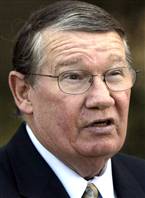
Duke was the most obnoxious member of a very obnoxious party, which should tell you something. And he had his hand in the cookie jar, too. What about that.
Good riddance.
5-128, 4-59
Chargers 23
Skins 17
A little math. Add 5-128 to 4-59 and you get 23-17. How? The Chargers received 5 Redskin kickoffs and returned them for 128 friggin yards. The Skins received 4 Chargers kickoffs and returned then a stinking 59 yards. When you stink up the joint on special teams, like the Skins did yesterday, this is what happens. When you allow the other team 128 yards on kickoff returns, especially a good offensive team like the Chargers, they're going to score. And when you only get 59 yards on kickoff returns you're going to forced to make long drives, which for a feeble offensive team like the Skins, means you're going to have trouble scoring. And when you add the 3 yards of punt returns the Skins got yesterday, you get two long LT TD runs and a
23-17 overtime loss.
Rams 33
Texans 27
Somebody named Ryan Fitzpatrick threw for 310 yards and 3 TD's for the Rams. The Texans are 1-10. And the Rams are next for the Redskins.
Da Bears 13
Tampa 10
Da Bears are 8-3!! And they have a rookie QB. How did this happen?
Brownies 12
Vikings 24
Brad Johnson has helped Minnesota come back from the dead.
Broncos 27
Cowboys 21
I know they lost, but can you imagine what the Cowboys and Bill Parcells would be doing this year without Drew Bledsoe? Over the last couple of years, here have been the Cowboys QB's--41 year old Vinnie, Drew Henson, Chad Hutchinson, Tony Romo, and Quincy Carter. Cowboy fans, say your lucky prayers. Nice comeback for Ron Dayne with the big run in OT.
Atlanta 27
Lions 7
How much of this game was played on the Detroit side of the field? What's happened in Motown? Do the Redskins play there when they aren't at FedEx? They have all those wideouts and can't get them the ball. Bad O-line, QB's can't get the thing down the field. Rumors Mooch was going to get sacked on Friday, which doesn't make any sense at this time of the year and given Dick Jauron is waiting in the wings.
Saints 21
Jets 19
More interesting game than the teams' records would have predicted. Brooks Bollinger is coming along, and I wonder if the Jets can start thinking about whether he can be a serious alternative at QB if Chad Pennington can't come back.
Pats 16
KC 26
Glad to see the Pats getting their comeuppance. Even if injuries have been largely responsible. But they're still likely to win their division and thus get a playoff bye, so don't count them out yet. Seriously.
College special
Nebraska 30
Colorado 3
A Huskers fan from NJ (don't ask) I was getting ready to launch firebillcallahan.com but then they go into Boulder and totally blow up the Buffs, who because Iowa State lost Saturday in Lawrence, will still be going to the Big 12 title game next week against Texas (yeah, good luck). That Zack Taylor is some QB. Is he a senior?
Skins 17
A little math. Add 5-128 to 4-59 and you get 23-17. How? The Chargers received 5 Redskin kickoffs and returned them for 128 friggin yards. The Skins received 4 Chargers kickoffs and returned then a stinking 59 yards. When you stink up the joint on special teams, like the Skins did yesterday, this is what happens. When you allow the other team 128 yards on kickoff returns, especially a good offensive team like the Chargers, they're going to score. And when you only get 59 yards on kickoff returns you're going to forced to make long drives, which for a feeble offensive team like the Skins, means you're going to have trouble scoring. And when you add the 3 yards of punt returns the Skins got yesterday, you get two long LT TD runs and a
23-17 overtime loss.
Rams 33
Texans 27
Somebody named Ryan Fitzpatrick threw for 310 yards and 3 TD's for the Rams. The Texans are 1-10. And the Rams are next for the Redskins.
Da Bears 13
Tampa 10
Da Bears are 8-3!! And they have a rookie QB. How did this happen?
Brownies 12
Vikings 24
Brad Johnson has helped Minnesota come back from the dead.
Broncos 27
Cowboys 21
I know they lost, but can you imagine what the Cowboys and Bill Parcells would be doing this year without Drew Bledsoe? Over the last couple of years, here have been the Cowboys QB's--41 year old Vinnie, Drew Henson, Chad Hutchinson, Tony Romo, and Quincy Carter. Cowboy fans, say your lucky prayers. Nice comeback for Ron Dayne with the big run in OT.
Atlanta 27
Lions 7
How much of this game was played on the Detroit side of the field? What's happened in Motown? Do the Redskins play there when they aren't at FedEx? They have all those wideouts and can't get them the ball. Bad O-line, QB's can't get the thing down the field. Rumors Mooch was going to get sacked on Friday, which doesn't make any sense at this time of the year and given Dick Jauron is waiting in the wings.
Saints 21
Jets 19
More interesting game than the teams' records would have predicted. Brooks Bollinger is coming along, and I wonder if the Jets can start thinking about whether he can be a serious alternative at QB if Chad Pennington can't come back.
Pats 16
KC 26
Glad to see the Pats getting their comeuppance. Even if injuries have been largely responsible. But they're still likely to win their division and thus get a playoff bye, so don't count them out yet. Seriously.
College special
Nebraska 30
Colorado 3
A Huskers fan from NJ (don't ask) I was getting ready to launch firebillcallahan.com but then they go into Boulder and totally blow up the Buffs, who because Iowa State lost Saturday in Lawrence, will still be going to the Big 12 title game next week against Texas (yeah, good luck). That Zack Taylor is some QB. Is he a senior?
Walk The Line

I went to this movie yesterday. I was experiencing movie-popcorn-hot-dog-withdrawal symptoms, didn't particularly care to watch the Skins game (more about this below), and didn't know what else to plop my seven dollars down for. I didn't know much about Cash, although I did like a couple of songs of his that had been featured in One Night at McCool's (Wanted Man) and Dawn of the Dead (When The Man Comes Around). I have one of his most recent albums,w which has some other good songs on it. So I thought, why not. But I wasn't expecting much.
But it was great. Really great. It was a little longer than I expected. But thoroughly entertaining. And the soundtrack just kills. Joaquin Phoenix can really belt out the Johnny Cash tunes. Unfortunately, the CD doesn't have the live recordings in the movie. Nonetheless, a really great movie and story. Afterwards I went to two stores looking for the CD, and I picked up two other Johnny Cash albums. I imagine the movie will have a similar effect on other movie-goers, so the Johnny Cash albums are probably going to be flying out of the stores for awhile.
Wednesday, November 23, 2005
The Best and Worst to be Thankful for (or not)
Amanda and a few others have been kicking this around the blogosphere, so why not?
Most disappointing movies (not sure I can really say "hated" since most movies I see are ones I have applied at least some selective quality towards, being sure to avoid the ones I'm absolutely sure I wouldn't make it through or would hate myself for doing so afterward):
1) Cold Mountain - a very picturesque movie, but just didn't have any jazz. The characters weren't interesting. The story ends sadly.
2) Constantine - a mess, unrealistic effects, a movie that couldn't quite make up its mind whether to be serious or not.
3) The Constant Gardner - a great cast, but didn't live up to expectations. Rachel Weisz's character dies in it.
4) Donnie Darko - ??
5) Leaving Las Vegas - Terribly depressing
6) My Best Friend's Wedding - The beginning of my I Don't Like Julia Roberts stage; just an annoying plot line and disturbing character interaction
7) 15 Minutes - another movie not sure whether it wanted to be serious or not. It wasn't.
8) 3000 Miles to Graceland - couldn't get past the first few minutes.
9) The Clearing - the ending just drops off to nowhere.
Under-rated or over-looked movies:
1. The Brady Bunch Movie - a most humerous takeoff of the old sitcom.
2. Cop Land - Stallone, DeNiro. Bad cop--no donut.
3. Summer School - Mark Harmon, a young Courtney Thorne Smith, in humorous story of slacker gym teacher turned english summer tutor and his equally unambitious students
4. Weekend at Bernies (surprised to see this on the bottom ranked 80's movies)
5. Darkness - suspenseful. And it has Anna Paquin in it.
6. The Village - but like most of his movies, can really only watch it once.
7. Death to Smoochie - Robin Williams and Edward Norton in dark comedy about two children's performers
8. Cheaters - Jena Malone, Jeff Daniels, story of high school honor class that cheats to win state-wide academic competition (based on true story).
9. Trapped - Charlieze Theron, Kevin Bacon; couple has child kidnapped, but they turn the tables on the kidnappers.
10. In the Cut - interesting and erotic movie with Meg Ryan playing against type.
Most disappointing movies (not sure I can really say "hated" since most movies I see are ones I have applied at least some selective quality towards, being sure to avoid the ones I'm absolutely sure I wouldn't make it through or would hate myself for doing so afterward):
1) Cold Mountain - a very picturesque movie, but just didn't have any jazz. The characters weren't interesting. The story ends sadly.
2) Constantine - a mess, unrealistic effects, a movie that couldn't quite make up its mind whether to be serious or not.
3) The Constant Gardner - a great cast, but didn't live up to expectations. Rachel Weisz's character dies in it.
4) Donnie Darko - ??
5) Leaving Las Vegas - Terribly depressing
6) My Best Friend's Wedding - The beginning of my I Don't Like Julia Roberts stage; just an annoying plot line and disturbing character interaction
7) 15 Minutes - another movie not sure whether it wanted to be serious or not. It wasn't.
8) 3000 Miles to Graceland - couldn't get past the first few minutes.
9) The Clearing - the ending just drops off to nowhere.
Under-rated or over-looked movies:
1. The Brady Bunch Movie - a most humerous takeoff of the old sitcom.
2. Cop Land - Stallone, DeNiro. Bad cop--no donut.
3. Summer School - Mark Harmon, a young Courtney Thorne Smith, in humorous story of slacker gym teacher turned english summer tutor and his equally unambitious students
4. Weekend at Bernies (surprised to see this on the bottom ranked 80's movies)
5. Darkness - suspenseful. And it has Anna Paquin in it.
6. The Village - but like most of his movies, can really only watch it once.
7. Death to Smoochie - Robin Williams and Edward Norton in dark comedy about two children's performers
8. Cheaters - Jena Malone, Jeff Daniels, story of high school honor class that cheats to win state-wide academic competition (based on true story).
9. Trapped - Charlieze Theron, Kevin Bacon; couple has child kidnapped, but they turn the tables on the kidnappers.
10. In the Cut - interesting and erotic movie with Meg Ryan playing against type.
Used Books
I'm still waiting for my used copy of The Satanic Verses to come in the mail from the Amazon-affiliated book-dealer. Seems like I ordered it weeks ago. That's the thing with getting stuff through the mail. Like with Amazon, your order could come the next day, or you might wait three weeks. And I couldn't find a copy at my neighborhood Borders. Figures. I'll only have time to skim it by the time of my bookclub meeting. And it's a complex book, I hear, to say the least. There's a primer for it that was sent to me by one of my bookclub mates.
Meanwhile, I've picked up reading James O' Donnell's Augustine again. As at least one of it's reviewers noted, this Augustine is not an easy read, at least in terms of how the book is organized. The prose is fine, but if you're looking for a nice chronological story-telling, and an outline of all the characters and issues, this book isn't it. Probably better to read the Peter Brown version. Nonetheless, there are things to like in O'Donnell's version.
Like a lot of recent church scholarship, O'Donnell reveals a more nuanced Augustine and a more complex church portrait than what church apologists have painted. O'Donnell's Augustine maintains the career climbing, publicity seeking that marked his younger, uncoverted days. Only in his ecclesiastical career, his ambition takes the form of church authority and that era's form of self-promotion--letter writing, between the Bishop and the notables of the day, preferably the political and influential, rather than his fellow clergy.
Of the theological and political divide between Augustine's Caecilianists and the opposition Donatists, the latter of whom Augustine was himself once affiliated, and which before Augustine's time was the dominant sect, O' Donnell doesn't draw a nice, neat distinction for the reader, most likely because the distinctions are not easy to grasp for us moderns.
In fact, the strength of O'Donnell's tale is it's illumination of a less unified, theologically sorted out Christian religion than that proposed by both the orthodox Catholics and fundamentalist Protestants today. But for each, Augustine's more global, authoritarian views had a great deal in shaping their tradition's world views.
Meanwhile, I've picked up reading James O' Donnell's Augustine again. As at least one of it's reviewers noted, this Augustine is not an easy read, at least in terms of how the book is organized. The prose is fine, but if you're looking for a nice chronological story-telling, and an outline of all the characters and issues, this book isn't it. Probably better to read the Peter Brown version. Nonetheless, there are things to like in O'Donnell's version.
Like a lot of recent church scholarship, O'Donnell reveals a more nuanced Augustine and a more complex church portrait than what church apologists have painted. O'Donnell's Augustine maintains the career climbing, publicity seeking that marked his younger, uncoverted days. Only in his ecclesiastical career, his ambition takes the form of church authority and that era's form of self-promotion--letter writing, between the Bishop and the notables of the day, preferably the political and influential, rather than his fellow clergy.
Of the theological and political divide between Augustine's Caecilianists and the opposition Donatists, the latter of whom Augustine was himself once affiliated, and which before Augustine's time was the dominant sect, O' Donnell doesn't draw a nice, neat distinction for the reader, most likely because the distinctions are not easy to grasp for us moderns.
In fact, the strength of O'Donnell's tale is it's illumination of a less unified, theologically sorted out Christian religion than that proposed by both the orthodox Catholics and fundamentalist Protestants today. But for each, Augustine's more global, authoritarian views had a great deal in shaping their tradition's world views.
Tuesday, November 22, 2005
Dude, Where's My Ideology?
I've been trying to be pragmatic about the 2008 Dem field for president. Just win, baby.
But I can't help feeling concerned when I read stuff like this in yesterday's Wash Post Style article on Mark Warner:
"It behooves Democrats, he says, to reframe the debate liberal vs. conservative to 'future vs. past.' "
We've heard this before:
"This election is not about ideology, it's about competence."
Of course, after Iraq and Katrina, I'd welcome some good old fashioned competence for a change. And I think we can reasonably conclude that there's a connection between an anti-government ideology and the actual performance of government. And maybe Warner's right: reframing the debate from "liberal" to "future" is a good way to avoid a negative label while simultaneously recasting the conservative's backward agenda in a way that would make Democrats seem appealing by comparison.
But I hope this doesn't turn into a wholesale refutation of ideology, particularly among the progressive grassroots. Starting at least with the Dukakis campaign, Democrats began a withdrawal of their own from the ideological field of combat with Republicans and not surprisingly, we've been getting our hats handed to us ever since, defensive about our beliefs, and unable to shape the public debate and policymaking process.
Ezra Klein's concerned too:
For my part, I have an article on the Brown/Hackett race (and what it says about the netroots) in the most recent American Prospect. My argument is, basically, that the netroots need to start thinking about who they are ideologically rather than simply flocking to who they prefer pugilistically.
While Democrats should be optimistic about their prospects in 2006 and 2008, it may be tempting to do and say whatever we think it takes to win, without regard for laying out a cohesive narrative about what Democrats value (and the risks inherent in defining ourselves). But since the Republicans will define us anyway, better to do on our own terms.
But I can't help feeling concerned when I read stuff like this in yesterday's Wash Post Style article on Mark Warner:
"It behooves Democrats, he says, to reframe the debate liberal vs. conservative to 'future vs. past.' "
We've heard this before:
"This election is not about ideology, it's about competence."
Of course, after Iraq and Katrina, I'd welcome some good old fashioned competence for a change. And I think we can reasonably conclude that there's a connection between an anti-government ideology and the actual performance of government. And maybe Warner's right: reframing the debate from "liberal" to "future" is a good way to avoid a negative label while simultaneously recasting the conservative's backward agenda in a way that would make Democrats seem appealing by comparison.
But I hope this doesn't turn into a wholesale refutation of ideology, particularly among the progressive grassroots. Starting at least with the Dukakis campaign, Democrats began a withdrawal of their own from the ideological field of combat with Republicans and not surprisingly, we've been getting our hats handed to us ever since, defensive about our beliefs, and unable to shape the public debate and policymaking process.
Ezra Klein's concerned too:
For my part, I have an article on the Brown/Hackett race (and what it says about the netroots) in the most recent American Prospect. My argument is, basically, that the netroots need to start thinking about who they are ideologically rather than simply flocking to who they prefer pugilistically.
While Democrats should be optimistic about their prospects in 2006 and 2008, it may be tempting to do and say whatever we think it takes to win, without regard for laying out a cohesive narrative about what Democrats value (and the risks inherent in defining ourselves). But since the Republicans will define us anyway, better to do on our own terms.
Monday, November 21, 2005
Monday Morning QB
Norv Turner 16
The Danny 13
Everytime Kerry Collins dropped back to pass--and the nearest Washington defensive lineman appeared to be in Fairfax County--I cringed, imagining Randy Moss catching a bomb and scoring. Well, it turned out that Jerry Porter caught the bombs away pass that started the Raiders turn around yesterday. This game exposed just about everything that's been wrong with the Skins this year. Aside from the blitz, a non-existent pass rush, an inconsistent offense, turnovers, and poor pass protection. This was a crucial game for Washington. I've said previously that I thought Washington had a favorable remaining schedule, but not now. They needed to win--at home--yesterday and didn't get it done. Their season's over.
Seahawks 27
49'ers 25
Can someone explain to me why this game was listed as one of the TV games in the Balt-Wash DC area yesterday? Fortunately we got Indy-Cincy on the other station, but c'mon. And how was it that with Ken Dorsey at QB, the Seahawks didn't cover the spread?
Steelers 13
Ravens 16
Pittsburgh didn't have the one guy on their team that can pass-Rothlesburger--on the field yesterday, so you think they'd run the ball all afternoon. But everytime I tuned into this game when Pitt had the ball, I saw XFLer Tommy Maddux trying to pass. Strange game. Were Duce and the Bus hurt? Good game for the Colts as Pitt drops three games behind them for home field. Denver is two back.
Speaking of which,
Jets 0
Broncos 27
Ouch. Herm Edwards is too good a coach to have this kind of season. But their QB position is desperate. Wonder who they'll have next year? At 2-8, they may still be in the Matt Leinert sweepstakes.
Bills 3
Chargers 40
And SD is coming into town next week. Will Marty be the second ex-Skins coach to beat his former team? Skins go for two in a row next week.
Tampa 30
Falcons 27
Falcons have lost two straight and have fallen out of first in the NFC South. Tampa and Carolina on top. Guess the Bucs got healthy against the Redskins last week. Raiders will probably go on to win six straight.
Colts 45
Bengals 37
Very tedious end to this game, with Cincy trying to line up for an onsides kick at the end. The officials spent a basketball game final minute trying to sort things out. And, oh yeah, Colts 10-0.
Dolphins 0
Browns 22
What happened here?
The Danny 13
Everytime Kerry Collins dropped back to pass--and the nearest Washington defensive lineman appeared to be in Fairfax County--I cringed, imagining Randy Moss catching a bomb and scoring. Well, it turned out that Jerry Porter caught the bombs away pass that started the Raiders turn around yesterday. This game exposed just about everything that's been wrong with the Skins this year. Aside from the blitz, a non-existent pass rush, an inconsistent offense, turnovers, and poor pass protection. This was a crucial game for Washington. I've said previously that I thought Washington had a favorable remaining schedule, but not now. They needed to win--at home--yesterday and didn't get it done. Their season's over.
Seahawks 27
49'ers 25
Can someone explain to me why this game was listed as one of the TV games in the Balt-Wash DC area yesterday? Fortunately we got Indy-Cincy on the other station, but c'mon. And how was it that with Ken Dorsey at QB, the Seahawks didn't cover the spread?
Steelers 13
Ravens 16
Pittsburgh didn't have the one guy on their team that can pass-Rothlesburger--on the field yesterday, so you think they'd run the ball all afternoon. But everytime I tuned into this game when Pitt had the ball, I saw XFLer Tommy Maddux trying to pass. Strange game. Were Duce and the Bus hurt? Good game for the Colts as Pitt drops three games behind them for home field. Denver is two back.
Speaking of which,
Jets 0
Broncos 27
Ouch. Herm Edwards is too good a coach to have this kind of season. But their QB position is desperate. Wonder who they'll have next year? At 2-8, they may still be in the Matt Leinert sweepstakes.
Bills 3
Chargers 40
And SD is coming into town next week. Will Marty be the second ex-Skins coach to beat his former team? Skins go for two in a row next week.
Tampa 30
Falcons 27
Falcons have lost two straight and have fallen out of first in the NFC South. Tampa and Carolina on top. Guess the Bucs got healthy against the Redskins last week. Raiders will probably go on to win six straight.
Colts 45
Bengals 37
Very tedious end to this game, with Cincy trying to line up for an onsides kick at the end. The officials spent a basketball game final minute trying to sort things out. And, oh yeah, Colts 10-0.
Dolphins 0
Browns 22
What happened here?
Sunday, November 20, 2005
NYT Special Edition
Here's Frank Rich:
One hideous consequence of the White House's Big Lie - fusing the war of choice in Iraq with the war of necessity that began on 9/11 - is that the public, having rejected one, automatically rejects the other. That's already happening. The percentage of Americans who now regard fighting terrorism as a top national priority is either in the single or low double digits in every poll. Thus the tragic bottom line of the Bush catastrophe: the administration has at once increased the ranks of jihadists by turning Iraq into a new training ground and recruitment magnet while at the same time exhausting America's will and resources to confront that expanded threat.
But if anything, Brooks is even more interesting:
For while the American presence is a catalyst for violence in Iraq, it is not the main catalyst. The main source of violence in Iraq is the sectarian war between the Sunnis and the Shiites.
And, um, gee, why would that be?
In the vacuum of security caused by the botched American occupation, these ethnic tensions have turned into a low-grade civil war.
And, um, maybe the invasion has had something to do with the civil war breaking out, too.
And what about the administration coming clean on what it knows about Iraq, rather than pummeling us with "stay the course" propaganda?
There's one area, though, where I completely sympathize with Jack Murtha. I sympathize with his frustration. On Feb. 23, 1942, Franklin Roosevelt asked Americans to spread out maps before them and he described, step by step, what was going on in World War II, where the U.S. was winning and where it was losing. Why can't today's president do that? Why can't he show that he is aware that his biggest problem is not in Iraq, it's on the home front?
Since the president doesn't give out credible information, it's no wonder Republicans are measuring success by how quickly we can get out;
One hideous consequence of the White House's Big Lie - fusing the war of choice in Iraq with the war of necessity that began on 9/11 - is that the public, having rejected one, automatically rejects the other. That's already happening. The percentage of Americans who now regard fighting terrorism as a top national priority is either in the single or low double digits in every poll. Thus the tragic bottom line of the Bush catastrophe: the administration has at once increased the ranks of jihadists by turning Iraq into a new training ground and recruitment magnet while at the same time exhausting America's will and resources to confront that expanded threat.
But if anything, Brooks is even more interesting:
For while the American presence is a catalyst for violence in Iraq, it is not the main catalyst. The main source of violence in Iraq is the sectarian war between the Sunnis and the Shiites.
And, um, gee, why would that be?
In the vacuum of security caused by the botched American occupation, these ethnic tensions have turned into a low-grade civil war.
And, um, maybe the invasion has had something to do with the civil war breaking out, too.
And what about the administration coming clean on what it knows about Iraq, rather than pummeling us with "stay the course" propaganda?
There's one area, though, where I completely sympathize with Jack Murtha. I sympathize with his frustration. On Feb. 23, 1942, Franklin Roosevelt asked Americans to spread out maps before them and he described, step by step, what was going on in World War II, where the U.S. was winning and where it was losing. Why can't today's president do that? Why can't he show that he is aware that his biggest problem is not in Iraq, it's on the home front?
Since the president doesn't give out credible information, it's no wonder Republicans are measuring success by how quickly we can get out;
Subscribe to:
Posts (Atom)