Not in the pews. Not in the pews of evangelical America. I know some of you have probably seen this quote from somebody named Michael Marcavage, who professes to be a Christian activist:
"Although the loss of lives is deeply saddening, this act of God destroyed a wicked city," stated Repent America director Michael Marcavage. "From 'Girls Gone Wild' to 'Southern Decadence,' New Orleans was a city that had its doors wide open to the public celebration of sin. From the devastation may a city full of righteousness emerge," he continued.
[snip]
"We must help and pray for those ravaged by this disaster, but let us not forget that the citizens of New Orleans tolerated and welcomed the wickedness in their city for so long," Marcavage said. "May this act of God cause us all to think about what we tolerate in our city limits, and bring us trembling before the throne of Almighty God," Marcavage concluded.
And probably this from somebody named Rick Scarborough, who professes to be a minister of the Word:
After September 11, 2001, "God bless America" was on everyone's lips. But what, exactly, are we asking God to bless - a nation moving a breakneck speed toward homosexual marriage, a nation awash in pornography, a nation in which our children are indoctrinated in perversion in the public schools, a nation in which most public displays of The Ten Commandments are considered offensive to the Constitution, a nation in which the elite does all in its considerable power to efface our Biblical heritage?
We are sowing the wind. Surely, we shall reap the whirlwind.
But perhaps you think these are merely the voices of extremists. Certainly the masses of Christianity are more sympathetic to the plight of the oppressed, and duly grieved for the dying and outraged at their government for the neglect and delays.
Well, if my experience in evangelical America this weekend is any indication, you would be disappointed.
While you and I may have been cringing at the coverage of death and carnage in New Orleans last week, to the conservative, white, middle class group of church goers in rural and suburban America, the worst natural catastrophe in American history is a big, fat zero.
Around the table at our Saturday morning lesson study, when prayer requests were entertained, and after waiting for someone else to bring up the obvious, I mentioned Katrinia and its deadly aftermath.
I may have been the only concerned member of the group. Here were some of the comments that followed:
"New Orleans is a wicked city...the people were told to leave...they shouldn't be blaming others (the President).
I patiently explained that a good many of the people were unable to leave, seeing as they didn't have the means or transportation to do so.
I also suggested, as a qualification to the city's "wicked" reputation, that the city was deathly poor, and its economy based on low-paying service jobs.
In any event, for those of you wondering why the administration's response was less than immediate and overwhelming, as say, it was LAST SUMMER in FLORIDA for that state's hurricane victims, I would point you to the President's recognized base of conservative evangelical followers for a clue.
And oh, yes yes, conservative apologists will respond by listing the various religious groups sponsoring assistance to the victims of the crisis, such as the Salvation Army, Catholic Charities, etc. And yesterday did witness TV superevangelist, megachurch superstar and best selling author T.D. Jakes aside the President in Lousiana, and maybe he and his massive organization are even doing something to help. If so, my hats off to him for putting his celebrity to a good use. And there appears to have been a legitamately generous and well organized response in the Houston area to evacuees. Again, to the extent church groups have helped facilitate that process, they are deserving of our gratitute on the part of the nation.
But I don't mean the official, non-profit entities the established churches have set up to provide social services, as well intended as these efforts are, because they don't necessarily capture the mood of the church members themselves, which is what has been the most alarming for its indifference, again if my limited experience is any measure. But if the churches are outraged at the senseless deaths and official incompetency, I haven't seen any indication of it. Stained, blue dresses. Oh, yes, we'll be angry about that. The existence of legalized abortion? Oh, yes, great moral travesty. Gays? Oh yes, what has happened to our sense of right and wrong, good and evil, moral absolutes, the need to defend the family? No officially coerced prayer in schools? Oh yes, we are outraged. What of America's renowned Christian religious heritage?
Of these the church and its pew-dwellers can assuredly be outraged over.
But the deaths and sufferings of inner-city blacks? Uh uh. They brought it on themselves. Serves them right. And don't blame our President.
It's moments like these that make me think the church is dead. Oh, it will go on baptising people, holding revivals, expressing outrage at the private, consensual actions of individuals that have no direct bearing on their own rights to life, liberty and the pursuit of happiness, there will be more Justice Sundays, there will be more Christian self help best sellers, there will be new and bigger mega churches, their leaders will continue to hold the Republican Party and the rest of us hostage to its narrow and bigoted agenda, and on and on.
But the church's heart and soul, or the lack thereof, is being exposed, subordinated to the demands and ambitions of conservative politics, commercial empire, and "doctrinal purity".
Maybe David Brooks will eventually be proven right, that last week was a tipping point, a deciding moment in the future of the country's politics, a seminal event in this nation's summer of discontent, a symbol of the growing dis-ease in the country. But if our churches are any indication, the result won't be a progressive revival and maybe not even a "centrist" establishment. And that leaves some other alternatives that I'd rather not contemplate.
Tuesday, September 06, 2005


Friday, September 02, 2005
They Don't Get It


Ken Mehlman, GOP chair, speaking in July to the NAACP:
By the 70s and into the 80s and 90s, the Democratic Party solidified its gains in the African American community, and we Republicans did not effectively reach out.
Some Republicans gave up on winning the African American vote, looking the other way or trying to benefit politically from racial polarization. I am here today as the Republican Chairman to tell you we were wrong.
But if my party benefited from racial polarization in the past, it is the Democratic Party that benefits from it today.
I know it is not in my interest as chairman of the Republican Party for close to 90% of African-Americans to vote for the Democrat every election. But more important, its not in the interest of African-Americans for 90% to vote for the Democrat every election.
And its not healthy for the country for our political parties to be so racially polarized. African-American voters should have the benefit of a two-party system. In recent years, the Democratic Party, in my judgment, has come to take many African American voters for granted.
Just as the Democrats came to this community in 1964 with something real to offer, today we Republicans have something that should cause you to take another look at the party of Lincoln.
Just last month, Bruce Gordon talked about a wider vision of civil rights. "We've got to get the right emphasis placed on economic equality," he said. "I happen to think that when you have economic stability and equality that often becomes an enabler for social equality."
I couldnt agree more.
The next step in civil rights is to build on equal treatment under the law to ensure equal opportunity to pursue the American Dream, equal opportunity in education, equal opportunity in where you live, equal opportunity in making a living, equal opportunity for a secure retirement.
--------------------------------------------------------------------------------------
Meanwhile,
Mehlman's email to the party faithful this week during the worse natural disaster in the country's history:

When they return from their August recess, Senators will consider a key issue: elimination of the death tax. The death tax is an unfair double taxation of income, which hurts America's small businesses and farms and threatens job growth. Unfortunately, Senate Democrats are working hard to oppose our efforts to eliminate this unfair tax.
Will you help bring tax relief to more hard-working Americans? Call Senator X at XXX-XXX-XXXX and ask them to eliminate the death tax.
Our party's opportunity agenda means allowing families to keep more of the income they earn. This historic tax relief in the president's first term was only the beginning. The Senate needs to do its part by making tax relief permanent and burying the death tax forever.
-------------------------------------------------------------------------------------
Report in the September 2004 Independent on Bush and FEMA:
Among emergency specialists, "mitigation" the measures taken in advance to minimize the damage caused by natural disasters is a crucial part of the strategy to save lives and cut recovery costs. But since 2001, key federal disaster mitigation programs, developed over many years, have been slashed and tossed aside. FEMA's Project Impact, a model mitigation program created by the Clinton administration, has been canceled outright.
....[In 2001], President Bush appointed a close aide, Joe Allbaugh, to be the agency's new director....The White House quickly launched a government-wide effort to privatize public services, including key elements of disaster management. Bush's first budget director, Mitch Daniels, spelled out the philosophy in remarks at an April 2001 conference: "The general idea — that the business of government is not to provide services, but to make sure that they are provided — seems self-evident to me," he said.
In a May 15, 2001, appearance before a Senate appropriations subcommittee, Allbaugh signaled that the new, stripped-down approach would be applied at FEMA as well. "Many are concerned that federal disaster assistance may have evolved into both an oversized entitlement program and a disincentive to effective state and local risk management," he said. "Expectations of when the federal government should be involved and the degree of involvement may have ballooned beyond what is an appropriate level."
---------------------------------------------------------------------------------------
Will Bunch, writing in Editor-and-Publisher, on the relationship between federal spending, tax cuts, and the defense and security of the Gulf Coast:
New Orleans had long known it was highly vulnerable to flooding and a direct hit from a hurricane. In fact, the federal government has been working with state and local officials in the region since the late 1960s on major hurricane and flood relief efforts. When flooding from a massive rainstorm in May 1995 killed six people, Congress authorized the Southeast Louisiana Urban Flood Control Project, or SELA.
Over the next 10 years, the Army Corps of Engineers, tasked with carrying out SELA, spent $430 million on shoring up levees and building pumping stations, with $50 million in local aid. But at least $250 million in crucial projects remained, even as hurricane activity in the Atlantic Basin increased dramatically and the levees surrounding New Orleans continued to subside.
Yet after 2003, the flow of federal dollars toward SELA dropped to a trickle. The Corps never tried to hide the fact that the spending pressures of the war in Iraq, as well as homeland security -- coming at the same time as federal tax cuts -- was the reason for the strain. At least nine articles in the Times-Picayune from 2004 and 2005 specifically cite the cost of Iraq as a reason for the lack of hurricane- and flood-control dollars.
Well, Ken, it might not be in yours or your party's interest for Democrats to win 90% of the African-American vote all the time, but if your list of priorities, combined with your administration's response to the biggest disaster in American history are any indication, I don't see your share of the African-American vote increasing anytime soon.
Should the games continue?
I'm a college football junkie and have been eagerly awaiting the start of the new college football season with as much anticipation as for the NFL. But under the circumstances should the games this weekend go on? Maybe it's too late for their cancellation to have any practical effect for the good of the people trapped in New Orleans. If the travel plans for those going to the games have already been made, does it make sense to send the fans back home so that greater room can be opened up for refugees in either stadiums or in surrounding hotels?
From Atrios it appears that the games in at least one college town have prevented the sending of refugees to a city with ample accomodations.
Beyond the practical implications of providing space and resources for the victims, does it make sense to direct as much focus, symbolic or otherwise, to the tragedy in NO rather than expending it on sports entertainment for at least one weekend while the relief of the refugees is presumably, at last, rectified?
One could argue that this week's events have been every bit as tragic and lethal to the country as those occuring on 9-11, albeit without the sinister unnatural causes. It would seem that this week's events are every bit as worthy of focus as those occuring four years ago, which as I speak are apparently still serving as the basis for a "freedom walk" sponsored by the Pentagon in commemoration.
Speaking of which, can we please have someone step up to demand that this Pentagon extravaganza and propaganda display be cancelled?
Although the president's acknowledgement today that the recovery effort has so far been "unacceptable" has been greeted with skepticism on the part of much of the left, I welcome the president's apparently belated recognition whatever its political nature. Admitting that things are not going swimmingly is at least a first step. How about following it up with requests to cancel this weekend's sporting events and to make the resources resulting available for the victims of the tragedy and to those providing relief? And how about following it up with an announcement that the 9-11 "walk" has been cancelled and therefore any further human efforts dedicated to its organization henceforth redirected?
From Atrios it appears that the games in at least one college town have prevented the sending of refugees to a city with ample accomodations.
Beyond the practical implications of providing space and resources for the victims, does it make sense to direct as much focus, symbolic or otherwise, to the tragedy in NO rather than expending it on sports entertainment for at least one weekend while the relief of the refugees is presumably, at last, rectified?
One could argue that this week's events have been every bit as tragic and lethal to the country as those occuring on 9-11, albeit without the sinister unnatural causes. It would seem that this week's events are every bit as worthy of focus as those occuring four years ago, which as I speak are apparently still serving as the basis for a "freedom walk" sponsored by the Pentagon in commemoration.
Speaking of which, can we please have someone step up to demand that this Pentagon extravaganza and propaganda display be cancelled?
Although the president's acknowledgement today that the recovery effort has so far been "unacceptable" has been greeted with skepticism on the part of much of the left, I welcome the president's apparently belated recognition whatever its political nature. Admitting that things are not going swimmingly is at least a first step. How about following it up with requests to cancel this weekend's sporting events and to make the resources resulting available for the victims of the tragedy and to those providing relief? And how about following it up with an announcement that the 9-11 "walk" has been cancelled and therefore any further human efforts dedicated to its organization henceforth redirected?
Demanding Accountability
The morning after another night of outrage watching news coverage of New Orleans.
I witnessed two interviews of FEMA head Michael Brown by, first, Brian Williams of NBC News and then later by Paula Zahn of CNN. By now you've probably read of Brown's claim, incredible, that FEMA didn't know about the situation at the Convention Center until Thursday.
Along with the refugee camp being staged at the Superdome, the nearby Convention Center has served as a gathering point for refugees. Apparently, city officials directed residents to the convention center in lieu of going to the overcrowded Superdome but have not provided any semblence of administration there, from security to food, water, medical aid and resting accomodations. Today's NYT reported that armed "thugs" have in effect commandeered the convention center and prevented eight teams of eleven NO police officers from gaining entrance to the area.
This is just mind boggling. Where is the New Orleans city administration on this? Where are the city officials and staff personnel? If NO is like just about any other city, where are it's public health, police, budget, transportation, maintenance, parks/recreation, utility and other workers, staff and managers? They should have been sent to administer the area. How could the city have directed residents to this area and then left it completely unsecured and unsupplied?
And yes, for the third day in a row I am wondering where the federal and NG food and water drops are? I was gratified to see a picture on the front page of today's Wash Post that at least one helicopter is reported to have made such a drop in the area, finally, but how wide spread the aid is now and what other measures are being taken to get the refugees the medical help they need and to get them out of there once these needs are taken care of is unclear.
Where are the refugee camps? They can't stay at the Astrodome in Houston forever. New arrivals are in fact being turned away. Why aren't underused or abandoned military bases being prepared and opened?
Watching the TV coverage has been frustrating in two main ways: one, it begs for help that other than donating to the Red Cross one is unable to provide; and two, all the anecdotal reporting doesn't help in understanding the logistics of it all. How and when were residents directed to the Convention Center? Where are the government officials and staff? Who's in charge? What was the plan? What did the governments responsible know and when did they know it?
The newspaper coverage is a bit better but still much too incomplete and patchy.
On the political, and even less tasteful front, we're beginning to see the outlines of the responses by the administration's apologists. The apologists offer many responses, but all are misdirections, blame the victims, and outright untruths designed to ensure that the administration is not held responsible for any of the problem. Not responsible for the underfinancing of the Army Corps of Engineers Louisiana projects, not responsible for information indicating the levees might brake, not responsible for ensuring that FEMA was adequately staff, managed and funded, not responsible for evacuating the refugees or providing for their needs, not responsible for ensuring that adequate numbers of a state's NG were on hand ready to help in case of emergencies, or that their equipment for combatting flooded conditions were also in Louisiana rather than in Mesopotamia.
Fortunately, and somewhat surprisingly, the usually-patsy media isn't buying it. Anderson Cooper ripped, ripped, ripped LA senator Mary Landrieu for offering up mushy praise for fellow politicians while, in Anderson's words, dead bodies were being devoured by rats. Paula Zahn ripped, ripped, ripped FEMA head Michael Brown for supposedly not knowing about the conditions at the convention center. CNN's resident crabby old guy, Jack McCafferty, ripped, ripped, ripped (scroll down) the federal response to the disaster and the obvious racial and class dimension to the crisis.
This is the administration's (and its media and Internets water carriers) anti-911. Bold words and bullhorns won't cut it. There's no foreign enemy to blame, no axis of evil country to bomb or invade, there's no foreign religion, language or culture to "clash" with. And as for "national security" and protecting the lives of Americans, well, all this crisis does is reveal the fallacy of promoting military ventures and arms expenditures at the expense of real homeland security and disaster prevention. Limbaugh, Hannity, Coulter, Powerrocket, Lileks, Sullivan, LGF, and FreeRepublik all claim they have the interests of American lives at heart. Do they? From their initial responses to the tragedy, it would appear that they don't, or that they at least don't have the value the lives of all Americans equally. Or else their use of 9-11 has been merely window dressing to cover their anti-humanitarian, anti-liberty conservative agenda.
And what of those in higher, elected and appointed places? I want to believe that Krugman is not right here when he says,
I don't think this is a simple tale of incompetence. The reason the military wasn't rushed in to help along the Gulf Coast is, I believe, the same reason nothing was done to stop looting after the fall of Baghdad. Flood control was neglected for the same reason our troops in Iraq didn't get adequate armor.
At a fundamental level, I'd argue, our current leaders just aren't serious about some of the essential functions of government. They like waging war, but they don't like providing security, rescuing those in need or spending on preventive measures.
But whatever the intent and the motivation of today's leadership, the end result has been to ask, in the words of Arianna Huffington,
Are People Dying Over Here Because We're Fighting Them Over There?
And after some initial qualms about this, I have to say I'm with Wolcott,
There is no "next week" when it comes to getting answers and fixing accountability for failure under this president. Next week never comes.
Look at 9/11. There were tough questions about the breakdown of communications at Ground Zero, the lateness in scrambling fighter jets once the hijacked planes were heading toward NY and DC, Bush's strange behavior on that day, etc., and in the aftermath those questions were considered inappropriate, "divisive." We needed to grieve first, heal; and then the tough questions could be raised.
But they weren't. As months passed, the focus was on overthrowing the Taliban and avenging 9/11, and tough questions were taken off the table as the drumbeat was about the Nation Moving Forward. The media fell into zombie lockstep behind the invigorated Bush agenda. It took the 9/11 widows and esp the "Jersey Girls" to push and shame the Congress, the media, and the administration into launching a proper investigation, otherwise it would have all slid into the memory hole apart from the iconic images of the smoking towers before their collapse.
No, this is the time for politics, none better, because I can tell you just from being out of NY a few days that a lot of people in this country are shocked and sobered by New Orleans, but they're also worried and pissed off. They're making the connection between the money, manpower, and resources expended in Iraq and how raggedy-ass the rescue effort has been in the Gulf. If you don't say it now when people's nerves are raw and they're paying full attention, it'll be too late once the waters receded and the media-emoting "healing process" begins.
I witnessed two interviews of FEMA head Michael Brown by, first, Brian Williams of NBC News and then later by Paula Zahn of CNN. By now you've probably read of Brown's claim, incredible, that FEMA didn't know about the situation at the Convention Center until Thursday.
Along with the refugee camp being staged at the Superdome, the nearby Convention Center has served as a gathering point for refugees. Apparently, city officials directed residents to the convention center in lieu of going to the overcrowded Superdome but have not provided any semblence of administration there, from security to food, water, medical aid and resting accomodations. Today's NYT reported that armed "thugs" have in effect commandeered the convention center and prevented eight teams of eleven NO police officers from gaining entrance to the area.
This is just mind boggling. Where is the New Orleans city administration on this? Where are the city officials and staff personnel? If NO is like just about any other city, where are it's public health, police, budget, transportation, maintenance, parks/recreation, utility and other workers, staff and managers? They should have been sent to administer the area. How could the city have directed residents to this area and then left it completely unsecured and unsupplied?
And yes, for the third day in a row I am wondering where the federal and NG food and water drops are? I was gratified to see a picture on the front page of today's Wash Post that at least one helicopter is reported to have made such a drop in the area, finally, but how wide spread the aid is now and what other measures are being taken to get the refugees the medical help they need and to get them out of there once these needs are taken care of is unclear.
Where are the refugee camps? They can't stay at the Astrodome in Houston forever. New arrivals are in fact being turned away. Why aren't underused or abandoned military bases being prepared and opened?
Watching the TV coverage has been frustrating in two main ways: one, it begs for help that other than donating to the Red Cross one is unable to provide; and two, all the anecdotal reporting doesn't help in understanding the logistics of it all. How and when were residents directed to the Convention Center? Where are the government officials and staff? Who's in charge? What was the plan? What did the governments responsible know and when did they know it?
The newspaper coverage is a bit better but still much too incomplete and patchy.
On the political, and even less tasteful front, we're beginning to see the outlines of the responses by the administration's apologists. The apologists offer many responses, but all are misdirections, blame the victims, and outright untruths designed to ensure that the administration is not held responsible for any of the problem. Not responsible for the underfinancing of the Army Corps of Engineers Louisiana projects, not responsible for information indicating the levees might brake, not responsible for ensuring that FEMA was adequately staff, managed and funded, not responsible for evacuating the refugees or providing for their needs, not responsible for ensuring that adequate numbers of a state's NG were on hand ready to help in case of emergencies, or that their equipment for combatting flooded conditions were also in Louisiana rather than in Mesopotamia.
Fortunately, and somewhat surprisingly, the usually-patsy media isn't buying it. Anderson Cooper ripped, ripped, ripped LA senator Mary Landrieu for offering up mushy praise for fellow politicians while, in Anderson's words, dead bodies were being devoured by rats. Paula Zahn ripped, ripped, ripped FEMA head Michael Brown for supposedly not knowing about the conditions at the convention center. CNN's resident crabby old guy, Jack McCafferty, ripped, ripped, ripped (scroll down) the federal response to the disaster and the obvious racial and class dimension to the crisis.
This is the administration's (and its media and Internets water carriers) anti-911. Bold words and bullhorns won't cut it. There's no foreign enemy to blame, no axis of evil country to bomb or invade, there's no foreign religion, language or culture to "clash" with. And as for "national security" and protecting the lives of Americans, well, all this crisis does is reveal the fallacy of promoting military ventures and arms expenditures at the expense of real homeland security and disaster prevention. Limbaugh, Hannity, Coulter, Powerrocket, Lileks, Sullivan, LGF, and FreeRepublik all claim they have the interests of American lives at heart. Do they? From their initial responses to the tragedy, it would appear that they don't, or that they at least don't have the value the lives of all Americans equally. Or else their use of 9-11 has been merely window dressing to cover their anti-humanitarian, anti-liberty conservative agenda.
And what of those in higher, elected and appointed places? I want to believe that Krugman is not right here when he says,
I don't think this is a simple tale of incompetence. The reason the military wasn't rushed in to help along the Gulf Coast is, I believe, the same reason nothing was done to stop looting after the fall of Baghdad. Flood control was neglected for the same reason our troops in Iraq didn't get adequate armor.
At a fundamental level, I'd argue, our current leaders just aren't serious about some of the essential functions of government. They like waging war, but they don't like providing security, rescuing those in need or spending on preventive measures.
But whatever the intent and the motivation of today's leadership, the end result has been to ask, in the words of Arianna Huffington,
Are People Dying Over Here Because We're Fighting Them Over There?
And after some initial qualms about this, I have to say I'm with Wolcott,
There is no "next week" when it comes to getting answers and fixing accountability for failure under this president. Next week never comes.
Look at 9/11. There were tough questions about the breakdown of communications at Ground Zero, the lateness in scrambling fighter jets once the hijacked planes were heading toward NY and DC, Bush's strange behavior on that day, etc., and in the aftermath those questions were considered inappropriate, "divisive." We needed to grieve first, heal; and then the tough questions could be raised.
But they weren't. As months passed, the focus was on overthrowing the Taliban and avenging 9/11, and tough questions were taken off the table as the drumbeat was about the Nation Moving Forward. The media fell into zombie lockstep behind the invigorated Bush agenda. It took the 9/11 widows and esp the "Jersey Girls" to push and shame the Congress, the media, and the administration into launching a proper investigation, otherwise it would have all slid into the memory hole apart from the iconic images of the smoking towers before their collapse.
No, this is the time for politics, none better, because I can tell you just from being out of NY a few days that a lot of people in this country are shocked and sobered by New Orleans, but they're also worried and pissed off. They're making the connection between the money, manpower, and resources expended in Iraq and how raggedy-ass the rescue effort has been in the Gulf. If you don't say it now when people's nerves are raw and they're paying full attention, it'll be too late once the waters receded and the media-emoting "healing process" begins.
Thursday, September 01, 2005
Remember that Bankruptcy "reform" bill
that passed a few months ago? The one where endless Democratic amendments--such as the one protecting victims of natural disasters--were batted down by the Republican majority?
Rep. John Conyers, Jr., Rep. Mel Watt, Rep. Jerrold Nadler, and Rep. Sheila Jackson Lee announced today that when Congress returns next Tuesday, they will introduce legislation to protect the thousands of families and small businesses financially devastated by Hurricane Katrina from being penalized by anti-debtor provisions contained in the Bankruptcy Abuse Prevention and Consumer Protection Act of 2005, scheduled to take effect on October 17, 2005.
Reps. Conyers, Nadler, and Jackson Lee released the following joint statement:"We are concerned that just as survivors of Hurricane Katrina are beginning to rebuild their lives, the new bankruptcy law will result in a further and unintended financial whammy. Unfortunately, the new law is likely to have the consequence of preventing devestated families from being able to obtain relief from massive and unexpected new financial obligations they are incurring and by forcing them to repay their debt with income they no longer have, but which is counted by the law.
When the Judiciary Committee considered the Bankruptcy Abuse and Consumer Protection Act earlier this year, Ms. Jackson Lee offered an amendment to protect the victims of natural disaster like those now devastated by Hurricane Katrina. While the amendment was defeated on a party line vote without any debate, we hope that in light of recent events our colleagues will recognize the importance of protecting our most financially vulnerable Americans. The legislation we plan to introduce will prevent new bankruptcy provisions from having adverse and unintended consequences for the hundreds of thousands now facing financial catastrophe by providing needed flexibility for victims of natural disasters in bankruptcy proceedings.
Our common sense bill will insure that we do not compound a natural disaster with a man made financial disaster. We hope to obtain bipartisan support for expedited consideration of this critical legislation."
I would hope this would draw some bi-partisan support for a change.
(thanks to Atrios for the link).
Rep. John Conyers, Jr., Rep. Mel Watt, Rep. Jerrold Nadler, and Rep. Sheila Jackson Lee announced today that when Congress returns next Tuesday, they will introduce legislation to protect the thousands of families and small businesses financially devastated by Hurricane Katrina from being penalized by anti-debtor provisions contained in the Bankruptcy Abuse Prevention and Consumer Protection Act of 2005, scheduled to take effect on October 17, 2005.
Reps. Conyers, Nadler, and Jackson Lee released the following joint statement:"We are concerned that just as survivors of Hurricane Katrina are beginning to rebuild their lives, the new bankruptcy law will result in a further and unintended financial whammy. Unfortunately, the new law is likely to have the consequence of preventing devestated families from being able to obtain relief from massive and unexpected new financial obligations they are incurring and by forcing them to repay their debt with income they no longer have, but which is counted by the law.
When the Judiciary Committee considered the Bankruptcy Abuse and Consumer Protection Act earlier this year, Ms. Jackson Lee offered an amendment to protect the victims of natural disaster like those now devastated by Hurricane Katrina. While the amendment was defeated on a party line vote without any debate, we hope that in light of recent events our colleagues will recognize the importance of protecting our most financially vulnerable Americans. The legislation we plan to introduce will prevent new bankruptcy provisions from having adverse and unintended consequences for the hundreds of thousands now facing financial catastrophe by providing needed flexibility for victims of natural disasters in bankruptcy proceedings.
Our common sense bill will insure that we do not compound a natural disaster with a man made financial disaster. We hope to obtain bipartisan support for expedited consideration of this critical legislation."
I would hope this would draw some bi-partisan support for a change.
(thanks to Atrios for the link).
Yes, Why?
Why is the Sept 11 party on the national mall still happening?
Common sense might suggest this would require resources that would be better applied to the Gulf Coast and the victims of Katrina. Not to mention the attitude of pride and glory this "walk" is designed to engender, we'd be better off dumping the "walk of pride" for some good old fashioned saving of lives.
Common sense might suggest this would require resources that would be better applied to the Gulf Coast and the victims of Katrina. Not to mention the attitude of pride and glory this "walk" is designed to engender, we'd be better off dumping the "walk of pride" for some good old fashioned saving of lives.
Do the Democrats have an obligation to lead?
I'll return to Katrina-related posting shortly, but I want to memorialize these comments about the need for Democratic Party leadership before I forget them or before they disappear behind the NYT new $ wall of sleep.
First, here's Gary Hart, op-edding at the Washington Post last week:
But what will history say about an opposition party that stands silent while all this goes on? My generation of Democrats jumped on the hot stove of Vietnam and now, with its members in positions of responsibility, it is afraid of jumping on any political stove. In their leaders, the American people look for strength, determination and self-confidence, but they also look for courage, wisdom, judgment and, in times of moral crisis, the willingness to say: "I was wrong."
To stay silent during such a crisis, and particularly to harbor the thought that the administration's misfortune is the Democrats' fortune, is cowardly.
And here's Frank Rich, writing from the NYT:
The Democrats are hoping that if they do nothing, they might inherit the earth as the Bush administration goes down the tubes. Whatever the dubious merits of this Kerryesque course as a political strategy, as a moral strategy it's unpatriotic. The earth may not be worth inheriting if Iraq continues to sabotage America's ability to take on Iran and North Korea, let alone Al Qaeda.
While Hart and Rich are writing in the context of Iraq, the same could be said for Katrina and the economic aftershocks already beginning but which are likely to get worse. And if the posts at the Washington Monthly and by Steve Gilliard are any indication, congress and the executive branch will soon be the justifiable targets of the federal government's failure to both protect the nation's gulf coast as well as to save the lives the area's citizens once the damage was done.
First, here's Gary Hart, op-edding at the Washington Post last week:
But what will history say about an opposition party that stands silent while all this goes on? My generation of Democrats jumped on the hot stove of Vietnam and now, with its members in positions of responsibility, it is afraid of jumping on any political stove. In their leaders, the American people look for strength, determination and self-confidence, but they also look for courage, wisdom, judgment and, in times of moral crisis, the willingness to say: "I was wrong."
To stay silent during such a crisis, and particularly to harbor the thought that the administration's misfortune is the Democrats' fortune, is cowardly.
And here's Frank Rich, writing from the NYT:
The Democrats are hoping that if they do nothing, they might inherit the earth as the Bush administration goes down the tubes. Whatever the dubious merits of this Kerryesque course as a political strategy, as a moral strategy it's unpatriotic. The earth may not be worth inheriting if Iraq continues to sabotage America's ability to take on Iran and North Korea, let alone Al Qaeda.
While Hart and Rich are writing in the context of Iraq, the same could be said for Katrina and the economic aftershocks already beginning but which are likely to get worse. And if the posts at the Washington Monthly and by Steve Gilliard are any indication, congress and the executive branch will soon be the justifiable targets of the federal government's failure to both protect the nation's gulf coast as well as to save the lives the area's citizens once the damage was done.
Wednesday, August 31, 2005
The Stand
For understanding the potential long-term economic effect soon to be wrought by Katrina, there are two very good exposes at MyDD and at Billmon's Whiskey Bar.
Probably most striking are statements such as these:
Billmon: As a living, functioning city, then, New Orleans has ceased to exist.
MyDD: New Orleans as the world has known it will never exist again.
Seems hard to fathom but based on the pictures we're seeing, it's likewise hard to see how this is fixed.
On the cable-TV front, I imagine I'll be glued to the tube again tonight to see what the major networks and cable "news" outlets are letting us know about the catastrophe and which video clips (housetop rescues, looting) they choose to rerun over and over.
Last night, MSNBC's Rita Cosby, a refugee, if you'll pardon the expression, herself from Fox "news" ripped into the looting and (mostly black) looters, whose pictures (again, basically the continual cycling of a short clip) whose replaying nonetheless inspired a great deal of angst and irrighteously feigned outrage. And to an extent, I have to admit I bit on it, too.
But seeing some of the pictures again this morning and reading the insightful analyses of bloggers brighter than myself such as Steve Gilliard and Amanda Marcotte at Pandagon have made me cautious about responding to the media's presentation--designed to draw ratings more than help or being objective--of this tragic event and the people caught up in it.
Nevertheless, as Newsweek's Howard Fineman comments today, the implications of this week's natural disaster may join with other unnatural disasters to create a geopolitical hurricane of its own:
...[you] do get the sense, as President Bush finally arrived here after a month-long vacation, that a political hurricane is gathering force, and its going to hit the capital any day.
Probably most striking are statements such as these:
Billmon: As a living, functioning city, then, New Orleans has ceased to exist.
MyDD: New Orleans as the world has known it will never exist again.
Seems hard to fathom but based on the pictures we're seeing, it's likewise hard to see how this is fixed.
On the cable-TV front, I imagine I'll be glued to the tube again tonight to see what the major networks and cable "news" outlets are letting us know about the catastrophe and which video clips (housetop rescues, looting) they choose to rerun over and over.
Last night, MSNBC's Rita Cosby, a refugee, if you'll pardon the expression, herself from Fox "news" ripped into the looting and (mostly black) looters, whose pictures (again, basically the continual cycling of a short clip) whose replaying nonetheless inspired a great deal of angst and irrighteously feigned outrage. And to an extent, I have to admit I bit on it, too.
But seeing some of the pictures again this morning and reading the insightful analyses of bloggers brighter than myself such as Steve Gilliard and Amanda Marcotte at Pandagon have made me cautious about responding to the media's presentation--designed to draw ratings more than help or being objective--of this tragic event and the people caught up in it.
Nevertheless, as Newsweek's Howard Fineman comments today, the implications of this week's natural disaster may join with other unnatural disasters to create a geopolitical hurricane of its own:
...[you] do get the sense, as President Bush finally arrived here after a month-long vacation, that a political hurricane is gathering force, and its going to hit the capital any day.
Tuesday, August 30, 2005
Hurricane Katrina
I've spent the last hour and a half watching coverage of the hurricane, and as may be needless to say, the damage is devastating in the coastal portions of Louisiana and Mississippi. New Orleans is reported to be 80% under water and the Mississippi cities of Gulf Port and Biloxi have been nearly flattened. Residents have had to take to the roofs of their homes to escape the rising tides, sometimes having to dig or chop their way through to their roofs in the hopes that helicopters from the Coast Guard and other rescue missions can see and reach them. And unfortunately there appears also to be at least some looting and other potential forms of violence to go with the natural mayhem and loss.
Given these circumstances, I'll put off any more political posting for the time being.
For those of you with loved ones in the stricken areas, our hearts and prayers go out to you.
Given these circumstances, I'll put off any more political posting for the time being.
For those of you with loved ones in the stricken areas, our hearts and prayers go out to you.
I'm Just Sayin'
From the NYT, Monday, August 29, 2005
Prime-time average viewers for cable TV "news" stations, first three weeks of August:
MSNBC: 325,000
CNN: 695,000
Fox: 2,000,000
President Bush approval rating: 40%
Prime-time average viewers for cable TV "news" stations, first three weeks of August:
MSNBC: 325,000
CNN: 695,000
Fox: 2,000,000
President Bush approval rating: 40%
Sunday, August 28, 2005
All the President's Men
I picked the book up today, a special 30th year commemorative edition Borders had on display for eager readers like me. Oddly enough, I can't remember having actually read this book before, although I did read the Final Days several years ago. I wasn't all that interested when Mark Felt came forward several months ago but for some reason, now, the original version of the story itself seems more interesting to me.
Ah, yes, when there was something approaching real journalisming in this country. I'm just glad Bob Woodward isn't still alive to see what butt-kissers the media's become.
I was struck, however, by some comments by the authors in the first chapter. In it, Bernstein (with his long-hair and college-drop out credentials) is viewed by Woodward as a kind of hippie journalist, the type of person Woodward despises, while Woodward is seen by Bernstein, and apparently by other members of the Wash Post staff as a smug kind of establishment guy. So maybe it isn't surprising how Woodward turned out after all.
Ah, yes, when there was something approaching real journalisming in this country. I'm just glad Bob Woodward isn't still alive to see what butt-kissers the media's become.
I was struck, however, by some comments by the authors in the first chapter. In it, Bernstein (with his long-hair and college-drop out credentials) is viewed by Woodward as a kind of hippie journalist, the type of person Woodward despises, while Woodward is seen by Bernstein, and apparently by other members of the Wash Post staff as a smug kind of establishment guy. So maybe it isn't surprising how Woodward turned out after all.
The General
As the 2008 Democratic field begins to take shape, it's worth considering the liabilities each may bring to the race.
Although widely regarded by many party followers as the prototypical national security Democrat, General Wesley Clark has come in for criticism regarding his NATO command in Kosovo, and likely will again should he progress very far in the 2008 primaries.
Among those critical of Clark is Andrew Bacevich, a self-described conservative whose recent book The New American Militarism I've discussed favorably on prior occasions in this space for its critique of the Bush administration's military overstretch. Although saving most of his critique for the Republican administration and the conservative forces pushing a messianic American militarism Bacevich disapproved of the Kosovo venture, viewing it as "using limited force in pursuit of less than vital objectives."
Bacevich criticizes Clark for his part in encouraging the bombing campaign, for overestimating the bombing's effects as Serb troops dispersed to villages and forests, and for underestimating the humanitarian crisis spawned by the air attacks as the Serbs accelerated their policy of ethnic cleansing.
Bacevich faults Operation Allied Force and Clark for undermining "the Powell Doctrine" of using overwhelming force (sparingly) for certain completeable national security interests, for discrediting the judgment of military leaders in the eyes of political officials who would thereafter invite themselves to second-guess military strategies and advice, and for reintroducing the mingling of the civil-political with the military when matters of waging war, limited or otherwise, were concerned.
I recite this not to validate or negate Bacevich as a critic of military policy or of Clark as a candidate.
I merely offer it for your consideration, to evaluate and to do with as you wish.
I report, you decide.
Although widely regarded by many party followers as the prototypical national security Democrat, General Wesley Clark has come in for criticism regarding his NATO command in Kosovo, and likely will again should he progress very far in the 2008 primaries.
Among those critical of Clark is Andrew Bacevich, a self-described conservative whose recent book The New American Militarism I've discussed favorably on prior occasions in this space for its critique of the Bush administration's military overstretch. Although saving most of his critique for the Republican administration and the conservative forces pushing a messianic American militarism Bacevich disapproved of the Kosovo venture, viewing it as "using limited force in pursuit of less than vital objectives."
Bacevich criticizes Clark for his part in encouraging the bombing campaign, for overestimating the bombing's effects as Serb troops dispersed to villages and forests, and for underestimating the humanitarian crisis spawned by the air attacks as the Serbs accelerated their policy of ethnic cleansing.
Bacevich faults Operation Allied Force and Clark for undermining "the Powell Doctrine" of using overwhelming force (sparingly) for certain completeable national security interests, for discrediting the judgment of military leaders in the eyes of political officials who would thereafter invite themselves to second-guess military strategies and advice, and for reintroducing the mingling of the civil-political with the military when matters of waging war, limited or otherwise, were concerned.
I recite this not to validate or negate Bacevich as a critic of military policy or of Clark as a candidate.
I merely offer it for your consideration, to evaluate and to do with as you wish.
I report, you decide.
Wednesday, August 24, 2005
What is to be done?
I've just finished reading Rick Perlstein's The Stock Ticker and the Superjumbo, a short booklet outlining various perspectives on the Democratic Party's decline and future prospects.
Perlstein's basic argument is that the reason Democrats have continued to lose ground to Republicans over the last several decades is because the Democratic elite has grown too cautious, turning away from the economically populist vision associated with the New Deal and Great Society, substituting in its stead, a short term, swing voter approach that is either policy marginal (think V-chips, school uniforms) or self-defeating (balance budgets) but that is in either case, ever changing and malleable, leaving more and more voters less sure of the party's goals and values and therefore less and less likely to identify with the Democratic Party, ultimately driving down party identification and with it, long term party success. And resulting in more and more bad policymaking by conservatives. Perlstein says to interrupt this vicious downwardly spiraling process by proposing bold initiatives and sticking with them through rain or shine. As conservatives have patiently built a brand name, achieved majority status, and enacted a policy agenda--the many particulars of which majorities of voters cite as unpopular or of low priority--this way, so should Democrats go and do likewise.
The remainder of the booklet contains 12 short complimentary as well as counter arguments by several well-known and some not so well known analysts, former officials, and political scientists, followed by a final rebuttal by Perlstein at the end.
The critiques of Perlstein's argument represented by each of the contributors are not mutually exclusive and not easy to firmly pigeon-hole or categorize. Nonetheless, it helps me to at least give it a shot.
I'd say that at least one strain of criticism concerns the belief--held by many among the DLC--that the Democrat's achilles heal or heals has been its liberalism, particularly in regard to cultural issues, taxes and national security. This, combined with the country's growing conservatism, renders Democratic attempts to recreate itself on more economically liberal lines highly problematic. The pieces by Galston and Teixeira highlight this perspective and Klinkner touches on it. In the case of Galston and Teixeira, these authors would agree with Perlstein that the Democratic decline is real, worrisome, and presumably correctable. But they disagree with Perlstein as to the reasons--largely because they differ with respect to interpreting past election results--and what to prescribe to arrest the party's decline. Galston and Teixeira would have us tack to the right or at least shift our focus to a different demographic set of targets (i.e. more or less keep the status quo).
A second, important line of critique implies that the Democratic Party's decline is either not as dramatic or the party's future as worrisome as Perlstein alleges, or that to the extent that it is, is just as likely to remedied by time, outside events or chance as by any wholescale purposeful or planned changes in party direction, organization or philosophy. Dan Carol, Philip Klinkner and Larry Bartels all make arguments of this type. In Carol's case, he argues that while the old powerful and visible Democratic Party is probably not going to be reborn anytime soon, a newer do it yourself type of politics driven by grassroot activists and issue publics is and will do a lot to create the same effect. Klinkner, meanwhile, contends that planning the type of long term wholescale movement envisioned by Perlstein is unrealistic and doesn't take into account the fact that election outcomes are driven by party id, which isn't easy to change, and by outside and unpredictable factors, such as wars and scandals. Klinkner also notes that the party out of power has a 50/50 chance to win a presidential election in any event, so the advantages to be gained by vision making, dream building, and party restructuring may be easy to overstate. Bartel's contribution is to say that short term strategizing isn't all that bad since most elections can't be won on the basis of party mobilization alone--independents and fence-sitters need to be swayed so some degree of swing voter targeting makes sense.
There are other arguments I could discuss but I think these the most important.
So where do I come down in all of this? Basically I tend to discount the Galston, Teixeira school of thought. I agree with Perlstein that few voters are carrying around images of the Democratic Party from the 1960's and increasingly, from the 1970's, two decades that have done so much to singe the memories of many Democratic strategists.
I do, however, think there is a lot to the arguments presented by Carol, Klinkner and Bartels. In particular, elections, especially presidential ones, are both highly idiosyncratic as well as difficult to control or shape. The economy, part id, and the charisma of the candidate matter a lot and aren't always susceptible to message intervention or even mobilization (as we saw this last time around).
At the same time, while the quantitative evidence for Perlstein's argument may be somewhat insufficient, I do agree that the party is at a minimum highly tentative, defensive and inconsistent in regards to promoting the cultural, economic and international liberalism I think most of its members support and which I believe would enjoy greater respect and support among the public were Democrats to be more upfront and less apologetic about it. This may in fact be what drives Perlstein's views more than anything.
What needs further refining is how Perlstein believes the Democrats should go about implementing his vision. Should it be driven by the presidential candidate and thus dependent on a progressive at the top of the ticket? How do congressional elections, dependent as they are on local influences fit into this? Perlstein I believe also minimizes the importance of civil rights and civil liberties issues to the Democratic agenda and the public good of the country.
In any event, I come away from Perlstein's thesis and the arguments of his peers somewhat more optimistic than I was going in. And I see a good deal of issue consistency in Democrats support for reproductive rights, civil rights and the like, defensive as it may be, and as unpopular or at least subject to negative demogoguery as these issues sometimes are, that model much of the consistency I believe Perlstein would like Democrats to emulate on economic issues.
In conclusion, I think it's important for Democrats to think about picking up the tool used so well by Newt Gingrich in 1994 and begin working on a contract type document, outlining what the party would do if it had control of Congress. I'll even mention a few: prevent the president's tax cuts from taking permanent effect; restore the estate tax; increase the minimum wage; reverse the bankruptcy "reform" changes; reverse the "tort reform" changes; reauthorize the voting rights act.
That should get you started. Please contribute your own ideas. Maybe with a little luck, we bloggers might provide something constructive for Democratic members to think about in preparation for 2006 and beyond.
Perlstein's basic argument is that the reason Democrats have continued to lose ground to Republicans over the last several decades is because the Democratic elite has grown too cautious, turning away from the economically populist vision associated with the New Deal and Great Society, substituting in its stead, a short term, swing voter approach that is either policy marginal (think V-chips, school uniforms) or self-defeating (balance budgets) but that is in either case, ever changing and malleable, leaving more and more voters less sure of the party's goals and values and therefore less and less likely to identify with the Democratic Party, ultimately driving down party identification and with it, long term party success. And resulting in more and more bad policymaking by conservatives. Perlstein says to interrupt this vicious downwardly spiraling process by proposing bold initiatives and sticking with them through rain or shine. As conservatives have patiently built a brand name, achieved majority status, and enacted a policy agenda--the many particulars of which majorities of voters cite as unpopular or of low priority--this way, so should Democrats go and do likewise.
The remainder of the booklet contains 12 short complimentary as well as counter arguments by several well-known and some not so well known analysts, former officials, and political scientists, followed by a final rebuttal by Perlstein at the end.
The critiques of Perlstein's argument represented by each of the contributors are not mutually exclusive and not easy to firmly pigeon-hole or categorize. Nonetheless, it helps me to at least give it a shot.
I'd say that at least one strain of criticism concerns the belief--held by many among the DLC--that the Democrat's achilles heal or heals has been its liberalism, particularly in regard to cultural issues, taxes and national security. This, combined with the country's growing conservatism, renders Democratic attempts to recreate itself on more economically liberal lines highly problematic. The pieces by Galston and Teixeira highlight this perspective and Klinkner touches on it. In the case of Galston and Teixeira, these authors would agree with Perlstein that the Democratic decline is real, worrisome, and presumably correctable. But they disagree with Perlstein as to the reasons--largely because they differ with respect to interpreting past election results--and what to prescribe to arrest the party's decline. Galston and Teixeira would have us tack to the right or at least shift our focus to a different demographic set of targets (i.e. more or less keep the status quo).
A second, important line of critique implies that the Democratic Party's decline is either not as dramatic or the party's future as worrisome as Perlstein alleges, or that to the extent that it is, is just as likely to remedied by time, outside events or chance as by any wholescale purposeful or planned changes in party direction, organization or philosophy. Dan Carol, Philip Klinkner and Larry Bartels all make arguments of this type. In Carol's case, he argues that while the old powerful and visible Democratic Party is probably not going to be reborn anytime soon, a newer do it yourself type of politics driven by grassroot activists and issue publics is and will do a lot to create the same effect. Klinkner, meanwhile, contends that planning the type of long term wholescale movement envisioned by Perlstein is unrealistic and doesn't take into account the fact that election outcomes are driven by party id, which isn't easy to change, and by outside and unpredictable factors, such as wars and scandals. Klinkner also notes that the party out of power has a 50/50 chance to win a presidential election in any event, so the advantages to be gained by vision making, dream building, and party restructuring may be easy to overstate. Bartel's contribution is to say that short term strategizing isn't all that bad since most elections can't be won on the basis of party mobilization alone--independents and fence-sitters need to be swayed so some degree of swing voter targeting makes sense.
There are other arguments I could discuss but I think these the most important.
So where do I come down in all of this? Basically I tend to discount the Galston, Teixeira school of thought. I agree with Perlstein that few voters are carrying around images of the Democratic Party from the 1960's and increasingly, from the 1970's, two decades that have done so much to singe the memories of many Democratic strategists.
I do, however, think there is a lot to the arguments presented by Carol, Klinkner and Bartels. In particular, elections, especially presidential ones, are both highly idiosyncratic as well as difficult to control or shape. The economy, part id, and the charisma of the candidate matter a lot and aren't always susceptible to message intervention or even mobilization (as we saw this last time around).
At the same time, while the quantitative evidence for Perlstein's argument may be somewhat insufficient, I do agree that the party is at a minimum highly tentative, defensive and inconsistent in regards to promoting the cultural, economic and international liberalism I think most of its members support and which I believe would enjoy greater respect and support among the public were Democrats to be more upfront and less apologetic about it. This may in fact be what drives Perlstein's views more than anything.
What needs further refining is how Perlstein believes the Democrats should go about implementing his vision. Should it be driven by the presidential candidate and thus dependent on a progressive at the top of the ticket? How do congressional elections, dependent as they are on local influences fit into this? Perlstein I believe also minimizes the importance of civil rights and civil liberties issues to the Democratic agenda and the public good of the country.
In any event, I come away from Perlstein's thesis and the arguments of his peers somewhat more optimistic than I was going in. And I see a good deal of issue consistency in Democrats support for reproductive rights, civil rights and the like, defensive as it may be, and as unpopular or at least subject to negative demogoguery as these issues sometimes are, that model much of the consistency I believe Perlstein would like Democrats to emulate on economic issues.
In conclusion, I think it's important for Democrats to think about picking up the tool used so well by Newt Gingrich in 1994 and begin working on a contract type document, outlining what the party would do if it had control of Congress. I'll even mention a few: prevent the president's tax cuts from taking permanent effect; restore the estate tax; increase the minimum wage; reverse the bankruptcy "reform" changes; reverse the "tort reform" changes; reauthorize the voting rights act.
That should get you started. Please contribute your own ideas. Maybe with a little luck, we bloggers might provide something constructive for Democratic members to think about in preparation for 2006 and beyond.
He's Tanned, Rested and Ready
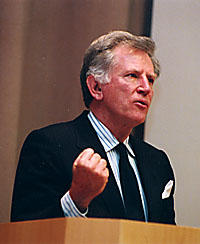

Gary Hart in today's Wash Post:
In 2008 I want a leader who is willing now to say: "I made a mistake, and for my mistake I am going to Iraq and accompanying the next planeload of flag-draped coffins back to Dover Air Force Base. And I am going to ask forgiveness for my mistake from every parent who will talk to me."
Further, this leader should say: "I am now going to give a series of speeches across the country documenting how the administration did not tell the American people the truth, why this war is making our country more vulnerable and less secure, how we can drive a wedge between Iraqi insurgents and outside jihadists and leave Iraq for the Iraqis to govern, how we can repair the damage done to our military, what we and our allies can do to dry up the jihadists' swamp, and what dramatic steps we must take to become energy-secure and prevent Gulf Wars III, IV and so on."
At stake is not just the leadership of the Democratic Party and the nation but our nation's honor, our nobility and our principles. Franklin D. Roosevelt established a national community based on social justice. Harry Truman created international networks that repaired the damage of World War II and defeated communism. John F. Kennedy recaptured the ideal of the republic and the sense of civic duty. To expect to enter this pantheon, the next Democratic leader must now undertake all three tasks.
But this cannot be done while the water is rising in the Big Muddy of the Middle East. No Democrat, especially one now silent, should expect election by default. The public trust must be earned, and speaking clearly, candidly and forcefully now about the mess in Iraq is the place to begin.
The real defeatists today are not those protesting the war. The real defeatists are those in power and their silent supporters in the opposition party who are reduced to repeating "Stay the course" even when the course, whatever it now is, is light years away from the one originally undertaken. The truth is we're way off course. We've stumbled into a hornet's nest. We've weakened ourselves at home and in the world. We are less secure today than before this war began.
Who now has the courage to say this?
Who has the courage to say this? Um, you do, Senator.
Tuesday, August 23, 2005
With Friends Like These
Over at the Whiskey Bar, Billmon takes apart one of Will Marshall's (the head of the DLC's "Progressive" Policy Institute) comments about the Iraq war, and emphasizes the bold type:
As they catalogue the administration's many mistakes, Democrats should also attend to the other side of the balance sheet. That side shows that our forces and their allies have toppled one of the world's most odious tyrants; upheld the principle of collective security; liberated a nation of 24 million; made possible Iraq's hopeful experiment in representative self-government; and changed the strategic equation in the Arab-Israeli conflict. (emphasis added)
But the part in bold type isn't what strikes me as the most offensive and ridiculous aspect of Marshall's statement. That would be the assertions about topplying the world's most odious "tyrant", upholding "collective security" and "liberating" a nation. The bit about "self-government" is either bafflingly ignorant, or deliberately manipulative, too, but we'll leave that for another day.
First of all, I suspect Marshall is in danger of being held liable for plagiarism since his remarks seem strikingly similar to those from any one of a number of Republican outlets, conservative think tank websites, or chicken-hawk blogs that have sounded like-minded themes over the past three years in an effort to combat any anti-war sentiment and oh, say, the facts about Iraq's supposed stash of WMD.
Second, it strains credibility to believe or accept the notion that the task of American foreign policy is to remove by military means foreign heads of governments, and the destruction of innocent civilian life that inevitably accompanies such military action, just because we believe those foreign heads to be, today, "odious tyrants" or "brutal dictators" (while in the past we might have cozied up to them despite their "odious" ways). In fact, American history sports a long, rich, and infamous record of support for brutal military dictatorships in Latin America, Africa, Asia and the Middle East, that have largely gone unnoticed by the American public, including our nation's support for Saddam Hussein in the 1980's when an alliance with him supported our material and ideological interests. We've overthrown or worked to overthrow democratically elected governments, even as recently as three years ago in Venezuela (whose democratically elected head Republican "reverend" Pat Robertson wants whacked, as if American foreign policy should be conducted like an episode of the Sopranos). So please, Will Marshall, spare us the sanctimonious babble about removing "tyrants". You might be able to peddle this to a kindergarten class (although that would be an insult to kindergarteners) or at the American Enterprise Institute, but don't try shoving it off on dedicated party supporters.
Third, everybody alltogether now, there was no principle of "collective security" involved in the U.S. invasion of Iraq. It wasn't "collective" because the U.S. invaded unilaterally, never mind the sprinkling of soldiers supplied by Britain, Spain and Australia (and Don't Forget Poland!!) whose small additions were undoubtedly provided in exchange for promises of future American aid the details of which I shudder to consider. And it wasn't "security" because Iraq wasn't a threat to us or anyone else. It possessed no WMD, had no alliance with Al Qaeda or connection to 9-11, and its military was in shambles stemming from the first Gulf War, thus presenting no threat to its neighbors. Rather, our invasion has only served to fuel the rising tide of Islamic hostility to our expanding military bases in their lands and thus undermined our own security (and theirs).
Fourth, again, everybody alltogether now, only in the minds of the PNAC-led foreign policy establishment and their DLC enablers does the situation in Iraq now and for the foreseeable future resemble anything along the likes of "liberation." The country is on the brink of civil war and would already be there in actuality were 150,000 U.S. troops not encamped there. What was a relatively secular society is now threatening to become either a splintered, failed state ready and waiting to serve as the new terrorist haven, or, and apparently with our blessing, a Shiite dominated, women repressing Islamic state aligned with Iran. Both scenarios would require and imply the need for a prolonged U.S. military presence in Iraq so as to guard against, in the worst case scenario, an invasion by Iran in support of its Shiite compatriots, or, just as necessary, to prevent wanton mass murder between the various religious and tribal groups that we've now allowed to be unleashed on one another on the account of our invasion and destabilizing of the country. Moreover, the presence of even the relatively low levels of American military forces needed for keeping order and deterring Iranian intercession would themselves require greater numbers of American military personnel so as to ensure that the low troop numbers needed aren't themselves in danger of being overrun, especially to the extent that those remaining would be required to conduct operations outside the concrete security walls of Baghdad's Green Zone.
Finally, at a time when public opinion has finally managed to see through the media and political elite smokescreen that is the camaflouge of the support for the Iraq invasion, Democrats are faced with the prospect of squaring off against not only existing Republican majorities in Congress (some of whose members are actually beginning to respond to the war's failure to a greater degree than most Democrats) and the weight of the executive bureaucracy and bully pulpit of the presidency, but also against Republican sympathesizers masquerading under the guise of the DLC and committing grand larceny with the Democratic label.
Ooops. There goes my stab at being "moderate" in this debate. Oh well. Try try again. I now return you to your regularly scheduled blog cast.
As they catalogue the administration's many mistakes, Democrats should also attend to the other side of the balance sheet. That side shows that our forces and their allies have toppled one of the world's most odious tyrants; upheld the principle of collective security; liberated a nation of 24 million; made possible Iraq's hopeful experiment in representative self-government; and changed the strategic equation in the Arab-Israeli conflict. (emphasis added)
But the part in bold type isn't what strikes me as the most offensive and ridiculous aspect of Marshall's statement. That would be the assertions about topplying the world's most odious "tyrant", upholding "collective security" and "liberating" a nation. The bit about "self-government" is either bafflingly ignorant, or deliberately manipulative, too, but we'll leave that for another day.
First of all, I suspect Marshall is in danger of being held liable for plagiarism since his remarks seem strikingly similar to those from any one of a number of Republican outlets, conservative think tank websites, or chicken-hawk blogs that have sounded like-minded themes over the past three years in an effort to combat any anti-war sentiment and oh, say, the facts about Iraq's supposed stash of WMD.
Second, it strains credibility to believe or accept the notion that the task of American foreign policy is to remove by military means foreign heads of governments, and the destruction of innocent civilian life that inevitably accompanies such military action, just because we believe those foreign heads to be, today, "odious tyrants" or "brutal dictators" (while in the past we might have cozied up to them despite their "odious" ways). In fact, American history sports a long, rich, and infamous record of support for brutal military dictatorships in Latin America, Africa, Asia and the Middle East, that have largely gone unnoticed by the American public, including our nation's support for Saddam Hussein in the 1980's when an alliance with him supported our material and ideological interests. We've overthrown or worked to overthrow democratically elected governments, even as recently as three years ago in Venezuela (whose democratically elected head Republican "reverend" Pat Robertson wants whacked, as if American foreign policy should be conducted like an episode of the Sopranos). So please, Will Marshall, spare us the sanctimonious babble about removing "tyrants". You might be able to peddle this to a kindergarten class (although that would be an insult to kindergarteners) or at the American Enterprise Institute, but don't try shoving it off on dedicated party supporters.
Third, everybody alltogether now, there was no principle of "collective security" involved in the U.S. invasion of Iraq. It wasn't "collective" because the U.S. invaded unilaterally, never mind the sprinkling of soldiers supplied by Britain, Spain and Australia (and Don't Forget Poland!!) whose small additions were undoubtedly provided in exchange for promises of future American aid the details of which I shudder to consider. And it wasn't "security" because Iraq wasn't a threat to us or anyone else. It possessed no WMD, had no alliance with Al Qaeda or connection to 9-11, and its military was in shambles stemming from the first Gulf War, thus presenting no threat to its neighbors. Rather, our invasion has only served to fuel the rising tide of Islamic hostility to our expanding military bases in their lands and thus undermined our own security (and theirs).
Fourth, again, everybody alltogether now, only in the minds of the PNAC-led foreign policy establishment and their DLC enablers does the situation in Iraq now and for the foreseeable future resemble anything along the likes of "liberation." The country is on the brink of civil war and would already be there in actuality were 150,000 U.S. troops not encamped there. What was a relatively secular society is now threatening to become either a splintered, failed state ready and waiting to serve as the new terrorist haven, or, and apparently with our blessing, a Shiite dominated, women repressing Islamic state aligned with Iran. Both scenarios would require and imply the need for a prolonged U.S. military presence in Iraq so as to guard against, in the worst case scenario, an invasion by Iran in support of its Shiite compatriots, or, just as necessary, to prevent wanton mass murder between the various religious and tribal groups that we've now allowed to be unleashed on one another on the account of our invasion and destabilizing of the country. Moreover, the presence of even the relatively low levels of American military forces needed for keeping order and deterring Iranian intercession would themselves require greater numbers of American military personnel so as to ensure that the low troop numbers needed aren't themselves in danger of being overrun, especially to the extent that those remaining would be required to conduct operations outside the concrete security walls of Baghdad's Green Zone.
Finally, at a time when public opinion has finally managed to see through the media and political elite smokescreen that is the camaflouge of the support for the Iraq invasion, Democrats are faced with the prospect of squaring off against not only existing Republican majorities in Congress (some of whose members are actually beginning to respond to the war's failure to a greater degree than most Democrats) and the weight of the executive bureaucracy and bully pulpit of the presidency, but also against Republican sympathesizers masquerading under the guise of the DLC and committing grand larceny with the Democratic label.
Ooops. There goes my stab at being "moderate" in this debate. Oh well. Try try again. I now return you to your regularly scheduled blog cast.
Sunday, August 21, 2005
What I'm Reading
The Stock Ticker and the SuperJumbo: How the Democrats Can Once Again Become America's Dominant Political Party by Rick Perlstein and Lincoln at Cooper Union: The Speech that Made Abraham Lincoln President by Harold Holzer.
The Perlstein book, which is actually a short and edited booklet, contains, in addition to Perlstein's own argument, those of William Galston, Ruy Teixeira, and Robert Reich, among others, as well.
I picked each of the books up separately, without any preconceived idea that they fit together. But since I enjoy reading history and am interested in the future of the Democratic Party, both suit my eclectical tastes. And as I have started the Lincoln book, it strikes me that the two works may actually have a lot in common.
The Lincoln book is concerned with an address the future president delivered in February of 1860 in New York City that is credited with being instrumental in giving Lincoln positive exposure in the east and in helping him gain the new Republican Party nomination for president later that year. In the speech, Lincoln set out a historical, factual, and legal argument against the extension of slavery in the territories.
The book highlights the fact that Lincoln was in essence campaigning as the "moderate" candidate--more conservative than New York Senator William Seward, whose "irrepressible conflict" speech had alienated many "mainstream" Free Labor proponents, and more progressive than his Illinois rival, Democratic Senator Stephen Douglas, who argued for the principle of "popular sovereignty", which on the basis of the 1854 Kansas-Nebraska Act, allowed territories to vote on whether to allow slavery or not. Although earlier in 1858 he pronounced that "a house divided against itself cannot stand", Lincoln moderated his appeal in NYC two years later, trying to assure the South that he did not intend, and did not believe that any of that region's "peculiar institutions" would need to be disturbed. At the same time, he set out a distinct course from Douglas, arguing strenously against the idea of popular sovereignty and at the same time, warning the South about any future intrangience.
That Lincoln's was the "moderate" voice in the debate that seemed to be if anything, one revolving moral absolutes, is something I believe Democrats might do well to remember.
Democrats would do well to also remember the basis for Lincoln's approach and argument that night in NYC: that the nation's history as well as the ideas and votes of the founding generation, backed up Lincoln's argument that the federal government had the authority over slavery in the territories, a point of contention that Douglas earlier had denied. It is true that I have criticized historical romanticism from this space. However, it is also true that in moving away from the conservatism and injustice of America's past Democrats have allowed Republicans to hijack history, casting themselves as the true legacy holders of the American tradition. Democrats would do well to begin the process of reversing this image by laying claim to the most progressive instincts and examples of our heritage to support the need for a more free, and more progressive and modern future.
It is no secret what Democrats have lacked in past elections and most need to make up for in future ones in a rhetorical and demographic sense: the support of religious and rural voters. Naturally, there are a variety of ways for Democrats to begin making inroads to these constituencies.
What the Lincoln experience also helps confirm is that Democrats should not be embarrased to recognize and assert that they need a midwestern or southern candidate at the top of the ticket. Part of Lincoln's appeal to the nascent Republican Party was exactly that--his geography, both literally as well as figuratively. Not only did he sectionally represent a growing "battleground" area, but he spoke its language as well.
Lincoln's appeal to history and faith provide additional models for Democrats to follow. While, again, the exact methods of doing this are varied, and as Robert Kennedy once said in managing his brother's campaign for the White House, campaigns are not well oiled and methodic processes, but rather, consist of a multitude of efforts, keeping those that work, discarding those that don't, and trying new ones. Democrats will fail, as they must, in trying to recapture the country's allegiance. But try they must.
As I continue with the Lincoln and Perlstein books, I hope to continue this discussion and perhaps arrive at some more satisfactory suggestions.
For the moment, I'll reiterate that Democrats do need to appeal to religious and rural voters, and that I believe they can do that without sacrificing the vital issues of civil liberties and political pluralism I believe progresssives value. On the religious question, Democrats can authentically claim the positive dimensions of our country's religious history while at the same time warning against the dangers of religious extremism.
As Lincoln remarked regarding slavery in NYC the evening of February 27, 1860: Our fathers, when they framed the government under which we live, understood the question just as well, and even better, than we do now.
As with religion as with the extension of slavery. "Our fathers" did understand this question as well if not better than we do today. That is why they acknowleged the right to its free expression while prohibiting the coercision of religious worship and the requiring of religious oaths of affiliations as a mark of government service or citizenship. Democrats can and need to reaffirm our history on this point, authenticating our tradition of religious freedom while protecting the rights of religious and non religious minorities.
The Perlstein book, which is actually a short and edited booklet, contains, in addition to Perlstein's own argument, those of William Galston, Ruy Teixeira, and Robert Reich, among others, as well.
I picked each of the books up separately, without any preconceived idea that they fit together. But since I enjoy reading history and am interested in the future of the Democratic Party, both suit my eclectical tastes. And as I have started the Lincoln book, it strikes me that the two works may actually have a lot in common.
The Lincoln book is concerned with an address the future president delivered in February of 1860 in New York City that is credited with being instrumental in giving Lincoln positive exposure in the east and in helping him gain the new Republican Party nomination for president later that year. In the speech, Lincoln set out a historical, factual, and legal argument against the extension of slavery in the territories.
The book highlights the fact that Lincoln was in essence campaigning as the "moderate" candidate--more conservative than New York Senator William Seward, whose "irrepressible conflict" speech had alienated many "mainstream" Free Labor proponents, and more progressive than his Illinois rival, Democratic Senator Stephen Douglas, who argued for the principle of "popular sovereignty", which on the basis of the 1854 Kansas-Nebraska Act, allowed territories to vote on whether to allow slavery or not. Although earlier in 1858 he pronounced that "a house divided against itself cannot stand", Lincoln moderated his appeal in NYC two years later, trying to assure the South that he did not intend, and did not believe that any of that region's "peculiar institutions" would need to be disturbed. At the same time, he set out a distinct course from Douglas, arguing strenously against the idea of popular sovereignty and at the same time, warning the South about any future intrangience.
That Lincoln's was the "moderate" voice in the debate that seemed to be if anything, one revolving moral absolutes, is something I believe Democrats might do well to remember.
Democrats would do well to also remember the basis for Lincoln's approach and argument that night in NYC: that the nation's history as well as the ideas and votes of the founding generation, backed up Lincoln's argument that the federal government had the authority over slavery in the territories, a point of contention that Douglas earlier had denied. It is true that I have criticized historical romanticism from this space. However, it is also true that in moving away from the conservatism and injustice of America's past Democrats have allowed Republicans to hijack history, casting themselves as the true legacy holders of the American tradition. Democrats would do well to begin the process of reversing this image by laying claim to the most progressive instincts and examples of our heritage to support the need for a more free, and more progressive and modern future.
It is no secret what Democrats have lacked in past elections and most need to make up for in future ones in a rhetorical and demographic sense: the support of religious and rural voters. Naturally, there are a variety of ways for Democrats to begin making inroads to these constituencies.
What the Lincoln experience also helps confirm is that Democrats should not be embarrased to recognize and assert that they need a midwestern or southern candidate at the top of the ticket. Part of Lincoln's appeal to the nascent Republican Party was exactly that--his geography, both literally as well as figuratively. Not only did he sectionally represent a growing "battleground" area, but he spoke its language as well.
Lincoln's appeal to history and faith provide additional models for Democrats to follow. While, again, the exact methods of doing this are varied, and as Robert Kennedy once said in managing his brother's campaign for the White House, campaigns are not well oiled and methodic processes, but rather, consist of a multitude of efforts, keeping those that work, discarding those that don't, and trying new ones. Democrats will fail, as they must, in trying to recapture the country's allegiance. But try they must.
As I continue with the Lincoln and Perlstein books, I hope to continue this discussion and perhaps arrive at some more satisfactory suggestions.
For the moment, I'll reiterate that Democrats do need to appeal to religious and rural voters, and that I believe they can do that without sacrificing the vital issues of civil liberties and political pluralism I believe progresssives value. On the religious question, Democrats can authentically claim the positive dimensions of our country's religious history while at the same time warning against the dangers of religious extremism.
As Lincoln remarked regarding slavery in NYC the evening of February 27, 1860: Our fathers, when they framed the government under which we live, understood the question just as well, and even better, than we do now.
As with religion as with the extension of slavery. "Our fathers" did understand this question as well if not better than we do today. That is why they acknowleged the right to its free expression while prohibiting the coercision of religious worship and the requiring of religious oaths of affiliations as a mark of government service or citizenship. Democrats can and need to reaffirm our history on this point, authenticating our tradition of religious freedom while protecting the rights of religious and non religious minorities.
Friday, August 19, 2005
Friedman: Blacklist "Excuse Makers"
The NYT op-ed from last month is behind the paper's new $ wall of sleep, but if the abstract, and this John Pilger article are an accurate reflection of its content, then the war at home could get as FUBAR as the war over there:
Friedman's latest bark is about free speech, which his country's Constitution is said to safeguard. He wants the State Department to draw up a blacklist of those who make "wrong" political statements. He is referring not only to those who advocate violence, but to those who believe American actions are the root cause of the current terrorism. The latter group, which he describes as "just one notch less despicable than the terrorists," includes most Americans and Britons, according to the latest polls.
Friedman wants a "War of Ideas report" that names those who try to understand and explain, for example, why London was bombed. These are "excuse makers" who "deserve to be exposed." He borrows the term "excuse makers" from James Rubin, who was Madeleine Albright's chief apologist at the State Department. Albright, who rose to secretary of state under President Clinton, said that the death of half a million Iraqi infants as a result of an American-driven blockade was a "price" that was "worth it." Of all the interviews I have filmed in official Washington, Rubin's defense of this mass killing is unforgettable.
Don't ask why. Don't object to anything. Don't question or criticize.
As the war over there continues to falter, war mongers will increasingly turn on the only remaining and apparently vulnerable enemy--the rest of us. Don't believe me? See right-wing smears of Cindy Sheehan as a "trailer" of things to come.
Friedman's latest bark is about free speech, which his country's Constitution is said to safeguard. He wants the State Department to draw up a blacklist of those who make "wrong" political statements. He is referring not only to those who advocate violence, but to those who believe American actions are the root cause of the current terrorism. The latter group, which he describes as "just one notch less despicable than the terrorists," includes most Americans and Britons, according to the latest polls.
Friedman wants a "War of Ideas report" that names those who try to understand and explain, for example, why London was bombed. These are "excuse makers" who "deserve to be exposed." He borrows the term "excuse makers" from James Rubin, who was Madeleine Albright's chief apologist at the State Department. Albright, who rose to secretary of state under President Clinton, said that the death of half a million Iraqi infants as a result of an American-driven blockade was a "price" that was "worth it." Of all the interviews I have filmed in official Washington, Rubin's defense of this mass killing is unforgettable.
Don't ask why. Don't object to anything. Don't question or criticize.
As the war over there continues to falter, war mongers will increasingly turn on the only remaining and apparently vulnerable enemy--the rest of us. Don't believe me? See right-wing smears of Cindy Sheehan as a "trailer" of things to come.
Bullying Venezuela
Not content with just mucking up the Middle East, Def Sec Rummy went south to try to cajole our Latin American neighbors into helping the administration "isolate" (read=destabilize) Venezuela and the Hugo Chavez government, because the Hugo government is allegedly acting to "destabilize" other Latin American governments, such as Bolivia. Well, that is, Chavez and his buddy, and U.S. thorn-in-the-side, Fidel Castro.
After acting in concert with military coup planners in 2002 to unseat the democratically elected Chavez, the administration worked to force a recall vote. The recall petition succeeded but Chavez ultimately won the vote anyway. So despite U.S. wishes, Chavez remains in office. And apparently doesn't like us much. Gee, I wonder why.
After acting in concert with military coup planners in 2002 to unseat the democratically elected Chavez, the administration worked to force a recall vote. The recall petition succeeded but Chavez ultimately won the vote anyway. So despite U.S. wishes, Chavez remains in office. And apparently doesn't like us much. Gee, I wonder why.
While You Were Out
Republicans in Congress continue their war against Constitutional liberties:
PROPONENTS OF the so-called Streamlined Procedures Act justify this radical piece of legislation by citing the supposedly intrusive scrutiny of federal courts of state capital convictions and the delays that ensue. So it is particularly instructive that chief justices of the nation's state court systems have voted overwhelmingly to urge Congress to slow down. The chief justices would be, after all, the apparent beneficiaries of the bill, which would gut federal review of the convictions they oversee. Yet in a strongly worded resolution by the Conference of Chief Justices -- with only the chief justice of death-happy Texas voting no -- the heads of state judicial systems said in essence, "Thanks, but no thanks." Cooler heads in Congress ought to listen.
The bill, pushed in the Senate by Jon Kyl (R-Ariz.) and in the House by Daniel E. Lungren (R-Calif.), would be an unmitigated disaster. Habeas corpus is the centuries-old device by which inmates challenge the legality of their detentions. In modern times it has become the essential vehicle by which convicts on death row or serving lengthy prison terms attack their state-court convictions. Many innocent people owe their freedom to their ability to file habeas petitions.
Yet in many death cases, the most drastic versions of the bill would eliminate federal review entirely. Even where they didn't do that, they would create onerous procedural roadblocks and prevent federal courts from considering key issues. They would bar federal courts from reviewing most capital sentencing and create arbitrary timetables for federal appeals courts to handle these cases. All of which, you might think, would be music to the ears of state court justices, for whom it is a big blank check.
Unless, of course, those chief justices are interested in, well, justice. The resolution, adopted jointly with the Conference of State Court Administrators, notes that "the changes contemplated in these measures may preclude state defendants in both capital and non-capital matters from seeking habeas corpus relief" with "unknown consequences for the state courts and for the administration of justice." It recommends "delaying further action" pending additional study to evaluate whether change in current law is even necessary. If it is, the justices urge Congress "to consider appropriate targeted measures that will ameliorate the documented problems and avoid depriving the federal courts of their traditional jurisdiction without more supporting evidence."
The Senate Judiciary Committee is poised to take up a somewhat less dire version of the bill when Congress returns. This rebuke ought to give senators pause about even that. At a minimum, any senator contemplating voting for it needs to ask why the Senate should be insulating state courts from review against their apparent will.
You know when the neocon Wash Post editors are aghast at a Republican-sponsored bill, we should be alarmed. Let's keep our eyes on this bill and inform our representatives, particularly in the Senate, that acting as obstructionists would be entirely acceptable as well as necessary.
PROPONENTS OF the so-called Streamlined Procedures Act justify this radical piece of legislation by citing the supposedly intrusive scrutiny of federal courts of state capital convictions and the delays that ensue. So it is particularly instructive that chief justices of the nation's state court systems have voted overwhelmingly to urge Congress to slow down. The chief justices would be, after all, the apparent beneficiaries of the bill, which would gut federal review of the convictions they oversee. Yet in a strongly worded resolution by the Conference of Chief Justices -- with only the chief justice of death-happy Texas voting no -- the heads of state judicial systems said in essence, "Thanks, but no thanks." Cooler heads in Congress ought to listen.
The bill, pushed in the Senate by Jon Kyl (R-Ariz.) and in the House by Daniel E. Lungren (R-Calif.), would be an unmitigated disaster. Habeas corpus is the centuries-old device by which inmates challenge the legality of their detentions. In modern times it has become the essential vehicle by which convicts on death row or serving lengthy prison terms attack their state-court convictions. Many innocent people owe their freedom to their ability to file habeas petitions.
Yet in many death cases, the most drastic versions of the bill would eliminate federal review entirely. Even where they didn't do that, they would create onerous procedural roadblocks and prevent federal courts from considering key issues. They would bar federal courts from reviewing most capital sentencing and create arbitrary timetables for federal appeals courts to handle these cases. All of which, you might think, would be music to the ears of state court justices, for whom it is a big blank check.
Unless, of course, those chief justices are interested in, well, justice. The resolution, adopted jointly with the Conference of State Court Administrators, notes that "the changes contemplated in these measures may preclude state defendants in both capital and non-capital matters from seeking habeas corpus relief" with "unknown consequences for the state courts and for the administration of justice." It recommends "delaying further action" pending additional study to evaluate whether change in current law is even necessary. If it is, the justices urge Congress "to consider appropriate targeted measures that will ameliorate the documented problems and avoid depriving the federal courts of their traditional jurisdiction without more supporting evidence."
The Senate Judiciary Committee is poised to take up a somewhat less dire version of the bill when Congress returns. This rebuke ought to give senators pause about even that. At a minimum, any senator contemplating voting for it needs to ask why the Senate should be insulating state courts from review against their apparent will.
You know when the neocon Wash Post editors are aghast at a Republican-sponsored bill, we should be alarmed. Let's keep our eyes on this bill and inform our representatives, particularly in the Senate, that acting as obstructionists would be entirely acceptable as well as necessary.
Thursday, August 18, 2005
We Are Not Worthy Of Their War
Naturally the thing that gets me about Cindy Sheehan is the right-wing's reaction to her. It didn't take long for the usual suspects to drop whatever it was they weren't doing and go all apeshit on her. Limbaugh, Drudge, Oh, Really? Malkin, and now this guy.
I'm not sure what it is that bothers them so. Maybe it's as this one freerepublic.commer suggested at last night's anti-war candle-light vigil counter-protest :
The're [anti-war protests] getting a little out of hand.
Even though representatives from the right/wrong's hate radio militia went to the Green Zone for a spell and quickly came back trumpeting the "progress" being made in Iraq, the true believers are beginning to realize that things stink to high heaven. But the thing is, for them, because the effort is Bush-led, the cause is still just, even if the results stink. And if we, and mild mannered women holding candles don't get that, it's because we are just not worthy of their war.
I'm not sure what it is that bothers them so. Maybe it's as this one freerepublic.commer suggested at last night's anti-war candle-light vigil counter-protest :
The're [anti-war protests] getting a little out of hand.
Even though representatives from the right/wrong's hate radio militia went to the Green Zone for a spell and quickly came back trumpeting the "progress" being made in Iraq, the true believers are beginning to realize that things stink to high heaven. But the thing is, for them, because the effort is Bush-led, the cause is still just, even if the results stink. And if we, and mild mannered women holding candles don't get that, it's because we are just not worthy of their war.
Subscribe to:
Posts (Atom)