The gazillion-selling Da Vinci Code has been converted into a blockbuster movie and the right-wing culture warriors are not happy:
"Da Vinci Thoughts [Stanley Kurtz]
"I just saw The Da Vinci Code. Point one: Michael Novak's review is dead on. [At NRO, Novak found the movie such a maelstrom of hate and decadence that he could barely finish his Junior Mints.]
"Point two: This movie is a salutary kick in the teeth for conservatives. There's no gainsaying the fact that the Narnia movie was a big deal. Having conceded that, the fact remains that when it comes to exercising influence on the fundamental levers of American culture, conservatives remain in a pathetically weakened position.
"I may not be a professor of 'symbology,' but I have taught at Harvard and studied religious symbolism. So I feel in a particularly strong position to reveal the entirely unsecret conspiracy against patriotism, tradition, and religion hiding in plain sight on our movie and television screens, in our universities, and on the pages of the mainstream press. Conservatives have forgotten just how precarious our position is. One cable news channel, talk radio, and the blogosphere do not an invincible army make. It only seems that way because we also have nominal control of the reigns of power. But lose our foothold in government, and conservatives are up a creek. The other side controls the levers of cultural power in this country, and we are the enemy in their eyes (and on their screens).
"Conservatives need to face the fact that our position in this culture is genuinely precarious. If we lose our hold on power, we'll scream bloody murder on our outlets at everything the other side does. Yet those screams may only confirm our helplessness. The deep cultural dimension of our political battles makes an ordinary transfer of political power far more consequential than it was in the days when America had a bipartisan foreign policy and a broad cultural consensus. We can dream about forcing Republicans to the right and then riding back into power two years later, but one big loss could easily turn conservatives back into a marginal cultural force for some time.
"Why have Democrats been so angry? It's because their taken-for-granted cultural superiority has been called into question by 9/11, the return of patriotism, a tough foreign policy, and the open defense of the sort of traditional values they thought were on the way out. Republican victories have punctured the cultural left's sense of the historical inevitability of their triumph, and that is at the root of their rage. By controlling the political agenda, conservatives control the cultural agenda as well (or at least a large part of it). But the truth is, other than the government, the left is still in control of our critical cultural institutions. Should the left recapture the government as well, it may well succeed in pushing traditionalists aside in the culture at large.
"The battle is radicalizing. Big Love and The Da Vinci Code are far more direct and brazen attacks on tradition than we might have anticipated just a few years ago. Conservatives are the targets, and Hollywood is aiming and shooting repeatedly. Give credit to Tom Hanks, by the way. As producer of Big Love and star of The Da Vinci Code, he is clearly one of the captains of the not-so-secret conspiracy.
This is some piece of whining. Of course I don't read NRO a lot so maybe this is typical. But this is Conservative-as-Victim mania such as I've rarely seen, at least since the election of Shrub.
And what's the conservative complaint about Big Love? Polygamy (like slavery) has plenty of Biblical precedence and justification. Most of the Old Testament patriarchs and kings had more than one wife at the same time. For that matter, the taboo against polygamy seems to be of a rather modernist, liberal, secular humanist origin.
I would think conservatives might be more offended by that other HBO series, The Sopranos. I've never watched it, but as I understand it, the show is noted for its, um, character "clipping". That is to say, it's violent. And it's a violence practiced outside the bounds of law, which should be especially offensive to today's conservatives so bent on restoring the rule of law where it applies to immigrants. But if there's a monumental conservative Christian opposition to or boycott of The Sopranos I am unaware of it.
Anyway, the boys and girls at NRO, and presumably elsewhere around the conservative media empire are (gasp!) offended and outraged that people are allowed to write (and read) books and make (and go to) movies that offend and outrage Christian conservatives. This despite the fact that conservatives have been making a big show over the last few decades about the outrages of "political correctness" that prevent them from saying mean things about black people and other minorities and those groups conservatives consider socially inferior or threatening.
Meanwhile, the conservative bubble that was the post-911 period is collapsing into a smoking pile of financial and political fund-raising scandals, an unpopular and unfullfilling war in Iraq (and the re-emergence of conflict in Afghanistan), and a rising tide of political ineptitude generally. In the face of these challenges to their dream of permanent political and cultural hegemony, some conservatives are reallocating their resources and vitriol to other potential and pseudo wars against immigrants, Iran, and other, non-conforming Americans. The war against the latter is waged officially against noted liberal demons like college professors and Hollywood celebrities (of which The Da Vinci Code is a representative), but in actuality is aimed at regular Americans who by purchasing the goods and services of a free, market-driven culture are offending the conservative movement's sensibilities. Still other conservatives are turning on their political leadership, threatening to embroil the forces of reactionism in a civil war.
Most frustrating to the spokespersons of cultural conservatism is the realization that political control over elected institutions does not necessitate cultural control over the individual and over the masses, at least not in a democrat, pluralistic and capitalist system. This latter element seems particularly important in that while conservatives loudly trumpet the virtues of capitalism, market mechanisms are essentially amoral processes that produce large financial rewards for Mel Gibson and Tom Hanks alike.
Moreover, conservative angst is amplified by the recognition that the last 6, 12 and 25 years of conservative political leadership has not fundamentally altered the direction of society or yielded the revolutionized world their fantasies have imagined and inflamed. As James Wolcott writes, society tends to move along by fits and starts, regressing a little here, advancing a little there. This is problematic for conservative and liberal utopianists alike, but especially for conservatives whose perspective of the 20th century is probably not a record they are proud of or can revel in when one considers the importance of Civil Rights, for example, and the development of federal government programs like Social Security, Medicare, and college aid. The end of the Cold War and the relative collapse of world Communism, while on the surface clear conservative triumphs, in practice have probably done more to erode conservative ambitions than enhance them. The end of Communism as a global threat has meant less fear generally and more freedom, politically and economically in particular. Neither of these outcomes are conducive to a vibrant conservative value system and hierarchical form of social control.
On the other hand, as Kevin Phillips and Michelle Goldberg have documented, trends in the religious world would seem to be more advantageous for conservative thinkers hopeful for erecting a more authoritarian and conformist state in this country. But despite the size, intensity, and peculiarity of American religious conservatism, it remains unclear, at least to me, what the origin or origins of this new wave of Christian fundamentalism is, and what ultimate impact it will have in a large, fragmented, individualistic and consumerist society like America. While the organizations, programs and rhetoric of Christian Reconstructionalist leaders are indeed frightening in many respects, I suspect that much like the soldiers of the 101st Fighting Keyboarders, the rank and file of Christian followership is much less committed to a project of political and cultural purification that might cost them their SUV's, comfortable homes, and peaceful retirements than their eliminationist rhetoric would suggest.
Friday, May 26, 2006


John Murtha: Right Again
TBogg steals my thunder, but he neglected this quote from today's NYT piece:
Representative John Kline, a Minnesota Republican who is a retired Marine colonel, said that the allegations indicated that "this was not an accident. This was direct fire by marines at civilians." He added, "This was not an immediate response to an attack. This would be an atrocity."
Hmmmm. Maybe the 101st Fighting Keyboarders should consider Rep. Kline for some kind of award:
James Taranto makes a great point about the comments of Rep. John KLINE regarding the investigation into whether U.S. troops committed war crimes in a November incident where 15 Iraqi civilians were killed in Haditha, Iraq. KLINE claims that an internal investigation will show "there was no firefight, there was no IED (improvised explosive device) that killed these innocent people. Our troops overreacted because of the pressure on them, and they killed innocent civilians in cold blood."
As Tananto notes, however, KLINE's description is self-contradictory because if the Marines "overreacted," then the killings were not premeditated. And if the killings were not premeditated, they were not in cold blood.
Moreover, if the killings were not in cold blood, then KLINE is slandering our troops by saying that they were. If the killings were in cold blood, then KLINE, in characterizing them as an overreaction to the pressure of the mission, is making an excuse for horrific crimes.
Representative John Kline, a Minnesota Republican who is a retired Marine colonel, said that the allegations indicated that "this was not an accident. This was direct fire by marines at civilians." He added, "This was not an immediate response to an attack. This would be an atrocity."
Hmmmm. Maybe the 101st Fighting Keyboarders should consider Rep. Kline for some kind of award:
James Taranto makes a great point about the comments of Rep. John KLINE regarding the investigation into whether U.S. troops committed war crimes in a November incident where 15 Iraqi civilians were killed in Haditha, Iraq. KLINE claims that an internal investigation will show "there was no firefight, there was no IED (improvised explosive device) that killed these innocent people. Our troops overreacted because of the pressure on them, and they killed innocent civilians in cold blood."
As Tananto notes, however, KLINE's description is self-contradictory because if the Marines "overreacted," then the killings were not premeditated. And if the killings were not premeditated, they were not in cold blood.
Moreover, if the killings were not in cold blood, then KLINE is slandering our troops by saying that they were. If the killings were in cold blood, then KLINE, in characterizing them as an overreaction to the pressure of the mission, is making an excuse for horrific crimes.
Thursday, May 25, 2006
Bill's Getting Cranky
Millions of Americans get their news from Jon Stewart and their opinions from far-left entertainers...bomb-throwers...
Really, Bill? Gee, I thought we all got our news and opinions from you and your comrades at Fox "News", which is, after all, the highest rated cable television "news" station.
...many Americans 18-24 have no idea what's going on...
Yeah, but they know no WMD turned up in Iraq, unlike, you know, your devout viewers.
Really, Bill? Gee, I thought we all got our news and opinions from you and your comrades at Fox "News", which is, after all, the highest rated cable television "news" station.
...many Americans 18-24 have no idea what's going on...
Yeah, but they know no WMD turned up in Iraq, unlike, you know, your devout viewers.
It's Official: Jacob Weisberg is on Crack
What the $%&# is up with this column?
You could see the other Clinton making the same sort of calculations this week, when the New York Post put to Hillary the key culturally identifying question of our era: What's on your iPod? Musical taste is eternally revealing, and thanks to the growing ubiquity of MP3 players, many people now wear this signifying data on their belts. The senator from New York responded that she has the Beatles and the Rolling Stones on the white iPod that her husband gave her for a birthday present, along with Motown and classical music. She then rattled off a list of songs: the Beatles "Hey Jude," Aretha Franklin's, "Respect," the Eagles "Take It to the Limit," and U2's "Beautiful Day."
Hillary Clinton is the least spontaneous of politicians, and this playlist suggests premeditation, if not actual poll-testing. She first indicates that she basically likes everything before coming to roost on classic rock and soul, which any baby boomer must identify with, lest she or he be branded terminally uncool. Hillary avoids, however, anything too racy, druggie, or aggressive, while naming tunes that are empowering and inspirational. On the world-is-divided-into-two-kinds-of-people question "the Beatles or the Stones," she, like her husband, finds a middle path: both. She names no Stones songs and chooses a consensus, universally liked, neither-early-nor-late Beatles tune, "Hey Jude." Hillary also manages a shout-out to racial diversity and feminism via Aretha Franklin, and she strikes a younger, socially conscious chord with U2. "Take It to the Limit," on the other hand, is such a lame, black-hole-of-the-1970s choice that it can't be taken for anything other than an expression of actual taste.
So, Hillary's iPod list "suggests premeditation". Quick, somebody call the NSA or the FBI! Premeditation? What a partisan dope. No wonder Kevin Phillips felt obligated to give Lord Weisberg a smack-down for his pithy review of American Theocracy.
Voters wondering if they like the same music as Hillary but wanting a bit more to go on have at their disposal a wonderful tool called Pandora. This Web site uses music you like to predict other music you might also like, then plays the selections it generates on an individually tailored "radio" station. Unlike Amazon.com, which uses a collaborative filtering model for its recommendations (people who bought Abbey Road also bought Let It Be), Pandora filters on the basis of "genomic" musical analysis. If the songs you like are sung by women in a major key with acoustic guitars, it finds more songs like that.
Hillary, it seems, likes "basic rock song structures," "repetitive melodic phrasing," and "extensive vamping." Pandora predicts she would enjoy various '60s girl groups and '70s soul singers: Gladys Knight and the Pips, Carla Thomas, and the Velvelettes. The service can be a bit uncanny. One of its first recommendations on the Hillary station I created was "Girls Can't Do What the Guys Do," by Betty Wright, a feminist-minded '70s soul artist. This was followed by Barbra Streisand's rendition of David Bowie's "Life on Mars," a deeply unfortunate recording, but one somehow indicative of the present predicament of the Democratic Party.
Wait a minute...let's stop right there. Read that statement again. "One of its first recommendations on the Hillary station I created..." What the $%#@?!?!? Lord Weisberg created a "Hillary" station, so he could write this stench of a "column"?!?! Let's all offer a word of thanksgiving for the "liberal" media that has been bestowed on us. As the Rude One might say, the world is on $%#& fire, and Lord Weisberg is creating Hillary play lists?!?!?!!!!!
In point of fact, I doubt that the relentlessly driven Hillary Clinton spends much time listening to music of any kind. Condoleezza Rice, by contrast, who recently revealed her musical Top 10 to Bono when he guest-edited The Independent newspaper in Britain for a day, clearly loves many kinds of music. For Condi, who was trained as a classical pianist, the playlist is an opportunity to show that she is not as uptight as she sometimes seems. In addition to Brahms, Mozart, and Mussorgsky, she reveals that she likes to work out to Cream's "Sunshine of Your Love" and loves "anything by U2." Aretha Franklin's "Respect" gets another vote, along with Kool and the Gang's "Celebration," and Elton John's "Rocket Man," which the secretary of state says reminds her of her first boyfriend. Hmmm. Pandora doesn't do classical, but based on her pop choices, Secretary Rice responds to "disco influences," "a busy horn section," and "groove-based composition." Radio Condi is a lot more fun than Radio Hillary.
So Hillary is too "relentlessly driven" to listen to much music, but Condi, on the other hand, although a busy gal, is a real authentic-type person, Lord Weisberg discerns from his analysis of her musical tastes. Jeebus Christmas!!?!
Last year, the president also revealed part of the playlist of his iPod, which he listens to while mountain biking. It includes "My Sharona" by the Knack, "Centerfield" by John Fogerty, "Brown-Eyed Girl" by Van Morrison, and music by the honky-tonk singer George Jones. Unlike Hillary and Condi, this all sounds pretty uncalculated. Bush doesn't worry about being politically correct or care what other people think of him. He likes to listen to white guys singing country and rock and doesn't care if Jerry Falwell objects to some of the lyrics. According to Pandora, Bush likes "mixed acoustic and electric instrumentation," "meandering melodic phrasing," "major key tonality" and "a smooth male lead vocalist." It is recommended that he try Van Halen and Jimi Hendrix as well as Billy Ray Cyrus and Conway Twitty. You could wait a long time for Morrissey or Neil Young to surface on his radio station, and Pandora was wise enough not to suggest the Dixie Chicks.
Hillary is calculating, the President is not calculating. The President isn't "politically correct". And we know this because...??? What a moron.
Thanks to Atrios and Eric Boehlert for the links.
You could see the other Clinton making the same sort of calculations this week, when the New York Post put to Hillary the key culturally identifying question of our era: What's on your iPod? Musical taste is eternally revealing, and thanks to the growing ubiquity of MP3 players, many people now wear this signifying data on their belts. The senator from New York responded that she has the Beatles and the Rolling Stones on the white iPod that her husband gave her for a birthday present, along with Motown and classical music. She then rattled off a list of songs: the Beatles "Hey Jude," Aretha Franklin's, "Respect," the Eagles "Take It to the Limit," and U2's "Beautiful Day."
Hillary Clinton is the least spontaneous of politicians, and this playlist suggests premeditation, if not actual poll-testing. She first indicates that she basically likes everything before coming to roost on classic rock and soul, which any baby boomer must identify with, lest she or he be branded terminally uncool. Hillary avoids, however, anything too racy, druggie, or aggressive, while naming tunes that are empowering and inspirational. On the world-is-divided-into-two-kinds-of-people question "the Beatles or the Stones," she, like her husband, finds a middle path: both. She names no Stones songs and chooses a consensus, universally liked, neither-early-nor-late Beatles tune, "Hey Jude." Hillary also manages a shout-out to racial diversity and feminism via Aretha Franklin, and she strikes a younger, socially conscious chord with U2. "Take It to the Limit," on the other hand, is such a lame, black-hole-of-the-1970s choice that it can't be taken for anything other than an expression of actual taste.
So, Hillary's iPod list "suggests premeditation". Quick, somebody call the NSA or the FBI! Premeditation? What a partisan dope. No wonder Kevin Phillips felt obligated to give Lord Weisberg a smack-down for his pithy review of American Theocracy.
Voters wondering if they like the same music as Hillary but wanting a bit more to go on have at their disposal a wonderful tool called Pandora. This Web site uses music you like to predict other music you might also like, then plays the selections it generates on an individually tailored "radio" station. Unlike Amazon.com, which uses a collaborative filtering model for its recommendations (people who bought Abbey Road also bought Let It Be), Pandora filters on the basis of "genomic" musical analysis. If the songs you like are sung by women in a major key with acoustic guitars, it finds more songs like that.
Hillary, it seems, likes "basic rock song structures," "repetitive melodic phrasing," and "extensive vamping." Pandora predicts she would enjoy various '60s girl groups and '70s soul singers: Gladys Knight and the Pips, Carla Thomas, and the Velvelettes. The service can be a bit uncanny. One of its first recommendations on the Hillary station I created was "Girls Can't Do What the Guys Do," by Betty Wright, a feminist-minded '70s soul artist. This was followed by Barbra Streisand's rendition of David Bowie's "Life on Mars," a deeply unfortunate recording, but one somehow indicative of the present predicament of the Democratic Party.
Wait a minute...let's stop right there. Read that statement again. "One of its first recommendations on the Hillary station I created..." What the $%#@?!?!? Lord Weisberg created a "Hillary" station, so he could write this stench of a "column"?!?! Let's all offer a word of thanksgiving for the "liberal" media that has been bestowed on us. As the Rude One might say, the world is on $%#& fire, and Lord Weisberg is creating Hillary play lists?!?!?!!!!!
In point of fact, I doubt that the relentlessly driven Hillary Clinton spends much time listening to music of any kind. Condoleezza Rice, by contrast, who recently revealed her musical Top 10 to Bono when he guest-edited The Independent newspaper in Britain for a day, clearly loves many kinds of music. For Condi, who was trained as a classical pianist, the playlist is an opportunity to show that she is not as uptight as she sometimes seems. In addition to Brahms, Mozart, and Mussorgsky, she reveals that she likes to work out to Cream's "Sunshine of Your Love" and loves "anything by U2." Aretha Franklin's "Respect" gets another vote, along with Kool and the Gang's "Celebration," and Elton John's "Rocket Man," which the secretary of state says reminds her of her first boyfriend. Hmmm. Pandora doesn't do classical, but based on her pop choices, Secretary Rice responds to "disco influences," "a busy horn section," and "groove-based composition." Radio Condi is a lot more fun than Radio Hillary.
So Hillary is too "relentlessly driven" to listen to much music, but Condi, on the other hand, although a busy gal, is a real authentic-type person, Lord Weisberg discerns from his analysis of her musical tastes. Jeebus Christmas!!?!
Last year, the president also revealed part of the playlist of his iPod, which he listens to while mountain biking. It includes "My Sharona" by the Knack, "Centerfield" by John Fogerty, "Brown-Eyed Girl" by Van Morrison, and music by the honky-tonk singer George Jones. Unlike Hillary and Condi, this all sounds pretty uncalculated. Bush doesn't worry about being politically correct or care what other people think of him. He likes to listen to white guys singing country and rock and doesn't care if Jerry Falwell objects to some of the lyrics. According to Pandora, Bush likes "mixed acoustic and electric instrumentation," "meandering melodic phrasing," "major key tonality" and "a smooth male lead vocalist." It is recommended that he try Van Halen and Jimi Hendrix as well as Billy Ray Cyrus and Conway Twitty. You could wait a long time for Morrissey or Neil Young to surface on his radio station, and Pandora was wise enough not to suggest the Dixie Chicks.
Hillary is calculating, the President is not calculating. The President isn't "politically correct". And we know this because...??? What a moron.
Thanks to Atrios and Eric Boehlert for the links.
Wednesday, May 24, 2006
The Contenders
Al Gore is getting a lot of attention these days, much of it positive, concerning his post-2000 after-life and his 2008 presidential prospects. I suspect there are three main reasons for this. First is the release of his new global warming movie, An Incovenient Truth, which has played to warm (no pun intended) reviews. Second is the state of the 2008 Democratic field, with HRC enjoying a wide financial and name-recognition lead over most of her rivals, leading some members of the party unmotivated by her calculating centrism and polarization potential to hope someone else of similar or greater stature gets in the race. Third is the low poll numbers of George W. Bush, the situation in Iraq, and a general wistfullness for the peace and prosperity years of the 1990's and the administration of Clinton/Gore.
Where there is reservation about Gore, it seems to be related more to his potential as a candidate than as a president. Although he has been more passionate and likeable of late, disgruntlement over his poorly run 2000 campaign, lingering apprehensions as to his political smarts and charisma, and questions as to how he would help bridge the specific regional or demographical gaps the party believes it faces have all contributed to a certain degree of angst about a potential Gore run in '08. But even among these concerns is an implicit or explicit assumption that Gore would make a fine president, should he actually win.
My own view runs in the opposite direction. I think Gore would be a strong candidate, at least relative to the Democratic field. I'm not particularly bothered by the memories of '00 as I assume he's learned a few things over the past several years and would be a much different, more aggressive and principled candidate. I'm also not worried about what state, region, or specific demographic the punditry thinks Gore--and by extension the Democratic Party--needs to capture the next time around (more about this in an upcoming post). Moreover, Gore's recent speaches, while delivered before small, friendly audiences, have shown a progressive purpose, ideological clarity and political timeliness and relevancy none of his rivals have demonstrated so far.
But Gore as president is something different. How would a combative Candidate Gore shift to being President Gore? How would President Gore deal with a vocal, organized and unified conservative opposition and daily diatribes from the Republican Noise Machine over a prolonged stretch of time? Does he have what it takes to "go public", reaching over the heads of an antagonistic Congress and hostile media to persuade the public to support his programs? Or could he skillfully coopt his opposition's policy goals and rallying cries through a Clintoneque "strategery" of triangulation? In short, does he have the presidential character and political smarts needed to be up to the job over the long haul, in an unpredicatable, combative political environment?
For some reason, I am dubious about Gore's potential in these areas. And while the rest of the field has its own problems, I think there are several potential candidates who have a lot more upside as actual presidents. Who?
You'll have to come back later for that.
Where there is reservation about Gore, it seems to be related more to his potential as a candidate than as a president. Although he has been more passionate and likeable of late, disgruntlement over his poorly run 2000 campaign, lingering apprehensions as to his political smarts and charisma, and questions as to how he would help bridge the specific regional or demographical gaps the party believes it faces have all contributed to a certain degree of angst about a potential Gore run in '08. But even among these concerns is an implicit or explicit assumption that Gore would make a fine president, should he actually win.
My own view runs in the opposite direction. I think Gore would be a strong candidate, at least relative to the Democratic field. I'm not particularly bothered by the memories of '00 as I assume he's learned a few things over the past several years and would be a much different, more aggressive and principled candidate. I'm also not worried about what state, region, or specific demographic the punditry thinks Gore--and by extension the Democratic Party--needs to capture the next time around (more about this in an upcoming post). Moreover, Gore's recent speaches, while delivered before small, friendly audiences, have shown a progressive purpose, ideological clarity and political timeliness and relevancy none of his rivals have demonstrated so far.
But Gore as president is something different. How would a combative Candidate Gore shift to being President Gore? How would President Gore deal with a vocal, organized and unified conservative opposition and daily diatribes from the Republican Noise Machine over a prolonged stretch of time? Does he have what it takes to "go public", reaching over the heads of an antagonistic Congress and hostile media to persuade the public to support his programs? Or could he skillfully coopt his opposition's policy goals and rallying cries through a Clintoneque "strategery" of triangulation? In short, does he have the presidential character and political smarts needed to be up to the job over the long haul, in an unpredicatable, combative political environment?
For some reason, I am dubious about Gore's potential in these areas. And while the rest of the field has its own problems, I think there are several potential candidates who have a lot more upside as actual presidents. Who?
You'll have to come back later for that.
Thursday, May 18, 2006
Tuesday, May 16, 2006
What Would it Mean to "Win" the "War on Terror"?
This is exactly right.
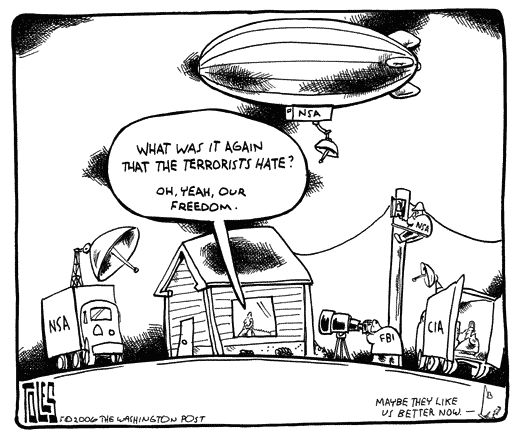
I've had my share of heated debates with conservatives who claim we are winning the war on terror because we haven't been attacked since 9/11. But only those with a myopic view of the conflict can make such a claim. Limiting the definition of success solely to the physical safety of Americans fails to take into account that the goal of al Qaeda is not merely to cause death, but to cause a destruction of the very thing that defines us as Americans: our freedom.
As the President said the day the towers fell, "our way of life, our very freedom" was attacked. And how have we responded in the past five years? Not by preserving our way of life, not by zealously gaurding our freedom, but by surrendering.
Read the whole thing.
In a previous post I said I wasn't afraid of terrorism. I was in Washington, D.C. on the morning of 9-11 and since I work for the federal government, which presumably remains a terrorist target generally, and since I commute to work in D.C. via the metro rail system--as likely a terrorist target as any in the area, I think I have as much right as anyone to speak for those of us most likely to be affected by future terrorist actions. And I ain't afraid. And I ain't moved by conservative bullying to surrender my first and fourth amendment rights to pacify their own fears or satisfy their authoritarian ambitions.
John Kerry was criticized by fear-mongering right-wingers for saying during one of the debates that he hoped or looked forward to the day when the threat of terrorism would be merely an inconvenience. But Kerry was right to say that, however it may have offended the 101st Fighting Keyboarders.
Democrats basically let Republicans use fear as a baseball bat during the last two election cycles. At the same time, there have been some leading or at least high profile Democrats (Peter Beinert, the DLC) who have stressed the need for Democrats to convince the public they are "serious about national security" and will protect them, and thereby played into Republican hands. That tactic has been a political as well as substantive failure and abdication of the party's responsibility to uphold and protect the Constitution. Here's hoping Democrats have learned something and have the courage to push back on the conservative fear meme.
I've had my share of heated debates with conservatives who claim we are winning the war on terror because we haven't been attacked since 9/11. But only those with a myopic view of the conflict can make such a claim. Limiting the definition of success solely to the physical safety of Americans fails to take into account that the goal of al Qaeda is not merely to cause death, but to cause a destruction of the very thing that defines us as Americans: our freedom.
As the President said the day the towers fell, "our way of life, our very freedom" was attacked. And how have we responded in the past five years? Not by preserving our way of life, not by zealously gaurding our freedom, but by surrendering.
Read the whole thing.
In a previous post I said I wasn't afraid of terrorism. I was in Washington, D.C. on the morning of 9-11 and since I work for the federal government, which presumably remains a terrorist target generally, and since I commute to work in D.C. via the metro rail system--as likely a terrorist target as any in the area, I think I have as much right as anyone to speak for those of us most likely to be affected by future terrorist actions. And I ain't afraid. And I ain't moved by conservative bullying to surrender my first and fourth amendment rights to pacify their own fears or satisfy their authoritarian ambitions.
John Kerry was criticized by fear-mongering right-wingers for saying during one of the debates that he hoped or looked forward to the day when the threat of terrorism would be merely an inconvenience. But Kerry was right to say that, however it may have offended the 101st Fighting Keyboarders.
Democrats basically let Republicans use fear as a baseball bat during the last two election cycles. At the same time, there have been some leading or at least high profile Democrats (Peter Beinert, the DLC) who have stressed the need for Democrats to convince the public they are "serious about national security" and will protect them, and thereby played into Republican hands. That tactic has been a political as well as substantive failure and abdication of the party's responsibility to uphold and protect the Constitution. Here's hoping Democrats have learned something and have the courage to push back on the conservative fear meme.
What about the Canadian Border?
Although I can't say I'm terribly concerned about the threat of terrorism generally or the threat of would-be terrorists crossing the Mexican border in particular, I have to admit that the need to tighten our borders to guard against the potential from terrorist infiltration at least has some logical merit.
Which is why I'm a little surprised that that angle hasn't been a real common one in the array of anti-immigration complaints I've been hearing, watching, or reading about.
Most of the anti-immigrant apologetics seem either spurriously convenient (illegal immigrants drive down wages) or blatantly racist (illegal immigration from Mexico is why phone services have "if you speak English, press 1" options).
Moreover, if stopping terrorist infiltration was the over-riding concern, as I would think it would be in a post-911 world, where is the call for walling off our Canadian border? Surely terrorist infiltration, if it is to come, is just as likely, if not more so, to come over the Canadian border as over the Mexican one.
No, despite all the frantic demands on the part of the right that we abandon any and all civil liberties to ensure we aren't attacked by terrorists again, the terrorist threat potentially posed by immigration seems almost off the radar. This leads me to think that neither the rabidly anti-civil liberties right nor the rabidly anti-immigration right are sincere (imagine that). Of course, even were terrorism the main fear element of the anti-immigration movement, it wouldn't mean it wasn't based in part or in whole on racist fears and demogoguery.
But the relative absence of terrorism from the anti-immigration debate is suprising nonetheless.
Which is why I'm a little surprised that that angle hasn't been a real common one in the array of anti-immigration complaints I've been hearing, watching, or reading about.
Most of the anti-immigrant apologetics seem either spurriously convenient (illegal immigrants drive down wages) or blatantly racist (illegal immigration from Mexico is why phone services have "if you speak English, press 1" options).
Moreover, if stopping terrorist infiltration was the over-riding concern, as I would think it would be in a post-911 world, where is the call for walling off our Canadian border? Surely terrorist infiltration, if it is to come, is just as likely, if not more so, to come over the Canadian border as over the Mexican one.
No, despite all the frantic demands on the part of the right that we abandon any and all civil liberties to ensure we aren't attacked by terrorists again, the terrorist threat potentially posed by immigration seems almost off the radar. This leads me to think that neither the rabidly anti-civil liberties right nor the rabidly anti-immigration right are sincere (imagine that). Of course, even were terrorism the main fear element of the anti-immigration movement, it wouldn't mean it wasn't based in part or in whole on racist fears and demogoguery.
But the relative absence of terrorism from the anti-immigration debate is suprising nonetheless.
Immigration--A Tipping Point?
I don't know if we've reached, or are reaching a Tipping Point where the Republican majority begins to disintegrate, but I think there are a number of reasons to wonder where the conservative movement goes from here, especially if the conservative chatter after last night's prez address is at all reflective of the movement's strains.
As Glenn Greenwald suggests, the Republican Party breakdown on immigration, at this particular time, probably owes a lot to the fact that the war in Iraq has failed to live up to its billing; it's producing neither clear-cut military or moral victories.
But as Barbara at Mahablog discusses, there's certainly more going on, above as well as beneath the surface, here than immigration politics and the war in Iraq. The last four decades have represented what political scientists refer to as a secular realignment; a realignment in party control that develops over a period of time, as opposed to the type of party realignments that stems from a crisis event (i.e. the Great Depression). That gradual-ness has allowed the party elite to draw ever widening groups of the electorate into its fold, largely based on symbolic and rhetorical gestures (the flag, religious values, etc) without signficantly altering the basic structure of American society and government and without therefore turning off essential components of the political middle. The downside for the Republican Party is that its more baser elements are tired of the slow process of change and now want more visible and substantive results. The party's further downside is that to implement the changes demanded by its baser elements would be infeasible.
The appointment of two conservative justices to the Surpreme Court, and the passage in South Dakota of an abortion-criminalization law highlight the risk involved in moving the party further to the right on social issues. It was one thing to call abortion murder when conservatives weren't running all three branches of government. It's another thing alltogether to implement the logical extensions of the abortion-is-murder argument and criminalize abortion providers and abortion consumers.
Taxes represent another problematic front. Cutting government to the bone was a lot easier spoken of in theory, from outside the halls of power, than it was once the party was in charge of government. Even though conservatives were more than willing to let most dimensions of federal capabilities and authority whither on the vine (like FEMA), today's conservative movement actually has little to do with the frequent calls for "smaller government" that it's rhetoricians have been broadcasting at least since the Reagan era. Conservatives very much want big government to do things--like "enforce our borders" and eliminate the opposition (us liberals). Those types of things tend to require government employees and structure of some kind, which all in turn, require money. Tax money. The marginal utility to be derived from the "tax cuts today, tomorrow, and forever" part of the Republican Party platform is all but used up.
Finally, the "war on terror" rhetoric is also wearing thin. Wars are exciting for a certain class of the conservative movement. But unfortunately for this class, they are finding out that war is a pretty limited instrument, especially when it's discovered that it involves material and physical sacrifice to implement. And this most conservatives, comfortable in their homes with their keyboards, are unwilling to follow through on.
This reluctance to put its money where its mouth is, is probably the decisive factor preventing (at least for now) the full flowering of a fascist party in the U.S. Conservatives talk tough, they may make death threats to celebrities or schoolchildren, they may call for eliminating liberals from their audiences, from the nation's campuses, and from society, but in the final analysis, the conservative movement lacks the Will to implement its dreams. It is cowardly.
Put simply, the conservative movement is at, or at least very near, a breaking point between its rhetorical and symbolic goals on the one hand, and the policy choices needed to implement its rhetoric on the other.
As Glenn Greenwald suggests, the Republican Party breakdown on immigration, at this particular time, probably owes a lot to the fact that the war in Iraq has failed to live up to its billing; it's producing neither clear-cut military or moral victories.
But as Barbara at Mahablog discusses, there's certainly more going on, above as well as beneath the surface, here than immigration politics and the war in Iraq. The last four decades have represented what political scientists refer to as a secular realignment; a realignment in party control that develops over a period of time, as opposed to the type of party realignments that stems from a crisis event (i.e. the Great Depression). That gradual-ness has allowed the party elite to draw ever widening groups of the electorate into its fold, largely based on symbolic and rhetorical gestures (the flag, religious values, etc) without signficantly altering the basic structure of American society and government and without therefore turning off essential components of the political middle. The downside for the Republican Party is that its more baser elements are tired of the slow process of change and now want more visible and substantive results. The party's further downside is that to implement the changes demanded by its baser elements would be infeasible.
The appointment of two conservative justices to the Surpreme Court, and the passage in South Dakota of an abortion-criminalization law highlight the risk involved in moving the party further to the right on social issues. It was one thing to call abortion murder when conservatives weren't running all three branches of government. It's another thing alltogether to implement the logical extensions of the abortion-is-murder argument and criminalize abortion providers and abortion consumers.
Taxes represent another problematic front. Cutting government to the bone was a lot easier spoken of in theory, from outside the halls of power, than it was once the party was in charge of government. Even though conservatives were more than willing to let most dimensions of federal capabilities and authority whither on the vine (like FEMA), today's conservative movement actually has little to do with the frequent calls for "smaller government" that it's rhetoricians have been broadcasting at least since the Reagan era. Conservatives very much want big government to do things--like "enforce our borders" and eliminate the opposition (us liberals). Those types of things tend to require government employees and structure of some kind, which all in turn, require money. Tax money. The marginal utility to be derived from the "tax cuts today, tomorrow, and forever" part of the Republican Party platform is all but used up.
Finally, the "war on terror" rhetoric is also wearing thin. Wars are exciting for a certain class of the conservative movement. But unfortunately for this class, they are finding out that war is a pretty limited instrument, especially when it's discovered that it involves material and physical sacrifice to implement. And this most conservatives, comfortable in their homes with their keyboards, are unwilling to follow through on.
This reluctance to put its money where its mouth is, is probably the decisive factor preventing (at least for now) the full flowering of a fascist party in the U.S. Conservatives talk tough, they may make death threats to celebrities or schoolchildren, they may call for eliminating liberals from their audiences, from the nation's campuses, and from society, but in the final analysis, the conservative movement lacks the Will to implement its dreams. It is cowardly.
Put simply, the conservative movement is at, or at least very near, a breaking point between its rhetorical and symbolic goals on the one hand, and the policy choices needed to implement its rhetoric on the other.
Defending Joe Klein*
So Joe's gone and done it again--put his foot in the mouth with some derogatory comments about members of the Democratic Party. And those angry, leftish bloggers are giving him hell.
But I'm afraid Joe needs some sympathy here. Yes, yes, it's true that Charley Rangel and John Conyers are technically war vets, but that doesn't change the fact that their long congressional careers are an embarassment. An embarassment How and to Who you ask? Why, to Joe Klein of course.
Try to put yourself in Joe's shoes. He's got a kool gig at Time, writin' a weekly column, hanging out with the other kool kidz; and he does all those cable TV "news" programs, where he's a special kinda pundit, the "liberal" kind. And as much fun and rewarding the comradery and cash are from these posts, the truth is it continually puts him in the difficult position of having to try to defend liberalism and liberals to all his conservative friends. And it would sure be a lot easier to do that if the liberal party's leadership didn't contain black folks, and the worse kind of black folks--the kind that aim to raise a fuss.
And what's all this talk about hearings and impeachments if Democrats win Congress? That's not how we unite a divided nation or reassure the real, regular Americans in fly-over country.
Joe notices his friends raise their eyebrows whenever uppitidy Democrats show up with inflammatory comments in the press, and it embarasses him. Joe wishes these Dems would be quiet.
And besides, don't Democrats realize that if they allow black Democrats a prominent place in committees and in the media, that the nice Republicans will be forced to make race and Democratic anger issues in the 2006 campaign? And don't Democrats realize that the sight of angry, black Democrats in Congress trying to lead investigations into a popular administration will cause a backlash among centrist voters? Joe is really trying to do "his" party a favor.
So all you angry, lefty-liberal bloggers, you lay off of Joe Klein.
*This post is intended as Satire.
But I'm afraid Joe needs some sympathy here. Yes, yes, it's true that Charley Rangel and John Conyers are technically war vets, but that doesn't change the fact that their long congressional careers are an embarassment. An embarassment How and to Who you ask? Why, to Joe Klein of course.
Try to put yourself in Joe's shoes. He's got a kool gig at Time, writin' a weekly column, hanging out with the other kool kidz; and he does all those cable TV "news" programs, where he's a special kinda pundit, the "liberal" kind. And as much fun and rewarding the comradery and cash are from these posts, the truth is it continually puts him in the difficult position of having to try to defend liberalism and liberals to all his conservative friends. And it would sure be a lot easier to do that if the liberal party's leadership didn't contain black folks, and the worse kind of black folks--the kind that aim to raise a fuss.
And what's all this talk about hearings and impeachments if Democrats win Congress? That's not how we unite a divided nation or reassure the real, regular Americans in fly-over country.
Joe notices his friends raise their eyebrows whenever uppitidy Democrats show up with inflammatory comments in the press, and it embarasses him. Joe wishes these Dems would be quiet.
And besides, don't Democrats realize that if they allow black Democrats a prominent place in committees and in the media, that the nice Republicans will be forced to make race and Democratic anger issues in the 2006 campaign? And don't Democrats realize that the sight of angry, black Democrats in Congress trying to lead investigations into a popular administration will cause a backlash among centrist voters? Joe is really trying to do "his" party a favor.
So all you angry, lefty-liberal bloggers, you lay off of Joe Klein.
*This post is intended as Satire.
Sunday, May 14, 2006
American Theocracy's Hostile Takeover, Part 1
Picked up the Philips and Sirota books last week and have read a few chapters from each. I think both books represent opposite sides of the same coin. Philips' is generally a macro perspective of the effects of corporate conglomeration and political influence on aggregate U.S. finances and the U.S.'s role in the international system, while Sirota's is more of a micro analysis, concerned more about the distributional impacts of recent corporate induced policies flowing out of Washington on the American middle class. And both books in turn sound a great deal like Thomas Franks' What's the Matter with Kansas? that came out last year, synthesizing the conservative movement's melding of economic corporatism and religious fundamentalism.
Sirota's book covers a wider range of specific policies, from taxes to debt and pensions. Although each chapter can be read alone, it's clear they are linked, all representing how Big Business has acted to reduce the participation and influence of workers and consumers by funding political campaigns, formulating policy options, and manipulating public opinion to further its goals.
Sirota's book is certainly the more infuriating of the two. Reading the chapters on debt and legal rights, for example, is enough to make you want to shoot somebody in the face (by accident of course, during a hunting trip). The tone and structure of the book is in some ways similar to the style of conservative reactionary pamphlets on "moral relativism", moral values, religion in the public square, etc, that the Mellon's and Scaife's have financed over the past couple of decades from the right, meant to shock and inflame, but on closer examination, lacking the sort of context, nuance and balance necessary for a well-informed view on the issues. For example, in the pensions chapter, Sirota refers to the (relatively recent) corporate practice of converting traditional defined benefit (db) pension plans for employees into "cash-balance" plans, leaving the recipient with a lump sum distribution presumably lower than what an annuitized db payout would provide. But Sirota doesn't indicate how prevalent this is or what it's magnitude is in the market-place.
Sirota also provides anecdotal evidence of cases in which corporations (like United Airlines) have apparently sued the employees or retirees in order to recoup or limit their pension obligations. But Sirota doesn't mention the protection offered employees by way of the Pension Benefit Guarantee Corporation, which insures private, db style pension plans. Nor does Sirota refer to the shift in private pension plan coverage from db to defined contribution (dc), which while it offers some employees the potential for higher investment returns, also involves a shift in risk from the employer (i.e. social or collective risk) to the worker and retiree (i.e. individual risk). This shift in risk is an important feature of Sirota's overall narrative (and an important political dynamic I think) and I'm a bit surprised he doesn't make this connection.
Likewise, while last year's bankrupcy "reform" bill was truly excretable, a payback to credit card companies that generously fund congressional campaigns and a shaft to vulnerable families, and while the loan shark level of interest rates companies can charge is inherently immoral and predatory, Sirota's, and the Democratic Party's opportunity for generating the appropriate public outrage over them will be difficult as long as the middle class homes in neighborhoods like mine continue to showcase one or two SUV's. If people are doing well, if unemployment is low, if the economy is "growing", I suspect that Democratic efforts to drive up middle class economic angst through a populist sort of appeal may fall short. It's worth trying, and the corruptness of the current regime and processes need to be pointed out, but I'm not optimistic.
In short, while Sirota is good at dialing up the outrage for us progressive types, as long as the political economy debate is confined to individual anectdotes and issues of redistribution progressives will probably have a hard time making use of them.
More interesting to me in some ways and more important in the long run I believe is the implication many of these policies--and the forces making them operative--have for the U.S.'s overall economic health, financial stability, and standing in the international arena.
Here's where Philips' book comes in. Philips takes many of the strands of Sirota's book and weaves them into a larger narrative of how the U.S. is weakened nationally and internationally through policies favoring financial deregulation, debt expansion, and oil dependence. Philips provides data showing that the U.S. economic sector has changed dramatically in the past 20 to 30 years, from one based on manufacturing to one based on financial services. And contrary to standard conservative economic philosophy which asserts that the U.S. national government shouldn't pick winners or losers, Philips asserts that U.S. policymakers have done just that in encouraging financial deregulation, allowing banking and insurance interests, for example, to both be conducted under the auspices of particular companies. Likewise, the increase in debt by the government and by U.S. households provides an additional troubling harbinger of future economic prospects.
Philips' perspective thus provides a framework for understanding how individual policy choices, like the kind Sirota highlights, shape the nation's overall economic future in the aggregate and how we can understand the apparent disjunction between soaring personal debt and a growing economy. Based on Philips' data and arguments, both individual and national economic prosperity are at a considerable risk given our consumption and financing patterns.
Of course, America's economic hegemony has been pronounced dead, or at least on life support before, only to rebound at least in the short run. But the data and narratives contructed by Sirota and Philips, originating largely from unrelated points on the political-economic map, would seem to indicate that the U.S. economy and political superstructure could be soon facing a point of reckoning. At least we can say we've been warned.
As I finish reading these books I hope to have more to say on these issues, especially Philips' explanation of how religious changes in America have contributed to its economic ones.
For now, if you're wondering what's going on at the political level, given recent developments with the NSA, read this.
Sirota's book covers a wider range of specific policies, from taxes to debt and pensions. Although each chapter can be read alone, it's clear they are linked, all representing how Big Business has acted to reduce the participation and influence of workers and consumers by funding political campaigns, formulating policy options, and manipulating public opinion to further its goals.
Sirota's book is certainly the more infuriating of the two. Reading the chapters on debt and legal rights, for example, is enough to make you want to shoot somebody in the face (by accident of course, during a hunting trip). The tone and structure of the book is in some ways similar to the style of conservative reactionary pamphlets on "moral relativism", moral values, religion in the public square, etc, that the Mellon's and Scaife's have financed over the past couple of decades from the right, meant to shock and inflame, but on closer examination, lacking the sort of context, nuance and balance necessary for a well-informed view on the issues. For example, in the pensions chapter, Sirota refers to the (relatively recent) corporate practice of converting traditional defined benefit (db) pension plans for employees into "cash-balance" plans, leaving the recipient with a lump sum distribution presumably lower than what an annuitized db payout would provide. But Sirota doesn't indicate how prevalent this is or what it's magnitude is in the market-place.
Sirota also provides anecdotal evidence of cases in which corporations (like United Airlines) have apparently sued the employees or retirees in order to recoup or limit their pension obligations. But Sirota doesn't mention the protection offered employees by way of the Pension Benefit Guarantee Corporation, which insures private, db style pension plans. Nor does Sirota refer to the shift in private pension plan coverage from db to defined contribution (dc), which while it offers some employees the potential for higher investment returns, also involves a shift in risk from the employer (i.e. social or collective risk) to the worker and retiree (i.e. individual risk). This shift in risk is an important feature of Sirota's overall narrative (and an important political dynamic I think) and I'm a bit surprised he doesn't make this connection.
Likewise, while last year's bankrupcy "reform" bill was truly excretable, a payback to credit card companies that generously fund congressional campaigns and a shaft to vulnerable families, and while the loan shark level of interest rates companies can charge is inherently immoral and predatory, Sirota's, and the Democratic Party's opportunity for generating the appropriate public outrage over them will be difficult as long as the middle class homes in neighborhoods like mine continue to showcase one or two SUV's. If people are doing well, if unemployment is low, if the economy is "growing", I suspect that Democratic efforts to drive up middle class economic angst through a populist sort of appeal may fall short. It's worth trying, and the corruptness of the current regime and processes need to be pointed out, but I'm not optimistic.
In short, while Sirota is good at dialing up the outrage for us progressive types, as long as the political economy debate is confined to individual anectdotes and issues of redistribution progressives will probably have a hard time making use of them.
More interesting to me in some ways and more important in the long run I believe is the implication many of these policies--and the forces making them operative--have for the U.S.'s overall economic health, financial stability, and standing in the international arena.
Here's where Philips' book comes in. Philips takes many of the strands of Sirota's book and weaves them into a larger narrative of how the U.S. is weakened nationally and internationally through policies favoring financial deregulation, debt expansion, and oil dependence. Philips provides data showing that the U.S. economic sector has changed dramatically in the past 20 to 30 years, from one based on manufacturing to one based on financial services. And contrary to standard conservative economic philosophy which asserts that the U.S. national government shouldn't pick winners or losers, Philips asserts that U.S. policymakers have done just that in encouraging financial deregulation, allowing banking and insurance interests, for example, to both be conducted under the auspices of particular companies. Likewise, the increase in debt by the government and by U.S. households provides an additional troubling harbinger of future economic prospects.
Philips' perspective thus provides a framework for understanding how individual policy choices, like the kind Sirota highlights, shape the nation's overall economic future in the aggregate and how we can understand the apparent disjunction between soaring personal debt and a growing economy. Based on Philips' data and arguments, both individual and national economic prosperity are at a considerable risk given our consumption and financing patterns.
Of course, America's economic hegemony has been pronounced dead, or at least on life support before, only to rebound at least in the short run. But the data and narratives contructed by Sirota and Philips, originating largely from unrelated points on the political-economic map, would seem to indicate that the U.S. economy and political superstructure could be soon facing a point of reckoning. At least we can say we've been warned.
As I finish reading these books I hope to have more to say on these issues, especially Philips' explanation of how religious changes in America have contributed to its economic ones.
For now, if you're wondering what's going on at the political level, given recent developments with the NSA, read this.
Thursday, May 11, 2006
Enablers
The President may have 31% approval ratings, and the country may despise Congress, but that didn't stop 15 Democrats from joining all but two Republicans in the House of People's Deputies to pass the Tax "Relief" Extension Reconciliation Act yesterday.
Even the administration's collaborators at the Washington Post think this tax "relief" bill stinks to high heaven:
This is what passes for fairness in Washington these days: a big windfall for the wealthy to "pay for" -- at least in the skewed reality of Washington budgeting -- another tax cut for the wealthy.
(snip)
You'll hear the administration and its allies crowing that a recent surge in tax revenue proves that the Bush tax cuts are "working." Capital gains cuts aren't a particularly effective way to stimulate the economy, and while the rise in the stock market coincided with the passage of the cuts in 2003, the evidence of a causal link is weak. In fact, tax revenue (and the stock market) did pretty well in the 1990s, too, with a more responsible fiscal policy.
It's true that there were enough Republican votes to pass this bill but, and even perhaps because of that fact, you'd think that by this time, the administration's Democratic enablers would have gotten the point and realized they don't need to keep bending over.
So who were faux 15?
Barrow (GA), Bean (IL), Boren (OK), Case (HI), Cramer (AL), Cuellar (TX), Davis (TN), Ford (TN), Gordon (TN), Marshall (GA), Matheson (UT), McIntyre (NC), Melancon (LA), Peterson (MN), and Salazar (CO).
Of this clan, only Barrow and Marshall voted Nay on last year's Leave No Credit Card Company Behind Act. Of course they were joined by 60 other Democratic weasels that day to pass bankruptcy "reform".
I'm really glad this group is on Our team, aren't you?
Even the administration's collaborators at the Washington Post think this tax "relief" bill stinks to high heaven:
This is what passes for fairness in Washington these days: a big windfall for the wealthy to "pay for" -- at least in the skewed reality of Washington budgeting -- another tax cut for the wealthy.
(snip)
You'll hear the administration and its allies crowing that a recent surge in tax revenue proves that the Bush tax cuts are "working." Capital gains cuts aren't a particularly effective way to stimulate the economy, and while the rise in the stock market coincided with the passage of the cuts in 2003, the evidence of a causal link is weak. In fact, tax revenue (and the stock market) did pretty well in the 1990s, too, with a more responsible fiscal policy.
It's true that there were enough Republican votes to pass this bill but, and even perhaps because of that fact, you'd think that by this time, the administration's Democratic enablers would have gotten the point and realized they don't need to keep bending over.
So who were faux 15?
Barrow (GA), Bean (IL), Boren (OK), Case (HI), Cramer (AL), Cuellar (TX), Davis (TN), Ford (TN), Gordon (TN), Marshall (GA), Matheson (UT), McIntyre (NC), Melancon (LA), Peterson (MN), and Salazar (CO).
Of this clan, only Barrow and Marshall voted Nay on last year's Leave No Credit Card Company Behind Act. Of course they were joined by 60 other Democratic weasels that day to pass bankruptcy "reform".
I'm really glad this group is on Our team, aren't you?
Campaigns, Money, and "Crisis" Politics
So the Wash Post has a story out today about discord between the DNC and the DCCC on how to spend money.
And Ezra Klein and Garance Franke-Ruta at TAPPED have jumped in to say that if the Dems bomb out in 2006 it will be Dean's fault for spending too much money on a so-called 50-State Strategy.
I respect Ezra Klein a great deal and this criticism of Dean may very well be on the mark. But there's a statement in Garance's post that makes me think the DC Beltway types don't quite get it:
Should Democrats fail to regain power, it's likely they won't get as favorable an electoral environment again any time soon, regardless of what's built out on the ground.
And Ezra says much the same thing:
Dean's...determination to create a 50-state structure would deprive the party of crucial resources in an almost historically fertile election year.
Do you hear the desperation in those statements? With the president's poll numbers at record lows, Democrats are drooling at the prospect of not only reducing Republican majorities in the House and Senate, but the very real potential that they could in fact recapture control of both houses. And to folks like Garance, the president's and Congress's low poll numbers mean this election may be the only chance Democrats have of getting themselves and their unpopular values elected. If we blow it this year, the thinking goes, we're toast for another generation. We have to win Now! or else all is lost.
Does that thinking sound familiar? In the sports world, it typifies teams that mortgage the future for the win-now demands of the present. But the strategery is a risky one because if the team does mortgage its future by trading away draft picks (the Washington Redskins) and still doesn't win Today, the team is in worst shape than when it started. Contrast that approach with the approach of the New England Patriots and Pittsburgh Steelers who frequently let the high-priced talent walk and keep reloading through the draft with young, less costly talent, and yet almost always are in the playoff picture, if not winning the Big Game outright.
There's a parallel in the religious world as well. If you have read about or have spent any time at all in the world of religious "reform" movements, you'll notice a characteristic that's always present: the church or denomination is in "crisis" and it's up to the pure elements in the body of Christ to right the ship. Regardless of the church's growth or lack thereof, to the purists, the church is always in crisis. The result of this perpetual crisis mode in the churches is that there's no time for objectively assessing the church's teachings or place for permitting thoughtful inquiry or truth-seeking.
Likewise in the political world, there's a risk in cashing in all your cards on the next election--which is pretty much what the Democrats have been doing for the last several decades. This short-term focus has resulted in the party's declining presence and support in many areas of the country and a narrow "swing state" strategy in national elections. Building long-term structures and support at the local and state levels are important for many reasons. As David Sirota notes:
First and foremost, we've got to start focusing on politics in our backyard--not just national politics. The media and the political elite in Washington want us only focused on federal politics. They seem to think, as ABC's The Note epitomizes, that the only thing that is important in politics is what a bunch of suits in D.C. decide is important. Though that might make the self-important Washington political operatives, pundits and media chattering class feel good about itself, nothing could be further from the truth.
State, county and municipal policy often affects people's daily economic lives in far more profound ways than even federal policy. That's not to say that federal policy isn't important, but it is to say that there are other arenas for engagement. And because the hostile takeover is far less pronounced in these other arenas, it means citizens still have an ability to affect policy at this level, elect good people to office, and make real change. Put 20 people in a room with your city council person and demand something from them, and you will see that while they may not fully switch their position or do exactly what you ask, they are listening a hell of a lot more than your average national politician.
The other reason to get local is because these city council people, county commissioners and state legislators are going to be tomorrow's congressmen, senators and presidents. We've got to get to them now before they become co-opted by Washington's money-drenched indoctrination system.
Now, it may be that the Dean skeptics are right and that reallocating greater funds towards the party's once-in-a-lifetime shot at recapturing political control of Congress in '06 would be the Democrats' best strategy this year.
But it is also undoubtedly true that the party faces not just simple numerical obstacles to taking control of Congress, but in fact, faces considerable structural impediments as well; impediments that have come about because Republicans have been busy winning state and local elections and thus controlling the electoral machinery in those states and redrawing congressional districts to prevent the sort of Democratic tidal waves the DCCC is hoping to accomplish This Year.
Naturally, a political party aims to win every election. But it would be short sighted to think that The Next Election is all that matters. It would be better, obviously, if Democrats were able to capture control of one or both chambers of Congress in November. But for all practical purposes, the Bush II presidency is dead. What happens in November won't significantly alter that reality. True, a Democratic Congress could investigate, finally, the administration's excesses. But it wouldn't be able to pass any meaningful legislation with George W. ready to throw down his first vetoes. And if the structural impediments to winning This Year are as steep as some of our best analysts point out, a cash-run on 2006 could set the party back if it isn't successful.
Ultimately, for Democrats to be a majority again, they have to change the paradigm of American politics, the one that has been operative for the last 25 years or so. And in the wider scheme of things, that is the kind of thing that requires both the necessary rhetorical foundation as well as the appropriate political structure--neither of which would a 2006 Democratic sweep necessarily accomplish.
So while I know we're all anxious for big gains in November, recognize that conservatives have spent decades building up a movement and party apparatus. That won't be conquered over night in one election or at one level of government.
And Ezra Klein and Garance Franke-Ruta at TAPPED have jumped in to say that if the Dems bomb out in 2006 it will be Dean's fault for spending too much money on a so-called 50-State Strategy.
I respect Ezra Klein a great deal and this criticism of Dean may very well be on the mark. But there's a statement in Garance's post that makes me think the DC Beltway types don't quite get it:
Should Democrats fail to regain power, it's likely they won't get as favorable an electoral environment again any time soon, regardless of what's built out on the ground.
And Ezra says much the same thing:
Dean's...determination to create a 50-state structure would deprive the party of crucial resources in an almost historically fertile election year.
Do you hear the desperation in those statements? With the president's poll numbers at record lows, Democrats are drooling at the prospect of not only reducing Republican majorities in the House and Senate, but the very real potential that they could in fact recapture control of both houses. And to folks like Garance, the president's and Congress's low poll numbers mean this election may be the only chance Democrats have of getting themselves and their unpopular values elected. If we blow it this year, the thinking goes, we're toast for another generation. We have to win Now! or else all is lost.
Does that thinking sound familiar? In the sports world, it typifies teams that mortgage the future for the win-now demands of the present. But the strategery is a risky one because if the team does mortgage its future by trading away draft picks (the Washington Redskins) and still doesn't win Today, the team is in worst shape than when it started. Contrast that approach with the approach of the New England Patriots and Pittsburgh Steelers who frequently let the high-priced talent walk and keep reloading through the draft with young, less costly talent, and yet almost always are in the playoff picture, if not winning the Big Game outright.
There's a parallel in the religious world as well. If you have read about or have spent any time at all in the world of religious "reform" movements, you'll notice a characteristic that's always present: the church or denomination is in "crisis" and it's up to the pure elements in the body of Christ to right the ship. Regardless of the church's growth or lack thereof, to the purists, the church is always in crisis. The result of this perpetual crisis mode in the churches is that there's no time for objectively assessing the church's teachings or place for permitting thoughtful inquiry or truth-seeking.
Likewise in the political world, there's a risk in cashing in all your cards on the next election--which is pretty much what the Democrats have been doing for the last several decades. This short-term focus has resulted in the party's declining presence and support in many areas of the country and a narrow "swing state" strategy in national elections. Building long-term structures and support at the local and state levels are important for many reasons. As David Sirota notes:
First and foremost, we've got to start focusing on politics in our backyard--not just national politics. The media and the political elite in Washington want us only focused on federal politics. They seem to think, as ABC's The Note epitomizes, that the only thing that is important in politics is what a bunch of suits in D.C. decide is important. Though that might make the self-important Washington political operatives, pundits and media chattering class feel good about itself, nothing could be further from the truth.
State, county and municipal policy often affects people's daily economic lives in far more profound ways than even federal policy. That's not to say that federal policy isn't important, but it is to say that there are other arenas for engagement. And because the hostile takeover is far less pronounced in these other arenas, it means citizens still have an ability to affect policy at this level, elect good people to office, and make real change. Put 20 people in a room with your city council person and demand something from them, and you will see that while they may not fully switch their position or do exactly what you ask, they are listening a hell of a lot more than your average national politician.
The other reason to get local is because these city council people, county commissioners and state legislators are going to be tomorrow's congressmen, senators and presidents. We've got to get to them now before they become co-opted by Washington's money-drenched indoctrination system.
Now, it may be that the Dean skeptics are right and that reallocating greater funds towards the party's once-in-a-lifetime shot at recapturing political control of Congress in '06 would be the Democrats' best strategy this year.
But it is also undoubtedly true that the party faces not just simple numerical obstacles to taking control of Congress, but in fact, faces considerable structural impediments as well; impediments that have come about because Republicans have been busy winning state and local elections and thus controlling the electoral machinery in those states and redrawing congressional districts to prevent the sort of Democratic tidal waves the DCCC is hoping to accomplish This Year.
Naturally, a political party aims to win every election. But it would be short sighted to think that The Next Election is all that matters. It would be better, obviously, if Democrats were able to capture control of one or both chambers of Congress in November. But for all practical purposes, the Bush II presidency is dead. What happens in November won't significantly alter that reality. True, a Democratic Congress could investigate, finally, the administration's excesses. But it wouldn't be able to pass any meaningful legislation with George W. ready to throw down his first vetoes. And if the structural impediments to winning This Year are as steep as some of our best analysts point out, a cash-run on 2006 could set the party back if it isn't successful.
Ultimately, for Democrats to be a majority again, they have to change the paradigm of American politics, the one that has been operative for the last 25 years or so. And in the wider scheme of things, that is the kind of thing that requires both the necessary rhetorical foundation as well as the appropriate political structure--neither of which would a 2006 Democratic sweep necessarily accomplish.
So while I know we're all anxious for big gains in November, recognize that conservatives have spent decades building up a movement and party apparatus. That won't be conquered over night in one election or at one level of government.
Wednesday, May 10, 2006
Kingfish Government
I've been reading Kingfish: The Reign of Huey Long by Richard White.
One of the striking things about the book and Huey's real-life story is how it makes his fictional counterpart in All the King's Men seem almost positively benign.
The other striking thing is how similar the real Kingfish's politics resemble that of the current Republican regime ruling in Washington.
Both were obsessed with obtaining and maintaining absolute power. Like the Cheney Administration's unitary executive theories, 750 signing statements, and FISA-busting NSA wiretaps, the Kingfish believed he was a law unto himself. Like the Cheney Administration's disregard for Congress (even when controlled by its own party), the Kingfish was known for his direct intervention in the legislative process, even going so far as to patrol the floors of the Louisiana state legislature, threating and cajoling the people's representatives to vote for his bills. Like the Cheney Administration's promotion of loyalty over competence and legality, the Kingfish used patronage to reward his friends and contributors and punish his enemies. Like the Cheney Administration's retribution against opponents, Huey Long would employ "any means necessary" to enact his policies and control the state. Like the Cheney Administration, Huey cast himself as a representative of the Common Man and sprinkled his speeches with and based his policies and political manueverings on stories and quotes from the Bible (while failing to uphold that Book's ethical injunctions). Like the Cheney Administration, the Kingfish viewed himself as superior to his opponents and those he ruled, never admitting mistakes but instead blaming others for his failures.
Of course, today's Republican Party and ruling elite don't mirror the Kingfish in every way. Huey Long constructed roads (albeit shabby ones at inflated contractor rates) across the state, builty up Louisiana State University (while intervening insufferably in the institution's sport's and academic life) into one of the country's most well-known and well-funded universities, distributed free texbooks for school children across the state, alienating richer districts that didn't want to be "tainted" with the appearance of charity or unfavorably linked with poorer areas of the state, and called for raising taxes to pay for it (once the state's ability to borrow had been exhausted).
In short, the Bush Restoration, together with its Gingrich-Delay K Street Project forebearer, has given us the worst of the Kingfish's autocratic excesses but little or none of its generosity.
One of the striking things about the book and Huey's real-life story is how it makes his fictional counterpart in All the King's Men seem almost positively benign.
The other striking thing is how similar the real Kingfish's politics resemble that of the current Republican regime ruling in Washington.
Both were obsessed with obtaining and maintaining absolute power. Like the Cheney Administration's unitary executive theories, 750 signing statements, and FISA-busting NSA wiretaps, the Kingfish believed he was a law unto himself. Like the Cheney Administration's disregard for Congress (even when controlled by its own party), the Kingfish was known for his direct intervention in the legislative process, even going so far as to patrol the floors of the Louisiana state legislature, threating and cajoling the people's representatives to vote for his bills. Like the Cheney Administration's promotion of loyalty over competence and legality, the Kingfish used patronage to reward his friends and contributors and punish his enemies. Like the Cheney Administration's retribution against opponents, Huey Long would employ "any means necessary" to enact his policies and control the state. Like the Cheney Administration, Huey cast himself as a representative of the Common Man and sprinkled his speeches with and based his policies and political manueverings on stories and quotes from the Bible (while failing to uphold that Book's ethical injunctions). Like the Cheney Administration, the Kingfish viewed himself as superior to his opponents and those he ruled, never admitting mistakes but instead blaming others for his failures.
Of course, today's Republican Party and ruling elite don't mirror the Kingfish in every way. Huey Long constructed roads (albeit shabby ones at inflated contractor rates) across the state, builty up Louisiana State University (while intervening insufferably in the institution's sport's and academic life) into one of the country's most well-known and well-funded universities, distributed free texbooks for school children across the state, alienating richer districts that didn't want to be "tainted" with the appearance of charity or unfavorably linked with poorer areas of the state, and called for raising taxes to pay for it (once the state's ability to borrow had been exhausted).
In short, the Bush Restoration, together with its Gingrich-Delay K Street Project forebearer, has given us the worst of the Kingfish's autocratic excesses but little or none of its generosity.
Sunday, May 07, 2006
Frank Rich Sounds Off
Today's NYT op-ed is priceless:
DON'T feel guilty if you, like most Americans, have not run or even walked to see "United 93." The movie that has been almost unanimously acclaimed as a rite of patriotism second only to singing the national anthem in English is clinical to the point of absurdity: it reduces the doomed and brave Americans on board to nameless stick figures with less personality than the passengers in "Airport." Rather than deepening our knowledge of them or their heroism, the movie caps an hour of air-controller nail-biting with a tasteful re-enactment of the grisly end.
But it's not a total waste. The debate that preceded the film's arrival actually does tell us something about the war on terror. The two irrelevant questions that were asked over and over — Does "United 93" exploit the tragedy? Was it made too soon? — reveal just how adrift we are from reality as we head toward the fifth anniversary of the attacks.
The answer to the first question is yes, of course "United 93" exploits 9/11. It's a Hollywood entertainment marketed to make a profit, with a smoking World Trade Center on its poster as a gratuitous selling tool and a trailer cunningly deployed to drum up pre-premiere controversy (a k a publicity) by ambushing Manhattan audiences. The project's unappetizing commercialism is not mitigated by Universal Pictures' donation of 10 percent of the opening weekend's so-so proceeds to a memorial at the site of the crash in Shanksville, Pa. Roughly 50 times that sum is needed to build the memorial (and its cost is peanuts next to the planned $1 billion extravaganza in New York).
Still, a movie that exploits 9/11 is business as usual. This is America, for heaven's sake. "United 93" is merely the latest in a long line of such products and relatively restrained at that. This film doesn't use documentary images of shrouded remains being borne from ground zero, as the Bush-Cheney campaign ads did two years ago. And it isn't cheesy like the first fictional 9/11 movie, Showtime's "DC 9/11: Time of Crisis," in 2003. That dog, produced with White House cooperation and larded with twin-tower money shots, starred Timothy Bottoms as a derring-do President Bush given to pronouncements like "If some tinhorn terrorist wants me, tell him to come get me!" It's amazing that it hasn't found an honored place beside "The Rocky Horror Picture Show" as a campy midnight perennial.
As for the second question in the "United 93" debate, it's disturbing that it was asked at all. Is this movie too soon? Hardly: it's already been preceded by two TV movies about the same flight. The question we should be asking instead is if its message comes too late.
Whatever the movie's other failings, that message is clear and essential: the identity of the enemy. The film opens with the four hijackers praying to Allah and, in keeping with the cockpit voice recording played at the Zacarias Moussaoui trial, portrays them as prayerful right until they murder 40 innocent people. Such are the Islamic radicals who struck us on 9/11 and whose brethren have only multiplied since.
Yet how fleeting has been their fame. Thanks to the administration's deliberate post-9/11 decision to make the enemy who attacked us interchangeable with the secular fascists of Iraq who did not, the original war on terrorism has been diluted in its execution and robbed of its support from the American public. Brian Williams seemed to be hinting as much when, in effusively editorializing about "United 93" on NBC (a sister company of Universal), he suggested that "it just may be a badly needed reminder for some that we are a nation at war because of what happened in New York and Washington and in this case in a field in Pennsylvania." But he stopped short of specifying exactly what war he meant, and that's symptomatic of our confusion. When Americans think about war now, they don't think about the war prompted by what happened on 9/11 so much as the war in Iraq, and when they think about Iraq, they don't say, "Let's roll!," they say, "Let's Leave!"
The administration's blurring of the distinction between Al Qaeda and Saddam threatens to throw out the baby that must survive, the war against Islamic terrorists, with the Iraqi quagmire. Last fall a Pew Research Center survey found that Iraq had driven isolationist sentiment in the United States to its post-Vietnam 1970's high. In a CBS News poll released last week, the percentage of Americans who name terrorism as the nation's "most important problem" fell to three. Every day we spend in Iraq erodes the war against those who attacked us on 9/11.
Just how much so was dramatized by an annual report on terrorism issued by the State Department on the same day that "United 93" opened nationwide. The number of terrorist attacks was up by a factor of nearly four in 2005. While Al Qaeda is scattered, it has been replaced by what Richard Clarke, the former counterterrorism czar, describes as "a many-headed hydra that is just as deadly and far harder to slay." Osama bin Laden, no longer an operational leader, retains, in the State Department's language, "the capability to influence events, and inspire actual and potential terrorists."
We remain unprepared should they once again strike here. Like Hurricane Katrina before it, the Dubai Ports tsunami proved yet another indictment of our inept homeland security. While the country hyperventilated about the prospect of turning over our ports to a rare Arab ally, every expert on the subject, the former 9/11 commissioners included, was condemning our inability to check cargo at any point of entry, whether by sea or land, even if the Sopranos ran the show. Congress's Government Accountability Office reported that in a test conducted last year, undercover investigators smuggled enough radioactive material past our border inspectors to fuel two dirty bombs.
To add insult to this potential nuclear Armageddon, Afghanistan is falling back into the hands of religious fanatics; not even the country's American-backed president, Hamid Karzai, dared to publicly intervene in the trial of a man facing execution for converting from Islam to Christianity. "The Taliban and Al Qaeda are everywhere" is how a shopkeeper described the situation to the American commander in Afghanistan, The Times reported last week. These were the conditions that spawned the hijackers of "United 93" — all four of them trained in Qaeda camps in Afghanistan under Taliban rule. At this rate, we are in danger of marking the next anniversary of 9/11 with a reboot of the Afghanistan war we were supposed to have won more than four years ago.
Our level of denial about these setbacks is embedded not just in the White House, which blithely keeps telling us "we're winning" the war on terror, but also in the culture. The decision of most major networks and newspapers (including this one) to avoid showing the inflammatory Danish Muhammad cartoons attests less to our heightened religious sensitivities (we've all run reproductions of art Christians and Jews find blasphemous) than to our deep-seated fear of the terrorists' unimpeded power to strike back. The cheers that greet the long-awaited start of construction at ground zero are all the louder to drown out the unsettling truth that no major private tenant has bet on the Freedom Tower's security by signing a lease.
We also practice denial by manufacturing vicarious and symbolic victories at home to compensate for those we are not winning abroad. Two major liberties taken with the known facts in "United 93" — sequences suggesting that passengers thrashed and possibly killed two of the hijackers and succeeded in entering the cockpit — are highly cathartic but unsupported by the evidence. In its way, the Moussaoui prosecution conducted its own Hollywood rewrite by exaggerating the stature of the only person to go to trial for the crimes of 9/11. The larger this marginal creep loomed, the better the proxy he'd be for those we let get away (starting with bin Laden). Perhaps we might even be tempted to forget that F.B.I. incompetence had kept us from squeezing Moussaoui (or his computer) for information that might have saved lives during the weeks he languished in jail before 9/11.
Two of the F.B.I. bosses who repeatedly squelched Moussaoui search warrants in August 2001 remained at the F.B.I. as he went to trial. The genuinely significant 9/11 figures in American custody, like Khalid Sheikh Mohammed, cannot be prosecuted because their firsthand accounts of our "interrogation techniques" at Guantánamo and our "black sites" are bound to incite more terrorists. Meanwhile, the American leaders who devote every waking moment to defending their indefensible decisions in Iraq have squandered the energy, the armed forces and the international good will needed to fight the war that began on 9/11 and that, in our own State Department's words, is "still in the first phase."
That's the scenario before us now. Next to it, "United 93" may in time look as escapist as the Robin Williams vehicle that outgrossed it last weekend, "RV."
The airplane personnel and passengers aboard United 93 were indeed heroes that day. No doubt about it. But the right-wing intellegencia that is demanding we sacramentalize 9-11 to advance their own authoritarian agenda is not, by any means. Time to let the Keyboard Commandos on the right and the administration they blindly support know we won't be intimidated by the memories of 9-11 and the threat of terrorism to sanction their domestic spying among other civil liberty abuses. Not anymore. As in starting Monday when:
Barring a change of heart, aides expect Bush to name (Deputy National Intelligence Direct, General Michael V.) Hayden tomorrow as his choice to succeed CIA director Porter J. Goss, who resigned under pressure Friday. Hayden, a former director of the National Security Agency and now deputy director of national intelligence, has become the most forceful defender of Bush's eavesdropping program since its disclosure in December.
Rather than steer away from a Hayden nomination because of the controversy, the White House seems ready for a new fight over it, convinced that it has public support and that Democrats opposing Hayden's confirmation would risk looking weak on terrorism. Democrats yesterday began formulating a strategy built around grilling Hayden during hearings and then determining whether any refusal to answer questions provides enough justification to oppose his confirmation.
"By nominating him, they are looking for a confrontation and forcing the Congress to take sides, so I am troubled by this," said Rep. Jane Harman (Calif.), ranking Democrat on the House intelligence committee, who has a close relationship with Hayden and considers him "very professional and dedicated."
A senior White House official said Bush did not choose Hayden to pick a fight but would welcome one if it came. "We felt that we're in a position on offense," said the official, who spoke on the condition of anonymity because the nomination has not been announced. "We have no concerns about a public debate over the terrorist surveillance program."
DON'T feel guilty if you, like most Americans, have not run or even walked to see "United 93." The movie that has been almost unanimously acclaimed as a rite of patriotism second only to singing the national anthem in English is clinical to the point of absurdity: it reduces the doomed and brave Americans on board to nameless stick figures with less personality than the passengers in "Airport." Rather than deepening our knowledge of them or their heroism, the movie caps an hour of air-controller nail-biting with a tasteful re-enactment of the grisly end.
But it's not a total waste. The debate that preceded the film's arrival actually does tell us something about the war on terror. The two irrelevant questions that were asked over and over — Does "United 93" exploit the tragedy? Was it made too soon? — reveal just how adrift we are from reality as we head toward the fifth anniversary of the attacks.
The answer to the first question is yes, of course "United 93" exploits 9/11. It's a Hollywood entertainment marketed to make a profit, with a smoking World Trade Center on its poster as a gratuitous selling tool and a trailer cunningly deployed to drum up pre-premiere controversy (a k a publicity) by ambushing Manhattan audiences. The project's unappetizing commercialism is not mitigated by Universal Pictures' donation of 10 percent of the opening weekend's so-so proceeds to a memorial at the site of the crash in Shanksville, Pa. Roughly 50 times that sum is needed to build the memorial (and its cost is peanuts next to the planned $1 billion extravaganza in New York).
Still, a movie that exploits 9/11 is business as usual. This is America, for heaven's sake. "United 93" is merely the latest in a long line of such products and relatively restrained at that. This film doesn't use documentary images of shrouded remains being borne from ground zero, as the Bush-Cheney campaign ads did two years ago. And it isn't cheesy like the first fictional 9/11 movie, Showtime's "DC 9/11: Time of Crisis," in 2003. That dog, produced with White House cooperation and larded with twin-tower money shots, starred Timothy Bottoms as a derring-do President Bush given to pronouncements like "If some tinhorn terrorist wants me, tell him to come get me!" It's amazing that it hasn't found an honored place beside "The Rocky Horror Picture Show" as a campy midnight perennial.
As for the second question in the "United 93" debate, it's disturbing that it was asked at all. Is this movie too soon? Hardly: it's already been preceded by two TV movies about the same flight. The question we should be asking instead is if its message comes too late.
Whatever the movie's other failings, that message is clear and essential: the identity of the enemy. The film opens with the four hijackers praying to Allah and, in keeping with the cockpit voice recording played at the Zacarias Moussaoui trial, portrays them as prayerful right until they murder 40 innocent people. Such are the Islamic radicals who struck us on 9/11 and whose brethren have only multiplied since.
Yet how fleeting has been their fame. Thanks to the administration's deliberate post-9/11 decision to make the enemy who attacked us interchangeable with the secular fascists of Iraq who did not, the original war on terrorism has been diluted in its execution and robbed of its support from the American public. Brian Williams seemed to be hinting as much when, in effusively editorializing about "United 93" on NBC (a sister company of Universal), he suggested that "it just may be a badly needed reminder for some that we are a nation at war because of what happened in New York and Washington and in this case in a field in Pennsylvania." But he stopped short of specifying exactly what war he meant, and that's symptomatic of our confusion. When Americans think about war now, they don't think about the war prompted by what happened on 9/11 so much as the war in Iraq, and when they think about Iraq, they don't say, "Let's roll!," they say, "Let's Leave!"
The administration's blurring of the distinction between Al Qaeda and Saddam threatens to throw out the baby that must survive, the war against Islamic terrorists, with the Iraqi quagmire. Last fall a Pew Research Center survey found that Iraq had driven isolationist sentiment in the United States to its post-Vietnam 1970's high. In a CBS News poll released last week, the percentage of Americans who name terrorism as the nation's "most important problem" fell to three. Every day we spend in Iraq erodes the war against those who attacked us on 9/11.
Just how much so was dramatized by an annual report on terrorism issued by the State Department on the same day that "United 93" opened nationwide. The number of terrorist attacks was up by a factor of nearly four in 2005. While Al Qaeda is scattered, it has been replaced by what Richard Clarke, the former counterterrorism czar, describes as "a many-headed hydra that is just as deadly and far harder to slay." Osama bin Laden, no longer an operational leader, retains, in the State Department's language, "the capability to influence events, and inspire actual and potential terrorists."
We remain unprepared should they once again strike here. Like Hurricane Katrina before it, the Dubai Ports tsunami proved yet another indictment of our inept homeland security. While the country hyperventilated about the prospect of turning over our ports to a rare Arab ally, every expert on the subject, the former 9/11 commissioners included, was condemning our inability to check cargo at any point of entry, whether by sea or land, even if the Sopranos ran the show. Congress's Government Accountability Office reported that in a test conducted last year, undercover investigators smuggled enough radioactive material past our border inspectors to fuel two dirty bombs.
To add insult to this potential nuclear Armageddon, Afghanistan is falling back into the hands of religious fanatics; not even the country's American-backed president, Hamid Karzai, dared to publicly intervene in the trial of a man facing execution for converting from Islam to Christianity. "The Taliban and Al Qaeda are everywhere" is how a shopkeeper described the situation to the American commander in Afghanistan, The Times reported last week. These were the conditions that spawned the hijackers of "United 93" — all four of them trained in Qaeda camps in Afghanistan under Taliban rule. At this rate, we are in danger of marking the next anniversary of 9/11 with a reboot of the Afghanistan war we were supposed to have won more than four years ago.
Our level of denial about these setbacks is embedded not just in the White House, which blithely keeps telling us "we're winning" the war on terror, but also in the culture. The decision of most major networks and newspapers (including this one) to avoid showing the inflammatory Danish Muhammad cartoons attests less to our heightened religious sensitivities (we've all run reproductions of art Christians and Jews find blasphemous) than to our deep-seated fear of the terrorists' unimpeded power to strike back. The cheers that greet the long-awaited start of construction at ground zero are all the louder to drown out the unsettling truth that no major private tenant has bet on the Freedom Tower's security by signing a lease.
We also practice denial by manufacturing vicarious and symbolic victories at home to compensate for those we are not winning abroad. Two major liberties taken with the known facts in "United 93" — sequences suggesting that passengers thrashed and possibly killed two of the hijackers and succeeded in entering the cockpit — are highly cathartic but unsupported by the evidence. In its way, the Moussaoui prosecution conducted its own Hollywood rewrite by exaggerating the stature of the only person to go to trial for the crimes of 9/11. The larger this marginal creep loomed, the better the proxy he'd be for those we let get away (starting with bin Laden). Perhaps we might even be tempted to forget that F.B.I. incompetence had kept us from squeezing Moussaoui (or his computer) for information that might have saved lives during the weeks he languished in jail before 9/11.
Two of the F.B.I. bosses who repeatedly squelched Moussaoui search warrants in August 2001 remained at the F.B.I. as he went to trial. The genuinely significant 9/11 figures in American custody, like Khalid Sheikh Mohammed, cannot be prosecuted because their firsthand accounts of our "interrogation techniques" at Guantánamo and our "black sites" are bound to incite more terrorists. Meanwhile, the American leaders who devote every waking moment to defending their indefensible decisions in Iraq have squandered the energy, the armed forces and the international good will needed to fight the war that began on 9/11 and that, in our own State Department's words, is "still in the first phase."
That's the scenario before us now. Next to it, "United 93" may in time look as escapist as the Robin Williams vehicle that outgrossed it last weekend, "RV."
The airplane personnel and passengers aboard United 93 were indeed heroes that day. No doubt about it. But the right-wing intellegencia that is demanding we sacramentalize 9-11 to advance their own authoritarian agenda is not, by any means. Time to let the Keyboard Commandos on the right and the administration they blindly support know we won't be intimidated by the memories of 9-11 and the threat of terrorism to sanction their domestic spying among other civil liberty abuses. Not anymore. As in starting Monday when:
Barring a change of heart, aides expect Bush to name (Deputy National Intelligence Direct, General Michael V.) Hayden tomorrow as his choice to succeed CIA director Porter J. Goss, who resigned under pressure Friday. Hayden, a former director of the National Security Agency and now deputy director of national intelligence, has become the most forceful defender of Bush's eavesdropping program since its disclosure in December.
Rather than steer away from a Hayden nomination because of the controversy, the White House seems ready for a new fight over it, convinced that it has public support and that Democrats opposing Hayden's confirmation would risk looking weak on terrorism. Democrats yesterday began formulating a strategy built around grilling Hayden during hearings and then determining whether any refusal to answer questions provides enough justification to oppose his confirmation.
"By nominating him, they are looking for a confrontation and forcing the Congress to take sides, so I am troubled by this," said Rep. Jane Harman (Calif.), ranking Democrat on the House intelligence committee, who has a close relationship with Hayden and considers him "very professional and dedicated."
A senior White House official said Bush did not choose Hayden to pick a fight but would welcome one if it came. "We felt that we're in a position on offense," said the official, who spoke on the condition of anonymity because the nomination has not been announced. "We have no concerns about a public debate over the terrorist surveillance program."
A National Disgrace
Embarassed by the war in Iraq, their president's basement-dwelling poll numbers, and by their party's leadership generally, the right wing intelligencia is demanding we all go see United 93 so that we make sure we don't ever forget about 9-11 and that maybe we'll somehow forget about everything else.
Like Katrina.
Last week I wrote that any Democrat worth his salt should make the repeal of last year's Bankruptcy "reform" bill a centerpiece of his or her 2006 congressional or 2008 presidential campaign.
The 2008 hopefuls might also want to point their fellow Americans' attention to the continuing national disgrace that is the Gulf area devastated by last year's hurricanes. Yes, I know, Katrina is so last year, there are no Missing White Women, why should we care? Because apparently the place is still a disaster, Katrina's dead bodies are still being found, and even establishment journalists like Howie Kurtz are pissed.
I know we've all given the guy a hard time for his Republican bias, but this article in today's Post is blistering:
Like many Americans, I've followed the Katrina story closely, but then tuned out for days when other news or the daily strains of life intervened. After eight months you assume they must be making some progress. Downtown and the French Quarter basically look fine; the worst damage by now must be limited to a few of the hardest-hit areas, such as the Lower Ninth Ward.
But then you come here and see the devastation up close, and discover that things are far worse than you imagined. And you realize that, despite the millions of words and pictures devoted to the hurricane's aftermath, the normal rules of writing, photography and broadcasting are just not equal to the task.
(snip)
It is a depressing story, hardly a ratings grabber. It is like Iraq, day after day of numbing sameness: violence and suicide bombs there, a frozen-in-time lack of recovery here. Reporters like to cover tangible issues -- the battle over small-business loans, the race to buttress the levees, the failures of FEMA, the campaign for mayor, the first post-storm Mardi Gras. Everyone knows what happened to New Orleans; it is not new news.
But it is still news, if news is defined as a catastrophic event that alters a community and a country forever. (NBC News Anchor Brian) Williams, dismissing some viewer complaints and nasty e-mail saying that he devotes too much air time to this city's struggles, stays on the case, as do a handful of other television and print journalists.
CNN's Anderson Cooper has been here several times, and ABC maintains a bureau for rotating correspondents. Major newspapers have devoted plenty of resources to the region. Since Jan. 1, the New York Times has run more than 110 news stories on New Orleans, the Los Angeles Times about 90, The Washington Post about 75, dissecting the current state of hospitals, schools, housing, even Cajun cooking and jazz.
But can anyone really say that New Orleans remains an urgent, top-of-the-newscast issue, that the recent coverage captures the raw emotion of a crisis that continues unabated? By and large, the plight of this crippled city seems to have become background noise.
Reporters by trade parachute into disaster zones, steeling themselves against sadness. You start out as a young scribe chasing car accidents and then graduate to plane crashes. Later you might find yourself in Oklahoma City or in Lower Manhattan, trying to chronicle the aftermath of a terrorist attack, or in Bosnia or Baghdad, filing dispatches about military conflicts. Then the war ends, the community rebuilds, and you move on. Collectively, we all move on.
That is not possible in New Orleans. Yes, many people are tired of the Katrina saga. In a world filled with problems large and small, in a business that gravitates toward the latest buzz, the up-to-the-minute news flash, that's easy to grasp. If people saw what I saw, however, they would understand why journalism's work here is not done -- not by a long shot.
No, journalism's job is not done there, despite the demands by many of the country's white middle-class for the media and political establishments to focus on something else, anything else (like movies about 9-11). And if journalism's job isn't done down there, than neither can be any 2008 prospective Democratic contender's. Feingold, HRC, Bayh, Biden, Warner, you want some attention, you want to appear "authentic", you want to show leadership, camp out in the land time forgot. Save all the money you would have originally used to run TV ads or hire consultants and orchestrate a "convention", and just set up shop along the Gulf Coast. Do it in protest, demand answers and action. Will the country and public respond to the call? I don't know. Probably not. But leadership is as leadership does. If you don't lead, you don't deserve to be president, and the country will deserve whatever imitation of leadership it gets.
Like Katrina.
Last week I wrote that any Democrat worth his salt should make the repeal of last year's Bankruptcy "reform" bill a centerpiece of his or her 2006 congressional or 2008 presidential campaign.
The 2008 hopefuls might also want to point their fellow Americans' attention to the continuing national disgrace that is the Gulf area devastated by last year's hurricanes. Yes, I know, Katrina is so last year, there are no Missing White Women, why should we care? Because apparently the place is still a disaster, Katrina's dead bodies are still being found, and even establishment journalists like Howie Kurtz are pissed.
I know we've all given the guy a hard time for his Republican bias, but this article in today's Post is blistering:
Like many Americans, I've followed the Katrina story closely, but then tuned out for days when other news or the daily strains of life intervened. After eight months you assume they must be making some progress. Downtown and the French Quarter basically look fine; the worst damage by now must be limited to a few of the hardest-hit areas, such as the Lower Ninth Ward.
But then you come here and see the devastation up close, and discover that things are far worse than you imagined. And you realize that, despite the millions of words and pictures devoted to the hurricane's aftermath, the normal rules of writing, photography and broadcasting are just not equal to the task.
(snip)
It is a depressing story, hardly a ratings grabber. It is like Iraq, day after day of numbing sameness: violence and suicide bombs there, a frozen-in-time lack of recovery here. Reporters like to cover tangible issues -- the battle over small-business loans, the race to buttress the levees, the failures of FEMA, the campaign for mayor, the first post-storm Mardi Gras. Everyone knows what happened to New Orleans; it is not new news.
But it is still news, if news is defined as a catastrophic event that alters a community and a country forever. (NBC News Anchor Brian) Williams, dismissing some viewer complaints and nasty e-mail saying that he devotes too much air time to this city's struggles, stays on the case, as do a handful of other television and print journalists.
CNN's Anderson Cooper has been here several times, and ABC maintains a bureau for rotating correspondents. Major newspapers have devoted plenty of resources to the region. Since Jan. 1, the New York Times has run more than 110 news stories on New Orleans, the Los Angeles Times about 90, The Washington Post about 75, dissecting the current state of hospitals, schools, housing, even Cajun cooking and jazz.
But can anyone really say that New Orleans remains an urgent, top-of-the-newscast issue, that the recent coverage captures the raw emotion of a crisis that continues unabated? By and large, the plight of this crippled city seems to have become background noise.
Reporters by trade parachute into disaster zones, steeling themselves against sadness. You start out as a young scribe chasing car accidents and then graduate to plane crashes. Later you might find yourself in Oklahoma City or in Lower Manhattan, trying to chronicle the aftermath of a terrorist attack, or in Bosnia or Baghdad, filing dispatches about military conflicts. Then the war ends, the community rebuilds, and you move on. Collectively, we all move on.
That is not possible in New Orleans. Yes, many people are tired of the Katrina saga. In a world filled with problems large and small, in a business that gravitates toward the latest buzz, the up-to-the-minute news flash, that's easy to grasp. If people saw what I saw, however, they would understand why journalism's work here is not done -- not by a long shot.
No, journalism's job is not done there, despite the demands by many of the country's white middle-class for the media and political establishments to focus on something else, anything else (like movies about 9-11). And if journalism's job isn't done down there, than neither can be any 2008 prospective Democratic contender's. Feingold, HRC, Bayh, Biden, Warner, you want some attention, you want to appear "authentic", you want to show leadership, camp out in the land time forgot. Save all the money you would have originally used to run TV ads or hire consultants and orchestrate a "convention", and just set up shop along the Gulf Coast. Do it in protest, demand answers and action. Will the country and public respond to the call? I don't know. Probably not. But leadership is as leadership does. If you don't lead, you don't deserve to be president, and the country will deserve whatever imitation of leadership it gets.
Friday, May 05, 2006
The Party of Life
From today's Wash Post:
Sen. Gordon H. Smith faced a fundamental choice after his son committed suicide in 2003, the day before his 22nd birthday. He could end his political career and live out his years in an agony of "what ifs" and "whys." Or he could rededicate his professional life and powerful position to trying to make something positive come from the tragedy.
Staggered by grief, the Oregon Republican and devout Mormon seriously weighed the first option. But a church leader persuaded him to mourn his son and then "get back to work." Part of that work is a new book on a subject that cannot get too much attention: a plea for Americans to learn more about depression and suicide, and to confront mental illness openly, without embarrassment or prejudice.
"Remembering Garrett" is a straightforward, simply written account of one child's descent into despair and the nearly unbearable heartbreak his family endures.
Famous or powerful people can do more than suffer in private, however, and Smith has chosen to try, as he puts it, "to bring suicide's brutal toll and mental health's subordinate status out of the shadows. The shame and stigma our society feels about mental health must stop, and our national conversation needs to begin."
(snip)
Throughout the book, Smith takes care to blame no one, except perhaps himself, for misdiagnosing Garrett's condition or missing possible warning signs. His only ire is aimed at several unnamed House Republicans who complicated his bid to enact legislation intended to combat youth depression and suicide.
Other senators previously drafted two bills, but they rolled them into one, named it the Garrett Lee Smith Memorial Act, and let Smith take the lead in pushing it. It called for federally funded screening of school-age children "to detect those predisposed to depression and suicide," and for funds to combat suicide at colleges.
The Senate unanimously approved the legislation, but some House conservatives objected. Smith tried to address their concerns, but writes that he was "appalled by some of their responses. " 'Your bill has Democrat sponsors!' said one. 'We don't pass bills over here that Democrats want!' "
The House approved the bill only after several changes were made, including a provision that permits the school screening only for children whose parents request it.
One wishes Smith had named names. Plausible arguments can be made for and against federal spending for mental health screening and intervention. But to attack or push a bill in order to hurt the other political party is all too typical of the partisanship that poisons today's Congress, and Smith's account of his House negotiations adds a bitter note to a book already replete with heartache.
(snip)
Smith, generally labeled a moderate Republican, says he gave modest thought to such issues before his son's death. But now, he writes, "my heart has softened," and he proudly notes that he has defied GOP leaders by opposing cuts to Medicaid, food stamps "and other safety-net programs that serve the underprivileged." Whatever one thinks of his political reawakening, none can dispute that the price was unspeakable.
Sen. Gordon H. Smith faced a fundamental choice after his son committed suicide in 2003, the day before his 22nd birthday. He could end his political career and live out his years in an agony of "what ifs" and "whys." Or he could rededicate his professional life and powerful position to trying to make something positive come from the tragedy.
Staggered by grief, the Oregon Republican and devout Mormon seriously weighed the first option. But a church leader persuaded him to mourn his son and then "get back to work." Part of that work is a new book on a subject that cannot get too much attention: a plea for Americans to learn more about depression and suicide, and to confront mental illness openly, without embarrassment or prejudice.
"Remembering Garrett" is a straightforward, simply written account of one child's descent into despair and the nearly unbearable heartbreak his family endures.
Famous or powerful people can do more than suffer in private, however, and Smith has chosen to try, as he puts it, "to bring suicide's brutal toll and mental health's subordinate status out of the shadows. The shame and stigma our society feels about mental health must stop, and our national conversation needs to begin."
(snip)
Throughout the book, Smith takes care to blame no one, except perhaps himself, for misdiagnosing Garrett's condition or missing possible warning signs. His only ire is aimed at several unnamed House Republicans who complicated his bid to enact legislation intended to combat youth depression and suicide.
Other senators previously drafted two bills, but they rolled them into one, named it the Garrett Lee Smith Memorial Act, and let Smith take the lead in pushing it. It called for federally funded screening of school-age children "to detect those predisposed to depression and suicide," and for funds to combat suicide at colleges.
The Senate unanimously approved the legislation, but some House conservatives objected. Smith tried to address their concerns, but writes that he was "appalled by some of their responses. " 'Your bill has Democrat sponsors!' said one. 'We don't pass bills over here that Democrats want!' "
The House approved the bill only after several changes were made, including a provision that permits the school screening only for children whose parents request it.
One wishes Smith had named names. Plausible arguments can be made for and against federal spending for mental health screening and intervention. But to attack or push a bill in order to hurt the other political party is all too typical of the partisanship that poisons today's Congress, and Smith's account of his House negotiations adds a bitter note to a book already replete with heartache.
(snip)
Smith, generally labeled a moderate Republican, says he gave modest thought to such issues before his son's death. But now, he writes, "my heart has softened," and he proudly notes that he has defied GOP leaders by opposing cuts to Medicaid, food stamps "and other safety-net programs that serve the underprivileged." Whatever one thinks of his political reawakening, none can dispute that the price was unspeakable.
Thursday, May 04, 2006
Sliding Towards Absolutism
There were a couple of posts I wanted to point out, one at Mahablog and the other, a review of David Sirota's new book at TPM Cafe by Nathan Newman. While each has its own value, I didn't at first realize their connection.
The first by Mahablog is a discussion of an article in this past Sunday's NYT magazine basically on Freud, the fascist mind, and current political developments. I'm glad she pointed the article out because although I get the Sunday Times I didn't look at the magazine. I won't attempt to summarize either the whole article or Mahablog's comments, but I think it would suffice to say that a key element of both is the tendency towards absolutism and intolerance in today's conservatism, a vitriolic dislike for ambiguity.
The other post at TPM Cafe by Nathan Newman wonders who, or what, exactly, liberals think our "enemy" is. Who is the enemy of the Common Good that folks like Tomasky want us to be concerned with? If there is a Common Good, it would stand to reason that there is a force, or array of forces or processes acting in opposition to that Common Good which progressives must oppose. Newman argues that part of the conservatives' electoral successes over the past several decades has been just this quality--the ability to conjure up a class of enemies of which people of good will and proper morals should be afraid and opposed to.
I suspect this talk of "enemies" is uncomfortable for many liberals including myself. Politically it's often difficult in practice to single out any particular entity for condemnation on account of the fact that the target--some polluting corporation for example--is more than likely an employer of large numbers of people and maybe even your brother. Who votes. Likewise with religions, church leaders or denominations. We may think Pat Robertson a loon, but we likely have at least one friend or relative who watches The 700 Club, and for that reason, we might want to err on the side of politeness and ambiguity when determining a political campaign message or strategy.
On a more philosophical level, however, I think liberals by and large don't tend to think in terms of enemies, particularly at least enemies as being people, any of our fellow citizens. We may complain about Rush Limbaugh or Bill O'Reilly, but most liberals don't object to the existence and participation of those different from themselves. One of the underlying features of liberalism is its pluralism--the belief that the aim of society is to somehow ensure that people of varying beliefs, practices, tempraments, etc, can live together peacefully and all more or less equally contribute to and participate in the body politic and generally be able to enjoy the fruits of their labor and the community of their fellows without undue interference by others.
Let me give you an example. It's growing convention wisdom that there exists a secular-religious divide in American, with large majorities of devout Christians voting for Republicans and secular or atheistic people voting for Democrats. But these two groups are not diametrically opposite. Atheists may not like religious expression in the public square and not want to have someone else's religious beliefs imposed on them, even if it is a belief held by the majority, but most atheists don't have a political program or philosophical belief that assumes religious believers should be excluded from society or punished for their beliefs, either in the present or in the "age to come".
Unfortunately, this is not what most Christians believe at a fundamental level. Most Christians believe in some form of eternal life and future age of utopia in which only they and fellow adherents will share Heaven with God. Unbelievers, heretics, those who have "rejected" God's love, will, after some form of judgment, either die and remain in the grave, or suffer through an eternity of torment. Although many Christians in the West tend not to highlight this dimension of their faith, or choose to believe in a form of universalism in which almost everyone on the earth is eventually "saved", there are a not insubstantial share of Christians who are taught to regard non-believers, sinners, as deserving of eternal punishing or punishment. Not all of this class advocates that that punishment be administered by civil governments. But some do, or at least could conceivably be convinced to give passive acceptance of it should a goverment or society wish it. In any event, an orthodox Christian belief system includes a philosophy that essentially makes certain people, even large numbers of people, expendable (and makes a book like The Party of Death so misleading--the argument that liberal Democrats are the "party of death" turns each party's philisophical underpinnings upside down).
In a nutshell, this is the Absolutism that more and more pundits, elected leaders, religious elites, and opinion-shapers want to urge on the country. There is a certain right way to think and act. Deviations from this order will and should at least at some point, be punished. It is reflected in a variety of lingo, the most common perhaps being "moral relativism", a particularly attractive straw man. The use of phrases such as moral relativism also carries with it the belief that there are certain, maybe even many issues that should not be issues at all, should not be matters of social or political conflict, matters on which the mass public should be concerned or engaged with. The message behind complaints about moral relativism is that certain grievances, needs, wants, or rights should not be given a forum in our democratic institutions. It is a philosophy that is inherently undemocratic. It's quest for conformity and unity and demands for absolutism are an "unhealthy" attempt to reduce conflict and eliminate the uncomfortable but inherent tension in everyday life. Consider these paragraphs from the NYT magazine article"
Freud's implicit morality is counterintuitive. Though Freud acknowledged the uses of mild intoxicants like love and art, he was nonetheless extremely suspicious of any doctrine or activity that promised to unify the psyche--or to unify the nation, the people--without remainder and to do so forever. Freud believed that the inner tensions that we experience are by and large necessary tensions, not because they are so enjoyable in themselves--they are not--but because the alternatives to them are so much worse. For Freud, a healthy psyche is not always a psyche that feels good. For Herbert Marcuse, author of a brilliant meditation on Freud, "Eros and Civilization," Freud's politics are potentially the politics of ecstasy. We can collectively undo our repressions and regress toward collective erotic bliss. For Philip Rieff, author of the equally perceptive and original "Freud: The Mind of the Moralist," Freud appears to be a deep political pessimist who thinks that the healthiest individuals will probably be those who turn completely away from politics. But another way to look at Freud is to see him as someone who suggests that a considerable measure of freedom and even relative happiness can come from following a self-aware middle way. If we are willing to live with some inner tension, political as well as personal, we need never be overwhelmed by tyranny or fall into the anarchy that giving into the unconscious completely can bring.
For Freud, we might infer, a healthy body politic is one that allows for a good deal of continuing tension. A healthy polis is one that it doesn't always feel good to be a part of. There's too much argument, controversy, difference. But in that difference, annoying and difficult as it may be, lies the community's well-being. When a relatively free nation is threatened by terrorists with totalitarian goals, as ours is now, there is, of course, an urge to come together and to fight back by any means necessary. But the danger is that in fighting back we will become just as fierce, monolithic and, in the worst sense, as unified as our foes. We will seek our own great man; we will be blind to his foibles; we will stop questioning, stop arguing. When that happens, a war of fundamentalisms has begun, and of that war there can be no victor.
There is an inherent puritanical, Final Solution-ish fetish in the frequent calls for "moral clarity" and purges of "moral relativism" (or moral relativists) by many leaders on the political "right". If everything or near everything can be characterized as "right" or "wrong" than inherently, these are matters that legislation, constitutional parameters, or court rulings cannot respond to or address. Essentially, if most matters are either/or, black or white, right or wrong, there's no need for people to elect leaders to decide most issues critical to the community. Of course, if there is a right or wrong belief or action for everything, than there must be someone or something that makes this determination. And if the people, through a constitution, or branch of government are largely not allowed to make that decision, than another entity, say the Church, must. Consequently, this form of political absolutism demands a hierarchy, an authoritarian, non-participatory form of government.
Needless to say, this is a radically different notion of citizenship and humanity than that shared by liberal Christians and non-religious people, and one that potentially presents the greatest threat to a democratic society.
Now, it's important to point out that not all Christians are political absolutists and not all political absolutists who find their home in the Republican Party are Christians. But voting trends as well as the political posturing by many recognizable religious elites do serve to highlight the relationship and conflict between a politicial absolutism, rationalized on religious grounds, and political pluralism, the social arrangement believed in by small 'd' democrats.
Confronting this challenge will not be easy for the progressively-minded. I fear that appeals to economic populism or the Common Good will not adequately defeat the more malicious designs of political absolutists, at least not for any extended period of time. And even though many of us who share an opposition to political and moral absolutism are Christians ourselves, mitigating the reach and effect of the religious right will be difficult. Our institutions and books are not generally conducive to moderation. Our religion has been tempered by tradition. A tradition of democracy, freedom, and yes, humanism. All religions are a fusion of book-based theology and historical and human tradition. In other words, our beliefs are shaped by both orthodox theologies and culture. Unfortunately, the tradition that colors many conservative religions is an older tradition based on misogymy, patriarchalism and hierarchy. It's a tradition largely hostile to the Other in community life, a tradition hostile to the values of political pluralists and democrats.
So what are progressives to do? One, I believe is we need to elevate the ideological to our campaigning (and our bloggering). Conservatives have skillfully used the instrument of language to set the parameters of political debates, chiefly by demonizing liberalism, humanism, secularism and even in some cases, pluralism itself. Liberals need to rehabilitate these words and defend their contribution and importance to American democracy. The liberal blogosphere is getting more attention these days, not all of it positive or accurate, but it does provide an opportunity to insert new words, symbols, and ideas into the political debate.
Two, to the extent that Democrats rally around an agenda based on the Common Good, it must be a Common Good that celebrates and safeguards our diversity, not one that demonizes particular groups of people or one-issue interest groups (as some on the left seem to be demanding). In debates and campaign ads, Democrats should recognize that while "some people say" that liberals, women, the poor, environmentalists, or university professors are hurting America, we say that we can't risk attacking ourselves and that we need to allow everyone the right to play a part in shaping and improving our world. It's a bit lofty and idealistic, but hey, maybe that'll work for a change.
Third, by all means we should continue to push for a fairer economy, a more just and moral economy that promotes the consumer and worker above the interests of the financial centers of power. Specifically, I don't see why any Democrats campaigning in 2006 or those hoping to run in 2008 should not make a repeal of last year's bankruptcy "reform" legislation a very public item on their will-do list. We don't need to promise a cure for every economic inconvenience or to pledge absolute equality of outcomes. But we do need to demand that individuals be protected from forces more powerful than themselves.
In short, in order for progressives to increase their electoral share and hope to influence policy, we must identify and target the main problem facing the country and having done that, articulate the nature of the problem to the public. And that problem, from my point of view, is the risks of Political Absolutism. If I'm close to being right about this, Democrats will realize their other political aims--campaign clarity, authenticity, and the like by honestly, plainly and firmly making their concerns and aspirations for the country known.
The first by Mahablog is a discussion of an article in this past Sunday's NYT magazine basically on Freud, the fascist mind, and current political developments. I'm glad she pointed the article out because although I get the Sunday Times I didn't look at the magazine. I won't attempt to summarize either the whole article or Mahablog's comments, but I think it would suffice to say that a key element of both is the tendency towards absolutism and intolerance in today's conservatism, a vitriolic dislike for ambiguity.
The other post at TPM Cafe by Nathan Newman wonders who, or what, exactly, liberals think our "enemy" is. Who is the enemy of the Common Good that folks like Tomasky want us to be concerned with? If there is a Common Good, it would stand to reason that there is a force, or array of forces or processes acting in opposition to that Common Good which progressives must oppose. Newman argues that part of the conservatives' electoral successes over the past several decades has been just this quality--the ability to conjure up a class of enemies of which people of good will and proper morals should be afraid and opposed to.
I suspect this talk of "enemies" is uncomfortable for many liberals including myself. Politically it's often difficult in practice to single out any particular entity for condemnation on account of the fact that the target--some polluting corporation for example--is more than likely an employer of large numbers of people and maybe even your brother. Who votes. Likewise with religions, church leaders or denominations. We may think Pat Robertson a loon, but we likely have at least one friend or relative who watches The 700 Club, and for that reason, we might want to err on the side of politeness and ambiguity when determining a political campaign message or strategy.
On a more philosophical level, however, I think liberals by and large don't tend to think in terms of enemies, particularly at least enemies as being people, any of our fellow citizens. We may complain about Rush Limbaugh or Bill O'Reilly, but most liberals don't object to the existence and participation of those different from themselves. One of the underlying features of liberalism is its pluralism--the belief that the aim of society is to somehow ensure that people of varying beliefs, practices, tempraments, etc, can live together peacefully and all more or less equally contribute to and participate in the body politic and generally be able to enjoy the fruits of their labor and the community of their fellows without undue interference by others.
Let me give you an example. It's growing convention wisdom that there exists a secular-religious divide in American, with large majorities of devout Christians voting for Republicans and secular or atheistic people voting for Democrats. But these two groups are not diametrically opposite. Atheists may not like religious expression in the public square and not want to have someone else's religious beliefs imposed on them, even if it is a belief held by the majority, but most atheists don't have a political program or philosophical belief that assumes religious believers should be excluded from society or punished for their beliefs, either in the present or in the "age to come".
Unfortunately, this is not what most Christians believe at a fundamental level. Most Christians believe in some form of eternal life and future age of utopia in which only they and fellow adherents will share Heaven with God. Unbelievers, heretics, those who have "rejected" God's love, will, after some form of judgment, either die and remain in the grave, or suffer through an eternity of torment. Although many Christians in the West tend not to highlight this dimension of their faith, or choose to believe in a form of universalism in which almost everyone on the earth is eventually "saved", there are a not insubstantial share of Christians who are taught to regard non-believers, sinners, as deserving of eternal punishing or punishment. Not all of this class advocates that that punishment be administered by civil governments. But some do, or at least could conceivably be convinced to give passive acceptance of it should a goverment or society wish it. In any event, an orthodox Christian belief system includes a philosophy that essentially makes certain people, even large numbers of people, expendable (and makes a book like The Party of Death so misleading--the argument that liberal Democrats are the "party of death" turns each party's philisophical underpinnings upside down).
In a nutshell, this is the Absolutism that more and more pundits, elected leaders, religious elites, and opinion-shapers want to urge on the country. There is a certain right way to think and act. Deviations from this order will and should at least at some point, be punished. It is reflected in a variety of lingo, the most common perhaps being "moral relativism", a particularly attractive straw man. The use of phrases such as moral relativism also carries with it the belief that there are certain, maybe even many issues that should not be issues at all, should not be matters of social or political conflict, matters on which the mass public should be concerned or engaged with. The message behind complaints about moral relativism is that certain grievances, needs, wants, or rights should not be given a forum in our democratic institutions. It is a philosophy that is inherently undemocratic. It's quest for conformity and unity and demands for absolutism are an "unhealthy" attempt to reduce conflict and eliminate the uncomfortable but inherent tension in everyday life. Consider these paragraphs from the NYT magazine article"
Freud's implicit morality is counterintuitive. Though Freud acknowledged the uses of mild intoxicants like love and art, he was nonetheless extremely suspicious of any doctrine or activity that promised to unify the psyche--or to unify the nation, the people--without remainder and to do so forever. Freud believed that the inner tensions that we experience are by and large necessary tensions, not because they are so enjoyable in themselves--they are not--but because the alternatives to them are so much worse. For Freud, a healthy psyche is not always a psyche that feels good. For Herbert Marcuse, author of a brilliant meditation on Freud, "Eros and Civilization," Freud's politics are potentially the politics of ecstasy. We can collectively undo our repressions and regress toward collective erotic bliss. For Philip Rieff, author of the equally perceptive and original "Freud: The Mind of the Moralist," Freud appears to be a deep political pessimist who thinks that the healthiest individuals will probably be those who turn completely away from politics. But another way to look at Freud is to see him as someone who suggests that a considerable measure of freedom and even relative happiness can come from following a self-aware middle way. If we are willing to live with some inner tension, political as well as personal, we need never be overwhelmed by tyranny or fall into the anarchy that giving into the unconscious completely can bring.
For Freud, we might infer, a healthy body politic is one that allows for a good deal of continuing tension. A healthy polis is one that it doesn't always feel good to be a part of. There's too much argument, controversy, difference. But in that difference, annoying and difficult as it may be, lies the community's well-being. When a relatively free nation is threatened by terrorists with totalitarian goals, as ours is now, there is, of course, an urge to come together and to fight back by any means necessary. But the danger is that in fighting back we will become just as fierce, monolithic and, in the worst sense, as unified as our foes. We will seek our own great man; we will be blind to his foibles; we will stop questioning, stop arguing. When that happens, a war of fundamentalisms has begun, and of that war there can be no victor.
There is an inherent puritanical, Final Solution-ish fetish in the frequent calls for "moral clarity" and purges of "moral relativism" (or moral relativists) by many leaders on the political "right". If everything or near everything can be characterized as "right" or "wrong" than inherently, these are matters that legislation, constitutional parameters, or court rulings cannot respond to or address. Essentially, if most matters are either/or, black or white, right or wrong, there's no need for people to elect leaders to decide most issues critical to the community. Of course, if there is a right or wrong belief or action for everything, than there must be someone or something that makes this determination. And if the people, through a constitution, or branch of government are largely not allowed to make that decision, than another entity, say the Church, must. Consequently, this form of political absolutism demands a hierarchy, an authoritarian, non-participatory form of government.
Needless to say, this is a radically different notion of citizenship and humanity than that shared by liberal Christians and non-religious people, and one that potentially presents the greatest threat to a democratic society.
Now, it's important to point out that not all Christians are political absolutists and not all political absolutists who find their home in the Republican Party are Christians. But voting trends as well as the political posturing by many recognizable religious elites do serve to highlight the relationship and conflict between a politicial absolutism, rationalized on religious grounds, and political pluralism, the social arrangement believed in by small 'd' democrats.
Confronting this challenge will not be easy for the progressively-minded. I fear that appeals to economic populism or the Common Good will not adequately defeat the more malicious designs of political absolutists, at least not for any extended period of time. And even though many of us who share an opposition to political and moral absolutism are Christians ourselves, mitigating the reach and effect of the religious right will be difficult. Our institutions and books are not generally conducive to moderation. Our religion has been tempered by tradition. A tradition of democracy, freedom, and yes, humanism. All religions are a fusion of book-based theology and historical and human tradition. In other words, our beliefs are shaped by both orthodox theologies and culture. Unfortunately, the tradition that colors many conservative religions is an older tradition based on misogymy, patriarchalism and hierarchy. It's a tradition largely hostile to the Other in community life, a tradition hostile to the values of political pluralists and democrats.
So what are progressives to do? One, I believe is we need to elevate the ideological to our campaigning (and our bloggering). Conservatives have skillfully used the instrument of language to set the parameters of political debates, chiefly by demonizing liberalism, humanism, secularism and even in some cases, pluralism itself. Liberals need to rehabilitate these words and defend their contribution and importance to American democracy. The liberal blogosphere is getting more attention these days, not all of it positive or accurate, but it does provide an opportunity to insert new words, symbols, and ideas into the political debate.
Two, to the extent that Democrats rally around an agenda based on the Common Good, it must be a Common Good that celebrates and safeguards our diversity, not one that demonizes particular groups of people or one-issue interest groups (as some on the left seem to be demanding). In debates and campaign ads, Democrats should recognize that while "some people say" that liberals, women, the poor, environmentalists, or university professors are hurting America, we say that we can't risk attacking ourselves and that we need to allow everyone the right to play a part in shaping and improving our world. It's a bit lofty and idealistic, but hey, maybe that'll work for a change.
Third, by all means we should continue to push for a fairer economy, a more just and moral economy that promotes the consumer and worker above the interests of the financial centers of power. Specifically, I don't see why any Democrats campaigning in 2006 or those hoping to run in 2008 should not make a repeal of last year's bankruptcy "reform" legislation a very public item on their will-do list. We don't need to promise a cure for every economic inconvenience or to pledge absolute equality of outcomes. But we do need to demand that individuals be protected from forces more powerful than themselves.
In short, in order for progressives to increase their electoral share and hope to influence policy, we must identify and target the main problem facing the country and having done that, articulate the nature of the problem to the public. And that problem, from my point of view, is the risks of Political Absolutism. If I'm close to being right about this, Democrats will realize their other political aims--campaign clarity, authenticity, and the like by honestly, plainly and firmly making their concerns and aspirations for the country known.
Subscribe to:
Posts (Atom)