Gonna (try to) Isolate Al-Sadr
From the NYT:
BAGHDAD, Dec. 11 — After discussions with the Bush administration, several of Iraq’s major political parties are in talks to form a coalition whose aim is to break the powerful influence of the radical Shiite cleric Moktada al-Sadr within the government, senior Iraqi officials say.
(snip)
Officials involved in the talks say their aim is not to undermine Mr. Maliki, but to isolate Mr. Sadr as well as firebrand Sunni Arab politicians inside the government. Mr. Sadr controls a militia with an estimated 60,000 fighters that has rebelled twice against the American military and is accused of widening the sectarian war with reprisal killings of Sunni Arabs.
The Americans, frustrated with Mr. Maliki’s political dependence on Mr. Sadr, appear to be working hard to help build the new coalition. President Bush met last week in the White House with Abdul Aziz al-Hakim, the leader of the Iranian-backed Shiite party, and is to meet on Tuesday with Tariq al-Hashemi, leader of the Sunni Arab party. In late November, Mr. Bush and his top aides met with leaders from Sunni countries in the Middle East to urge them to press moderate Sunni Arab Iraqis to support Mr. Maliki.
Probably too little, too late. And I wonder what sort of popular support these other parties have. And those 60,000 fighters sound like quite an obstacle for any new coalition still lacking soldiers willing to fight. And then of course, Sadr is just another Shiite. There's the Sunni insurgency still out there as well. Who's their leader or leaders?
Tuesday, December 12, 2006


Monday, December 11, 2006
Next
So, of last night's Sunday Night Football, ESPN says Drew Brees? Five TD passes. Reggie Bush? One electrifying romp. Mike Karney? Three scores. The Saints are coming. Sunday's 42-17 clubbing of the Cowboys sent a loud message to the league.
Wonder who the Saints play next? Wait a minute, let me look for it. Oh yeah, here it is. The Washington Redskins. And where is the game? It's in Louisiana (not that the Skins have benefitted much from playing at home anyway).
Didn't see the Skins game yesterday. Opted for Apocalypto. I was prepared for a lot of gory violence and brutality, and the movie certainly had some of that, but it wasn't what I expected. Part of it are slow--there's a long journey from the forest village to the big city. Overall, I'd say I liked it, but I couldn't help feeling a little let down.
Meanwhile, while I was away, Ladell Betts rushed for 171 yards but the Kid threw two picks and Carlos Rogers apparently dropped or misplayed a certain interception.
The team has problems, but breaking in the Kid QB was going to take time. Nevertheless, having the big arm at QB has opened up the running game.
If the Skins don't go hog-wild--no pun intended--during free agency this year, they might manage to build on this year.
Wonder who the Saints play next? Wait a minute, let me look for it. Oh yeah, here it is. The Washington Redskins. And where is the game? It's in Louisiana (not that the Skins have benefitted much from playing at home anyway).
Didn't see the Skins game yesterday. Opted for Apocalypto. I was prepared for a lot of gory violence and brutality, and the movie certainly had some of that, but it wasn't what I expected. Part of it are slow--there's a long journey from the forest village to the big city. Overall, I'd say I liked it, but I couldn't help feeling a little let down.
Meanwhile, while I was away, Ladell Betts rushed for 171 yards but the Kid threw two picks and Carlos Rogers apparently dropped or misplayed a certain interception.
The team has problems, but breaking in the Kid QB was going to take time. Nevertheless, having the big arm at QB has opened up the running game.
If the Skins don't go hog-wild--no pun intended--during free agency this year, they might manage to build on this year.
Front Runner (updated below)
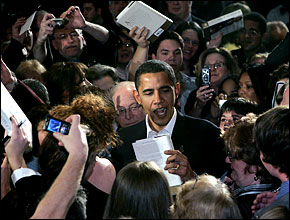
Today's New York Times had an article about Obama's trip to NH on the inside and below the fold. Above the fold was an article on prison reform in California. Interestlingly, and perhaps sadly, now that the elections are over, Governor Schwarzenegger and the California (Democratic) legislature are making plans to reform the troubled prison system. In other words, now that the politiking over insignificant and uncontroversial issues is over, the government can go ahead and actually try to solve the major problems of the day. Well, California deserves credit for recognizing the problem and for at least considering a range of options, some of them politically incorrect to the "law and order" crowd. But it's a sad commentary that serious problems can only be addressed after the elections, when actions can be taken and political repercussions hopefully put off for another day.
But I thought the placement of the prison reform article was highly fortuitous given the proximity to the article on the Obama event, where at least some of the observers were wondering where the beef was:
“I’ve looked through his book, and he barely touches issues,” said Robert Padian, 59, an unemployed database administrator. “I think he’s a serious candidate, but I don’t think he has great potential. No track record, and there are too many guys ahead of him in line.”
Well, Obama did touch on issues during his speech, but nothing controversial or original:
In two speeches and a news conference, Mr. Obama called for universal health care — the issue with which Mrs. Clinton, the New York Democrat, was once closely identified — a battle on global warming and a timed redeployment of troops from Iraq.
Universal health care is pretty standard stuff for Democrats and pretty uncontentious in the aggregate--how you get there has tended to be the sticking point. Likewise, some sort of redeployment in Iraq has greater traction today than even a year ago so Obama isn't exactly going out on a limb to call for it. He probably deserves credit for speaking about global warming, but even that's not necessarily an issue that identifies a particular winner or loser. Without having heard the particulars of Obama's speech, I imagine his discussion of the issue was a Clintonish-Gore-ish claim that efforts to slow or halt global warming would actually be good for the economy--in other words, an attempt to make it seem that there isn't a class basis to the policy. Maybe I'm wrong. If someone's read the speech and it was different than that, let me know.
But, keeping in mind the apparent pushing off of important policy discussions till after the election in California, I hate to see Democratic candidates, particularly someone as charismatic as Obama, fail to take advantage of the spotlight by taking on specific interests and problematic policy conditions, even if such an approach is controversial.
And speaking of California's prison reform, how about Democrats talk about the Drug War, which according to most studies of criminal justice policy I've seen, is responsible for the large infusion of inmates into the nation's brutal and over-crowded prisons. Not to mention the Drug War's questionable invasion of privacy.
Or how about someone on the Democratic side reading David Sirota's book and talking about the need to strengthen the nation's unions and overturning last year's dreadful bankruptcy "reform" bill?
Of course, it isn't as if HRC, or Bayh or Edwards have gone into much detail about these matters either. But for whatever reason, Obama is the man of the moment. It would be refreshing for the nation's leading Democratic figures to push the envelope, challenge the status quo, and raise questions about some of the nation's hidden or more intractable issues.
Update: There's a pretty good discussion about Obama going on over at the CarpetBagger Report. But to clarify what I said earlier--the issue isn't whether Obama is sufficiently policy-wonkish. My concern isn't a dichotomy between someone who speaks in generalities and someone who speaks policy-wonkese. In fact, I would contend that groups like the DLC are pretty wonkish. But they aren't very political. By political, I refer to the realities of power politics and conflict, and the issues that tend to bare that out, whether it be the right to privacy, the right to unionize or the power to make decisions in the private sphere, which is what happens in the case of a bankruptcy "reform" bill that gives power to credit card companies and takes it away from consumers and individuals. Democrats have tendency to want to substitute technocratic policy solutions or offer wonky political initiatives in the absence of identifying the underlying political conflicts that exacerbate the problems policies are designed to alleviate. That's the distinction Democrats need to make. Of course it's understandable for those desiring to be elected, to smoother over or avoid conflicts alltogether. But I believe that has been a short-term focus by Democrats that has hurt them in the more important task of building a brand-name and establishing trust with voters who both know what the Democratic party stands for, and what the realities of American politics are. Someone like Obama is probably in a no-win situation. If he doesn't go beyond generalities he won't get taken seriously, or he'll be ravaged by the press and Republicans for being an inexperienced relativist not ready for prime time. If he begins to draw lines in the sand and identifying enemies, or at least the sources of class conflict, he gets attacked all around for being a class-warrior and devisive. I hope Obama will rise to the challenge, and I have higher hopes for him along these lines than any of the other candidates (with the possible exception of Edwards). But I' m not optimistic.
Friday, December 08, 2006
In 2008 There Will be a Pony
Glenn Greenwald is pretty pessimistic about the contents and implications of B-H:
Some commenters seem to be trying to find some good in what James Baker did here -- as though the Baker-Hamilton Report will help end the war. It won't.
In 2002, it was clear that the President was intent on invading and occupying Iraq, and all sorts of people endorsed that central idea but then -- like James Baker or Tom Friedman -- added their own caveats about how they thought it should be done. That didn't matter. Anything other than unambiguous, emphatic opposition to the invasion counted as support for the war. It fueled, rather than impeded, Bush's ability to invade at will.
Exactly the same is true now. Anyone who does not clearly advocate withdrawal sooner rather than later in accordance with a clear timetable is, in effect, endorsing the status quo. Anything muddled or any "plan" which calls for our ongoing, indefinite presence in Iraq (as the Report does) is tantamount to support for Bush to have license to do what he wants. There is clear language in the Baker-Hamilton Report that warns against the dangers of withdrawal (just as one would expect from a Commission comprised of war advocates).
Therefore, the Report will be used as an instrument against withdrawal and thus, by definition, in support of our ongoing occupation -- exactly what the President wants to do and will do. Just as was true for those who failed to oppose the invasion, by failing to loudly and clearly oppose our ongoing occupation (and, if anything, by clearly endorsing it, even if lamentably), the Report does nothing other than enable the ongoing occupation.
Under the circumstances, one either advocates withdrawal or one does not. The Report did not.
It's really just as simple as that.
My own superficial read was that (1) the report was a pretty damning indictment of the Bush Administration's Iraq war policy and its foreign policy more broadly; but (2) there's not much that can be done about that now except (a) begin the process of shifting our military resources away from combat towards an advisory role; (b) enlist Syria and Iran in an effort to stabilize Iraq through a recognition of what each country stands to lose--if anything--from a failed Iraqi state or civil war; and (c) get on with the business of reconciling the Israeli-Palestinian conflict. And hope a pony comes out of all of this.
Still, even if Greenwald and others are right that the commission's recommendations are or will ultimately only give cover to the status quo, how is that supposed to benefit the Republican Party and it's 2008 candidate? I can't imagine the conversation on Iraq is going to be more upbeat in 2008 than it is now, which suggests to me that, ideally, the Republican Party, John McCain or no, will be stuck with Iraq around its neck in 2008 and the Democratic candidate will, again ideally, be free to campaign on that premise.
Some commenters seem to be trying to find some good in what James Baker did here -- as though the Baker-Hamilton Report will help end the war. It won't.
In 2002, it was clear that the President was intent on invading and occupying Iraq, and all sorts of people endorsed that central idea but then -- like James Baker or Tom Friedman -- added their own caveats about how they thought it should be done. That didn't matter. Anything other than unambiguous, emphatic opposition to the invasion counted as support for the war. It fueled, rather than impeded, Bush's ability to invade at will.
Exactly the same is true now. Anyone who does not clearly advocate withdrawal sooner rather than later in accordance with a clear timetable is, in effect, endorsing the status quo. Anything muddled or any "plan" which calls for our ongoing, indefinite presence in Iraq (as the Report does) is tantamount to support for Bush to have license to do what he wants. There is clear language in the Baker-Hamilton Report that warns against the dangers of withdrawal (just as one would expect from a Commission comprised of war advocates).
Therefore, the Report will be used as an instrument against withdrawal and thus, by definition, in support of our ongoing occupation -- exactly what the President wants to do and will do. Just as was true for those who failed to oppose the invasion, by failing to loudly and clearly oppose our ongoing occupation (and, if anything, by clearly endorsing it, even if lamentably), the Report does nothing other than enable the ongoing occupation.
Under the circumstances, one either advocates withdrawal or one does not. The Report did not.
It's really just as simple as that.
My own superficial read was that (1) the report was a pretty damning indictment of the Bush Administration's Iraq war policy and its foreign policy more broadly; but (2) there's not much that can be done about that now except (a) begin the process of shifting our military resources away from combat towards an advisory role; (b) enlist Syria and Iran in an effort to stabilize Iraq through a recognition of what each country stands to lose--if anything--from a failed Iraqi state or civil war; and (c) get on with the business of reconciling the Israeli-Palestinian conflict. And hope a pony comes out of all of this.
Still, even if Greenwald and others are right that the commission's recommendations are or will ultimately only give cover to the status quo, how is that supposed to benefit the Republican Party and it's 2008 candidate? I can't imagine the conversation on Iraq is going to be more upbeat in 2008 than it is now, which suggests to me that, ideally, the Republican Party, John McCain or no, will be stuck with Iraq around its neck in 2008 and the Democratic candidate will, again ideally, be free to campaign on that premise.
Thursday, December 07, 2006
Anniversary
Today is the one-month anniversary of November 7.
So, how are you all feeling out there?
What I think surprises me the most is both how cynical I was about Democratic prospects generally, and in fear of the Rove Machine in particular. After twelve years of Republican rule and my awakening about the sorry state of American media I was pretty convinced that the bad times were going to keep on a rollin. Despite the fact that I partake of a wide range of liberal and alternative media sources, I had bought into the media hype about the Bush White House.
There was short period of time during the '04 campaign when I first recognized the shell that was the Bush Conservative Movement: It was during the first debate when Kerry was looking tall and talking presidential while Bush looked like the frat boy we all thought he was in 1999. The difference between Kerry and Bush that night was striking, causing me to realize how much of Bush's persona was manufactured and how much it benefitted from being insulated from the public and opposing opinions.
Unfortunately, that awareness, which I suspect people besides myself also noticed, wasn't enough to carry the day; Bush was re-elected and brought with him more Republican House and Senate members. With 55 Senators, moreover, the 2005-2006 GOP appeared poised to reach anti-filibuster territory in the next election cycle or two.
Then there was the much vaunted Karl Rove genius, the strength of the Republican voting ground game, aided considerably by the growing millions of conservative evangelicals and abetted by a Missing White Woman obsessed media.
I was sure that for all their vileness and depravity, Rush Limbaugh, Ann Coulter, and Little Green Footballs had their fingers on the pulse of American resentment politics.
But how weak (and still vile) do those propagandists and hate-mongers look now? And they're still at it, convinced their great conservative cause was betrayed, in some cases still continuing to deny their war is a fiasco, not recognizing the shrinking of red America as conservatism finds itself increasingly isolated in the Old South.
Among the most refreshing changes has been to see the gradual realignment of bloggers such as John Cole and Andrew Sullivan. Sullivan in particular, who was calling us tree-hugging, angry bloggers a traitorous fifth column against America's holy war against Islam is now venting loudly and stridently against his fellow travelers. Here's Sullivan on the right-wing response to Mary Cheney's pregnancy:
Here's TownHall blogger Kevin McCullough's response to the Mary Cheney news. Money quote:
Knowing from scientific data that children excel best when given the full and natural parental structure of one mother and one father, is it moral to bring a child into such a scenario - purposefully, simply to stroke one's own desire to have a child - sort of like a new handbag, or pair of shoes?
So the vice-president's future grandchild is now the equivalent of a pair of shoes? Send me more examples of base reax, will you? In many ways, the GOP's base response to the reality of gays seems to me similar to their attitude to the reality of Iraq. They have an ideology; it just doesn't fit persuasively with reality. The more reality bites, the more fiercely they stick to their ideology. This is why the Christianist psyche really is the anti-conservative psyche. It is a rigid political ideology, enhanced with the certitude of religious fundamentalism, and deployed with Schmittian ruthlessness. In the end, it must fail. It will fail. And it is failing. All that remains to be discovered is the extent of the human damage it has wrought.
"In the end it must fail. And it is failing." Damn, that's some good shit.
And here's Sullivan commenting on the right-wing blogosphere's reaction to the photos of Jose Padilla:
But let me say this in defense of Althouse. She is at least conceding that the shameful treatment of Padilla is worth discussing. And her defense of the sadism is about as plausible as it will ever get. She sees there is an important principle here - something we once knew as habeas corpus. Here you have a U.S. citizen detained on American soil, kept without charges for 3 and a half years, accused of plotting a dirty bomb attack (an accusation never substantiated in any way), tortured until he may be mentally incapable of standing trial ... and the conservative blogosphere is completely, utterly silent. Habeas corpus disappears not with a bang, and not even with a whimper, but with deathly quiet. Well, we know what American conservatism now stands for. You can see the visual above.
The GOP is imploding.
Of course, as Digby has noted, it's unfortunate that there are still prospective candidates who want to triangulate against the dirty hippy bloggers and campaign as if Democrats must continue to appease the Serious Media People in the Media and the mythical heartland voters who voted Democratic but really didn't mean it.
But the last twelve years in the wilderness, and in particular the past six years of hell have paid off in the blooming of critical liberal voices in the blogosphere and around the country. Take Tom Schaller for instance, whose pre-election release of Whistling Past Dixie was incredibly, and singly, prescient about the election outcomes this year and future trends of American politics.
Another important voice has been that of David Sirota, an economic populist and strategist who, along with Schaller, has recognized the potential for anti-business elite leaders to win elections in the Mountain West and Mid-West.
The challenge for Democrats will be to live with the variety inherent in big-tent majority coalitions while ensuring the big-picture goals--increasing individual freedoms and economic opportunities for more and more Americans--stay in focus.
Anyway, feel free to celebrate our one-month anniversary. Just try not to shoot anyone in the face.
So, how are you all feeling out there?
What I think surprises me the most is both how cynical I was about Democratic prospects generally, and in fear of the Rove Machine in particular. After twelve years of Republican rule and my awakening about the sorry state of American media I was pretty convinced that the bad times were going to keep on a rollin. Despite the fact that I partake of a wide range of liberal and alternative media sources, I had bought into the media hype about the Bush White House.
There was short period of time during the '04 campaign when I first recognized the shell that was the Bush Conservative Movement: It was during the first debate when Kerry was looking tall and talking presidential while Bush looked like the frat boy we all thought he was in 1999. The difference between Kerry and Bush that night was striking, causing me to realize how much of Bush's persona was manufactured and how much it benefitted from being insulated from the public and opposing opinions.
Unfortunately, that awareness, which I suspect people besides myself also noticed, wasn't enough to carry the day; Bush was re-elected and brought with him more Republican House and Senate members. With 55 Senators, moreover, the 2005-2006 GOP appeared poised to reach anti-filibuster territory in the next election cycle or two.
Then there was the much vaunted Karl Rove genius, the strength of the Republican voting ground game, aided considerably by the growing millions of conservative evangelicals and abetted by a Missing White Woman obsessed media.
I was sure that for all their vileness and depravity, Rush Limbaugh, Ann Coulter, and Little Green Footballs had their fingers on the pulse of American resentment politics.
But how weak (and still vile) do those propagandists and hate-mongers look now? And they're still at it, convinced their great conservative cause was betrayed, in some cases still continuing to deny their war is a fiasco, not recognizing the shrinking of red America as conservatism finds itself increasingly isolated in the Old South.
Among the most refreshing changes has been to see the gradual realignment of bloggers such as John Cole and Andrew Sullivan. Sullivan in particular, who was calling us tree-hugging, angry bloggers a traitorous fifth column against America's holy war against Islam is now venting loudly and stridently against his fellow travelers. Here's Sullivan on the right-wing response to Mary Cheney's pregnancy:
Here's TownHall blogger Kevin McCullough's response to the Mary Cheney news. Money quote:
Knowing from scientific data that children excel best when given the full and natural parental structure of one mother and one father, is it moral to bring a child into such a scenario - purposefully, simply to stroke one's own desire to have a child - sort of like a new handbag, or pair of shoes?
So the vice-president's future grandchild is now the equivalent of a pair of shoes? Send me more examples of base reax, will you? In many ways, the GOP's base response to the reality of gays seems to me similar to their attitude to the reality of Iraq. They have an ideology; it just doesn't fit persuasively with reality. The more reality bites, the more fiercely they stick to their ideology. This is why the Christianist psyche really is the anti-conservative psyche. It is a rigid political ideology, enhanced with the certitude of religious fundamentalism, and deployed with Schmittian ruthlessness. In the end, it must fail. It will fail. And it is failing. All that remains to be discovered is the extent of the human damage it has wrought.
"In the end it must fail. And it is failing." Damn, that's some good shit.
And here's Sullivan commenting on the right-wing blogosphere's reaction to the photos of Jose Padilla:
But let me say this in defense of Althouse. She is at least conceding that the shameful treatment of Padilla is worth discussing. And her defense of the sadism is about as plausible as it will ever get. She sees there is an important principle here - something we once knew as habeas corpus. Here you have a U.S. citizen detained on American soil, kept without charges for 3 and a half years, accused of plotting a dirty bomb attack (an accusation never substantiated in any way), tortured until he may be mentally incapable of standing trial ... and the conservative blogosphere is completely, utterly silent. Habeas corpus disappears not with a bang, and not even with a whimper, but with deathly quiet. Well, we know what American conservatism now stands for. You can see the visual above.
The GOP is imploding.
Of course, as Digby has noted, it's unfortunate that there are still prospective candidates who want to triangulate against the dirty hippy bloggers and campaign as if Democrats must continue to appease the Serious Media People in the Media and the mythical heartland voters who voted Democratic but really didn't mean it.
But the last twelve years in the wilderness, and in particular the past six years of hell have paid off in the blooming of critical liberal voices in the blogosphere and around the country. Take Tom Schaller for instance, whose pre-election release of Whistling Past Dixie was incredibly, and singly, prescient about the election outcomes this year and future trends of American politics.
Another important voice has been that of David Sirota, an economic populist and strategist who, along with Schaller, has recognized the potential for anti-business elite leaders to win elections in the Mountain West and Mid-West.
The challenge for Democrats will be to live with the variety inherent in big-tent majority coalitions while ensuring the big-picture goals--increasing individual freedoms and economic opportunities for more and more Americans--stay in focus.
Anyway, feel free to celebrate our one-month anniversary. Just try not to shoot anyone in the face.
Victory? We Don't Even Know Who The Enemy Is
After coming out against James Webb and racial integration in schools in his two previous columns, George Will is back off the reservation:
The Iraq Study Group, like the policy it was created to critique, was overtaken by the unexpectedly rapid crumbling of the U.S. position in Iraq since the ISG was formed in March. The deterioration was manifested in last week's misbegotten summit between President Bush and Iraqi Prime Minister Nouri al-Maliki, which made brutally clear how difficult it will be to apply even the ISG's temperate recommendations to the deteriorating reality.
Summits usually do, and generally should, resemble American political conventions -- they should not be deliberative events but should ratify decisions made earlier. The ISG's recommendations must be read in light of these facts from the week during which the recommendations were being written:
Calling Iraq's prime minister "the right guy" for Iraq, Bush met him in Jordan, presumably because Iraq is too dangerous a venue for discussing how to, in Bush's words, "complete" the job. The job is to stabilize Iraq, which cannot be done without breaking the Mahdi Army, which cannot be done without bringing down Maliki, who is beholden to Moqtada al-Sadr, the cleric who more or less controls the Mahdi Army, which probably is larger and more capable than Iraq's army.
First, Will joins the ISG's smackdown of the Bush Administration's foreign policy, from Iraq to Israel-Palestine and beyond.
Then Will says Iraq is unstable because of al-Sadr, a prominent Shiite cleric, who runs a militia and controls about 30 seats in the Iraqi legislature.
What about the Sunni insurgency?
Do we even know who the enemy is anymore?
The Iraq Study Group, like the policy it was created to critique, was overtaken by the unexpectedly rapid crumbling of the U.S. position in Iraq since the ISG was formed in March. The deterioration was manifested in last week's misbegotten summit between President Bush and Iraqi Prime Minister Nouri al-Maliki, which made brutally clear how difficult it will be to apply even the ISG's temperate recommendations to the deteriorating reality.
Summits usually do, and generally should, resemble American political conventions -- they should not be deliberative events but should ratify decisions made earlier. The ISG's recommendations must be read in light of these facts from the week during which the recommendations were being written:
Calling Iraq's prime minister "the right guy" for Iraq, Bush met him in Jordan, presumably because Iraq is too dangerous a venue for discussing how to, in Bush's words, "complete" the job. The job is to stabilize Iraq, which cannot be done without breaking the Mahdi Army, which cannot be done without bringing down Maliki, who is beholden to Moqtada al-Sadr, the cleric who more or less controls the Mahdi Army, which probably is larger and more capable than Iraq's army.
First, Will joins the ISG's smackdown of the Bush Administration's foreign policy, from Iraq to Israel-Palestine and beyond.
Then Will says Iraq is unstable because of al-Sadr, a prominent Shiite cleric, who runs a militia and controls about 30 seats in the Iraqi legislature.
What about the Sunni insurgency?
Do we even know who the enemy is anymore?
Wednesday, December 06, 2006
2008 Chatter
So, with Vilsack (1) already in, and Obama (2) sending signals he might be in, too, HRC (3) is beginning to go public about her 2008 ambitions, maybe sooner than she'd hoped. Evan Bayh (4) has formed an exploratory committee, John Edwards (5) probably hasn't stopped running since 2004, and other Democratic notables from Joe Biden (6) to General Wesley Clark (7) and Bill Richardson (8) are also expected to throw their hats in the ring. And of course, the Al Gore (9) shadow continues to loom over the field, and will probably heat up next year when he--among many other potentials--has his book released.
Anyway, how do we begin to assess this field? To start with, for each candidate, what is their basis for running?
John Edwards is probably the most "message" centered candidate. With an equally charismatic, but less experienced Obama possibly running, Edwards' lack of experience relative to the rest of the field might be somewhat minimized, allowing his message to gain greater traction.
Bayh, Biden, Clark and Richardson will probably emphasize competence, experience, and common sense government. Clark and Richardson will no doubt emphasize their foreign policy credentials, while Bayh will try to run more as a centrist, bipartisan equiped, former governor of a mid-western state than a sitting U.S. Senator.
But I'm a little less clear about what the rationale is for an HRC candidacy. I say that not out any hostility to Hillary, as I don't really have a horse in this race yet. But it's tough to figure what she brings to the field and why she wants to be president. She isn't particularly visionary or charismatic. Nor does she have a particular message or area of policy expertise. In fact, of all the field, she probably brings the most political baggage. Of course, she would be the first woman president and would no doubt, by sheer name recognition alone, be the strongest female contender for the U.S. presidency, ever. But I can't imagine she's running merely to be the first woman president.
I've not proven myself a sage prognosticator of election outcomes, but I still don't think Obama will ultimately run this time. I hope to be proven wrong. Yes he's considerably under-experienced. But his entry would only make the primaries more interesting and potentially more drawn out, and thus, significant. And despite his lack of time in office, he'd be considered, rightly or wrongly, among the leading contenders, a bona fide heavyweight. Furthermore, if Gore also opts for the race, it would make a most impressive field, indeed. Can you imagine the media coverage of an Edwards-Gore-Obama-Clinton field? At the same time, such a list would no doubt greatly reduce the potential for other candidates to be heard, much less compete.
Anyway, how do we begin to assess this field? To start with, for each candidate, what is their basis for running?
John Edwards is probably the most "message" centered candidate. With an equally charismatic, but less experienced Obama possibly running, Edwards' lack of experience relative to the rest of the field might be somewhat minimized, allowing his message to gain greater traction.
Bayh, Biden, Clark and Richardson will probably emphasize competence, experience, and common sense government. Clark and Richardson will no doubt emphasize their foreign policy credentials, while Bayh will try to run more as a centrist, bipartisan equiped, former governor of a mid-western state than a sitting U.S. Senator.
But I'm a little less clear about what the rationale is for an HRC candidacy. I say that not out any hostility to Hillary, as I don't really have a horse in this race yet. But it's tough to figure what she brings to the field and why she wants to be president. She isn't particularly visionary or charismatic. Nor does she have a particular message or area of policy expertise. In fact, of all the field, she probably brings the most political baggage. Of course, she would be the first woman president and would no doubt, by sheer name recognition alone, be the strongest female contender for the U.S. presidency, ever. But I can't imagine she's running merely to be the first woman president.
I've not proven myself a sage prognosticator of election outcomes, but I still don't think Obama will ultimately run this time. I hope to be proven wrong. Yes he's considerably under-experienced. But his entry would only make the primaries more interesting and potentially more drawn out, and thus, significant. And despite his lack of time in office, he'd be considered, rightly or wrongly, among the leading contenders, a bona fide heavyweight. Furthermore, if Gore also opts for the race, it would make a most impressive field, indeed. Can you imagine the media coverage of an Edwards-Gore-Obama-Clinton field? At the same time, such a list would no doubt greatly reduce the potential for other candidates to be heard, much less compete.
Tuesday, December 05, 2006
The Authoritarian Mindset
Eugene Robinson
In the article, Sweig points out what any visitor to Cuba who is not wearing ideological blinkers quickly realizes: that the Cuban government's hold on power does not derive from repression alone. In my visits to the island, I've been struck by how Cubans can be bitterly critical of the hard-line restrictions the regime imposes on speech, assembly, movement, commerce and other activities, and in the next breath speak with pride of the government's achievements in providing free health care and education.
Ponder that second sentence for a moment:
So, the government in this case provides "free education", for which the people are supposedly eternally grateful and dependent, and the only downside is, they can't actually put that education to any use.
Likewise, yes it's a shame I can't speak my mind, freely associate, seek out information (aside from that provided for "free" from the government schools), or express my personality in any way, but hey, it's all worth it to ensure that I get the same health care as my neighbor.
But to bring it closer to home, let's play a little word substitution game:
In the article, Sweig points out what any visitor to America who is not wearing ideological blinkers quickly realizes: that the American government's hold on power does not derive from repression alone. In my visits to the continent, I've been struck by how Americans can be bitterly critical of the hard-line restrictions the regime imposes on speech, assembly, movement, commerce and other activities, and in the next breath speak with pride of the government's achievements in keeping them free of terrorist attacks over the last five years.
Meanwhile, in another Latin American country, Hugo Chavez has won another six year term, but despite his margin of victory, the New York Times reports that the former general is planning to ensure he can stick around for awhile:
Sent to power for a third time, Mr. Chávez seems intent on assuming the mantle from the fading Fidel Castro of chief Latin American scourge of the United States. He also has made no secret of his intent to consolidate his power further through legal and personnel changes.
He has spoken of a desire to unite his supporters in one political party and to alter legislation to allow him to remain in power past 2020.
Winning support for such measures may not be difficult in a country where his allies already control the legislature and the Supreme Court as well as governorships in all but two states, and where the military, the national oil company and other government bureaucracies and institutions have been systematically packed with Chávez boosters and stripped of opponents.
Now, facing an anemic opposition that could not win in any of Venezuela’s 23 states or Caracas, Mr. Chávez is expected to tighten his grip, first and foremost over his own supporters in an effort to prevent challenges to his rule from emerging.
“A priority for Chávez right now is what he calls a ‘revolution within a revolution,’ ” said Steve Ellner, a political scientist at the Universidad de Oriente in eastern Venezuela. “This means a purging process of those associated with corruption or excess bureaucracy. In January you’re going to see some heads being chopped.”
Venezuela leading newspapers, El Nacional and El Universal, published maps in their pages on Monday showing the entire country painted red, the color of Mr. Chávez’s campaign, as a reflection of his convincing victory.
Red, in fact, colored not just the clothing and advertisements of the Chávez campaign. Rafael Ramírez, the energy minister, described the national oil company as “red, really red,” in comments caught on video in which he told workers that they had no place in the company if they were not supporters of the government.
Mr. Ramírez’s words, which Mr. Chávez promptly adopted as one of his refrains, point to a creeping “with us or against us” radicalization in Venezuelan society that goes beyond the government-run oil company to institutions like public schools and museums.
On the home front, authoritarianism of another sort is rearing its head:
Hugh Hewitt has published a transcript of his "interview" with me yesterday. Here are some of his questions:
"Are you a Christian?"
"Do you believe Jesus Christ rose from the dead?"
"Do you consider yourself under the authority of Benedict, or before him, John Paul II?"
Notice the last question from Hewitt to Sullivan. "...under the authority of (Pope) Benedict..."
Authority is the critical element for the burgeoning National Law Right, as Sullivan analyzes them in his recent book, and as is also discussed in this New Republic cover story by Damon Linker.
The upshot of the Natural Law Authoritarianism is, like other forms of dictatorship, a rejection of individual liberty and freedom of conscience. But even more than in other forms of authoritarianism, Natural Law dictatorship is even more explicit in its rejection of pluralism, free thought, and compromise. As the church contended during the reformation, the individual was not permitted the freedom to serve God, or not, as he or she pleased. Today's Natural Law Catholicism hasn't changed since the Middle Ages: It still contends that individuals and governments are subject to the Pope and the Roman Catholic Church. It will work within, and appear to support democratic processes, but only because those are the only avenues open in many parts of the world. Their aim, however, as proponents like Richard John Neuhaus embody, is to ultimately exert control over both the individual and the nation.
As these few examples demonstrate, the authoritarian spirit is not restricted to one end of the ideological spectrum or present only in one hemisphere, or absent in developed economies.
But we can understand a little about where to expect the challenges to freedom to originate. One is unfortunately, from the economic sphere, where fears, or envy encourages the restriction of earning, consumption and individuality in favor of a rigid sense of equality.
The other two originate from religious and national security concerns. The latter, in the aftermath of 911, is most apparent to those of us in America but the implications of Natural Law theories and fundamentalist evangelicalism are equally as severe, even more so given that their designs are not temporal, as the restrictive ambitions of national security rationalizers suggest. Under religious dictatorship, to the contrary, the restrictions are intended to be permanent and have as their carrying card, a fear of, and desire to, respond to the demands of eternal life or eternal damnation, and for which, as Sam Harris has eloquently argued, no challenging evidence is neither allowed or conceivable.
The recent elections have offered us a reprieve, but have not, as some would hope, spelled the end of the creeping authoritarianism to which all societies are tempted.
In the article, Sweig points out what any visitor to Cuba who is not wearing ideological blinkers quickly realizes: that the Cuban government's hold on power does not derive from repression alone. In my visits to the island, I've been struck by how Cubans can be bitterly critical of the hard-line restrictions the regime imposes on speech, assembly, movement, commerce and other activities, and in the next breath speak with pride of the government's achievements in providing free health care and education.
Ponder that second sentence for a moment:
So, the government in this case provides "free education", for which the people are supposedly eternally grateful and dependent, and the only downside is, they can't actually put that education to any use.
Likewise, yes it's a shame I can't speak my mind, freely associate, seek out information (aside from that provided for "free" from the government schools), or express my personality in any way, but hey, it's all worth it to ensure that I get the same health care as my neighbor.
But to bring it closer to home, let's play a little word substitution game:
In the article, Sweig points out what any visitor to America who is not wearing ideological blinkers quickly realizes: that the American government's hold on power does not derive from repression alone. In my visits to the continent, I've been struck by how Americans can be bitterly critical of the hard-line restrictions the regime imposes on speech, assembly, movement, commerce and other activities, and in the next breath speak with pride of the government's achievements in keeping them free of terrorist attacks over the last five years.
Meanwhile, in another Latin American country, Hugo Chavez has won another six year term, but despite his margin of victory, the New York Times reports that the former general is planning to ensure he can stick around for awhile:
Sent to power for a third time, Mr. Chávez seems intent on assuming the mantle from the fading Fidel Castro of chief Latin American scourge of the United States. He also has made no secret of his intent to consolidate his power further through legal and personnel changes.
He has spoken of a desire to unite his supporters in one political party and to alter legislation to allow him to remain in power past 2020.
Winning support for such measures may not be difficult in a country where his allies already control the legislature and the Supreme Court as well as governorships in all but two states, and where the military, the national oil company and other government bureaucracies and institutions have been systematically packed with Chávez boosters and stripped of opponents.
Now, facing an anemic opposition that could not win in any of Venezuela’s 23 states or Caracas, Mr. Chávez is expected to tighten his grip, first and foremost over his own supporters in an effort to prevent challenges to his rule from emerging.
“A priority for Chávez right now is what he calls a ‘revolution within a revolution,’ ” said Steve Ellner, a political scientist at the Universidad de Oriente in eastern Venezuela. “This means a purging process of those associated with corruption or excess bureaucracy. In January you’re going to see some heads being chopped.”
Venezuela leading newspapers, El Nacional and El Universal, published maps in their pages on Monday showing the entire country painted red, the color of Mr. Chávez’s campaign, as a reflection of his convincing victory.
Red, in fact, colored not just the clothing and advertisements of the Chávez campaign. Rafael Ramírez, the energy minister, described the national oil company as “red, really red,” in comments caught on video in which he told workers that they had no place in the company if they were not supporters of the government.
Mr. Ramírez’s words, which Mr. Chávez promptly adopted as one of his refrains, point to a creeping “with us or against us” radicalization in Venezuelan society that goes beyond the government-run oil company to institutions like public schools and museums.
On the home front, authoritarianism of another sort is rearing its head:
Hugh Hewitt has published a transcript of his "interview" with me yesterday. Here are some of his questions:
"Are you a Christian?"
"Do you believe Jesus Christ rose from the dead?"
"Do you consider yourself under the authority of Benedict, or before him, John Paul II?"
Notice the last question from Hewitt to Sullivan. "...under the authority of (Pope) Benedict..."
Authority is the critical element for the burgeoning National Law Right, as Sullivan analyzes them in his recent book, and as is also discussed in this New Republic cover story by Damon Linker.
The upshot of the Natural Law Authoritarianism is, like other forms of dictatorship, a rejection of individual liberty and freedom of conscience. But even more than in other forms of authoritarianism, Natural Law dictatorship is even more explicit in its rejection of pluralism, free thought, and compromise. As the church contended during the reformation, the individual was not permitted the freedom to serve God, or not, as he or she pleased. Today's Natural Law Catholicism hasn't changed since the Middle Ages: It still contends that individuals and governments are subject to the Pope and the Roman Catholic Church. It will work within, and appear to support democratic processes, but only because those are the only avenues open in many parts of the world. Their aim, however, as proponents like Richard John Neuhaus embody, is to ultimately exert control over both the individual and the nation.
As these few examples demonstrate, the authoritarian spirit is not restricted to one end of the ideological spectrum or present only in one hemisphere, or absent in developed economies.
But we can understand a little about where to expect the challenges to freedom to originate. One is unfortunately, from the economic sphere, where fears, or envy encourages the restriction of earning, consumption and individuality in favor of a rigid sense of equality.
The other two originate from religious and national security concerns. The latter, in the aftermath of 911, is most apparent to those of us in America but the implications of Natural Law theories and fundamentalist evangelicalism are equally as severe, even more so given that their designs are not temporal, as the restrictive ambitions of national security rationalizers suggest. Under religious dictatorship, to the contrary, the restrictions are intended to be permanent and have as their carrying card, a fear of, and desire to, respond to the demands of eternal life or eternal damnation, and for which, as Sam Harris has eloquently argued, no challenging evidence is neither allowed or conceivable.
The recent elections have offered us a reprieve, but have not, as some would hope, spelled the end of the creeping authoritarianism to which all societies are tempted.
Sunday, December 03, 2006
The Senator Writes a Letter
To: Al Saunders, Assistant Head Coach, Offense, Washington Redskins
cc: Joe Gibbs, Head Coach, Washington Redskins
You've scored on the game's first two drives, and have just stuffed the Falcons on fourth and one from the Skins 47. You've been running the pigskin down the Falcon's throats with Ladell Betts.
And then. And then. You have the kid throw a pass to the sideline for Moss and the catch is ruled out of bounds. OK. But then. Then. You call up that double-reverse, end-around to Antwan Randal El you've tried, unsuccessfully, to run about 43 times already this year. The play results, unsurprisingly, in a two yard loss, putting our second year QB in a 3rd and 12. We end up punting the stinking ball and don't score the rest of the game. We had the Falcons about dead and buried in the first quarter and with one stupid call, you killed our momentum. We never recovered.
If you call that play one more time, Congress just might send Heath Schuler back to you. For now, whatever page of the playbook that end-around play is on, I say it's about time it found its way into the garbage bin.
cc: Joe Gibbs, Head Coach, Washington Redskins
You've scored on the game's first two drives, and have just stuffed the Falcons on fourth and one from the Skins 47. You've been running the pigskin down the Falcon's throats with Ladell Betts.
And then. And then. You have the kid throw a pass to the sideline for Moss and the catch is ruled out of bounds. OK. But then. Then. You call up that double-reverse, end-around to Antwan Randal El you've tried, unsuccessfully, to run about 43 times already this year. The play results, unsurprisingly, in a two yard loss, putting our second year QB in a 3rd and 12. We end up punting the stinking ball and don't score the rest of the game. We had the Falcons about dead and buried in the first quarter and with one stupid call, you killed our momentum. We never recovered.
If you call that play one more time, Congress just might send Heath Schuler back to you. For now, whatever page of the playbook that end-around play is on, I say it's about time it found its way into the garbage bin.
Update: A Washington Post writer noticed the same change in momentum.
Friday, December 01, 2006
One Arm Tied Behind Their Backs
I've been reading Bob Woodward's latest and found myself surprised to read that the U.S. marshalled some 400,000 troops to kick Saddam Hussein out of Kuwaiit in 1991.
I was reminded of that today when I read this post by Josh Marshall.
It's hard to believe that the American public would have objected to a similar or larger force to go to war against Iraq in the aftermath of 911 but have acquienced quietly when those same numbers were raised in 1991.
Of course, that's not really the point of Stanley Kurtz's post anyway. The actual point is that while the war accomplished one of its goals--dethroning Saddam Hussein--the war mongerer's two other stated goals: uncovering Iraq's WMD and stopping his terrorism and nuclear weapons program related activities; and to establish an American friendly, pluralist democracy in Baghdad, have proven to be bupkis and a fiasco, respectively. So historical revision of any kind, saying anything, no matter how ridiculous, is the order of the day.
I was reminded of that today when I read this post by Josh Marshall.
It's hard to believe that the American public would have objected to a similar or larger force to go to war against Iraq in the aftermath of 911 but have acquienced quietly when those same numbers were raised in 1991.
Of course, that's not really the point of Stanley Kurtz's post anyway. The actual point is that while the war accomplished one of its goals--dethroning Saddam Hussein--the war mongerer's two other stated goals: uncovering Iraq's WMD and stopping his terrorism and nuclear weapons program related activities; and to establish an American friendly, pluralist democracy in Baghdad, have proven to be bupkis and a fiasco, respectively. So historical revision of any kind, saying anything, no matter how ridiculous, is the order of the day.
Who Am I? What Am I Doing Here?

And Why Am I Running For President?
Does that V remind you of V for Vendetta? A little eery isn't it?
I've complained about this guy before, and I doubt he'll get the nomination. But he's all too representative of the DLC, "sensible" centrist type who has no real philosophy or message except to regurgitate mindless cliches and platitudes.
Of course the addition of HRC, Evan Bayh, or Bill Richardson to the race won't change this dynamic much. Thankfully we were spared the candidacy of Mark Warner who would only have deepened the emptiness.
David Brooks actually had a readable column the other day in which he challenged Republicans to concentrate more on offering solutions to policy problems instead of retreating into philosophical debates about the nature of the state and other abstractions.
Democrats, I'm afraid, have the opposite problem. They're all about solving policy problems--as they understand them--more affordable health care, better education, etc, all non-controversial goals to be sure, but it seemingly isn't driven by any coherent philosophy of government.
Yesterday also witnessed one of those election deconstruction efforts sponsored by Larry Sabato and broadcast by C-Span. There were separate panels comprised of representatives from most of the prospective 2008 candidates, one for Democrats and a separate one for Republicans. There was of course lots of talk about money, who can raise it, who can't. But very little policy stuff and even less discussion of what government should be about. And of course, no sense of how Democrats should think about, much less address, the array of problems presented by the Christianist right, who despite their losses this time around, aren't going away any time soon, if only for the reason that the issues that concern them are, however misguided and malignant from my perspective, originate from some sort of philosophical view of life and government. I used to think, and still tend to think, that Democrats are just generally afraid to address these issues. But another more worrisome idea should also be considered: Democrats don't talk much about these issues because they aren't driven by any deeply rooted philosophical understanding or appreciation for the nature of man, the role of the state, or the politics of conflict that renders these issues contentious.
While Democrats should be thankful for their gains this year, they should recognize that at some point, they will need to not only deliver, but be prepared to tackle the so-called wedge issues that Republicans will certainly continue to raise in the future.
Somewhat along these lines, Glenn Greenwald wonders how come politicians don't address issues like this:
(3) One of the oddest and most damaging aspects of our political discourse is that some of the most significant issues -- ones which have the greatest impact on our laws and government -- somehow become too controversial for mainstream political figures even to mention, let alone seriously debate. An orthodoxy arises which one cannot even question, let alone deviate from, while still maintaining political viability.
One such topic is the role which our commitment to Israel plays in shaping U.S. foreign policy in the Middle East. But another equally significant topic is the rationale behind ongoing drug prohibition laws and the havoc those laws wreak on every level. As this post from McQ illustrates (h/t Mona), opposition to drug laws and their accompanying Draconian enforcement efforts (along with still more Draconian laws to enable enforcement) is a political position which finds considerable support across the ideological spectrum. Despite that, opposition to drug laws still remains strictly off-limits for any mainstream political figure. It is hard to see exactly what accounts for that dynamic.
Yes it is. What do Democrats think about drug policy?
Or how about the Separation between Church and State? Greenwald again:
(2) Whenever you think that Bush followers cannot descend any lower into un-American authoritarianism, they always prove you wrong. Congressman-elect Keith Ellison, the first Muslim elected to the U.S. Congress, has said that he will take his oath of office on the Koran rather than the Bible, since -- as a Muslim -- he happens to believe in the Koran and not the Bible. Dennis Prager has a column (cheered on by various extremists) insisting that Ellison "not be allowed to do so," arguing that "if you are incapable of taking an oath on that book, don't serve in Congress":
What Ellison and his Muslim and leftist supporters are saying is that it is of no consequence what America holds as its holiest book; all that matters is what any individual holds to be his holiest book.
Forgive me, but America should not give a hoot what Keith Ellison's favorite book is. Insofar as a member of Congress taking an oath to serve America and uphold its values is concerned, America is interested in only one book, the Bible.
If you hadn't read that for yourself, wouldn't it be hard to believe that someone is actually arguing this? Prager is essentially asking: What has happened to America where now it seems that people can decide for themselves what books they will believe are holy? The viewpoint which Prager derisively attributes to the "Muslim and leftist supporters" of Ellison happens to be one of the core founding principles of the Republic: "it is of no consequence what America holds as its holiest book; all that matters is what any individual holds to be his holiest book."
James Joyner and Stephen Bainbridge both provide excellent rebuttals, including Joyner's pointing out the rather obvious fact that requiring elected officials to take their oaths on the Bible would constitute a textbook case of a "religious test" prohibited by Article VI, and would almost certainly violate the Establishment Clause of the First Amendment as well.
As always, it is the most basic constitutional principles -- which were previously beyond challenge -- that are placed in doubt by the most rabid Bush followers. And these attacks on our constitutional values are, with no sense of irony, waged in the name of defending "America."
Where are Democrats on the big Constitutional issues? If the next campaign is all about "jobs, healthcare and education" I'm going to be sick. And not very willing to open my checkbook.
Tuesday, November 28, 2006
The War Against Atheists
I was in the midst of posting about this NYTimes op-ed when another one just like it showed up, again in the NYT, this time from the keyboard of Nicholas Kristof.
What the bloody hell?
As I mentioned at Steve M's place, apparently, after years of a one-sided war against secularism and the separation of church and state waged by the media and conservative think tanks, the Sensible Centrists in the Center are NOW offended that the other side is fighting back.
And Steve points out, the attack is all the more confounding on account of what the Kristofs and the culture warriors such as David Brooks say in response--that Dawkins and Harris are wrong to argue against religion and against a conservative religious culture war because, of course, there is no culture war, or that if there was a benign, centrist, moderate, culture war from the Heartland, that such a war is now over. This is kind of like Bush saying he never said his policy was "stay the course" even while YouTube and the Internets are full of Bush statements saying exactly that. I guess it just goes to show that the occupant of the WH is not the only Washingtonian in a State of Denial. So, now that the bullied are striking back, our professional pundit class suddenly wants to declare (for the moment) that the game is over, saving them the burden of responding objectively to Dawkins' and Harris's arguments.
What the bloody hell?
As I mentioned at Steve M's place, apparently, after years of a one-sided war against secularism and the separation of church and state waged by the media and conservative think tanks, the Sensible Centrists in the Center are NOW offended that the other side is fighting back.
And Steve points out, the attack is all the more confounding on account of what the Kristofs and the culture warriors such as David Brooks say in response--that Dawkins and Harris are wrong to argue against religion and against a conservative religious culture war because, of course, there is no culture war, or that if there was a benign, centrist, moderate, culture war from the Heartland, that such a war is now over. This is kind of like Bush saying he never said his policy was "stay the course" even while YouTube and the Internets are full of Bush statements saying exactly that. I guess it just goes to show that the occupant of the WH is not the only Washingtonian in a State of Denial. So, now that the bullied are striking back, our professional pundit class suddenly wants to declare (for the moment) that the game is over, saving them the burden of responding objectively to Dawkins' and Harris's arguments.
Monday, November 27, 2006
Groundhog Day
Although I don't normally listen to right-wing radio or visit their blogging associates, the recent elections have emboldened me somewhat. So heading home Friday I tuned into one of the right-wing Christianist radio stations in town to listen in.
And it sounded like a tape from 2004. The hosts were lamenting the media coverage of the war in Iraq. The hosts were tired of hearing about all the "negative" and wanted more "hero" stories.* This, after the Thanksgiving Day Massacre in which over 200 Shiites in Sadr City were slain by Sunni insurgents.
Aside from the delusion this line of complaining reveals, though, is the amoral, hyper-Americanism of the Christianist movement. Although Christianists engage in considerable hand-wringing about the supposed loss of "moral absolutes" in American life, it doesn't take much time in the company of the True Believers to recognize the only absolute morals their gang is amped about is their idea of American destiny. Not only are the only lives worth worrying about "American" ones, but to satisfy their fantasies, media coverage and intellectual discussion about our country's foreign adventures should be restricted to that of American soldiers themselves--and of the foreigners we're supposedly liberating only if the latter are sufficiently grateful to their American conquerers.
The ironic thing about the Christianist movement is how essentially amoral it is. And now that they've lost the elections, they've added denial to their portfolios.
The upshot of all of this is, the longer the Christianists and their GOP representatives continue to deny the repercussions of American military actions and the realities on the ground in Iraq and elsewhere, the longer it will take for the American Right to resume power--not that that's a bad thing.
*Christianists continue to attack the media, seemingly forgetting the dominance and pro-war coverage of Fox "news", not to mention the special "heroes" tributes made by CNN's Lou Dobbs, among others. But all of this is irrelevant to the American Christianists who don't just want hero tributes, they want only hero tributes, all the time.
Wednesday, November 22, 2006
If I had to vote in the Democratic Primary today...
Have the 2006 elections affected your view of the 2008 presidential contenders? How would you rank order the potential (and some already announced) candidates?
Mine has changed since the last time I posted a list. Here are my ordinal level rankings:
1. Wes Clark
2. Evan Bayh
3. Joe Biden
4. John Edwards
5. Bill Richardson
6. Barack Obama
7. HRC
8. Tom Vilsack
9. Al Gore
10. John Kerry
My listing is largely based on my view of (a) can they win? and (b) can they govern? That is to say, it's probably heavy on personal characteristics and experience. But the rank ordering doesn't completely depend on those aspects. For instance, I suspect HRC would have the hardest time winning of the ten. But I think she'd be a better candidate than the three I ranked below her. Perhaps I'll develop an index along these lines, with ideology and other dimensions added to it. And as time goes on, I'll try to develop a policy platform.
How about a list of candidates you'd like to see enter the race but who have gone unmentioned?
Congress (past and present)
Governor (past and present)
Former administration official
Celebrity
Discuss, but try not to shoot anybody in the face.
Mine has changed since the last time I posted a list. Here are my ordinal level rankings:
1. Wes Clark
2. Evan Bayh
3. Joe Biden
4. John Edwards
5. Bill Richardson
6. Barack Obama
7. HRC
8. Tom Vilsack
9. Al Gore
10. John Kerry
My listing is largely based on my view of (a) can they win? and (b) can they govern? That is to say, it's probably heavy on personal characteristics and experience. But the rank ordering doesn't completely depend on those aspects. For instance, I suspect HRC would have the hardest time winning of the ten. But I think she'd be a better candidate than the three I ranked below her. Perhaps I'll develop an index along these lines, with ideology and other dimensions added to it. And as time goes on, I'll try to develop a policy platform.
How about a list of candidates you'd like to see enter the race but who have gone unmentioned?
Congress (past and present)
Governor (past and present)
Former administration official
Celebrity
Discuss, but try not to shoot anybody in the face.
You can criticize Massachusetts and San Francisco, but not Mississippi
In case you missed it, before incoming HW&M committee chairman--and NY Congressman--Charley Rangel talked about a military draft, he said this:
"Mississippi gets more than their fair share back in federal money, but who the hell wants to live in Mississippi?"
At which point, as if on cue, the sensitive hearts among southern Republicans got all teary-eyed. And indignant:
...Rep. Chip Pickering, R-Mississippi, issued a sharp statement criticizing the choice of words.
"I hope his remarks are not the kind of insults, slander and defamation that Mississippians will come to expect from the Democrat leadership in Washington, D.C.," Pickering said.
Yeah, it's too bad regional animosity has become such a fixture of American politics.
"Mississippi gets more than their fair share back in federal money, but who the hell wants to live in Mississippi?"
At which point, as if on cue, the sensitive hearts among southern Republicans got all teary-eyed. And indignant:
...Rep. Chip Pickering, R-Mississippi, issued a sharp statement criticizing the choice of words.
"I hope his remarks are not the kind of insults, slander and defamation that Mississippians will come to expect from the Democrat leadership in Washington, D.C.," Pickering said.
Yeah, it's too bad regional animosity has become such a fixture of American politics.
Tuesday, November 21, 2006
Unleashing Maliki
From the NYT
An Iraqi Solution, Vietnam Style
by Mark Moyar
Quantico, Va.
IRAQ’S prime minister, Nuri al-Maliki, is now saying that he wants the United States to stand back and let him use Iraqi forces to restore order. Within six months, he asserts, the bloodletting will cease. The United States must give this proposal very serious consideration. Critics of America’s current Iraq policy, particularly among the Congressional Democrats, have tended to concentrate on international diplomatic remedies. Experience, however, suggest that only the Iraqis themselves can end the chaos and violence.
The United States faced a very similar crisis a half-century ago. In 1955, the pro-American government of Ngo Dinh Diem sought to disband militias that belonged to religious sects, analogous to the Shiite militias in Iraq today. A self-interested faction controlled the South Vietnamese police, much as self-interested Shiites dominate the Iraqi police. In Vietnam as in Iraq, the only strong force not beholden to the sects was the army, and the army’s leadership was not entirely loyal to the national government.
When the South Vietnamese sects defied the authority of the Saigon government in the spring of 1955, the American special ambassador, Gen. J. Lawton Collins, urged Diem to compromise with them. Efforts to suppress the sects by force, Collins warned, would alienate the Vietnamese people, unhinge the army and lead to disastrous civil warfare. This advice was based on the mistaken premise that political solutions suitable in the United States would likewise be suitable in any other country.
Diem rejected Collins’s advice, and with good reason. In South Vietnam, as in other historically authoritarian countries, if the government failed to maintain a monopoly on power, it would lose prestige among its supporters and enemies. Only a strong national government could prevent the sects and other factions from tearing the country apart. While Diem was able to gain the submission of some groups by persuasion, others remained defiant.
In April 1955, fighting broke out between the South Vietnamese National Army and one of the militias. Diem sought to capitalize on the fighting to destroy the militia, which caused Collins to advocate Diem’s removal. Other Americans predicted chaos and wanted to abandon South Vietnam altogether.
President Dwight Eisenhower, however, decided that Diem should be allowed to use the army against the militias. In Eisenhower’s view, a leader who had the smarts and the strength to prevail on his own — even if it meant he discarded American advice — would be a better and more powerful ally than one who survived by doing whatever the United States recommended.
Through political acumen and force of personality, Diem gained the full cooperation of the National Army and used it to subdue the sects. Simultaneously, he seized control of the police by replacing its leaders with nationalists loyal to him. In a culture that respected the strong man for vanquishing his enemies, Diem’s suppression of the militias gained him many new followers.
Diem went on to become a highly effective national war leader. When, in August 1963, he suppressed challenges to his authority from another religious group, he again experienced an upsurge in prestige. Some American officials and journalists, however, denounced him for what they mistakenly saw as counterproductive heavy-handedness, and the officials prodded South Vietnamese generals into overthrowing him.
The South Vietnamese government rapidly deteriorated after the coup, in which Diem was assassinated. The new leaders were inept and tolerated strident opposition groups in order to satisfy the Americans. Violence proliferated among religious groups, and Viet Cong subversion accelerated.
South Vietnam’s history recommends the pursuit of two objectives that American officials are now urging upon Prime Minister Maliki: subduing the Shiite militias and transferring control of the police from Shiite partisans to Iraqi nationalists.
In Iraq as in Vietnam, the leader best able to end the violence will be one who possesses a very keen understanding of the country’s politics and can judge them better than outsiders can. Mr. Maliki has shown that he does not share America’s views on how to deal with the militias and the police. Vietnam tells us that we should welcome his willingness to act on his own initiative, rather than being alarmed by it.
Just as Diem established himself because Eisenhower let him participate unhindered in a Darwinian struggle, we should give Mr. Maliki the chance to restore order as he sees fit, provided his government does not try to suppress the insurgency through wholesale violence against Sunni civilians, as some fear it will.
If we pull back our troops temporarily and let Mr. Maliki deal with Iraq’s problems using Iraqi forces, we will be able to determine more quickly whether he can save his country as Diem saved his in 1955. We will see whether he has the political skills to cut deals with local leaders, the support of enough security forces to suppress those who won’t cut deals, and the determination to prevent the obliteration of the Sunnis.
If he does not have these attributes, it is to be hoped that the Iraqi Parliament, the Council of Representatives, will exercise its constitutional right to remove the prime minister by a vote of no confidence. Perhaps there is a better prime minister out there. It is also possible that nationalists will try to stage a coup and install a more authoritarian, less sectarian government. We may decide to condone a coup if the situation becomes desperate enough. But we would be best advised to avoid orchestrating one as we did so disastrously in 1963.
The United States may ultimately find that no Iraqi leader can neutralize both the insurgents and the militias. The benefits of a self-sufficient Iraqi government are so great, however, that we must give Mr. Maliki the opportunity to try.
Mark Moyar, an associate professor at the United States Marine Corps University, is the author of “Triumph Forsaken: The Vietnam War, 1954-1965.”
--------
I'm miles away from Knowing Everything There Is To Know About Vietnam, but Moyar's suggestion that "if we had only let Diem do his thing, we'd a won in the 'Nam" strikes me as a bit simplistic. It is, however, a novel revisionism I'd not heard before.
In any event, Moyar's thinks a similar strategery would help in Iraq now. Actually I tend to agree that diplomacy and conciliatory moves are probably not going to stench the flow of blood in Baghdad, and the emerging consensus behind some form of withdrawal or redeploying of U.S. forces is based on the idea that only the Iraqis will be able to solve the problems the U.S. invasion created.
But "transferring control of the police from Shiite partisans to Iraqi nationalists" makes me wonder if Moyar has any idea who these Iraqi nationalists might be, or how many of them exist? And Moyar seems to think there is such a thing as an Iraqi army that is untainted by sectarian loyalties and distinct from the Shiite partisan police forces. Really? If they exist, are numerous, and relatively effective, their presence and acumen have gone unnoticed thus far as Iraq's government continues to rely on the U.S. military to clear-out insurgent strongholds, while the Iraqi forces that are supposed to be deployed along side of, if not in front of, the U.S. forces don't stick around to fight, probably for reasons of fear or sectarian loyalty that Moyar's deplores in the police forces.
An Iraqi Solution, Vietnam Style
by Mark Moyar
Quantico, Va.
IRAQ’S prime minister, Nuri al-Maliki, is now saying that he wants the United States to stand back and let him use Iraqi forces to restore order. Within six months, he asserts, the bloodletting will cease. The United States must give this proposal very serious consideration. Critics of America’s current Iraq policy, particularly among the Congressional Democrats, have tended to concentrate on international diplomatic remedies. Experience, however, suggest that only the Iraqis themselves can end the chaos and violence.
The United States faced a very similar crisis a half-century ago. In 1955, the pro-American government of Ngo Dinh Diem sought to disband militias that belonged to religious sects, analogous to the Shiite militias in Iraq today. A self-interested faction controlled the South Vietnamese police, much as self-interested Shiites dominate the Iraqi police. In Vietnam as in Iraq, the only strong force not beholden to the sects was the army, and the army’s leadership was not entirely loyal to the national government.
When the South Vietnamese sects defied the authority of the Saigon government in the spring of 1955, the American special ambassador, Gen. J. Lawton Collins, urged Diem to compromise with them. Efforts to suppress the sects by force, Collins warned, would alienate the Vietnamese people, unhinge the army and lead to disastrous civil warfare. This advice was based on the mistaken premise that political solutions suitable in the United States would likewise be suitable in any other country.
Diem rejected Collins’s advice, and with good reason. In South Vietnam, as in other historically authoritarian countries, if the government failed to maintain a monopoly on power, it would lose prestige among its supporters and enemies. Only a strong national government could prevent the sects and other factions from tearing the country apart. While Diem was able to gain the submission of some groups by persuasion, others remained defiant.
In April 1955, fighting broke out between the South Vietnamese National Army and one of the militias. Diem sought to capitalize on the fighting to destroy the militia, which caused Collins to advocate Diem’s removal. Other Americans predicted chaos and wanted to abandon South Vietnam altogether.
President Dwight Eisenhower, however, decided that Diem should be allowed to use the army against the militias. In Eisenhower’s view, a leader who had the smarts and the strength to prevail on his own — even if it meant he discarded American advice — would be a better and more powerful ally than one who survived by doing whatever the United States recommended.
Through political acumen and force of personality, Diem gained the full cooperation of the National Army and used it to subdue the sects. Simultaneously, he seized control of the police by replacing its leaders with nationalists loyal to him. In a culture that respected the strong man for vanquishing his enemies, Diem’s suppression of the militias gained him many new followers.
Diem went on to become a highly effective national war leader. When, in August 1963, he suppressed challenges to his authority from another religious group, he again experienced an upsurge in prestige. Some American officials and journalists, however, denounced him for what they mistakenly saw as counterproductive heavy-handedness, and the officials prodded South Vietnamese generals into overthrowing him.
The South Vietnamese government rapidly deteriorated after the coup, in which Diem was assassinated. The new leaders were inept and tolerated strident opposition groups in order to satisfy the Americans. Violence proliferated among religious groups, and Viet Cong subversion accelerated.
South Vietnam’s history recommends the pursuit of two objectives that American officials are now urging upon Prime Minister Maliki: subduing the Shiite militias and transferring control of the police from Shiite partisans to Iraqi nationalists.
In Iraq as in Vietnam, the leader best able to end the violence will be one who possesses a very keen understanding of the country’s politics and can judge them better than outsiders can. Mr. Maliki has shown that he does not share America’s views on how to deal with the militias and the police. Vietnam tells us that we should welcome his willingness to act on his own initiative, rather than being alarmed by it.
Just as Diem established himself because Eisenhower let him participate unhindered in a Darwinian struggle, we should give Mr. Maliki the chance to restore order as he sees fit, provided his government does not try to suppress the insurgency through wholesale violence against Sunni civilians, as some fear it will.
If we pull back our troops temporarily and let Mr. Maliki deal with Iraq’s problems using Iraqi forces, we will be able to determine more quickly whether he can save his country as Diem saved his in 1955. We will see whether he has the political skills to cut deals with local leaders, the support of enough security forces to suppress those who won’t cut deals, and the determination to prevent the obliteration of the Sunnis.
If he does not have these attributes, it is to be hoped that the Iraqi Parliament, the Council of Representatives, will exercise its constitutional right to remove the prime minister by a vote of no confidence. Perhaps there is a better prime minister out there. It is also possible that nationalists will try to stage a coup and install a more authoritarian, less sectarian government. We may decide to condone a coup if the situation becomes desperate enough. But we would be best advised to avoid orchestrating one as we did so disastrously in 1963.
The United States may ultimately find that no Iraqi leader can neutralize both the insurgents and the militias. The benefits of a self-sufficient Iraqi government are so great, however, that we must give Mr. Maliki the opportunity to try.
Mark Moyar, an associate professor at the United States Marine Corps University, is the author of “Triumph Forsaken: The Vietnam War, 1954-1965.”
--------
I'm miles away from Knowing Everything There Is To Know About Vietnam, but Moyar's suggestion that "if we had only let Diem do his thing, we'd a won in the 'Nam" strikes me as a bit simplistic. It is, however, a novel revisionism I'd not heard before.
In any event, Moyar's thinks a similar strategery would help in Iraq now. Actually I tend to agree that diplomacy and conciliatory moves are probably not going to stench the flow of blood in Baghdad, and the emerging consensus behind some form of withdrawal or redeploying of U.S. forces is based on the idea that only the Iraqis will be able to solve the problems the U.S. invasion created.
But "transferring control of the police from Shiite partisans to Iraqi nationalists" makes me wonder if Moyar has any idea who these Iraqi nationalists might be, or how many of them exist? And Moyar seems to think there is such a thing as an Iraqi army that is untainted by sectarian loyalties and distinct from the Shiite partisan police forces. Really? If they exist, are numerous, and relatively effective, their presence and acumen have gone unnoticed thus far as Iraq's government continues to rely on the U.S. military to clear-out insurgent strongholds, while the Iraqi forces that are supposed to be deployed along side of, if not in front of, the U.S. forces don't stick around to fight, probably for reasons of fear or sectarian loyalty that Moyar's deplores in the police forces.
Monday, November 20, 2006
Books on Review
One Party Country: The Republican Plan for Dominance in the 21st Century
Tom Hamburger and Peter Wallsten
Despite the Bush Administration's current unpopularity, Hamburger and Wallsten contend, the Republican domination of American politics is unlikely to end anytime soon. In this astutely argued polemic, the authors note that political hegemony today has less to do with a party's popularity than it does with pinpoint marketing, judiciary packing and artful gerrymandering. Political mastermind Karl Rove is quoted as having remarked about the young George W. Bush: "He was exuding more charisma that any one individual should be allowed to have." Nevertheless, Rove has relied not upon Bush's charisma, but rather pro-industry regulation to build Republican war chests, careful selection of congressional candidates, and grassroots campaigning of the sort that used to be the province of Democrats. From lobbying to single-issue marketing to co-opting traditional Democratic constituencies (Hispanics, African Americans, Jews, immigrants), the authors find that the Republican machine appears to have identified and commodified every potential vote in the nation. Unfortunately, there's a crippling streak of self-defeatism underlying the text: the Republican agenda is portrayed as an invincible crushing force, and the book provides no view into the limits of Republican power. This convincing work certainly calls attention to the threat that the U.S. may soon be one red state nation under God, but for those who would sooner be dead than red, the authors offer little solace.
Building Red America: The New Conservative Coalition and the Drive For Permanent Power
Thomas Byrne Edsall
In this comprehensive and insightful book, Edsall shows just how much angrier Democrats could be—not least of all at themselves—if only they knew the half of what was going on. A senior political reporter for the Washington Post, he knows the capitol's ins and outs as well as anyone, without the bedfellowism of some other Washington journalists. The book goes a long way to explain why Bush, who ran in 2000 as a "uniter, not a divider," proceeded with an aggressively right-wing strategy once in power. Beginning with the revelation to conservative thinkers in 2000 that the "center of the electorate had collapsed," Edsall assiduously details every aspect of their successful push to galvanize their base and emasculate their opponents. "Without pressure to accommodate the center," he adds, "Republicans in the majority have been, with little cost, relatively unresponsive to criticism." Hence, the administration managed to draw both working-class evangelicals (using classic "wedge issues" like race and outrage over gay rights and abortion) and wealthy K Street lobbyists with little consequence. But he also shows that the Democrats lack salable strategies and have lost "a decisive majority of white voters." With depth and journalistic clarity, Edsall illustrates exactly why, more than ever, Democrats need their own Karl Rove.
Winning Right: Campaign Politics and Conservative Policies
Ed Gillespie
The former Republican National Committee chairman channels his inner Sun Tzu in this memoir-cum-campaign primer, serving up pithy lessons learned on various campaigns...
Whistling Past Dixie: How Democrats Can Win Without the South
Thomas F. Schaller
Instead of "futile pandering to the nation's most conservative voters," in the South, Democrats should build a non-Southern majority to regain dominance, argues Schaller, a University of Maryland political scientist, in this focused, tactical account. The Republicans' Southern monopoly may have helped them achieve national majorities in the past, but it has never constituted a majority alone, Schaller explains. There are greener pastures for Democrats at all levels of elected government: the Midwest, Southwest and Mountain West...
One of these books seems to have been especially prescient, both in its arrival date as well as its message (and messenger). Can you guess which one?
Tom Hamburger and Peter Wallsten
Despite the Bush Administration's current unpopularity, Hamburger and Wallsten contend, the Republican domination of American politics is unlikely to end anytime soon. In this astutely argued polemic, the authors note that political hegemony today has less to do with a party's popularity than it does with pinpoint marketing, judiciary packing and artful gerrymandering. Political mastermind Karl Rove is quoted as having remarked about the young George W. Bush: "He was exuding more charisma that any one individual should be allowed to have." Nevertheless, Rove has relied not upon Bush's charisma, but rather pro-industry regulation to build Republican war chests, careful selection of congressional candidates, and grassroots campaigning of the sort that used to be the province of Democrats. From lobbying to single-issue marketing to co-opting traditional Democratic constituencies (Hispanics, African Americans, Jews, immigrants), the authors find that the Republican machine appears to have identified and commodified every potential vote in the nation. Unfortunately, there's a crippling streak of self-defeatism underlying the text: the Republican agenda is portrayed as an invincible crushing force, and the book provides no view into the limits of Republican power. This convincing work certainly calls attention to the threat that the U.S. may soon be one red state nation under God, but for those who would sooner be dead than red, the authors offer little solace.
Building Red America: The New Conservative Coalition and the Drive For Permanent Power
Thomas Byrne Edsall
In this comprehensive and insightful book, Edsall shows just how much angrier Democrats could be—not least of all at themselves—if only they knew the half of what was going on. A senior political reporter for the Washington Post, he knows the capitol's ins and outs as well as anyone, without the bedfellowism of some other Washington journalists. The book goes a long way to explain why Bush, who ran in 2000 as a "uniter, not a divider," proceeded with an aggressively right-wing strategy once in power. Beginning with the revelation to conservative thinkers in 2000 that the "center of the electorate had collapsed," Edsall assiduously details every aspect of their successful push to galvanize their base and emasculate their opponents. "Without pressure to accommodate the center," he adds, "Republicans in the majority have been, with little cost, relatively unresponsive to criticism." Hence, the administration managed to draw both working-class evangelicals (using classic "wedge issues" like race and outrage over gay rights and abortion) and wealthy K Street lobbyists with little consequence. But he also shows that the Democrats lack salable strategies and have lost "a decisive majority of white voters." With depth and journalistic clarity, Edsall illustrates exactly why, more than ever, Democrats need their own Karl Rove.
Winning Right: Campaign Politics and Conservative Policies
Ed Gillespie
The former Republican National Committee chairman channels his inner Sun Tzu in this memoir-cum-campaign primer, serving up pithy lessons learned on various campaigns...
Whistling Past Dixie: How Democrats Can Win Without the South
Thomas F. Schaller
Instead of "futile pandering to the nation's most conservative voters," in the South, Democrats should build a non-Southern majority to regain dominance, argues Schaller, a University of Maryland political scientist, in this focused, tactical account. The Republicans' Southern monopoly may have helped them achieve national majorities in the past, but it has never constituted a majority alone, Schaller explains. There are greener pastures for Democrats at all levels of elected government: the Midwest, Southwest and Mountain West...
One of these books seems to have been especially prescient, both in its arrival date as well as its message (and messenger). Can you guess which one?
Back to the Front
Tom Ricks (The Washington Post)
The Pentagon's closely guarded review of how to improve the situation in Iraq has outlined three basic options: Send in more troops, shrink the force but stay longer, or pull out, according to senior defense officials.
Insiders have dubbed the options "Go Big," "Go Long" and "Go Home."*
Steve Gilliard
The problem is that the go home option is the only viable one.
The American public doesn't support this war, will not send their kids to fight it, will not permit a draft for it, and want their soldiers home.
Bush may not realize that a go big option may face bitter, bitter opposition in Congress and here's why:The Iraqi miliary is growing more factionalized, more unruly as we speak. Giving them better arms and training will not make them more responsive to our needs, but their own agenda. The Iranians can make our stay in Iraq impossible, with few fingerprints, but the fact is that the Iraqi government is a fiction of our making.
The Iraqis want no part of our war, but want to fight their war. Which is a war to see who runs Iraq. Bush tried to rebuild Iraq and convince us that was a worthy goal. The public is war weary and there is no success on the horizon. There is an intense dishonesty about how the faltering, corrupt Iraqi Army and police are depicted. They are not going to fight for a central government which defines the word useless.
At some point, our Iraqi auxillaries will turn on us and show us their true intentions
Spencer Ackerman
GO NOWHERE. Thanks to Tom Ricks, we learn that the Pentagon's Iraq review promises more of the same -- an infusion of an unspecified number of forces for an unspecified period of time to fight the insurgents, and an eventual but unspecific shift in emphasis to the training of Iraqi troops and police. This is called "Go Long," but in reality it's "Go Nowhere." This is exactly what we've been doing for at least a year, plus or minus an Army division.
*I actually prefer the "go long" option, only if Brandon Lloyd would make the catch this time.
The Pentagon's closely guarded review of how to improve the situation in Iraq has outlined three basic options: Send in more troops, shrink the force but stay longer, or pull out, according to senior defense officials.
Insiders have dubbed the options "Go Big," "Go Long" and "Go Home."*
Steve Gilliard
The problem is that the go home option is the only viable one.
The American public doesn't support this war, will not send their kids to fight it, will not permit a draft for it, and want their soldiers home.
Bush may not realize that a go big option may face bitter, bitter opposition in Congress and here's why:The Iraqi miliary is growing more factionalized, more unruly as we speak. Giving them better arms and training will not make them more responsive to our needs, but their own agenda. The Iranians can make our stay in Iraq impossible, with few fingerprints, but the fact is that the Iraqi government is a fiction of our making.
The Iraqis want no part of our war, but want to fight their war. Which is a war to see who runs Iraq. Bush tried to rebuild Iraq and convince us that was a worthy goal. The public is war weary and there is no success on the horizon. There is an intense dishonesty about how the faltering, corrupt Iraqi Army and police are depicted. They are not going to fight for a central government which defines the word useless.
At some point, our Iraqi auxillaries will turn on us and show us their true intentions
Spencer Ackerman
GO NOWHERE. Thanks to Tom Ricks, we learn that the Pentagon's Iraq review promises more of the same -- an infusion of an unspecified number of forces for an unspecified period of time to fight the insurgents, and an eventual but unspecific shift in emphasis to the training of Iraqi troops and police. This is called "Go Long," but in reality it's "Go Nowhere." This is exactly what we've been doing for at least a year, plus or minus an Army division.
*I actually prefer the "go long" option, only if Brandon Lloyd would make the catch this time.
Casino Royale
I went to see the new Bond flick yesterday. I left with very mixed impressions.
As some of the reviewers noted, this Bond was more real than previous renditions, more physical, yet more vulnerable. And on the whole, there was a lot less silliness in this picture than in any of the franchise's last 20 years or so.
But it felt too long; there were a number of loose ends; like most Bond movies the main woman is beautiful but painfully thin; and the plot--if Bond movies can be noted for them at all--was less than compelling. There's no diabolical mastermind in this movie plotting to take over or destroy the world. Of course, in one reviewer's analysis, it was this lack of grandiosity that made the movie more believable (and was perhaps why this movie lacked the silliness of other Bond movies cited above).
But I did like the Daniel Craig version of Bond a lot. So, I guess I'll cast my vote with the consensus view that Casino Royale is a much-needed jump-start to the 007 series (the heart-starting defibrillator Bond reaches for from the glove compartment of his Aston Martin perhaps an intential point of symbolicism meant to invoke Casino Royale's James Bond resuscitation).
As some of the reviewers noted, this Bond was more real than previous renditions, more physical, yet more vulnerable. And on the whole, there was a lot less silliness in this picture than in any of the franchise's last 20 years or so.
But it felt too long; there were a number of loose ends; like most Bond movies the main woman is beautiful but painfully thin; and the plot--if Bond movies can be noted for them at all--was less than compelling. There's no diabolical mastermind in this movie plotting to take over or destroy the world. Of course, in one reviewer's analysis, it was this lack of grandiosity that made the movie more believable (and was perhaps why this movie lacked the silliness of other Bond movies cited above).
But I did like the Daniel Craig version of Bond a lot. So, I guess I'll cast my vote with the consensus view that Casino Royale is a much-needed jump-start to the 007 series (the heart-starting defibrillator Bond reaches for from the glove compartment of his Aston Martin perhaps an intential point of symbolicism meant to invoke Casino Royale's James Bond resuscitation).
Friday, November 17, 2006
Not Our Fault
Matthew 27: 24-25
24 When Pilate saw that he could prevail nothing, but that rather a tumult was made, he took water, and washed his hands before the multitude, saying, I am innocent of the blood of this just person: see ye to it.
25 Then answered all the people, and said, His blood be on us, and on our children.
For those of you worrying about Iraq and in particular, America's contribution to that nation's destruction, civil war, and overall murder and mayhem, fear not.
Charles Krauthammer has weighed in and declared that it ain't our bad. No way, Jose.
As One Allowed To Write For The Washington Post, Krauthammer says:
Our objectives in Iraq were twofold and always simple: Depose Saddam Hussein and replace his murderous regime with a self-sustaining, democratic government.
So there (notice how the aim of uncovering and destroying the Iraqi dictator's much vaunted and feared WMD enters not into this itinerary). We were there to do the Iraqi's some good, whether they wanted it or not, and whether or not the world community thought it was A-OK.
We might not have been invited. But our hearts were in the right place.
So what went wrong?
I have my own theories. In retrospect, I think we made several serious mistakes -- not shooting looters, not installing an Iraqi exile government right away, and not taking out Moqtada al-Sadr and his Mahdi Army in its infancy in 2004 -- that greatly compromised the occupation. Nonetheless, the root problem lies with Iraqis and their political culture.
Yeah. We were too easy on them, those people we went to liberate. Should have been more brutal. And don't give me any crap about how more U.S. troops would have meant fewer or no Iraqi looters to shoot. The Man already said it ain't our fault. So all you hate-America firsters just shut the *&^% up.
And then there's the problem of Iraq's so-called "sovereign" government.
Last month American soldiers captured a Mahdi Army death squad leader in Baghdad -- only to be forced to turn him loose on order of Prime Minister Nouri al-Maliki. Two weeks ago, we were ordered, again by Maliki, to take down the barricades we had established around Sadr City in search of another notorious death squad leader and a missing American soldier.
This is no way to conduct a war.
Damn straight. Maliki may nominally head Iraq's "sovereign" government, but the term "sovereign" should be understood loosely. The term "sovereign" was a word meant for U.S. domestic consumption, in 2004, when it was needed to assure an American populace about ready to engage in their own purple-finger voting process. It was not a declaration that Iraq's people and it's "elected" leaders had authority over their country, particularly in cases where American troops were conducting operations.
So, don't go into this weekend, or this happy holiday season (excuse me, Merry Christmas season--thanks O'Reilly and Gibson) for that matter, fretting about our adventure in Mesopotamia.
Is this America's fault? No.
No.
24 When Pilate saw that he could prevail nothing, but that rather a tumult was made, he took water, and washed his hands before the multitude, saying, I am innocent of the blood of this just person: see ye to it.
25 Then answered all the people, and said, His blood be on us, and on our children.
For those of you worrying about Iraq and in particular, America's contribution to that nation's destruction, civil war, and overall murder and mayhem, fear not.
Charles Krauthammer has weighed in and declared that it ain't our bad. No way, Jose.
As One Allowed To Write For The Washington Post, Krauthammer says:
Our objectives in Iraq were twofold and always simple: Depose Saddam Hussein and replace his murderous regime with a self-sustaining, democratic government.
So there (notice how the aim of uncovering and destroying the Iraqi dictator's much vaunted and feared WMD enters not into this itinerary). We were there to do the Iraqi's some good, whether they wanted it or not, and whether or not the world community thought it was A-OK.
We might not have been invited. But our hearts were in the right place.
So what went wrong?
I have my own theories. In retrospect, I think we made several serious mistakes -- not shooting looters, not installing an Iraqi exile government right away, and not taking out Moqtada al-Sadr and his Mahdi Army in its infancy in 2004 -- that greatly compromised the occupation. Nonetheless, the root problem lies with Iraqis and their political culture.
Yeah. We were too easy on them, those people we went to liberate. Should have been more brutal. And don't give me any crap about how more U.S. troops would have meant fewer or no Iraqi looters to shoot. The Man already said it ain't our fault. So all you hate-America firsters just shut the *&^% up.
And then there's the problem of Iraq's so-called "sovereign" government.
Last month American soldiers captured a Mahdi Army death squad leader in Baghdad -- only to be forced to turn him loose on order of Prime Minister Nouri al-Maliki. Two weeks ago, we were ordered, again by Maliki, to take down the barricades we had established around Sadr City in search of another notorious death squad leader and a missing American soldier.
This is no way to conduct a war.
Damn straight. Maliki may nominally head Iraq's "sovereign" government, but the term "sovereign" should be understood loosely. The term "sovereign" was a word meant for U.S. domestic consumption, in 2004, when it was needed to assure an American populace about ready to engage in their own purple-finger voting process. It was not a declaration that Iraq's people and it's "elected" leaders had authority over their country, particularly in cases where American troops were conducting operations.
So, don't go into this weekend, or this happy holiday season (excuse me, Merry Christmas season--thanks O'Reilly and Gibson) for that matter, fretting about our adventure in Mesopotamia.
Is this America's fault? No.
No.
The Role and Effect of Party Primaries
Matt Yglesias has an intriguing post up about Tommy Thompson's recently announced bid for the WH and what sort of difference a President Thompson might have made in 2000 compared to George W. Bush. Yglesias also uses this comparative as an indictment of the primary process in general.
On the first front, in international affairs, Thompson would have probably responded in similar fashion towards Afghanistan (as would I suspect most any president of either party) but his approach from there would have depended greatly on who made up his foreign policy team. While a Thompson national security team would have undoubtedly been hawkish, it would seem hard to imagine that the neo-conservative influence would have been as substantial, and thus the Iraq war probably less likely. On this point, while much of the public and pundit world rallied around Bush's call to arms against Iraq, I doubt a major push to attack Iraq would have come into being without a major push by the administration.
I suspect domestic policy would have been more or less the same as under Bush. While
Thompson doesn't wear his religion on his sleeve as much as Bush--and for that reason might not have been buffeted by the adoring allegiance of millions of American evangelicals, Thompson is apparently still very conservative on much of the traditional Republican social agenda from abortion to gay rights.
On the economic front, given Thompson's reputation for innovation, it wouldn't have surprised me if Thompson had pushed Social Security privatization "reform". And he would have undoubtedly pushed for a broad range of tax cuts given both the actual and projected budget surpluses he was faced with, as well as the political environment he inherited--a Republican majority in both Houses of Congress and a conservative Republican elite that is enamored of tax cuts at any time for any reason anyway.
Which I guess brings me to the second part of Yglesias' post:
What it comes down to is that, somewhat perversely, the "more open" primary system -- as opposed to old-school smoke filled rooms -- has in many ways made webs of connections more rather than less important. Power has been taken out of the hands of a small group of geographically dispersed elites who, acting out of self-interest, might choose to elevate a relatively obscure figure in the interests of securing victory and placed less in the hands of a broad mass of people than in the hands of a small geographically concentrated elite that controls the channels of mass communications -- i.e., the Washington political press. This elite, lacking an actual stake in the outcome, can afford to let self-interest essentially dictate a policy of laziness. Hence, we may be doomed to an endless cycle of Senators (who DC political reporters already cover), governors from Virginia and Maryland (whose exploits are detailed in the Metro section of The Washington Post), and scions of famous families.
I have a number of reservations about the current presidential selection process, but I'm not as sure as Yglesias seems to be that the traditional Republican elite didn't play a substantial role in enlisting Mr. Bush to run. In fact, I strongly suspect Mr. Bush was THE choice of the financiers and ideologues that make up the party's visible and invisible leadership. When the books are written about the behind the scenes dynamics in 2000--and maybe those books are already out there, I don't know--we will have a better sense of this influence. Anyway, I doubt the role of primaries and the role of the Washington elite press corps had much to do with Bush's elevation in 2000. I think Bush's selection was engineered from behind closed doors by a geographically diverse, but not ideologically diverse or financially diverse of Republican leaders who saw in Bush both a positive name recognition as well as someone who could be "taught" and guided to make the "right" policy choices by the powers behind the throne. Someone like Thompson might have seemed to some of the hierarchy as sufficiently conservative but, having held the governorship of Wisconsin for seemingly the past half century, as not being sufficiently pliable.
As to Yglesias' broader point about the primary process, I don't know if the Washington media is any different than it's been throughout it's modern history. Consider 1976. The Democratic candidates frequently mentioned as contenders that year were nearly all Washington insiders, mostly Senators (Henry "Scoop" Jackson, Lloyd Bentsen, Teddy Kennedy, and Walter Mondale) with perennial but now paralyzed Alabama Governor George Wallace thrown in for good measure. No one saw Carter coming. In 1988 and 1992, the popular names were Mario Cuomo, governor of NY and long a public figure, and Sam Nunn and Bill Bradley, both U.S. Senators. So, there's long been a tendency for the Washington press corps to pay attention to incumbent Senators or well-known personages when talk of the presidency comes up. So, I doubt the obstacles to a Thompson campaign would have been any less in 1988 than in 2000, or that the results would have been any different.
As for the role of party and political or media elites, I suspect that's varied over time and between the parties. Ronald Reagan was to a large degree a product of (well, himself mostly) of the rising tide of grassroots conservatism, spurred on by evangelical and anti-communist opinion leaders. Over time the Republican elite shifted from its base in the northeast and a relatively moderate to liberal political vision to a more radically conservative and centralized one based largely in the south.
It's a little less clear to me who the Democratic party elite is, if there is any or if there has been any consistent group or ideology for any meaningful length of time. Throughout the 90's, the Democratic elite was largely centrist and money-oriented, two inclinations that went hand in hand. But both Al Gore's defeat, as well as his straying from the DLC line in 2000, helped thwart that orientation, as did the politics of the Bush II era. The momentary rise of Howard Dean as a presidential candidate then party chairman has signaled a shift of some degree to the grassroots of the party. However, with 2008 looming the role of money is once again primed to play a significant role in the nomination and to be focused largely on a candidacy by HRC, shifting power once again away from the grassroots and genuinely democratic Democratic Party selection process. John Edwards and Wes Clark seem to me the two candidates most outside of this system; Obama may not be formally affiliated with the centrist Clintonistas, but his approach seems about the equivalent of theirs, as would the candidacies of Joe Biden, Evan Bayh and Tom Vilsack.
What would be a better system? As Harry Truman's 1992 biographer, David McCoullough put in when describing the 1944 vice-presidential nomination process that elevated Truman, "the old boys network in the smoke-filled room made a pretty good choice" (very rough paraphrase). So at certain periods of time, there's probably something to be said for elite decision-making and winnowing. But, although I would prefer a primary and caucus system that allowed room for legitimate action at the party conventions, I do think the primary system still offers voters the best opportunity to influence their parties and the political system.
My preference would be for a more spread out primary system that either rotated states that went first or provided for a system that provided regional competition at the early stages on the same day or days. For example, instead of Iowa having the first caucus by itself, two or three states from separate regions would vote on the same day. That would raise havoc with the campaigns who'd have to decide whether to compete in some or all of the states that day and make it more expensive for them to do so. But it might come closer to making the early races more competitive and ensuring a more deliberative process.
In any event, now that the election is over, let the election begin.
On the first front, in international affairs, Thompson would have probably responded in similar fashion towards Afghanistan (as would I suspect most any president of either party) but his approach from there would have depended greatly on who made up his foreign policy team. While a Thompson national security team would have undoubtedly been hawkish, it would seem hard to imagine that the neo-conservative influence would have been as substantial, and thus the Iraq war probably less likely. On this point, while much of the public and pundit world rallied around Bush's call to arms against Iraq, I doubt a major push to attack Iraq would have come into being without a major push by the administration.
I suspect domestic policy would have been more or less the same as under Bush. While
Thompson doesn't wear his religion on his sleeve as much as Bush--and for that reason might not have been buffeted by the adoring allegiance of millions of American evangelicals, Thompson is apparently still very conservative on much of the traditional Republican social agenda from abortion to gay rights.
On the economic front, given Thompson's reputation for innovation, it wouldn't have surprised me if Thompson had pushed Social Security privatization "reform". And he would have undoubtedly pushed for a broad range of tax cuts given both the actual and projected budget surpluses he was faced with, as well as the political environment he inherited--a Republican majority in both Houses of Congress and a conservative Republican elite that is enamored of tax cuts at any time for any reason anyway.
Which I guess brings me to the second part of Yglesias' post:
What it comes down to is that, somewhat perversely, the "more open" primary system -- as opposed to old-school smoke filled rooms -- has in many ways made webs of connections more rather than less important. Power has been taken out of the hands of a small group of geographically dispersed elites who, acting out of self-interest, might choose to elevate a relatively obscure figure in the interests of securing victory and placed less in the hands of a broad mass of people than in the hands of a small geographically concentrated elite that controls the channels of mass communications -- i.e., the Washington political press. This elite, lacking an actual stake in the outcome, can afford to let self-interest essentially dictate a policy of laziness. Hence, we may be doomed to an endless cycle of Senators (who DC political reporters already cover), governors from Virginia and Maryland (whose exploits are detailed in the Metro section of The Washington Post), and scions of famous families.
I have a number of reservations about the current presidential selection process, but I'm not as sure as Yglesias seems to be that the traditional Republican elite didn't play a substantial role in enlisting Mr. Bush to run. In fact, I strongly suspect Mr. Bush was THE choice of the financiers and ideologues that make up the party's visible and invisible leadership. When the books are written about the behind the scenes dynamics in 2000--and maybe those books are already out there, I don't know--we will have a better sense of this influence. Anyway, I doubt the role of primaries and the role of the Washington elite press corps had much to do with Bush's elevation in 2000. I think Bush's selection was engineered from behind closed doors by a geographically diverse, but not ideologically diverse or financially diverse of Republican leaders who saw in Bush both a positive name recognition as well as someone who could be "taught" and guided to make the "right" policy choices by the powers behind the throne. Someone like Thompson might have seemed to some of the hierarchy as sufficiently conservative but, having held the governorship of Wisconsin for seemingly the past half century, as not being sufficiently pliable.
As to Yglesias' broader point about the primary process, I don't know if the Washington media is any different than it's been throughout it's modern history. Consider 1976. The Democratic candidates frequently mentioned as contenders that year were nearly all Washington insiders, mostly Senators (Henry "Scoop" Jackson, Lloyd Bentsen, Teddy Kennedy, and Walter Mondale) with perennial but now paralyzed Alabama Governor George Wallace thrown in for good measure. No one saw Carter coming. In 1988 and 1992, the popular names were Mario Cuomo, governor of NY and long a public figure, and Sam Nunn and Bill Bradley, both U.S. Senators. So, there's long been a tendency for the Washington press corps to pay attention to incumbent Senators or well-known personages when talk of the presidency comes up. So, I doubt the obstacles to a Thompson campaign would have been any less in 1988 than in 2000, or that the results would have been any different.
As for the role of party and political or media elites, I suspect that's varied over time and between the parties. Ronald Reagan was to a large degree a product of (well, himself mostly) of the rising tide of grassroots conservatism, spurred on by evangelical and anti-communist opinion leaders. Over time the Republican elite shifted from its base in the northeast and a relatively moderate to liberal political vision to a more radically conservative and centralized one based largely in the south.
It's a little less clear to me who the Democratic party elite is, if there is any or if there has been any consistent group or ideology for any meaningful length of time. Throughout the 90's, the Democratic elite was largely centrist and money-oriented, two inclinations that went hand in hand. But both Al Gore's defeat, as well as his straying from the DLC line in 2000, helped thwart that orientation, as did the politics of the Bush II era. The momentary rise of Howard Dean as a presidential candidate then party chairman has signaled a shift of some degree to the grassroots of the party. However, with 2008 looming the role of money is once again primed to play a significant role in the nomination and to be focused largely on a candidacy by HRC, shifting power once again away from the grassroots and genuinely democratic Democratic Party selection process. John Edwards and Wes Clark seem to me the two candidates most outside of this system; Obama may not be formally affiliated with the centrist Clintonistas, but his approach seems about the equivalent of theirs, as would the candidacies of Joe Biden, Evan Bayh and Tom Vilsack.
What would be a better system? As Harry Truman's 1992 biographer, David McCoullough put in when describing the 1944 vice-presidential nomination process that elevated Truman, "the old boys network in the smoke-filled room made a pretty good choice" (very rough paraphrase). So at certain periods of time, there's probably something to be said for elite decision-making and winnowing. But, although I would prefer a primary and caucus system that allowed room for legitimate action at the party conventions, I do think the primary system still offers voters the best opportunity to influence their parties and the political system.
My preference would be for a more spread out primary system that either rotated states that went first or provided for a system that provided regional competition at the early stages on the same day or days. For example, instead of Iowa having the first caucus by itself, two or three states from separate regions would vote on the same day. That would raise havoc with the campaigns who'd have to decide whether to compete in some or all of the states that day and make it more expensive for them to do so. But it might come closer to making the early races more competitive and ensuring a more deliberative process.
In any event, now that the election is over, let the election begin.
Thursday, November 16, 2006
It's Hoyer
So the new Democratic Majority Leader is Steny Hoyer, defeating Speaker-to-be Nancy Pelosi's pick, Jack Murtha, 149-86.
I share Ezra's view that neither of these potential leaders was very appealing.
But I prefered Hoyer and am satisfied with the results for two main reasons. One, Hoyer is simply a younger, more energetic fellow, and one that for whatever his K-street connections and questionable committment to liberal causes, is probably the right person for the legislative combat the next session will bring. He's also well-guarded, and well spoken enough to avoid referring to his part's ethical reform legislation as "crap".
Two, I'm not as concerned as many people seem to be that this will reflect negatively on Speaker Pelosi. The Republicans ran more of a centralized, dictatorial House, first under Newt and then later, DeLay. While this yielded the necessary discipline to pass certain measures and by and large ensured the Republican Party's ability to speak with one voice, it ultimately led to the GOP's collapse last week as corruption and political blindness negated their control. So, the fact that the Democratic House Leadership will be fragmented to some degree doesn't strike me as the worst outcome we could imagine. Think of it as a system of checks and balances within the party leadership itself. On the negative side, it could cause a breakdown in party discipline and effectiveness; but on the positive side, it could help keep the leadership honest and result in a more democratic Democratic House.
I'm not contesting that Pelosi's public intervention was bone-headed--it probably was. But I'm not looking for the next Democratic Speaker to be a dictator. We've already seen what that can produce.
I share Ezra's view that neither of these potential leaders was very appealing.
But I prefered Hoyer and am satisfied with the results for two main reasons. One, Hoyer is simply a younger, more energetic fellow, and one that for whatever his K-street connections and questionable committment to liberal causes, is probably the right person for the legislative combat the next session will bring. He's also well-guarded, and well spoken enough to avoid referring to his part's ethical reform legislation as "crap".
Two, I'm not as concerned as many people seem to be that this will reflect negatively on Speaker Pelosi. The Republicans ran more of a centralized, dictatorial House, first under Newt and then later, DeLay. While this yielded the necessary discipline to pass certain measures and by and large ensured the Republican Party's ability to speak with one voice, it ultimately led to the GOP's collapse last week as corruption and political blindness negated their control. So, the fact that the Democratic House Leadership will be fragmented to some degree doesn't strike me as the worst outcome we could imagine. Think of it as a system of checks and balances within the party leadership itself. On the negative side, it could cause a breakdown in party discipline and effectiveness; but on the positive side, it could help keep the leadership honest and result in a more democratic Democratic House.
I'm not contesting that Pelosi's public intervention was bone-headed--it probably was. But I'm not looking for the next Democratic Speaker to be a dictator. We've already seen what that can produce.
Tuesday, November 14, 2006
What Happened to Lamont?
Among the few disappointments from last week's elections was Ned Lamont's defeat in Connecticut. I was hoping to see some analysis of the race from the FireDogLake writers who were active in the race and on the ground in CT throughout the campaign. But there, as well as across the blogosphere, I hadn't seen much until a FDL link to this post at Kos, as well as this from David Sirota.
To start I'll give my $1.23 worth of analysis. I think there were two main factors. One was Lamont the candidate. Lamont wasn't well known across the state. Unlike most of the successful Democrats last week, Lamont wasn't a state official or legislative member and nor had he ever run a state-wide or legislative race before. In the six races the Democrats won, state-wide officials or state or national legislators (or candidates who had previously held state office or run state wide) won in Missouri, Montana, Rhode Island, Pennsylvania and Ohio. Only in Virginia did the winning Democratic candidate not have state-wide experience or a record in the national legislature.
Adding to the lack of name-recognition and public familiarity was Lamont's general lack of forcefulness as a candidate. Lacking a political base as well as a dominating personality, Lamont the candidate just wasn't able to make it work. My impression of this feature of the race is compounded by reading the campaign debriefings from the Kos poster and Sirota. Both engage in considerable hand-wringing over the Democratic Party's failure to go all out for Lamont, whether it was the lack of attention and resources from the Senate Campaign Committee or individual Democrats Lamont's boosters think should have hung out in the state working for Lamont. Now, it's been a while since I've been immersed in the nitty-gritty of a campaign, so maybe I'm underestimating how much this contributed to the result (especially given Lamont's low-public familiarity discussed above) but this argument nonetheless strikes me as rather weak. It seems to reflect the view that the candidate himself was rather weak and lacked the heft and persona to make his own case to the voters. This problem was probably compounded by the attention paid to the role of the netroots during and immediately after the party primary. Maybe it's the case that the national party put considerably more effort into Virginia and Montana than in Connecticut, but all in all, complaints of this nature strike me as indictative of the candidate's own weaknesses as a state-wide candidate for national office more than a reflection of the national party. Perhaps the voters in Connecticut wondered whether Lamont was his own man or not, needing bloggers and Democratic Party elites to campaign for him--a matter that might have also tended to reinforce the Lieberman meme that Lamont's backers were primarily from out of state (although of course, so were Lieberman's, especially the money and staffers provided by Republican NY Mayor Bloomberg).
In any event, two, and closely related to the first point, is the apparent decision by the state's Republican voters to throw their lot in with Lieberman. As I wrote in an email to Jane Hamsher, this strategy on the part of Connecticut's Republicans strikes me as odd and counter-intuitive to the facts on the ground. Consider: There were in effect, two Democrats and one Republican in the race. Even conceding this year was going to be a Democratic year, if Republicans had strongly supported their candidate, and let the two Democrats split the Democratic vote, Connecticut would probably have a Republican U. S. Senator. Instead, they will have Lieberman, who said during the campaign he'd caucus with the Democrats, making a Republican vote for him all the more odd. I know there have been posts on other blogs indicating Lieberman may caucus with the Republicans at some future date if he doesn't feel like he's getting his way with the Democrats in control. But that prospect from a Republican point of view sounds pretty uncertain to me.
So, that's what I suspect happened. Given that Lieberman was ahead in the polls after the primary as an "independent Democrat" it seems likely that whatever went on during the campaign, its effects on both sides appear to have been a wash.
And unfortunately, our Senate chamber will be graced with the phony moralizing and self-serving antics of Holy Joe for another six years. But I look forward to seeing Senators James Webb and Jon Tester, among others, in action soon.
To start I'll give my $1.23 worth of analysis. I think there were two main factors. One was Lamont the candidate. Lamont wasn't well known across the state. Unlike most of the successful Democrats last week, Lamont wasn't a state official or legislative member and nor had he ever run a state-wide or legislative race before. In the six races the Democrats won, state-wide officials or state or national legislators (or candidates who had previously held state office or run state wide) won in Missouri, Montana, Rhode Island, Pennsylvania and Ohio. Only in Virginia did the winning Democratic candidate not have state-wide experience or a record in the national legislature.
Adding to the lack of name-recognition and public familiarity was Lamont's general lack of forcefulness as a candidate. Lacking a political base as well as a dominating personality, Lamont the candidate just wasn't able to make it work. My impression of this feature of the race is compounded by reading the campaign debriefings from the Kos poster and Sirota. Both engage in considerable hand-wringing over the Democratic Party's failure to go all out for Lamont, whether it was the lack of attention and resources from the Senate Campaign Committee or individual Democrats Lamont's boosters think should have hung out in the state working for Lamont. Now, it's been a while since I've been immersed in the nitty-gritty of a campaign, so maybe I'm underestimating how much this contributed to the result (especially given Lamont's low-public familiarity discussed above) but this argument nonetheless strikes me as rather weak. It seems to reflect the view that the candidate himself was rather weak and lacked the heft and persona to make his own case to the voters. This problem was probably compounded by the attention paid to the role of the netroots during and immediately after the party primary. Maybe it's the case that the national party put considerably more effort into Virginia and Montana than in Connecticut, but all in all, complaints of this nature strike me as indictative of the candidate's own weaknesses as a state-wide candidate for national office more than a reflection of the national party. Perhaps the voters in Connecticut wondered whether Lamont was his own man or not, needing bloggers and Democratic Party elites to campaign for him--a matter that might have also tended to reinforce the Lieberman meme that Lamont's backers were primarily from out of state (although of course, so were Lieberman's, especially the money and staffers provided by Republican NY Mayor Bloomberg).
In any event, two, and closely related to the first point, is the apparent decision by the state's Republican voters to throw their lot in with Lieberman. As I wrote in an email to Jane Hamsher, this strategy on the part of Connecticut's Republicans strikes me as odd and counter-intuitive to the facts on the ground. Consider: There were in effect, two Democrats and one Republican in the race. Even conceding this year was going to be a Democratic year, if Republicans had strongly supported their candidate, and let the two Democrats split the Democratic vote, Connecticut would probably have a Republican U. S. Senator. Instead, they will have Lieberman, who said during the campaign he'd caucus with the Democrats, making a Republican vote for him all the more odd. I know there have been posts on other blogs indicating Lieberman may caucus with the Republicans at some future date if he doesn't feel like he's getting his way with the Democrats in control. But that prospect from a Republican point of view sounds pretty uncertain to me.
So, that's what I suspect happened. Given that Lieberman was ahead in the polls after the primary as an "independent Democrat" it seems likely that whatever went on during the campaign, its effects on both sides appear to have been a wash.
And unfortunately, our Senate chamber will be graced with the phony moralizing and self-serving antics of Holy Joe for another six years. But I look forward to seeing Senators James Webb and Jon Tester, among others, in action soon.
Subscribe to:
Posts (Atom)