Sometimes a liberal blog will link to a selected item from a conservative blogger's post, highlighting the conservative blogger's apparent agreement with liberal thinking on something, or in contrast, highlighting the conservative blogger's outrageousness, and when you click the hyper-link you end up in a post that is either less liberal friendly or less outrageous than advertised (no doubt conservative bloggers do the same).
To a certain extent, this could be said for this TAPPED extraction from, and hyper-link to, this John Derbyshire book review of fellow NRO'er Ramesh Ponnuru's Party of Death: The Democrats, the Media, the Courts, and the Disregard for Human Life.
For example, Garance Franke-Ruta doesn't mention that Derbyshire believes, like Ponnuru, that Roe v. Wade is or was "jurisprudentially preposterous", that this conclusion is "indisputable" and that because the Constitution doesn't say the word "abortion", it's regulation should be "a matter for the states", despite the fact that the Constitution doesn't say anything specific about a lot of things, for example, the right to privacy, but do to other Amendments included in the Bill of Rights, this right has been recognized as superceding the ability of tyrannical majorities from invading.
Nonetheless, the Derbyshire paragraphs that Franke-Ruta does include are, indeed, "shocking":
I wonder again: Who, actually, is the Party of Death? Here I see a woman who, having missed her period and found herself pregnant, has an abortion, comes home, downs a stiff drink, and gets on with her life. With her life. Here I meet a man whose loved wife has gone, never to return, yet her personless body still twitches and grunts randomly on its plastic sheet, defying years of care and therapy. Let her go, everyone begs him, and his own conscience cries; and at last he does, whichever way the law will permit. Here I find a couple who want a lively, healthy child, but who know their genes carry dark possibilities of a lifetime's misery and an early death. They permit multiple embryos to be created, select the one free from the dread traits, and give over the rest to the use of science, or authorize their destruction.
The RTL-ers would tell me that these people, and the medical professionals who help them, are all moral criminals, who have destroyed human lives. They support their belief with careful definitions, precise chains of reasoning, and -- I do not doubt it -- sincere intentions. Yet how inhuman they seem! What a frigid and pitiless dogma they preach! -- one that would take from the living, without any regard to what the living have to say about it, to give to those whom common intuition regards as nonliving; that would criminalize acts of compassion, and that would strip away such little personal autonomy as is left to us after the attentions of the IRS, Big Medicine, the litigation rackets, and the myriad government bureaucracies that regulate our lives and peer into our private affairs.
For RTL is, really, just another species of Political Correctness, just another manifestation of the intellectual pathology, the hypertrophied and academical egalitarianism, the victimological scab-picking, the gaseous sentimentality. that has afflicted our civilization this past forty years. We have lost our innocence, traded it in for a passel of theorems. The RTL-ers are just another bunch of schoolmarms trying to boss us around and to diminish our liberties. Is it wrong to have concern for fetuses and for the vegetative, incapable, or incurable? Not at all. Do we need to do some hard thinking about the notion of personhood in a society with fast-advancing biological capabilities? We surely do. (And I think Party of Death contributes useful things to that discussion.) Should we let a cult of theologians, monks, scolds, grad-school debaters, logic-choppers, and schoolmarms tell us what to do with our wombs, or when we may give up the ghost, or when we should part with our loved ones? Absolutely not! Give me liberty, and give me death!
This is wild, bold ripping from a fellow traveler in the conservative empire. I wish Democrats would talk like this, instead of acting as if any comment on abortion, gay rights, or religion is tantamount to walking on egg-shells. Derbyshire's smackdown on Ponnuru's party of death thesis and counter-attack against the right's culture of privacy invading, liberty reducing, ambiguity ignoring mania is refreshing.
Nonetheless, Franke-Ruta's depiction of Derbyshire's broadside is in some ways understated. For example, right out of the starting gate Derbyshire doesn't hesitate to slap the cult designation on the right to life (RTL) movement:
Can Right to Life (hereinafter RTL) fairly be called a cult? This is a point on which I cannot make up my mind. Some of the common characteristics of culthood are missing--the Fuhrerprinzip, for example. On the other hand, RTL has the following things in common with every cult in the world: To those inside, it appears to be a structure of perfect logical integrity, founded on unassailable philosophical principles, while to those outside--among whom, obviously, I count myself--it seems to some degree (depending on the observer's temperament and inclinations) nutty; to some other degree (ditto) hysterical; and to some yet other degree (ditto ditto) a threat to liberty. My own ratings of RTL on those three degrees are 2, 6, and 4 out of a possible ten each.
The second of those ratings would have been lower before the grotesque carnival surrounding the death of Terri Schiavo last year, when a motley menagerie of quack doctors, bogus "Nobel Prize nominees," emoting relatives, get-a-life monomaniacs, keening mobs of religious fanatics, death-threat-hissing warriors for "life," dimwitted TV presenters straining to keep their very best my-puppy-just-died faces on while speaking of "Terri" as if they had known her personally from grade school, pandering politicians, and shyster lawyers all joined forces in a massive effort to convince the American public that RTL was a thing no sane citizen ought to touch with a barge pole while wearing triple-ply rubber gloves.
On the other hand, the first of those ratings would have been a couple of ticks higher before I read Party of Death. Ramesh Ponnuru is one of the best advocates a cult--cause, movement, whatever--could hope for; so much so that (just to complete the set) the third of my ratings went up by a corresponding amount after setting down his book. With polemical skills and intellectual firepower of this order, it is possible that RTL might break out from its natural habitat in student chapters of the Confraternity of the Immaculate Conception to attain real influence in the land. A general reduction of our liberties would indeed follow, since RTL is, in its essence, an authoritarian movement, whose ultimate desire is to boss the rest of us around.
Then, highlighting the event that might soon, if it hasn't already, serve as the marker of the right-wing's self destructive over-reach, it's point of no return, the high water mark of the Republican Revolution, Derbyshire let's fly a glorious ripping of the media circus that was the Terri Schiavo case:
Part Two opens with a discussion of euthanasia, with several references to the Schiavo case. To Ponnuru's credit, even he seems a little embarrassed by the freak show that surrounded Mrs. Schiavo's last days, and he spares us most of the details (which are anyway thoroughly covered, from both sides, in at least five recent books). Not that his embarrassment prevents the author from engaging in a dense flurry of those rhetorical sleights of hand I noted earlier. He tells us, to take one example from many, that Michael Schiavo won a $1.1 million settlement in a negligence suit against his wife's doctors, without also telling us that Mrs. Schiavo's parents fought like cats to get their hands on their daughter's estate; or that Mr. Schiavo offered (in writing, in documents deposited with officers of the court) to sign over that estate--which was anyway much diminished by legal bills--to a registered charity if his in-laws would withdraw their lawsuits; or for that matter that Mr. Schiavo was a well-paid working professional well able to support himself, while his in-laws were chronically broke, at least until the big RTL foundations showed up with checkbooks a-flapping. And of course Ponnuru does not mention the few seconds of misleading videotape, carefully selected from over four hours' worth, released (in violation of a court order!) by the in-laws to the media, and endlessly replayed on sensationalist TV news programs.
In fact, Ponnuru has nothing to say at all about the monstrous character assassination, carried out by utterly unscrupulous RTL propagandists, of a decent man who coped humanely and well with a terrible life calamity. Well, not quite nothing: "It cannot be denied that pro-lifers were guilty of some excesses," Ponnuru murmurs. Some excesses? I would say. Here the author sounds like nothing so much as a Soviet Communist Party apparatchik, circa 1960, offering a grudging admission that Stalin and his cronies might, just once or twice, have been a tad over-zealous in dealing with class enemies. Perhaps I should add here that after reading three (Schiavo, Schindler, and Eisenberg) of the above-mentioned five-or-so books, I came away more convinced than ever that Michael Schiavo is a good man criminally traduced by brutal, unprincipled RTL fanatics, from whose number, on the evidence of this chapter, Ponnuru cannot with certainty be excluded.
I'm thankful for Derbshire's recognizing that the bizarre and paradoxical "culture of life" crowd was prepared to sacrifice Michael Schiavo on the nearest alter of burnt offerings, willing to bring death to promote "life". I'm glad someone is finally pointing out the bullying incongruence of the RTL's agenda. And he didn't even mention how RTL's want to end abortion while also outlawing contraception.
As I suggested to Barbara O'Brien, guest posting at Glenn Greenwald's pad, the conservative movement practices an extreme but highly recognizable and decipherable form of psychological projection:
Seems like a classic case of projection to me.
Conservatives celebrate death but accuse of liberals of being the party of death.
Conservatives proclaim a dedication to small government and express contempt for liberal do-gooders but paradoxically defend a power-grabbing presidency and complain that the culture is too crude.
Conservatives complain that Christianity is given short thrift in the "public square" and that liberals are out to destroy it, but by their words and actions, don't appear to even be aware of their religion's basic tenets, spirit and Biblical foundation.
I might have added how peculiar it is to be lectured about the depravity and crudeness of our culture and our supposed moral relativism by a crowd that would allow Ann Coulter to represent them and that as far as I can see practices a form of moral relativism itself in that the only morals it appears to willing to defend, and the only actions it appears willing to justify are those used in the service of advancing a narrow version of America's self-interest.
A few glances at right-wing responses to Abu Graib and the latest reports from Haditha should be enough to demonstrate that the right, or at least a sizable class of it, has no morals whatsoever. The only morals it holds dear are those associated with its fantasies of American exceptionalism and world dominion.
Moreover, the "war-right" and the RTL crowds are not only fellow travelers in the bitter, alternative universe that is American conservativism, they are often and usually the exact same people.
The result is a weird mix of anachronistic, selectively chosen, biblically-based moralizing with an unhealthy dose of fascist privacy invading and nationalist tendencies, all of which serves to produce as Derbyshire notes, A Frigid and Pitiless Dogma, ready to sacrifice individual rights for those of an embryo while celebrating the deaths of people like Rachel Corrie and David Rosenbaum, not to mention willing and eager for others to make Iraq a desolate, wasteland of broken lives and burned bodies so that their country might achieve its glorious destiny.
Tuesday, June 06, 2006


Our Religion
So, Ann Coulter has a new book out today, entitled, Godless: The Church of Liberalism (no link). According to the full-page color ad I was subjected to in today's NYT, Godless contends that liberalism has its own churches (government schools); it's own commandments (thou shalt not punish the perp); it's own holy writ (Roe v. Wade); and it's own creation myth (Darwinism).
OK. Maybe so.
But if liberalism is a religion, at least it's one that doesn't burn people at the stake. Sounds like progress to me.
OK. Maybe so.
But if liberalism is a religion, at least it's one that doesn't burn people at the stake. Sounds like progress to me.
Monday, June 05, 2006
Warner and Feingold
C-Span's Road to the Whitehouse showcased Russ Feingold and Mark Warner speaking in NH to that state's Democratic Convention on Saturday.
The short version: I thought Warner was very, very impressive.
Neither speaker mentioned immigration, and neither referred explicitly to gay marriage or abortion. While both speeches managed to hit some similar themes, such as the failure of President Bush to unite the country with a call to shared sacrifice after 9-11, the speeches were remarkably different from one another, a distinction particularly telling given that the Warner speech appeared to immediately succeed Feingold's in order at the convention (although maybe this was a C-Span effect, appearing to make the speeches appear consecutively).
Feingold covered most of the outrage issues: No Child Left Behind; the Iraq War; the abuses of the Patriot Act; the NSA wiretaps and the Constitutional disregards more broadly; the demolition of FEMA and the Katrina debacle; the failure of Senate Democrats to lead on healthcare; a call for redeploying troops in Iraq. His remarks about the Iraq war, his call to redeploy the troops, and a bold statement for universal health insurance got the most cheers. Not a bad speech by any means, but it seemed to lack something. I couldn't put my finger on exactly what.
Then came Warner. He started off with his personal background, college, law degree, tour of duty with the NDC, and then a turn towards an entrepreneurial career that started off poorly before finding success in the car telephone business and then his election as Governor of Virginia. It was a short introduction and life summary that had similarities to that told by John Edwards, but it sounded less syrapy and Warner's transition from up-bringing to public service focused more on his gratefulness for his opportunity to fullfill The American Dream than on Edwards' fight on behalf of the downtrodden.
Warner then covered his single-term as VA Governor (by law, the Governor of Virginia cannot succeed himself), highlighting his approach and successes with taxes, the state budget, education, and technological advancement, specifically the expansion of broadband across the state. Warner closed his Virginia Story with what he said was the highlight of his term in office: bringing software computer jobs to one of the state's backwaters, Lebanon, VA, via a program his state created to help communities hold on to their future resources--their educated children.
From there Warner launched into an analysis of the state of the union, with a particular focus on ensuring the nation's competitiveness in a rapidly changing global economy. This was Warner's unifying theme, what we in the pundit world and political community think of as the Vision Thing. Warner sounds like a man who's beginning to put things together. When he talked about education, he talked about the liabilities of the country's schools falling behind in regards to math and science. The competitive risk inherent in falling math and science know-how helped smooth his transition to the discussion of "wedge issues". Warner called for greater R&D funding, the advancement of stem-cell research, and a bold criticism of those disputing the theory of evolution. The latter was a particularly emphatic line that surprised me, given Warner's reputation as a centrist known for reaching out to rural voters in Virginia. Furthermore, when Warner referred to Americans without health insurance, he did so mostly from a national well-being and competitiveness posture, as opposed to the more moralistic, economically redistributive norms of most candidates now and in the past. This seems like a better appeal to me, one that aims to arouse the country's national concerns and not limit the debate to arguments about dividing and reshuffling the economic pie.
On foreign policy, Warner recognized the differences of opinion on Iraq but stressed the fact that while the Iraq war was not originally about preventing Iranian expansion and containing Al Qaeda, both of those challenges were the result of the Iraq invasion, hinting that simply redeploying the troops wouldn't be a cure-all. Warner also critiqued the current administration for "dividing our friends and unifying our enemies." Expect to hear that line more and more in the days ahead.
Warner got some digs in at the president, but his speech was noted mostly for its forward looking, non-ideological approach. He contrasted Democrats with Republicans by contending that Democrats were the party that were always looking a few years ahead, and were thus best able to lead the country into the future.
Most of what Warner had to say I had heard him say before, or had seen printed somewhere, but it was woven together in a unifying rhetoric that I hadn't recognized before. Both his tone, style and substance were very effective I thought. More than any other candidate I've heard so far, Warner is constructing a visionary campaign. While this is important for Warner's own prospects and the party's in '08, Warner's framework on national competitiveness and facing the challenges of the future, both domestic and internation, were a subtle but strong contrast to that put forward by Republicans and could thus provide an important blueprint for Democrats to follow beyond Warner regardless of his candidacy's outcome.
A few remaining, random thoughts:
Warner's speech and outlining vision bears some similarities to The Common Good debate that circulated among lefty bloggers in April (although Warner did not use that term explicitly). I shared some reservations about that philosophy here. Despite what I think are the philosophy's limitations, in it's Warner rendition, it could be useful for correcting what most political observers think is the Democrat's achilles heal: it's lack of a bold, unifying, national agenda. As I pointed out in the beginning, Warner didn't speak on immigration or mention gay marriage or abortion, issues that will continue to be hot-button ones in the months ahead, so how he approaches the conflicts embedded in those issues will go a long way to influencing his prospective candicacy.
Another thing Warner emphasized was that in Virginia he worked with members of both parties to address the state's problems and was ready to pursue good policy recommendations regardless of whether they came from those with a D or an R besides their names. Now, it should be pointed out that many governors have said this (including the current president) and that in Virginia, Warner had little choice but to make common ground with the Republicans that ran the state legislature. What was different is that Warner said this at a Democratic State Party Convention, where such bipartisanship might be downplayed. I have a hard time envisioning any Republican candidate appearing at a state GOP convention and emphasizing his outreach to the other party. What this suggests to me is that (1) Republicans are much more ideological and partisan than Democrats; (2) that Republican Partisanship stems from either (a) its self-confidence that, occupying the majority, it doesn't need to expand its coalition or reach beyond its conservative identifying partisans and groups to unify the country or (b) it's arrogance that it doesn't need or want Democratic input. We've probably seen, in the form of conference bills and other processes, how the Republicans feel about expanding their appeal and unifying the country.
At the same time, Warner made clear his interest in electing Democrats in NH and across the country. And for those of us worried about Warner's Democratic commitment, his work on behalf of the party's candidates along with his aggressive slapdown of the anti-science forces in the Republican Party are a promising harbinger of positive things to come.
On a side note, and one that may pertain to the 2008 Democratic ticket, another state's Democrat seems to be reaping the rewards of an opposition party beginning to crack-up over its cultural "wedge" issues. Maybe the much feared culture war and warriors are beginning to commit suicide. Warner's approach to wedge issues could bear similar fruit.
The short version: I thought Warner was very, very impressive.
Neither speaker mentioned immigration, and neither referred explicitly to gay marriage or abortion. While both speeches managed to hit some similar themes, such as the failure of President Bush to unite the country with a call to shared sacrifice after 9-11, the speeches were remarkably different from one another, a distinction particularly telling given that the Warner speech appeared to immediately succeed Feingold's in order at the convention (although maybe this was a C-Span effect, appearing to make the speeches appear consecutively).
Feingold covered most of the outrage issues: No Child Left Behind; the Iraq War; the abuses of the Patriot Act; the NSA wiretaps and the Constitutional disregards more broadly; the demolition of FEMA and the Katrina debacle; the failure of Senate Democrats to lead on healthcare; a call for redeploying troops in Iraq. His remarks about the Iraq war, his call to redeploy the troops, and a bold statement for universal health insurance got the most cheers. Not a bad speech by any means, but it seemed to lack something. I couldn't put my finger on exactly what.
Then came Warner. He started off with his personal background, college, law degree, tour of duty with the NDC, and then a turn towards an entrepreneurial career that started off poorly before finding success in the car telephone business and then his election as Governor of Virginia. It was a short introduction and life summary that had similarities to that told by John Edwards, but it sounded less syrapy and Warner's transition from up-bringing to public service focused more on his gratefulness for his opportunity to fullfill The American Dream than on Edwards' fight on behalf of the downtrodden.
Warner then covered his single-term as VA Governor (by law, the Governor of Virginia cannot succeed himself), highlighting his approach and successes with taxes, the state budget, education, and technological advancement, specifically the expansion of broadband across the state. Warner closed his Virginia Story with what he said was the highlight of his term in office: bringing software computer jobs to one of the state's backwaters, Lebanon, VA, via a program his state created to help communities hold on to their future resources--their educated children.
From there Warner launched into an analysis of the state of the union, with a particular focus on ensuring the nation's competitiveness in a rapidly changing global economy. This was Warner's unifying theme, what we in the pundit world and political community think of as the Vision Thing. Warner sounds like a man who's beginning to put things together. When he talked about education, he talked about the liabilities of the country's schools falling behind in regards to math and science. The competitive risk inherent in falling math and science know-how helped smooth his transition to the discussion of "wedge issues". Warner called for greater R&D funding, the advancement of stem-cell research, and a bold criticism of those disputing the theory of evolution. The latter was a particularly emphatic line that surprised me, given Warner's reputation as a centrist known for reaching out to rural voters in Virginia. Furthermore, when Warner referred to Americans without health insurance, he did so mostly from a national well-being and competitiveness posture, as opposed to the more moralistic, economically redistributive norms of most candidates now and in the past. This seems like a better appeal to me, one that aims to arouse the country's national concerns and not limit the debate to arguments about dividing and reshuffling the economic pie.
On foreign policy, Warner recognized the differences of opinion on Iraq but stressed the fact that while the Iraq war was not originally about preventing Iranian expansion and containing Al Qaeda, both of those challenges were the result of the Iraq invasion, hinting that simply redeploying the troops wouldn't be a cure-all. Warner also critiqued the current administration for "dividing our friends and unifying our enemies." Expect to hear that line more and more in the days ahead.
Warner got some digs in at the president, but his speech was noted mostly for its forward looking, non-ideological approach. He contrasted Democrats with Republicans by contending that Democrats were the party that were always looking a few years ahead, and were thus best able to lead the country into the future.
Most of what Warner had to say I had heard him say before, or had seen printed somewhere, but it was woven together in a unifying rhetoric that I hadn't recognized before. Both his tone, style and substance were very effective I thought. More than any other candidate I've heard so far, Warner is constructing a visionary campaign. While this is important for Warner's own prospects and the party's in '08, Warner's framework on national competitiveness and facing the challenges of the future, both domestic and internation, were a subtle but strong contrast to that put forward by Republicans and could thus provide an important blueprint for Democrats to follow beyond Warner regardless of his candidacy's outcome.
A few remaining, random thoughts:
Warner's speech and outlining vision bears some similarities to The Common Good debate that circulated among lefty bloggers in April (although Warner did not use that term explicitly). I shared some reservations about that philosophy here. Despite what I think are the philosophy's limitations, in it's Warner rendition, it could be useful for correcting what most political observers think is the Democrat's achilles heal: it's lack of a bold, unifying, national agenda. As I pointed out in the beginning, Warner didn't speak on immigration or mention gay marriage or abortion, issues that will continue to be hot-button ones in the months ahead, so how he approaches the conflicts embedded in those issues will go a long way to influencing his prospective candicacy.
Another thing Warner emphasized was that in Virginia he worked with members of both parties to address the state's problems and was ready to pursue good policy recommendations regardless of whether they came from those with a D or an R besides their names. Now, it should be pointed out that many governors have said this (including the current president) and that in Virginia, Warner had little choice but to make common ground with the Republicans that ran the state legislature. What was different is that Warner said this at a Democratic State Party Convention, where such bipartisanship might be downplayed. I have a hard time envisioning any Republican candidate appearing at a state GOP convention and emphasizing his outreach to the other party. What this suggests to me is that (1) Republicans are much more ideological and partisan than Democrats; (2) that Republican Partisanship stems from either (a) its self-confidence that, occupying the majority, it doesn't need to expand its coalition or reach beyond its conservative identifying partisans and groups to unify the country or (b) it's arrogance that it doesn't need or want Democratic input. We've probably seen, in the form of conference bills and other processes, how the Republicans feel about expanding their appeal and unifying the country.
At the same time, Warner made clear his interest in electing Democrats in NH and across the country. And for those of us worried about Warner's Democratic commitment, his work on behalf of the party's candidates along with his aggressive slapdown of the anti-science forces in the Republican Party are a promising harbinger of positive things to come.
On a side note, and one that may pertain to the 2008 Democratic ticket, another state's Democrat seems to be reaping the rewards of an opposition party beginning to crack-up over its cultural "wedge" issues. Maybe the much feared culture war and warriors are beginning to commit suicide. Warner's approach to wedge issues could bear similar fruit.
Friday, June 02, 2006
Maybe they DO know what they're doing
from the CarpetBagger Report:
Long-time readers may recall Tracy Henke, the Executive Director of the Office of State and Local Government Coordination and Preparedness at the Department of Homeland Security, was one of 17 Bush cronies to receive controversial recess appointments in January. The Bush White House insisted she had to be on the job immediately, and the Senate wasn't acting fast enough.
Henke, before getting the DHS job, was best known for some "creative editing" to Justice Departments reports in order to remove information about racial-profiling data, and for then forcing an experienced and capable public official who disagreed out of a job.
Yesterday, Henke became infamous again. As Garance Franke-Ruta noted, Henke was the genius who decided to de-fund anti-terrorism efforts in New York and Washington.
We knew that someone at DHS decided that DC is a "low-risk" city and that the Statue of Liberty, Brooklyn Bridge, and Empire State Building are not worthy of "national icon" status — and that person was our old friend Tracy Henke.
And, as Dana Milbank explained, Henke, as the official in charge of DHS's grant-making, also decided to cut counterterrorism money for NYC and the Washington area — "which together have been the targets of 100 percent of al-Qaeda's terrorist attacks on American soil" — by 40% each.
Now, apparently, she's feeling sorry for herself.
"Needless to say, not everybody has nice things to say about me," she said, so "anybody who wants to say something nice, please feel free to do so. You know, it's one of those things where it's occasionally important to have a little bit of that positive affirmation. If nothing else, then I'll have to call my parents, and the reality is they don't give it to me either."
Let this be a reminder to everyone that Bush's fondness for promoting hacks and cronies to key government posts is not just an inconvenient quirk of governing. These people are running the executive branch — and they don't know what they're doing.
I'm not so sure Henke and others like her don't know what they're doing. Maybe they cut funding to NYC and DC because (1) down deep they understand that the ubiquitous "war on terror" really is a "show about nothing" and that no real threat from terrorism or terrorists exists in any meaningful way and because (2) NYC and DC are liberal bastions and the administration would be better off helping its friends rather than its enemies.
Long-time readers may recall Tracy Henke, the Executive Director of the Office of State and Local Government Coordination and Preparedness at the Department of Homeland Security, was one of 17 Bush cronies to receive controversial recess appointments in January. The Bush White House insisted she had to be on the job immediately, and the Senate wasn't acting fast enough.
Henke, before getting the DHS job, was best known for some "creative editing" to Justice Departments reports in order to remove information about racial-profiling data, and for then forcing an experienced and capable public official who disagreed out of a job.
Yesterday, Henke became infamous again. As Garance Franke-Ruta noted, Henke was the genius who decided to de-fund anti-terrorism efforts in New York and Washington.
We knew that someone at DHS decided that DC is a "low-risk" city and that the Statue of Liberty, Brooklyn Bridge, and Empire State Building are not worthy of "national icon" status — and that person was our old friend Tracy Henke.
And, as Dana Milbank explained, Henke, as the official in charge of DHS's grant-making, also decided to cut counterterrorism money for NYC and the Washington area — "which together have been the targets of 100 percent of al-Qaeda's terrorist attacks on American soil" — by 40% each.
Now, apparently, she's feeling sorry for herself.
"Needless to say, not everybody has nice things to say about me," she said, so "anybody who wants to say something nice, please feel free to do so. You know, it's one of those things where it's occasionally important to have a little bit of that positive affirmation. If nothing else, then I'll have to call my parents, and the reality is they don't give it to me either."
Let this be a reminder to everyone that Bush's fondness for promoting hacks and cronies to key government posts is not just an inconvenient quirk of governing. These people are running the executive branch — and they don't know what they're doing.
I'm not so sure Henke and others like her don't know what they're doing. Maybe they cut funding to NYC and DC because (1) down deep they understand that the ubiquitous "war on terror" really is a "show about nothing" and that no real threat from terrorism or terrorists exists in any meaningful way and because (2) NYC and DC are liberal bastions and the administration would be better off helping its friends rather than its enemies.
Thursday, June 01, 2006
What about Biden?
I realized that in my elections post yesterday I was pretty dismissive and not at all comprehensive of Joe Biden's prospects in '08. I should probably clarify things a bit and try to spell some other things out more.
First off, Biden is, like Evan Bayh, more disliked throughout the liberal blogosphere than I think he deserves. He's a decent speaker, seems to relate well at least to his Democratic audiences, and most importantly, has a good understanding of the religious and social forces at work that could and are undermining our civil liberties and the separation of church and state. I believe the emergence of the religious right (as documented by numerous writers but most recently by Kevin Phillips and Michelle Goldberg) is the primary development of our time and represents the greatest risk to pluralism, individual rights, freedom and democratic government in the years ahead. Biden would potentially be a great asset to have in the next campaign to take on these issues, hopefully in a way that helps turn the tide of religious radicalism while assuring mainstream religious voters that the party respects their values; encourages their participation; and will safeguard their liberties.
Most of the complaints about Biden, as far as I can tell are, he's a bit of a media-hound, running a near third probably only to John McCain and Joe Lieberman; too beholden to his state's credit card industry; a lackluster leader on foreign affairs, the other committee on which he serves; and finally just a bit of a schmuck all around. From his 1988 run, he also would inherit the charges of plagiarism, that while pretty mild by most estimations, were enough to torpedo him in that year and would surely be brought up and made to appear a criteria for burning at the stake by the Republican Party and its aspiring swift-boaters.
My reservations about Biden are his age: he's 60 or early 60-ish now and would be almost 70 during a second term. That's not as old as John McCain and isn't terribly old by most objective standards, but the job of president tends to age people pretty fast. An additional concern relates to that: Biden has been in the Senate since the early 1970's--over 30 years. He'd be among my first choices for someone who could, initially at least, be ready to be president from day one. I think he would inspire confidence on the campaign trail and even maybe among members of the media. He wouldn't need much of a learning curve. He's probably as intelligent and as engaged in public policy as anyone in Washington. But he's been on Capital Hill for 30+ years. As a Senator he's only had to face the electorate, an increasingly Democratic one at that, every six years. Add to that all the votes those years have produced and you have the usual drawbacks of a U.S. Senator running for president, but magnified in the case of Biden, who's about as insider as you get.
Granted there's a lot of intuition here with a sprinkling of conventional wisdom thrown in that isn't necessarily conclusive about his prospects especially given the alternatives available. But there will be younger, fresher faces on the campaign trail for Democrats in '08, who might be considered more cutting edge and who might also be more prepared to handle the responsibilities of the office over the long term.
First off, Biden is, like Evan Bayh, more disliked throughout the liberal blogosphere than I think he deserves. He's a decent speaker, seems to relate well at least to his Democratic audiences, and most importantly, has a good understanding of the religious and social forces at work that could and are undermining our civil liberties and the separation of church and state. I believe the emergence of the religious right (as documented by numerous writers but most recently by Kevin Phillips and Michelle Goldberg) is the primary development of our time and represents the greatest risk to pluralism, individual rights, freedom and democratic government in the years ahead. Biden would potentially be a great asset to have in the next campaign to take on these issues, hopefully in a way that helps turn the tide of religious radicalism while assuring mainstream religious voters that the party respects their values; encourages their participation; and will safeguard their liberties.
Most of the complaints about Biden, as far as I can tell are, he's a bit of a media-hound, running a near third probably only to John McCain and Joe Lieberman; too beholden to his state's credit card industry; a lackluster leader on foreign affairs, the other committee on which he serves; and finally just a bit of a schmuck all around. From his 1988 run, he also would inherit the charges of plagiarism, that while pretty mild by most estimations, were enough to torpedo him in that year and would surely be brought up and made to appear a criteria for burning at the stake by the Republican Party and its aspiring swift-boaters.
My reservations about Biden are his age: he's 60 or early 60-ish now and would be almost 70 during a second term. That's not as old as John McCain and isn't terribly old by most objective standards, but the job of president tends to age people pretty fast. An additional concern relates to that: Biden has been in the Senate since the early 1970's--over 30 years. He'd be among my first choices for someone who could, initially at least, be ready to be president from day one. I think he would inspire confidence on the campaign trail and even maybe among members of the media. He wouldn't need much of a learning curve. He's probably as intelligent and as engaged in public policy as anyone in Washington. But he's been on Capital Hill for 30+ years. As a Senator he's only had to face the electorate, an increasingly Democratic one at that, every six years. Add to that all the votes those years have produced and you have the usual drawbacks of a U.S. Senator running for president, but magnified in the case of Biden, who's about as insider as you get.
Granted there's a lot of intuition here with a sprinkling of conventional wisdom thrown in that isn't necessarily conclusive about his prospects especially given the alternatives available. But there will be younger, fresher faces on the campaign trail for Democrats in '08, who might be considered more cutting edge and who might also be more prepared to handle the responsibilities of the office over the long term.
Questioning the War on Terror
The Apostropher:
An important conversation is beginning to emerge on progressive blogs about the War on Terror and it is based on a notion that will prove controversial. Namely, that there is no War on Terror. You can expect the right to seize on this as evidence of the left's essential unseriousness in the face of an existential threat, and probably to win the rhetorical battle in the short run. However, it's past time for progressives to stop fretting about that. The right wing will say that no matter what position you take on any issue. It's a classic case of projection, and it is what they do best (aside from running up record-breaking deficits).
We are not at war. I'm not speaking here of Congressional war declarations; by that metric, we haven't been at war since 1945, though in practice we obviously have. I'm referring to an actual state of warfare. The war in Afghanistan ended when the Taliban fell. The war in Iraq ended when the Ba'ath were driven from power. What remains in both countries is a policing occupation among various Hobbesian conflicts that truly only concern us inasmuch as they affect our access to natural resources, or as long as we continue to proclaim ourselves the policemen of those countries. Not only is it unclear who we are fighting, it's increasingly unclear why we are fighting.
We are not faced with an existential threat. Even if all the violent Muslim extremist groups were working in concert, we still wouldn't be facing an existential threat. They plainly aren't powerful enough to bring down even the creaky government of Egypt, much less the world's last superpower. We are confronting a law enforcement issue, the same as every other government in the world. This reality is beginning to dawn on more and more Americans, which is why the ridiculous notion that we're in danger of losing the Southwest to Mexico has suddenly gained new traction. The right wing has no currency without an enemy, some scary "other"—hippies, blacks, drug users, Muslims, homosexuals, Mexicans—to hold up as a boogeyman to justify consolidating further power in an already too powerful executive. What is cowardly in this situation is not opposing the adventure in Iraq, it's allowing our own government to whittle away our freedoms because you're frightened some swarthy person might set off a bomb somewhere.
As Digby points out, the concept of a war on terror doesn't even make logical sense. It's a "war" that by design can never be won, that has no identifiable endpoint. And its goal isn't destruction of an ideology, but instead an entrenchment of domestic power.
What we do about Islamic fundamentalism is a topic we must deal with. I suspect that it will take a global effort and a willingness to deal intelligently with the impending global oil crisis. There will be other challenges as well, including potential wars and regional strife and any of the other things that have marked civilization from the beginning. All peoples must deal with such things.
But there is no war on terrorism. The nation is less secure because of this false construct. We are spending money we need not spend, making enemies we need not make and wasting lives we need not waste in the name of something that doesn't exist. That is as politically incorrect a statement as can be made in America today. But it's true. [...]
And I suspect, too, that I will be long in my grave before the "war on terrorism" is a thing of the past. It was a terrible accident of history that September 11th happened when the lunatic neocon cabal was in power. Nothing could have been worse. It was more damaging than the attacks themselves. We'll be dealing with the fall out from that strange happenstance for a generation.
Exactly. Feel free to call me unserious. I'm used to it. But so far, we've burned through nearly 2500 of our own troops, tens of thousands more permanently injured, God only knows how many dead or maimed Iraqis, hundreds of billions of dollars, most of our prestige and good will, and for what? For democracy? For freedom? Give me a break. It's the opening shot in a resource war, and everybody knows it, even if they won't admit it to themselves. And, like it or not, they aren't our resources. We don't have any right to insist the world petroleum market be conducted in dollars. We don't have the right to pick and choose other peoples' governments for them.
There is no war on terror. There never has been. It's time to start saying it aloud.
Very well said. The question in my mind, though, is whether the term War on Terror, and the fear and conformity it is meant to inspire, isn't already dying of its own volition. Does it become more ridiculous for its backers to invoke over time, and less central to the basis of campaigning and governing than it was in 2002 and even 2004? Foreign affairs and national security will continue to be staples of political concern and governmental responsibility. But I doubt the bat of national security will be as useful an instrument as it was the last two election cycles, regardless of how Democrats respond to it. But for what it's worth, I'm willing to challenge the ubiquitous assumptions involved in the term and those who employ it to eradicate civil liberties.
Here's another good post on the subject.
And finally, it appears that the federal DHS also agrees that the War on Terror is gobbledygook.
An important conversation is beginning to emerge on progressive blogs about the War on Terror and it is based on a notion that will prove controversial. Namely, that there is no War on Terror. You can expect the right to seize on this as evidence of the left's essential unseriousness in the face of an existential threat, and probably to win the rhetorical battle in the short run. However, it's past time for progressives to stop fretting about that. The right wing will say that no matter what position you take on any issue. It's a classic case of projection, and it is what they do best (aside from running up record-breaking deficits).
We are not at war. I'm not speaking here of Congressional war declarations; by that metric, we haven't been at war since 1945, though in practice we obviously have. I'm referring to an actual state of warfare. The war in Afghanistan ended when the Taliban fell. The war in Iraq ended when the Ba'ath were driven from power. What remains in both countries is a policing occupation among various Hobbesian conflicts that truly only concern us inasmuch as they affect our access to natural resources, or as long as we continue to proclaim ourselves the policemen of those countries. Not only is it unclear who we are fighting, it's increasingly unclear why we are fighting.
We are not faced with an existential threat. Even if all the violent Muslim extremist groups were working in concert, we still wouldn't be facing an existential threat. They plainly aren't powerful enough to bring down even the creaky government of Egypt, much less the world's last superpower. We are confronting a law enforcement issue, the same as every other government in the world. This reality is beginning to dawn on more and more Americans, which is why the ridiculous notion that we're in danger of losing the Southwest to Mexico has suddenly gained new traction. The right wing has no currency without an enemy, some scary "other"—hippies, blacks, drug users, Muslims, homosexuals, Mexicans—to hold up as a boogeyman to justify consolidating further power in an already too powerful executive. What is cowardly in this situation is not opposing the adventure in Iraq, it's allowing our own government to whittle away our freedoms because you're frightened some swarthy person might set off a bomb somewhere.
As Digby points out, the concept of a war on terror doesn't even make logical sense. It's a "war" that by design can never be won, that has no identifiable endpoint. And its goal isn't destruction of an ideology, but instead an entrenchment of domestic power.
What we do about Islamic fundamentalism is a topic we must deal with. I suspect that it will take a global effort and a willingness to deal intelligently with the impending global oil crisis. There will be other challenges as well, including potential wars and regional strife and any of the other things that have marked civilization from the beginning. All peoples must deal with such things.
But there is no war on terrorism. The nation is less secure because of this false construct. We are spending money we need not spend, making enemies we need not make and wasting lives we need not waste in the name of something that doesn't exist. That is as politically incorrect a statement as can be made in America today. But it's true. [...]
And I suspect, too, that I will be long in my grave before the "war on terrorism" is a thing of the past. It was a terrible accident of history that September 11th happened when the lunatic neocon cabal was in power. Nothing could have been worse. It was more damaging than the attacks themselves. We'll be dealing with the fall out from that strange happenstance for a generation.
Exactly. Feel free to call me unserious. I'm used to it. But so far, we've burned through nearly 2500 of our own troops, tens of thousands more permanently injured, God only knows how many dead or maimed Iraqis, hundreds of billions of dollars, most of our prestige and good will, and for what? For democracy? For freedom? Give me a break. It's the opening shot in a resource war, and everybody knows it, even if they won't admit it to themselves. And, like it or not, they aren't our resources. We don't have any right to insist the world petroleum market be conducted in dollars. We don't have the right to pick and choose other peoples' governments for them.
There is no war on terror. There never has been. It's time to start saying it aloud.
Very well said. The question in my mind, though, is whether the term War on Terror, and the fear and conformity it is meant to inspire, isn't already dying of its own volition. Does it become more ridiculous for its backers to invoke over time, and less central to the basis of campaigning and governing than it was in 2002 and even 2004? Foreign affairs and national security will continue to be staples of political concern and governmental responsibility. But I doubt the bat of national security will be as useful an instrument as it was the last two election cycles, regardless of how Democrats respond to it. But for what it's worth, I'm willing to challenge the ubiquitous assumptions involved in the term and those who employ it to eradicate civil liberties.
Here's another good post on the subject.
And finally, it appears that the federal DHS also agrees that the War on Terror is gobbledygook.
Wednesday, May 31, 2006
Huckabee (and Bayh)
Kos:
When people look at the GOP field for 2008, they worry about McCain or Allen or even Romney.
You want to know who the strongest GOP candidate would be, the one that would make me lose sleep at night?
Arkansas Gov. Mike Huckabee.
The guy is a scary good politician and the more Republican voters see him around the country, the more support he'll get.
I suggested the same thing last week at Lindsay Beyerstein's place:
Actually Huckabee as a presidential hopeful doesn't surprise me at all. He's a governor, which has historically been a more fruitful breeding ground for presidents than Congress; He's also a religious True Believer. Of the other GOP hopefuls, only Sam Brownback (albeit a new convert to Roman Catholicism and a member of Opus Dei) can lay claim to that. Of course, he's kinda homely looking and being from Arkansas, hasn't been a regular on the talk show circuit (like, say, George Allen). I doubt he'll get his party's nomination. But it wouldn't surprise me if he was a player two years from now.
My original thinking looking ahead to '08 was that Jeb Bush was a shoo-in for the nomination. I had a hard time seeing how it could be anyone else, considering the opposition to McCain and presumably Guliani among the conservative rank and file. Jeb has a conservative rep, and nationally, would have the electoral credentials, being a governor of an important swing state.
But his brother's basement-dwelling poll numbers have probably negated any potential benefit Jeb would have from inheriting his brother's mantel and continuing the Bush dynasty, at least in 2008. Interestingly, Jeb's official "not-running" stance on the nomination has been accompanied lately by a Gore-like revival of interest in his candidacy from the likes of Newt Gingrich, among others who think W's brother would make a fine CiC. For the moment I'm inclined to think Jeb will stay out in '08.
Meanwhile, McCain seems to be enjoying a bit of a rebound among Republicans, making his nomination at least plausible. But this will be interesting to watch play out because despite his appearance at Jerry Fallwell's Liberty University for graduation speech duties, McCain is not, religiously, a True Believer. And given growing discontent among the conservative grass roots with Bush's lack of follow through on their agenda, I'm skeptical about how willing the party's base is going to be to accept somebody like John McCain who probably isn't itching to go to church with them.
Allen hasn't particularly stressed his religiosity, but his state is known as one in which the religious right exercises considerable influence in, if not outright control over, the Republican Party. Romney is Mormon, a religious tradition viewed by most Christian evangelicals as not only heretical but fraudulent, despite its similar stand on social issues.
And while the last six years have demonstrated how far someone of limited intelligence and charisma can go in today's Republican Party, I have a hard time seeing how a virtual doofus like Allen makes the grade.
If McCain and Guliani are out, and if Allen and Romney are suspect, Huckabee might seem like a reasonable alternative.
On the Democratic side, I wrote last week that I didn't think Al Gore would make a very good president. So who would? I don't know that he would be great, but among the prospective contenders, Evan Bayh would probably be most up for the job.
I know to most progressives, Evan Bayh shouldn't be allowed to run for dog-catcher on the Democratic ticket, much less headline the presidential slate. I probably said as much when Bayh voted for cloture on last year's bankruptcy "reform" legislation.
But you go with the Democratic presidential contenders you have, not the ones you wish you had (as we might paraphrase Donald Rumsfield). And when I scan the field, I see inexperience (Edwards, Clark, Feingold, Obama), potential endurance issues (Biden), the charisma challenged (Richardson, Dodd), ideological mushiness (Vilsack, HRC, and Bayh), or been there done that loser reputations (Gore, Kerry, Daschle), not mention geographical deficits (Biden, Dodd, Gore, Kerry). To be fair, most of these candidates have at least some strengths that would be important in either a campaign or presidency. Edwards and Obama would bring the most charisma and energy to a campaign. Biden, Kerry, Gore, and Bayh I would count as being ready for the job starting on day one. Richardson, Bayh and maybe Clark, Edwards and Vilsack could help geographically. Clark, Vilsack, Bayh, Richardson and Gore would bring executive experience. Feingold and Edwards would be the most progressive. Another important attribute would be who among these folks can help build an enduring national party. This is much harder to guage but ideally it would be someone who doesn't regularly denigrate other Democrats (like Vilsack and Bayh).
This is a potpouri of assets and liabilities and I can't say there's some formula that renders any of this reduceable to an index ranking sort of thing. But executive experience, geographical base, and age-endurance are among the factors I consider important in the next Democratic nominee. And when I throw everything together, and in particular when I think about who will best handle the Republicans in Congress and conservatives in the media, Bayh strikes me as a not unreasonable choice, maybe even a pretty good one. As for Bayh's ideological and party building liabilities, ultimately I think that party building will be best accomplished by us, the grassroots, and state and local efforts (such as those being led by David Sirota). Presidents generally help their parties by projecting a positive, winning image, raising money, and influencing public debate. Bayh would probably help a lot on the first two of these, but would have a harder time with the third. But again, looking at our list, I don't see who else would do much better. Beyond that, presidents are too busy with foreign affairs and other responsiblities to hold the party's hand. This means that ultimately, much of the responsibility for the Democratic Party's future success and development will depend on those who take action in their communities and in their party's campaigns. All the rest depends on events and circumstances largely beyond our control.
Anyway, none of this is to say I'm locked into a choice. This is just how I see things shaping up so far. Maybe someone else outside of this group will emerge, or maybe someone within it will step up in the months ahead. Then again, the 2006 elections and developments between now and 2008 will also be of obvious importance for the 2008 campaign.
When people look at the GOP field for 2008, they worry about McCain or Allen or even Romney.
You want to know who the strongest GOP candidate would be, the one that would make me lose sleep at night?
Arkansas Gov. Mike Huckabee.
The guy is a scary good politician and the more Republican voters see him around the country, the more support he'll get.
I suggested the same thing last week at Lindsay Beyerstein's place:
Actually Huckabee as a presidential hopeful doesn't surprise me at all. He's a governor, which has historically been a more fruitful breeding ground for presidents than Congress; He's also a religious True Believer. Of the other GOP hopefuls, only Sam Brownback (albeit a new convert to Roman Catholicism and a member of Opus Dei) can lay claim to that. Of course, he's kinda homely looking and being from Arkansas, hasn't been a regular on the talk show circuit (like, say, George Allen). I doubt he'll get his party's nomination. But it wouldn't surprise me if he was a player two years from now.
My original thinking looking ahead to '08 was that Jeb Bush was a shoo-in for the nomination. I had a hard time seeing how it could be anyone else, considering the opposition to McCain and presumably Guliani among the conservative rank and file. Jeb has a conservative rep, and nationally, would have the electoral credentials, being a governor of an important swing state.
But his brother's basement-dwelling poll numbers have probably negated any potential benefit Jeb would have from inheriting his brother's mantel and continuing the Bush dynasty, at least in 2008. Interestingly, Jeb's official "not-running" stance on the nomination has been accompanied lately by a Gore-like revival of interest in his candidacy from the likes of Newt Gingrich, among others who think W's brother would make a fine CiC. For the moment I'm inclined to think Jeb will stay out in '08.
Meanwhile, McCain seems to be enjoying a bit of a rebound among Republicans, making his nomination at least plausible. But this will be interesting to watch play out because despite his appearance at Jerry Fallwell's Liberty University for graduation speech duties, McCain is not, religiously, a True Believer. And given growing discontent among the conservative grass roots with Bush's lack of follow through on their agenda, I'm skeptical about how willing the party's base is going to be to accept somebody like John McCain who probably isn't itching to go to church with them.
Allen hasn't particularly stressed his religiosity, but his state is known as one in which the religious right exercises considerable influence in, if not outright control over, the Republican Party. Romney is Mormon, a religious tradition viewed by most Christian evangelicals as not only heretical but fraudulent, despite its similar stand on social issues.
And while the last six years have demonstrated how far someone of limited intelligence and charisma can go in today's Republican Party, I have a hard time seeing how a virtual doofus like Allen makes the grade.
If McCain and Guliani are out, and if Allen and Romney are suspect, Huckabee might seem like a reasonable alternative.
On the Democratic side, I wrote last week that I didn't think Al Gore would make a very good president. So who would? I don't know that he would be great, but among the prospective contenders, Evan Bayh would probably be most up for the job.
I know to most progressives, Evan Bayh shouldn't be allowed to run for dog-catcher on the Democratic ticket, much less headline the presidential slate. I probably said as much when Bayh voted for cloture on last year's bankruptcy "reform" legislation.
But you go with the Democratic presidential contenders you have, not the ones you wish you had (as we might paraphrase Donald Rumsfield). And when I scan the field, I see inexperience (Edwards, Clark, Feingold, Obama), potential endurance issues (Biden), the charisma challenged (Richardson, Dodd), ideological mushiness (Vilsack, HRC, and Bayh), or been there done that loser reputations (Gore, Kerry, Daschle), not mention geographical deficits (Biden, Dodd, Gore, Kerry). To be fair, most of these candidates have at least some strengths that would be important in either a campaign or presidency. Edwards and Obama would bring the most charisma and energy to a campaign. Biden, Kerry, Gore, and Bayh I would count as being ready for the job starting on day one. Richardson, Bayh and maybe Clark, Edwards and Vilsack could help geographically. Clark, Vilsack, Bayh, Richardson and Gore would bring executive experience. Feingold and Edwards would be the most progressive. Another important attribute would be who among these folks can help build an enduring national party. This is much harder to guage but ideally it would be someone who doesn't regularly denigrate other Democrats (like Vilsack and Bayh).
This is a potpouri of assets and liabilities and I can't say there's some formula that renders any of this reduceable to an index ranking sort of thing. But executive experience, geographical base, and age-endurance are among the factors I consider important in the next Democratic nominee. And when I throw everything together, and in particular when I think about who will best handle the Republicans in Congress and conservatives in the media, Bayh strikes me as a not unreasonable choice, maybe even a pretty good one. As for Bayh's ideological and party building liabilities, ultimately I think that party building will be best accomplished by us, the grassroots, and state and local efforts (such as those being led by David Sirota). Presidents generally help their parties by projecting a positive, winning image, raising money, and influencing public debate. Bayh would probably help a lot on the first two of these, but would have a harder time with the third. But again, looking at our list, I don't see who else would do much better. Beyond that, presidents are too busy with foreign affairs and other responsiblities to hold the party's hand. This means that ultimately, much of the responsibility for the Democratic Party's future success and development will depend on those who take action in their communities and in their party's campaigns. All the rest depends on events and circumstances largely beyond our control.
Anyway, none of this is to say I'm locked into a choice. This is just how I see things shaping up so far. Maybe someone else outside of this group will emerge, or maybe someone within it will step up in the months ahead. Then again, the 2006 elections and developments between now and 2008 will also be of obvious importance for the 2008 campaign.
The Problem with Lieberman
I haven't said anything about Ned Lamont's primary campaign to unseat Joe Lieberman in Connecticut, mostly because, although Lieberman is capable of being a pain, his voting record is mostly solid. Add to that the fact that the issue that steams most other Democrats is his support of the Iraq war, something that can't be undone now. Third, the elevation of Ned Lamont to the U.S. Senate would only succeed in replacing one Democrat with another one, albeit a more progressive one. I think our energies would be better directed at electing Democrats where Republicans currently serve, not in replacing other Democrats.
Having said that, I acknowledge that Lieberman is troublesome to many wanting to build a Democratic majority because he has a disturbing nack of stiffing the party at particularly volatile times and on high profile issues, while playing up his moralizing, maverick status in the media (something that other maverick Democrats, like Nebraska's Ben Nelson, tend to avoid). Lieberman is moreover, the worst kind of moralist: the kind seemingly more obsessed with private sexual matters and provocative language in the entertainment industry than about the morals of war and economics.
And while mavericks and moralizers can be useful to a political party, especially in states where the party is weak, they aren't really necessary in states in which the party's presidential standard-bearer typically wins by double-digit margins, as has been the case in Connecticut the last few election cycles. Hence, Lieberman's problem. For Democrats he's a party contrarian from a state that doesn't need one.
Having said that, I acknowledge that Lieberman is troublesome to many wanting to build a Democratic majority because he has a disturbing nack of stiffing the party at particularly volatile times and on high profile issues, while playing up his moralizing, maverick status in the media (something that other maverick Democrats, like Nebraska's Ben Nelson, tend to avoid). Lieberman is moreover, the worst kind of moralist: the kind seemingly more obsessed with private sexual matters and provocative language in the entertainment industry than about the morals of war and economics.
And while mavericks and moralizers can be useful to a political party, especially in states where the party is weak, they aren't really necessary in states in which the party's presidential standard-bearer typically wins by double-digit margins, as has been the case in Connecticut the last few election cycles. Hence, Lieberman's problem. For Democrats he's a party contrarian from a state that doesn't need one.
Monday, May 29, 2006
Tens of Thousands
Baghdad Numb to Reports of Massacre
After three years of war that has been fought in their streets and claimed the lives of tens of thousands of civilians, people in Baghdad could spare little more than subdued expressions of sympathy Sunday after hearing reports of a U.S. Marine massacre of 24 men, women and children in a faraway western town.
"We are tired of this news. I don't want to hear about more killings," said Ismael Abbas, a 37-year-old express-mail courier, chuckling slightly in acknowledgment of the callousness of his words. He added, "The only news I care about is when a car bomb explodes in my neighborhood. I just check if my family is okay."
Like most in Baghdad, he counts his personal toll from the war: a brother and three cousins killed last year when a mortar round -- most likely from insurgents -- fell on their neighborhood in the eastern part of the city.
"So what if more innocent people were killed?" Abbas said of the reported massacre in Haditha. "Dozens of them die daily."
Marines of the 3rd Battalion, 1st Regiment are under investigation for allegedly storming at least three homes in Haditha on Nov. 19, turning their guns and grenades against civilians including a 76-year-old amputee who used a wheelchair, and girls and boys ages 14, 10, 5, 4, 3 and 1. Five men, four college students returning home for the weekend and their taxi driver, were also killed in the rampage, which allegedly came in retaliation for a roadside bombing in the neighborhood that killed a Marine.
U.S. Marine commanders in Washington have warned Congress of grave findings when two military investigations into the killings are concluded in coming weeks. Some U.S. military officials have said they are bracing for a scandal like that surrounding Abu Ghraib, when the disclosure of torture and humiliation of naked Iraqi prisoners disillusioned many Iraqis who had welcomed the overthrow of President Saddam Hussein.
Tens of thousands of Iraqis have died in violence since the U.S. invasion in 2003, many from insurgent bombs and execution-like killings in the intensifying sectarian violence, making TV broadcasts most days a montage of sprawled corpses and weeping families. A fraction of the deaths are caused directly by U.S. fire.
"We have a Haditha every day. We have a Fallujah and Karbala every day,'' said Muhanned Jasim, a local merchant, citing two of the many landmarks for civilian death in the war, the 2004 U.S. offensive in Fallujah and insurgent bombings in the Shiite Muslim holy city of Karbala.
An antiques seller in central Baghdad, Jasim hadn't heard the news of Haditha, he said, because he no longer has electricity to power his television.
"We live in darkness,'' he said, fanning his face as the sweat rolled down. "What's the big news about Iraqis getting killed? We're powerless to change the situation."
Ghasan Jayih, a pharmacist, said he could pinpoint when he stopped caring: in November 2004, when gunmen shot and killed his best friend as the man drove home from his job as an interpreter at a U.S. Army base. "When I lose the friend of my childhood, it means nothing else can matter to me."
"Were they the first . . . Iraqis to be killed for no reason?" Jayih said. "We're used to being killed. It's normal now to hear 25 Iraqis are killed in one day."
There's more from the article but you probably get the point. I just wonder when the Culture of Life folks are going to lament the killing of "tens of thousands" of Iraqi civilians as a result of the U.S. invasion. I wonder when the Party of Life and its ministerial water-carriers are going to deplore the moral relativism that excuses the deaths of "tens of thousands" in Iraq so that our military and political leaders could...um...what exactly? True, most of these deaths are not directly attributable to American soldiers or its sophisticated weaponry, but we're responsible all the same. The massacre in Haditha is a microcosm of the whole war. At the prompting of a few blood-thirsty media personalities and mislead by a political elite bent on demonstrating it's will and war power, U.S. voters permitted, and in many cases if phone calls to C-Span were any indication, lauded the bombing, invasion, and occupation of a country whose citizens harbored us no ill will and with whom we were not at war. Innocents. But whether of rational fear or irrational patriotic fervor run amok, we are now responsible for that country's subsequent disintegration, mayhem and bloodshed. To defend it now and celebrate its executioners on the basis of a supposed aim of "liberation" or on behalf of a good-faith belief in the country's WMD possession, and not admit our country's moral error, is to engage in moral relativism at its worst.
After three years of war that has been fought in their streets and claimed the lives of tens of thousands of civilians, people in Baghdad could spare little more than subdued expressions of sympathy Sunday after hearing reports of a U.S. Marine massacre of 24 men, women and children in a faraway western town.
"We are tired of this news. I don't want to hear about more killings," said Ismael Abbas, a 37-year-old express-mail courier, chuckling slightly in acknowledgment of the callousness of his words. He added, "The only news I care about is when a car bomb explodes in my neighborhood. I just check if my family is okay."
Like most in Baghdad, he counts his personal toll from the war: a brother and three cousins killed last year when a mortar round -- most likely from insurgents -- fell on their neighborhood in the eastern part of the city.
"So what if more innocent people were killed?" Abbas said of the reported massacre in Haditha. "Dozens of them die daily."
Marines of the 3rd Battalion, 1st Regiment are under investigation for allegedly storming at least three homes in Haditha on Nov. 19, turning their guns and grenades against civilians including a 76-year-old amputee who used a wheelchair, and girls and boys ages 14, 10, 5, 4, 3 and 1. Five men, four college students returning home for the weekend and their taxi driver, were also killed in the rampage, which allegedly came in retaliation for a roadside bombing in the neighborhood that killed a Marine.
U.S. Marine commanders in Washington have warned Congress of grave findings when two military investigations into the killings are concluded in coming weeks. Some U.S. military officials have said they are bracing for a scandal like that surrounding Abu Ghraib, when the disclosure of torture and humiliation of naked Iraqi prisoners disillusioned many Iraqis who had welcomed the overthrow of President Saddam Hussein.
Tens of thousands of Iraqis have died in violence since the U.S. invasion in 2003, many from insurgent bombs and execution-like killings in the intensifying sectarian violence, making TV broadcasts most days a montage of sprawled corpses and weeping families. A fraction of the deaths are caused directly by U.S. fire.
"We have a Haditha every day. We have a Fallujah and Karbala every day,'' said Muhanned Jasim, a local merchant, citing two of the many landmarks for civilian death in the war, the 2004 U.S. offensive in Fallujah and insurgent bombings in the Shiite Muslim holy city of Karbala.
An antiques seller in central Baghdad, Jasim hadn't heard the news of Haditha, he said, because he no longer has electricity to power his television.
"We live in darkness,'' he said, fanning his face as the sweat rolled down. "What's the big news about Iraqis getting killed? We're powerless to change the situation."
Ghasan Jayih, a pharmacist, said he could pinpoint when he stopped caring: in November 2004, when gunmen shot and killed his best friend as the man drove home from his job as an interpreter at a U.S. Army base. "When I lose the friend of my childhood, it means nothing else can matter to me."
"Were they the first . . . Iraqis to be killed for no reason?" Jayih said. "We're used to being killed. It's normal now to hear 25 Iraqis are killed in one day."
There's more from the article but you probably get the point. I just wonder when the Culture of Life folks are going to lament the killing of "tens of thousands" of Iraqi civilians as a result of the U.S. invasion. I wonder when the Party of Life and its ministerial water-carriers are going to deplore the moral relativism that excuses the deaths of "tens of thousands" in Iraq so that our military and political leaders could...um...what exactly? True, most of these deaths are not directly attributable to American soldiers or its sophisticated weaponry, but we're responsible all the same. The massacre in Haditha is a microcosm of the whole war. At the prompting of a few blood-thirsty media personalities and mislead by a political elite bent on demonstrating it's will and war power, U.S. voters permitted, and in many cases if phone calls to C-Span were any indication, lauded the bombing, invasion, and occupation of a country whose citizens harbored us no ill will and with whom we were not at war. Innocents. But whether of rational fear or irrational patriotic fervor run amok, we are now responsible for that country's subsequent disintegration, mayhem and bloodshed. To defend it now and celebrate its executioners on the basis of a supposed aim of "liberation" or on behalf of a good-faith belief in the country's WMD possession, and not admit our country's moral error, is to engage in moral relativism at its worst.
Royal Failures
Today is Memorial Day, which this year provides a strange juxtoposition between our annual celebration of glorious victories and worthy warriors past with the ugly spawn of this era's mother of all battles, Iraq II.
But Memorial Day also signals the unofficial beginning of Summer and the game played by the Boys of Summer, baseball. Which begs the question, what awesome games will ESPN provide MLB's ardent fans today? Apparently none. Zippo. Nada. The Style section of my paper indicates that ESPN will be broadcasting Lacrosse and Poker today. Are you kidding me?
What ad wizards in Bristol--home of ESPN--failed to recognize that the NY Yankees were in Detroit today at 1 pm? And you know what else? Randy Johnson is scheduled to pitch for the Yanks today against a Detroit team that three years removed from a 120-loss season is 35-15. 35-15! The best record in baseball. But Bristol wants to broadcast Lacrosse and Poker.
But ESPN isn't the only sports entity that's committing errors these days. Let's talk about the Kansas City Royals. Once the perennial favorite to win the American League West (in the days when each league contained two divisions) and the team once known for having George Brett on its roster, and of participating in the infamous pine-tar game has now replaced the Tigers as baseball's laughing stock. As recently as a few years ago the Royals have had Johnny Damon, Carlos Beltran and Jermaine Dye patrolling their outfield and filling out the line-up card. But after dumping those players they endured a 19-game losing streak last year and have already contributed 11 and 13 game losing streaks this year. On Saturday they got blown out by the Yanks 15-4.
Would it surprise you to find out where the Royals' owner, Ed Glass, used to be employed? How about as President of Wal-Mart? That's right. The Royals' benefactor took the cheap-skate, labor cost reduction strategeries he learned at Wal-Mart to the baseball fans of western Missouri.
Since Glass became the chief executive in 1993, the Royals have managed one winning season. Glass, the former president of Wal-Mart, has long been stingy with the payroll and the team has plummeted, dropping 104 games in 2004 and 106 last season. Unless the Royals rebound, they could lose more this season.
Hey, Major League Baseball, here's a tip. Don't let former Wal-Mart executives grow up to be owners of professional baseball teams.
But Memorial Day also signals the unofficial beginning of Summer and the game played by the Boys of Summer, baseball. Which begs the question, what awesome games will ESPN provide MLB's ardent fans today? Apparently none. Zippo. Nada. The Style section of my paper indicates that ESPN will be broadcasting Lacrosse and Poker today. Are you kidding me?
What ad wizards in Bristol--home of ESPN--failed to recognize that the NY Yankees were in Detroit today at 1 pm? And you know what else? Randy Johnson is scheduled to pitch for the Yanks today against a Detroit team that three years removed from a 120-loss season is 35-15. 35-15! The best record in baseball. But Bristol wants to broadcast Lacrosse and Poker.
But ESPN isn't the only sports entity that's committing errors these days. Let's talk about the Kansas City Royals. Once the perennial favorite to win the American League West (in the days when each league contained two divisions) and the team once known for having George Brett on its roster, and of participating in the infamous pine-tar game has now replaced the Tigers as baseball's laughing stock. As recently as a few years ago the Royals have had Johnny Damon, Carlos Beltran and Jermaine Dye patrolling their outfield and filling out the line-up card. But after dumping those players they endured a 19-game losing streak last year and have already contributed 11 and 13 game losing streaks this year. On Saturday they got blown out by the Yanks 15-4.
Would it surprise you to find out where the Royals' owner, Ed Glass, used to be employed? How about as President of Wal-Mart? That's right. The Royals' benefactor took the cheap-skate, labor cost reduction strategeries he learned at Wal-Mart to the baseball fans of western Missouri.
Since Glass became the chief executive in 1993, the Royals have managed one winning season. Glass, the former president of Wal-Mart, has long been stingy with the payroll and the team has plummeted, dropping 104 games in 2004 and 106 last season. Unless the Royals rebound, they could lose more this season.
Hey, Major League Baseball, here's a tip. Don't let former Wal-Mart executives grow up to be owners of professional baseball teams.
Sunday, May 28, 2006
Fighting Liberals
Drum:
There's a little more to it, of course, and Beinart remains critical of liberals who have gotten so disgusted with George Bush's approach to terrorism that they've decided the whole war on terror is just a sham. Still, it's an interesting transformation, and many of the differences that remain within liberal circles strike me as more rhetorical than substantive.
Atrios:
"The war on terror" was always a sham, in the sense that it was a hideously inappropriate metaphor which provided cover for a bunch of hideously inappropriate policies. As for these magical straw liberals who think terrorism isn't an issue, I imagine they're hiding out in Beinart's barn along with the rest of his straw monsters. As for the real issue, which is "George Bush's approach to terrorism," well, yes, that's a sham as I imagine even Beinart would acknowledge.
Well, I think the "war on terror(ism)" is a sham. At least it's a sham in the sense of it being a military conflict against foreign enemies. Obstensibly being waged against the Islamic world, the war on terrorism is in actuality a conflict being waged by Americans in the media, Congress, and conservative think tanks against dissent and non-conformity by other Americans. It's a war being waged against American freedom and liberty in an effort to fear-monger the creation of a Permanent Republican Majority.
The U.S. House of People's Deputies conducted a "hearing" on Friday in which some media figures and Constitutional specialists testified before the Select Committee on Intelligence about the "problem" of "national security" leaks to the media. Jonathan Turley a law prof from Georgetown (or George Washington) vigorously defended the need for whistleblowers to be protected and for the country's right to know about abuses being conducted in its name by its elected officials through the government's various agencies. Republicans on the Committee, meanwhile, continue to believe that the box-cutting orchestrated plane hijackings by 19 Egyptians, Saudis and Yemenians on Sept. 11 constitutes an open warrant for the Republican administration and its Congressional appeasers to roll back the Bill of Rights to secure their own power. Do Republicans really believe that Islamic terrorists represent a dire threat to the U.S. and are they really afraid the country will be attacked again, in some significant manner? Do you? I don't. The proper security of our major transportation systems, infrastructure, and energy establishments is needed, to be sure. But a war on the country's citizens and guaranteed freedoms are not. Republicans have made the 9-11 "19" into mystical, omniscient, omnipresent force that can only be combatted by surrending our God-given and Constitutionally guaranteed freedoms. This is nonsense. The time has come for leading Democrats to tell the American people that "the only thing we have to fear is fear itself". It's time for leading Democrats to declare that Al Qaeda is not the Confederate Army poised to torch Washington, D.C. after Bull Run, Nazi Germany, the Cold War Soviet Union, or even modern North Korea.
Somebody else agrees
There's a little more to it, of course, and Beinart remains critical of liberals who have gotten so disgusted with George Bush's approach to terrorism that they've decided the whole war on terror is just a sham. Still, it's an interesting transformation, and many of the differences that remain within liberal circles strike me as more rhetorical than substantive.
Atrios:
"The war on terror" was always a sham, in the sense that it was a hideously inappropriate metaphor which provided cover for a bunch of hideously inappropriate policies. As for these magical straw liberals who think terrorism isn't an issue, I imagine they're hiding out in Beinart's barn along with the rest of his straw monsters. As for the real issue, which is "George Bush's approach to terrorism," well, yes, that's a sham as I imagine even Beinart would acknowledge.
Well, I think the "war on terror(ism)" is a sham. At least it's a sham in the sense of it being a military conflict against foreign enemies. Obstensibly being waged against the Islamic world, the war on terrorism is in actuality a conflict being waged by Americans in the media, Congress, and conservative think tanks against dissent and non-conformity by other Americans. It's a war being waged against American freedom and liberty in an effort to fear-monger the creation of a Permanent Republican Majority.
The U.S. House of People's Deputies conducted a "hearing" on Friday in which some media figures and Constitutional specialists testified before the Select Committee on Intelligence about the "problem" of "national security" leaks to the media. Jonathan Turley a law prof from Georgetown (or George Washington) vigorously defended the need for whistleblowers to be protected and for the country's right to know about abuses being conducted in its name by its elected officials through the government's various agencies. Republicans on the Committee, meanwhile, continue to believe that the box-cutting orchestrated plane hijackings by 19 Egyptians, Saudis and Yemenians on Sept. 11 constitutes an open warrant for the Republican administration and its Congressional appeasers to roll back the Bill of Rights to secure their own power. Do Republicans really believe that Islamic terrorists represent a dire threat to the U.S. and are they really afraid the country will be attacked again, in some significant manner? Do you? I don't. The proper security of our major transportation systems, infrastructure, and energy establishments is needed, to be sure. But a war on the country's citizens and guaranteed freedoms are not. Republicans have made the 9-11 "19" into mystical, omniscient, omnipresent force that can only be combatted by surrending our God-given and Constitutionally guaranteed freedoms. This is nonsense. The time has come for leading Democrats to tell the American people that "the only thing we have to fear is fear itself". It's time for leading Democrats to declare that Al Qaeda is not the Confederate Army poised to torch Washington, D.C. after Bull Run, Nazi Germany, the Cold War Soviet Union, or even modern North Korea.
Somebody else agrees
Friday, May 26, 2006
Another Right Wing Meltdown
The gazillion-selling Da Vinci Code has been converted into a blockbuster movie and the right-wing culture warriors are not happy:
"Da Vinci Thoughts [Stanley Kurtz]
"I just saw The Da Vinci Code. Point one: Michael Novak's review is dead on. [At NRO, Novak found the movie such a maelstrom of hate and decadence that he could barely finish his Junior Mints.]
"Point two: This movie is a salutary kick in the teeth for conservatives. There's no gainsaying the fact that the Narnia movie was a big deal. Having conceded that, the fact remains that when it comes to exercising influence on the fundamental levers of American culture, conservatives remain in a pathetically weakened position.
"I may not be a professor of 'symbology,' but I have taught at Harvard and studied religious symbolism. So I feel in a particularly strong position to reveal the entirely unsecret conspiracy against patriotism, tradition, and religion hiding in plain sight on our movie and television screens, in our universities, and on the pages of the mainstream press. Conservatives have forgotten just how precarious our position is. One cable news channel, talk radio, and the blogosphere do not an invincible army make. It only seems that way because we also have nominal control of the reigns of power. But lose our foothold in government, and conservatives are up a creek. The other side controls the levers of cultural power in this country, and we are the enemy in their eyes (and on their screens).
"Conservatives need to face the fact that our position in this culture is genuinely precarious. If we lose our hold on power, we'll scream bloody murder on our outlets at everything the other side does. Yet those screams may only confirm our helplessness. The deep cultural dimension of our political battles makes an ordinary transfer of political power far more consequential than it was in the days when America had a bipartisan foreign policy and a broad cultural consensus. We can dream about forcing Republicans to the right and then riding back into power two years later, but one big loss could easily turn conservatives back into a marginal cultural force for some time.
"Why have Democrats been so angry? It's because their taken-for-granted cultural superiority has been called into question by 9/11, the return of patriotism, a tough foreign policy, and the open defense of the sort of traditional values they thought were on the way out. Republican victories have punctured the cultural left's sense of the historical inevitability of their triumph, and that is at the root of their rage. By controlling the political agenda, conservatives control the cultural agenda as well (or at least a large part of it). But the truth is, other than the government, the left is still in control of our critical cultural institutions. Should the left recapture the government as well, it may well succeed in pushing traditionalists aside in the culture at large.
"The battle is radicalizing. Big Love and The Da Vinci Code are far more direct and brazen attacks on tradition than we might have anticipated just a few years ago. Conservatives are the targets, and Hollywood is aiming and shooting repeatedly. Give credit to Tom Hanks, by the way. As producer of Big Love and star of The Da Vinci Code, he is clearly one of the captains of the not-so-secret conspiracy.
This is some piece of whining. Of course I don't read NRO a lot so maybe this is typical. But this is Conservative-as-Victim mania such as I've rarely seen, at least since the election of Shrub.
And what's the conservative complaint about Big Love? Polygamy (like slavery) has plenty of Biblical precedence and justification. Most of the Old Testament patriarchs and kings had more than one wife at the same time. For that matter, the taboo against polygamy seems to be of a rather modernist, liberal, secular humanist origin.
I would think conservatives might be more offended by that other HBO series, The Sopranos. I've never watched it, but as I understand it, the show is noted for its, um, character "clipping". That is to say, it's violent. And it's a violence practiced outside the bounds of law, which should be especially offensive to today's conservatives so bent on restoring the rule of law where it applies to immigrants. But if there's a monumental conservative Christian opposition to or boycott of The Sopranos I am unaware of it.
Anyway, the boys and girls at NRO, and presumably elsewhere around the conservative media empire are (gasp!) offended and outraged that people are allowed to write (and read) books and make (and go to) movies that offend and outrage Christian conservatives. This despite the fact that conservatives have been making a big show over the last few decades about the outrages of "political correctness" that prevent them from saying mean things about black people and other minorities and those groups conservatives consider socially inferior or threatening.
Meanwhile, the conservative bubble that was the post-911 period is collapsing into a smoking pile of financial and political fund-raising scandals, an unpopular and unfullfilling war in Iraq (and the re-emergence of conflict in Afghanistan), and a rising tide of political ineptitude generally. In the face of these challenges to their dream of permanent political and cultural hegemony, some conservatives are reallocating their resources and vitriol to other potential and pseudo wars against immigrants, Iran, and other, non-conforming Americans. The war against the latter is waged officially against noted liberal demons like college professors and Hollywood celebrities (of which The Da Vinci Code is a representative), but in actuality is aimed at regular Americans who by purchasing the goods and services of a free, market-driven culture are offending the conservative movement's sensibilities. Still other conservatives are turning on their political leadership, threatening to embroil the forces of reactionism in a civil war.
Most frustrating to the spokespersons of cultural conservatism is the realization that political control over elected institutions does not necessitate cultural control over the individual and over the masses, at least not in a democrat, pluralistic and capitalist system. This latter element seems particularly important in that while conservatives loudly trumpet the virtues of capitalism, market mechanisms are essentially amoral processes that produce large financial rewards for Mel Gibson and Tom Hanks alike.
Moreover, conservative angst is amplified by the recognition that the last 6, 12 and 25 years of conservative political leadership has not fundamentally altered the direction of society or yielded the revolutionized world their fantasies have imagined and inflamed. As James Wolcott writes, society tends to move along by fits and starts, regressing a little here, advancing a little there. This is problematic for conservative and liberal utopianists alike, but especially for conservatives whose perspective of the 20th century is probably not a record they are proud of or can revel in when one considers the importance of Civil Rights, for example, and the development of federal government programs like Social Security, Medicare, and college aid. The end of the Cold War and the relative collapse of world Communism, while on the surface clear conservative triumphs, in practice have probably done more to erode conservative ambitions than enhance them. The end of Communism as a global threat has meant less fear generally and more freedom, politically and economically in particular. Neither of these outcomes are conducive to a vibrant conservative value system and hierarchical form of social control.
On the other hand, as Kevin Phillips and Michelle Goldberg have documented, trends in the religious world would seem to be more advantageous for conservative thinkers hopeful for erecting a more authoritarian and conformist state in this country. But despite the size, intensity, and peculiarity of American religious conservatism, it remains unclear, at least to me, what the origin or origins of this new wave of Christian fundamentalism is, and what ultimate impact it will have in a large, fragmented, individualistic and consumerist society like America. While the organizations, programs and rhetoric of Christian Reconstructionalist leaders are indeed frightening in many respects, I suspect that much like the soldiers of the 101st Fighting Keyboarders, the rank and file of Christian followership is much less committed to a project of political and cultural purification that might cost them their SUV's, comfortable homes, and peaceful retirements than their eliminationist rhetoric would suggest.
"Da Vinci Thoughts [Stanley Kurtz]
"I just saw The Da Vinci Code. Point one: Michael Novak's review is dead on. [At NRO, Novak found the movie such a maelstrom of hate and decadence that he could barely finish his Junior Mints.]
"Point two: This movie is a salutary kick in the teeth for conservatives. There's no gainsaying the fact that the Narnia movie was a big deal. Having conceded that, the fact remains that when it comes to exercising influence on the fundamental levers of American culture, conservatives remain in a pathetically weakened position.
"I may not be a professor of 'symbology,' but I have taught at Harvard and studied religious symbolism. So I feel in a particularly strong position to reveal the entirely unsecret conspiracy against patriotism, tradition, and religion hiding in plain sight on our movie and television screens, in our universities, and on the pages of the mainstream press. Conservatives have forgotten just how precarious our position is. One cable news channel, talk radio, and the blogosphere do not an invincible army make. It only seems that way because we also have nominal control of the reigns of power. But lose our foothold in government, and conservatives are up a creek. The other side controls the levers of cultural power in this country, and we are the enemy in their eyes (and on their screens).
"Conservatives need to face the fact that our position in this culture is genuinely precarious. If we lose our hold on power, we'll scream bloody murder on our outlets at everything the other side does. Yet those screams may only confirm our helplessness. The deep cultural dimension of our political battles makes an ordinary transfer of political power far more consequential than it was in the days when America had a bipartisan foreign policy and a broad cultural consensus. We can dream about forcing Republicans to the right and then riding back into power two years later, but one big loss could easily turn conservatives back into a marginal cultural force for some time.
"Why have Democrats been so angry? It's because their taken-for-granted cultural superiority has been called into question by 9/11, the return of patriotism, a tough foreign policy, and the open defense of the sort of traditional values they thought were on the way out. Republican victories have punctured the cultural left's sense of the historical inevitability of their triumph, and that is at the root of their rage. By controlling the political agenda, conservatives control the cultural agenda as well (or at least a large part of it). But the truth is, other than the government, the left is still in control of our critical cultural institutions. Should the left recapture the government as well, it may well succeed in pushing traditionalists aside in the culture at large.
"The battle is radicalizing. Big Love and The Da Vinci Code are far more direct and brazen attacks on tradition than we might have anticipated just a few years ago. Conservatives are the targets, and Hollywood is aiming and shooting repeatedly. Give credit to Tom Hanks, by the way. As producer of Big Love and star of The Da Vinci Code, he is clearly one of the captains of the not-so-secret conspiracy.
This is some piece of whining. Of course I don't read NRO a lot so maybe this is typical. But this is Conservative-as-Victim mania such as I've rarely seen, at least since the election of Shrub.
And what's the conservative complaint about Big Love? Polygamy (like slavery) has plenty of Biblical precedence and justification. Most of the Old Testament patriarchs and kings had more than one wife at the same time. For that matter, the taboo against polygamy seems to be of a rather modernist, liberal, secular humanist origin.
I would think conservatives might be more offended by that other HBO series, The Sopranos. I've never watched it, but as I understand it, the show is noted for its, um, character "clipping". That is to say, it's violent. And it's a violence practiced outside the bounds of law, which should be especially offensive to today's conservatives so bent on restoring the rule of law where it applies to immigrants. But if there's a monumental conservative Christian opposition to or boycott of The Sopranos I am unaware of it.
Anyway, the boys and girls at NRO, and presumably elsewhere around the conservative media empire are (gasp!) offended and outraged that people are allowed to write (and read) books and make (and go to) movies that offend and outrage Christian conservatives. This despite the fact that conservatives have been making a big show over the last few decades about the outrages of "political correctness" that prevent them from saying mean things about black people and other minorities and those groups conservatives consider socially inferior or threatening.
Meanwhile, the conservative bubble that was the post-911 period is collapsing into a smoking pile of financial and political fund-raising scandals, an unpopular and unfullfilling war in Iraq (and the re-emergence of conflict in Afghanistan), and a rising tide of political ineptitude generally. In the face of these challenges to their dream of permanent political and cultural hegemony, some conservatives are reallocating their resources and vitriol to other potential and pseudo wars against immigrants, Iran, and other, non-conforming Americans. The war against the latter is waged officially against noted liberal demons like college professors and Hollywood celebrities (of which The Da Vinci Code is a representative), but in actuality is aimed at regular Americans who by purchasing the goods and services of a free, market-driven culture are offending the conservative movement's sensibilities. Still other conservatives are turning on their political leadership, threatening to embroil the forces of reactionism in a civil war.
Most frustrating to the spokespersons of cultural conservatism is the realization that political control over elected institutions does not necessitate cultural control over the individual and over the masses, at least not in a democrat, pluralistic and capitalist system. This latter element seems particularly important in that while conservatives loudly trumpet the virtues of capitalism, market mechanisms are essentially amoral processes that produce large financial rewards for Mel Gibson and Tom Hanks alike.
Moreover, conservative angst is amplified by the recognition that the last 6, 12 and 25 years of conservative political leadership has not fundamentally altered the direction of society or yielded the revolutionized world their fantasies have imagined and inflamed. As James Wolcott writes, society tends to move along by fits and starts, regressing a little here, advancing a little there. This is problematic for conservative and liberal utopianists alike, but especially for conservatives whose perspective of the 20th century is probably not a record they are proud of or can revel in when one considers the importance of Civil Rights, for example, and the development of federal government programs like Social Security, Medicare, and college aid. The end of the Cold War and the relative collapse of world Communism, while on the surface clear conservative triumphs, in practice have probably done more to erode conservative ambitions than enhance them. The end of Communism as a global threat has meant less fear generally and more freedom, politically and economically in particular. Neither of these outcomes are conducive to a vibrant conservative value system and hierarchical form of social control.
On the other hand, as Kevin Phillips and Michelle Goldberg have documented, trends in the religious world would seem to be more advantageous for conservative thinkers hopeful for erecting a more authoritarian and conformist state in this country. But despite the size, intensity, and peculiarity of American religious conservatism, it remains unclear, at least to me, what the origin or origins of this new wave of Christian fundamentalism is, and what ultimate impact it will have in a large, fragmented, individualistic and consumerist society like America. While the organizations, programs and rhetoric of Christian Reconstructionalist leaders are indeed frightening in many respects, I suspect that much like the soldiers of the 101st Fighting Keyboarders, the rank and file of Christian followership is much less committed to a project of political and cultural purification that might cost them their SUV's, comfortable homes, and peaceful retirements than their eliminationist rhetoric would suggest.
John Murtha: Right Again
TBogg steals my thunder, but he neglected this quote from today's NYT piece:
Representative John Kline, a Minnesota Republican who is a retired Marine colonel, said that the allegations indicated that "this was not an accident. This was direct fire by marines at civilians." He added, "This was not an immediate response to an attack. This would be an atrocity."
Hmmmm. Maybe the 101st Fighting Keyboarders should consider Rep. Kline for some kind of award:
James Taranto makes a great point about the comments of Rep. John KLINE regarding the investigation into whether U.S. troops committed war crimes in a November incident where 15 Iraqi civilians were killed in Haditha, Iraq. KLINE claims that an internal investigation will show "there was no firefight, there was no IED (improvised explosive device) that killed these innocent people. Our troops overreacted because of the pressure on them, and they killed innocent civilians in cold blood."
As Tananto notes, however, KLINE's description is self-contradictory because if the Marines "overreacted," then the killings were not premeditated. And if the killings were not premeditated, they were not in cold blood.
Moreover, if the killings were not in cold blood, then KLINE is slandering our troops by saying that they were. If the killings were in cold blood, then KLINE, in characterizing them as an overreaction to the pressure of the mission, is making an excuse for horrific crimes.
Representative John Kline, a Minnesota Republican who is a retired Marine colonel, said that the allegations indicated that "this was not an accident. This was direct fire by marines at civilians." He added, "This was not an immediate response to an attack. This would be an atrocity."
Hmmmm. Maybe the 101st Fighting Keyboarders should consider Rep. Kline for some kind of award:
James Taranto makes a great point about the comments of Rep. John KLINE regarding the investigation into whether U.S. troops committed war crimes in a November incident where 15 Iraqi civilians were killed in Haditha, Iraq. KLINE claims that an internal investigation will show "there was no firefight, there was no IED (improvised explosive device) that killed these innocent people. Our troops overreacted because of the pressure on them, and they killed innocent civilians in cold blood."
As Tananto notes, however, KLINE's description is self-contradictory because if the Marines "overreacted," then the killings were not premeditated. And if the killings were not premeditated, they were not in cold blood.
Moreover, if the killings were not in cold blood, then KLINE is slandering our troops by saying that they were. If the killings were in cold blood, then KLINE, in characterizing them as an overreaction to the pressure of the mission, is making an excuse for horrific crimes.
Thursday, May 25, 2006
Bill's Getting Cranky
Millions of Americans get their news from Jon Stewart and their opinions from far-left entertainers...bomb-throwers...
Really, Bill? Gee, I thought we all got our news and opinions from you and your comrades at Fox "News", which is, after all, the highest rated cable television "news" station.
...many Americans 18-24 have no idea what's going on...
Yeah, but they know no WMD turned up in Iraq, unlike, you know, your devout viewers.
Really, Bill? Gee, I thought we all got our news and opinions from you and your comrades at Fox "News", which is, after all, the highest rated cable television "news" station.
...many Americans 18-24 have no idea what's going on...
Yeah, but they know no WMD turned up in Iraq, unlike, you know, your devout viewers.
It's Official: Jacob Weisberg is on Crack
What the $%&# is up with this column?
You could see the other Clinton making the same sort of calculations this week, when the New York Post put to Hillary the key culturally identifying question of our era: What's on your iPod? Musical taste is eternally revealing, and thanks to the growing ubiquity of MP3 players, many people now wear this signifying data on their belts. The senator from New York responded that she has the Beatles and the Rolling Stones on the white iPod that her husband gave her for a birthday present, along with Motown and classical music. She then rattled off a list of songs: the Beatles "Hey Jude," Aretha Franklin's, "Respect," the Eagles "Take It to the Limit," and U2's "Beautiful Day."
Hillary Clinton is the least spontaneous of politicians, and this playlist suggests premeditation, if not actual poll-testing. She first indicates that she basically likes everything before coming to roost on classic rock and soul, which any baby boomer must identify with, lest she or he be branded terminally uncool. Hillary avoids, however, anything too racy, druggie, or aggressive, while naming tunes that are empowering and inspirational. On the world-is-divided-into-two-kinds-of-people question "the Beatles or the Stones," she, like her husband, finds a middle path: both. She names no Stones songs and chooses a consensus, universally liked, neither-early-nor-late Beatles tune, "Hey Jude." Hillary also manages a shout-out to racial diversity and feminism via Aretha Franklin, and she strikes a younger, socially conscious chord with U2. "Take It to the Limit," on the other hand, is such a lame, black-hole-of-the-1970s choice that it can't be taken for anything other than an expression of actual taste.
So, Hillary's iPod list "suggests premeditation". Quick, somebody call the NSA or the FBI! Premeditation? What a partisan dope. No wonder Kevin Phillips felt obligated to give Lord Weisberg a smack-down for his pithy review of American Theocracy.
Voters wondering if they like the same music as Hillary but wanting a bit more to go on have at their disposal a wonderful tool called Pandora. This Web site uses music you like to predict other music you might also like, then plays the selections it generates on an individually tailored "radio" station. Unlike Amazon.com, which uses a collaborative filtering model for its recommendations (people who bought Abbey Road also bought Let It Be), Pandora filters on the basis of "genomic" musical analysis. If the songs you like are sung by women in a major key with acoustic guitars, it finds more songs like that.
Hillary, it seems, likes "basic rock song structures," "repetitive melodic phrasing," and "extensive vamping." Pandora predicts she would enjoy various '60s girl groups and '70s soul singers: Gladys Knight and the Pips, Carla Thomas, and the Velvelettes. The service can be a bit uncanny. One of its first recommendations on the Hillary station I created was "Girls Can't Do What the Guys Do," by Betty Wright, a feminist-minded '70s soul artist. This was followed by Barbra Streisand's rendition of David Bowie's "Life on Mars," a deeply unfortunate recording, but one somehow indicative of the present predicament of the Democratic Party.
Wait a minute...let's stop right there. Read that statement again. "One of its first recommendations on the Hillary station I created..." What the $%#@?!?!? Lord Weisberg created a "Hillary" station, so he could write this stench of a "column"?!?! Let's all offer a word of thanksgiving for the "liberal" media that has been bestowed on us. As the Rude One might say, the world is on $%#& fire, and Lord Weisberg is creating Hillary play lists?!?!?!!!!!
In point of fact, I doubt that the relentlessly driven Hillary Clinton spends much time listening to music of any kind. Condoleezza Rice, by contrast, who recently revealed her musical Top 10 to Bono when he guest-edited The Independent newspaper in Britain for a day, clearly loves many kinds of music. For Condi, who was trained as a classical pianist, the playlist is an opportunity to show that she is not as uptight as she sometimes seems. In addition to Brahms, Mozart, and Mussorgsky, she reveals that she likes to work out to Cream's "Sunshine of Your Love" and loves "anything by U2." Aretha Franklin's "Respect" gets another vote, along with Kool and the Gang's "Celebration," and Elton John's "Rocket Man," which the secretary of state says reminds her of her first boyfriend. Hmmm. Pandora doesn't do classical, but based on her pop choices, Secretary Rice responds to "disco influences," "a busy horn section," and "groove-based composition." Radio Condi is a lot more fun than Radio Hillary.
So Hillary is too "relentlessly driven" to listen to much music, but Condi, on the other hand, although a busy gal, is a real authentic-type person, Lord Weisberg discerns from his analysis of her musical tastes. Jeebus Christmas!!?!
Last year, the president also revealed part of the playlist of his iPod, which he listens to while mountain biking. It includes "My Sharona" by the Knack, "Centerfield" by John Fogerty, "Brown-Eyed Girl" by Van Morrison, and music by the honky-tonk singer George Jones. Unlike Hillary and Condi, this all sounds pretty uncalculated. Bush doesn't worry about being politically correct or care what other people think of him. He likes to listen to white guys singing country and rock and doesn't care if Jerry Falwell objects to some of the lyrics. According to Pandora, Bush likes "mixed acoustic and electric instrumentation," "meandering melodic phrasing," "major key tonality" and "a smooth male lead vocalist." It is recommended that he try Van Halen and Jimi Hendrix as well as Billy Ray Cyrus and Conway Twitty. You could wait a long time for Morrissey or Neil Young to surface on his radio station, and Pandora was wise enough not to suggest the Dixie Chicks.
Hillary is calculating, the President is not calculating. The President isn't "politically correct". And we know this because...??? What a moron.
Thanks to Atrios and Eric Boehlert for the links.
You could see the other Clinton making the same sort of calculations this week, when the New York Post put to Hillary the key culturally identifying question of our era: What's on your iPod? Musical taste is eternally revealing, and thanks to the growing ubiquity of MP3 players, many people now wear this signifying data on their belts. The senator from New York responded that she has the Beatles and the Rolling Stones on the white iPod that her husband gave her for a birthday present, along with Motown and classical music. She then rattled off a list of songs: the Beatles "Hey Jude," Aretha Franklin's, "Respect," the Eagles "Take It to the Limit," and U2's "Beautiful Day."
Hillary Clinton is the least spontaneous of politicians, and this playlist suggests premeditation, if not actual poll-testing. She first indicates that she basically likes everything before coming to roost on classic rock and soul, which any baby boomer must identify with, lest she or he be branded terminally uncool. Hillary avoids, however, anything too racy, druggie, or aggressive, while naming tunes that are empowering and inspirational. On the world-is-divided-into-two-kinds-of-people question "the Beatles or the Stones," she, like her husband, finds a middle path: both. She names no Stones songs and chooses a consensus, universally liked, neither-early-nor-late Beatles tune, "Hey Jude." Hillary also manages a shout-out to racial diversity and feminism via Aretha Franklin, and she strikes a younger, socially conscious chord with U2. "Take It to the Limit," on the other hand, is such a lame, black-hole-of-the-1970s choice that it can't be taken for anything other than an expression of actual taste.
So, Hillary's iPod list "suggests premeditation". Quick, somebody call the NSA or the FBI! Premeditation? What a partisan dope. No wonder Kevin Phillips felt obligated to give Lord Weisberg a smack-down for his pithy review of American Theocracy.
Voters wondering if they like the same music as Hillary but wanting a bit more to go on have at their disposal a wonderful tool called Pandora. This Web site uses music you like to predict other music you might also like, then plays the selections it generates on an individually tailored "radio" station. Unlike Amazon.com, which uses a collaborative filtering model for its recommendations (people who bought Abbey Road also bought Let It Be), Pandora filters on the basis of "genomic" musical analysis. If the songs you like are sung by women in a major key with acoustic guitars, it finds more songs like that.
Hillary, it seems, likes "basic rock song structures," "repetitive melodic phrasing," and "extensive vamping." Pandora predicts she would enjoy various '60s girl groups and '70s soul singers: Gladys Knight and the Pips, Carla Thomas, and the Velvelettes. The service can be a bit uncanny. One of its first recommendations on the Hillary station I created was "Girls Can't Do What the Guys Do," by Betty Wright, a feminist-minded '70s soul artist. This was followed by Barbra Streisand's rendition of David Bowie's "Life on Mars," a deeply unfortunate recording, but one somehow indicative of the present predicament of the Democratic Party.
Wait a minute...let's stop right there. Read that statement again. "One of its first recommendations on the Hillary station I created..." What the $%#@?!?!? Lord Weisberg created a "Hillary" station, so he could write this stench of a "column"?!?! Let's all offer a word of thanksgiving for the "liberal" media that has been bestowed on us. As the Rude One might say, the world is on $%#& fire, and Lord Weisberg is creating Hillary play lists?!?!?!!!!!
In point of fact, I doubt that the relentlessly driven Hillary Clinton spends much time listening to music of any kind. Condoleezza Rice, by contrast, who recently revealed her musical Top 10 to Bono when he guest-edited The Independent newspaper in Britain for a day, clearly loves many kinds of music. For Condi, who was trained as a classical pianist, the playlist is an opportunity to show that she is not as uptight as she sometimes seems. In addition to Brahms, Mozart, and Mussorgsky, she reveals that she likes to work out to Cream's "Sunshine of Your Love" and loves "anything by U2." Aretha Franklin's "Respect" gets another vote, along with Kool and the Gang's "Celebration," and Elton John's "Rocket Man," which the secretary of state says reminds her of her first boyfriend. Hmmm. Pandora doesn't do classical, but based on her pop choices, Secretary Rice responds to "disco influences," "a busy horn section," and "groove-based composition." Radio Condi is a lot more fun than Radio Hillary.
So Hillary is too "relentlessly driven" to listen to much music, but Condi, on the other hand, although a busy gal, is a real authentic-type person, Lord Weisberg discerns from his analysis of her musical tastes. Jeebus Christmas!!?!
Last year, the president also revealed part of the playlist of his iPod, which he listens to while mountain biking. It includes "My Sharona" by the Knack, "Centerfield" by John Fogerty, "Brown-Eyed Girl" by Van Morrison, and music by the honky-tonk singer George Jones. Unlike Hillary and Condi, this all sounds pretty uncalculated. Bush doesn't worry about being politically correct or care what other people think of him. He likes to listen to white guys singing country and rock and doesn't care if Jerry Falwell objects to some of the lyrics. According to Pandora, Bush likes "mixed acoustic and electric instrumentation," "meandering melodic phrasing," "major key tonality" and "a smooth male lead vocalist." It is recommended that he try Van Halen and Jimi Hendrix as well as Billy Ray Cyrus and Conway Twitty. You could wait a long time for Morrissey or Neil Young to surface on his radio station, and Pandora was wise enough not to suggest the Dixie Chicks.
Hillary is calculating, the President is not calculating. The President isn't "politically correct". And we know this because...??? What a moron.
Thanks to Atrios and Eric Boehlert for the links.
Wednesday, May 24, 2006
The Contenders
Al Gore is getting a lot of attention these days, much of it positive, concerning his post-2000 after-life and his 2008 presidential prospects. I suspect there are three main reasons for this. First is the release of his new global warming movie, An Incovenient Truth, which has played to warm (no pun intended) reviews. Second is the state of the 2008 Democratic field, with HRC enjoying a wide financial and name-recognition lead over most of her rivals, leading some members of the party unmotivated by her calculating centrism and polarization potential to hope someone else of similar or greater stature gets in the race. Third is the low poll numbers of George W. Bush, the situation in Iraq, and a general wistfullness for the peace and prosperity years of the 1990's and the administration of Clinton/Gore.
Where there is reservation about Gore, it seems to be related more to his potential as a candidate than as a president. Although he has been more passionate and likeable of late, disgruntlement over his poorly run 2000 campaign, lingering apprehensions as to his political smarts and charisma, and questions as to how he would help bridge the specific regional or demographical gaps the party believes it faces have all contributed to a certain degree of angst about a potential Gore run in '08. But even among these concerns is an implicit or explicit assumption that Gore would make a fine president, should he actually win.
My own view runs in the opposite direction. I think Gore would be a strong candidate, at least relative to the Democratic field. I'm not particularly bothered by the memories of '00 as I assume he's learned a few things over the past several years and would be a much different, more aggressive and principled candidate. I'm also not worried about what state, region, or specific demographic the punditry thinks Gore--and by extension the Democratic Party--needs to capture the next time around (more about this in an upcoming post). Moreover, Gore's recent speaches, while delivered before small, friendly audiences, have shown a progressive purpose, ideological clarity and political timeliness and relevancy none of his rivals have demonstrated so far.
But Gore as president is something different. How would a combative Candidate Gore shift to being President Gore? How would President Gore deal with a vocal, organized and unified conservative opposition and daily diatribes from the Republican Noise Machine over a prolonged stretch of time? Does he have what it takes to "go public", reaching over the heads of an antagonistic Congress and hostile media to persuade the public to support his programs? Or could he skillfully coopt his opposition's policy goals and rallying cries through a Clintoneque "strategery" of triangulation? In short, does he have the presidential character and political smarts needed to be up to the job over the long haul, in an unpredicatable, combative political environment?
For some reason, I am dubious about Gore's potential in these areas. And while the rest of the field has its own problems, I think there are several potential candidates who have a lot more upside as actual presidents. Who?
You'll have to come back later for that.
Where there is reservation about Gore, it seems to be related more to his potential as a candidate than as a president. Although he has been more passionate and likeable of late, disgruntlement over his poorly run 2000 campaign, lingering apprehensions as to his political smarts and charisma, and questions as to how he would help bridge the specific regional or demographical gaps the party believes it faces have all contributed to a certain degree of angst about a potential Gore run in '08. But even among these concerns is an implicit or explicit assumption that Gore would make a fine president, should he actually win.
My own view runs in the opposite direction. I think Gore would be a strong candidate, at least relative to the Democratic field. I'm not particularly bothered by the memories of '00 as I assume he's learned a few things over the past several years and would be a much different, more aggressive and principled candidate. I'm also not worried about what state, region, or specific demographic the punditry thinks Gore--and by extension the Democratic Party--needs to capture the next time around (more about this in an upcoming post). Moreover, Gore's recent speaches, while delivered before small, friendly audiences, have shown a progressive purpose, ideological clarity and political timeliness and relevancy none of his rivals have demonstrated so far.
But Gore as president is something different. How would a combative Candidate Gore shift to being President Gore? How would President Gore deal with a vocal, organized and unified conservative opposition and daily diatribes from the Republican Noise Machine over a prolonged stretch of time? Does he have what it takes to "go public", reaching over the heads of an antagonistic Congress and hostile media to persuade the public to support his programs? Or could he skillfully coopt his opposition's policy goals and rallying cries through a Clintoneque "strategery" of triangulation? In short, does he have the presidential character and political smarts needed to be up to the job over the long haul, in an unpredicatable, combative political environment?
For some reason, I am dubious about Gore's potential in these areas. And while the rest of the field has its own problems, I think there are several potential candidates who have a lot more upside as actual presidents. Who?
You'll have to come back later for that.
Thursday, May 18, 2006
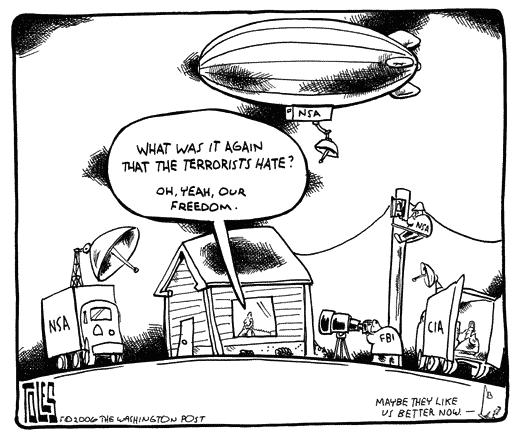
Tuesday, May 16, 2006
What Would it Mean to "Win" the "War on Terror"?
This is exactly right.
I've had my share of heated debates with conservatives who claim we are winning the war on terror because we haven't been attacked since 9/11. But only those with a myopic view of the conflict can make such a claim. Limiting the definition of success solely to the physical safety of Americans fails to take into account that the goal of al Qaeda is not merely to cause death, but to cause a destruction of the very thing that defines us as Americans: our freedom.
As the President said the day the towers fell, "our way of life, our very freedom" was attacked. And how have we responded in the past five years? Not by preserving our way of life, not by zealously gaurding our freedom, but by surrendering.
Read the whole thing.
In a previous post I said I wasn't afraid of terrorism. I was in Washington, D.C. on the morning of 9-11 and since I work for the federal government, which presumably remains a terrorist target generally, and since I commute to work in D.C. via the metro rail system--as likely a terrorist target as any in the area, I think I have as much right as anyone to speak for those of us most likely to be affected by future terrorist actions. And I ain't afraid. And I ain't moved by conservative bullying to surrender my first and fourth amendment rights to pacify their own fears or satisfy their authoritarian ambitions.
John Kerry was criticized by fear-mongering right-wingers for saying during one of the debates that he hoped or looked forward to the day when the threat of terrorism would be merely an inconvenience. But Kerry was right to say that, however it may have offended the 101st Fighting Keyboarders.
Democrats basically let Republicans use fear as a baseball bat during the last two election cycles. At the same time, there have been some leading or at least high profile Democrats (Peter Beinert, the DLC) who have stressed the need for Democrats to convince the public they are "serious about national security" and will protect them, and thereby played into Republican hands. That tactic has been a political as well as substantive failure and abdication of the party's responsibility to uphold and protect the Constitution. Here's hoping Democrats have learned something and have the courage to push back on the conservative fear meme.
I've had my share of heated debates with conservatives who claim we are winning the war on terror because we haven't been attacked since 9/11. But only those with a myopic view of the conflict can make such a claim. Limiting the definition of success solely to the physical safety of Americans fails to take into account that the goal of al Qaeda is not merely to cause death, but to cause a destruction of the very thing that defines us as Americans: our freedom.
As the President said the day the towers fell, "our way of life, our very freedom" was attacked. And how have we responded in the past five years? Not by preserving our way of life, not by zealously gaurding our freedom, but by surrendering.
Read the whole thing.
In a previous post I said I wasn't afraid of terrorism. I was in Washington, D.C. on the morning of 9-11 and since I work for the federal government, which presumably remains a terrorist target generally, and since I commute to work in D.C. via the metro rail system--as likely a terrorist target as any in the area, I think I have as much right as anyone to speak for those of us most likely to be affected by future terrorist actions. And I ain't afraid. And I ain't moved by conservative bullying to surrender my first and fourth amendment rights to pacify their own fears or satisfy their authoritarian ambitions.
John Kerry was criticized by fear-mongering right-wingers for saying during one of the debates that he hoped or looked forward to the day when the threat of terrorism would be merely an inconvenience. But Kerry was right to say that, however it may have offended the 101st Fighting Keyboarders.
Democrats basically let Republicans use fear as a baseball bat during the last two election cycles. At the same time, there have been some leading or at least high profile Democrats (Peter Beinert, the DLC) who have stressed the need for Democrats to convince the public they are "serious about national security" and will protect them, and thereby played into Republican hands. That tactic has been a political as well as substantive failure and abdication of the party's responsibility to uphold and protect the Constitution. Here's hoping Democrats have learned something and have the courage to push back on the conservative fear meme.
What about the Canadian Border?
Although I can't say I'm terribly concerned about the threat of terrorism generally or the threat of would-be terrorists crossing the Mexican border in particular, I have to admit that the need to tighten our borders to guard against the potential from terrorist infiltration at least has some logical merit.
Which is why I'm a little surprised that that angle hasn't been a real common one in the array of anti-immigration complaints I've been hearing, watching, or reading about.
Most of the anti-immigrant apologetics seem either spurriously convenient (illegal immigrants drive down wages) or blatantly racist (illegal immigration from Mexico is why phone services have "if you speak English, press 1" options).
Moreover, if stopping terrorist infiltration was the over-riding concern, as I would think it would be in a post-911 world, where is the call for walling off our Canadian border? Surely terrorist infiltration, if it is to come, is just as likely, if not more so, to come over the Canadian border as over the Mexican one.
No, despite all the frantic demands on the part of the right that we abandon any and all civil liberties to ensure we aren't attacked by terrorists again, the terrorist threat potentially posed by immigration seems almost off the radar. This leads me to think that neither the rabidly anti-civil liberties right nor the rabidly anti-immigration right are sincere (imagine that). Of course, even were terrorism the main fear element of the anti-immigration movement, it wouldn't mean it wasn't based in part or in whole on racist fears and demogoguery.
But the relative absence of terrorism from the anti-immigration debate is suprising nonetheless.
Which is why I'm a little surprised that that angle hasn't been a real common one in the array of anti-immigration complaints I've been hearing, watching, or reading about.
Most of the anti-immigrant apologetics seem either spurriously convenient (illegal immigrants drive down wages) or blatantly racist (illegal immigration from Mexico is why phone services have "if you speak English, press 1" options).
Moreover, if stopping terrorist infiltration was the over-riding concern, as I would think it would be in a post-911 world, where is the call for walling off our Canadian border? Surely terrorist infiltration, if it is to come, is just as likely, if not more so, to come over the Canadian border as over the Mexican one.
No, despite all the frantic demands on the part of the right that we abandon any and all civil liberties to ensure we aren't attacked by terrorists again, the terrorist threat potentially posed by immigration seems almost off the radar. This leads me to think that neither the rabidly anti-civil liberties right nor the rabidly anti-immigration right are sincere (imagine that). Of course, even were terrorism the main fear element of the anti-immigration movement, it wouldn't mean it wasn't based in part or in whole on racist fears and demogoguery.
But the relative absence of terrorism from the anti-immigration debate is suprising nonetheless.
Immigration--A Tipping Point?
I don't know if we've reached, or are reaching a Tipping Point where the Republican majority begins to disintegrate, but I think there are a number of reasons to wonder where the conservative movement goes from here, especially if the conservative chatter after last night's prez address is at all reflective of the movement's strains.
As Glenn Greenwald suggests, the Republican Party breakdown on immigration, at this particular time, probably owes a lot to the fact that the war in Iraq has failed to live up to its billing; it's producing neither clear-cut military or moral victories.
But as Barbara at Mahablog discusses, there's certainly more going on, above as well as beneath the surface, here than immigration politics and the war in Iraq. The last four decades have represented what political scientists refer to as a secular realignment; a realignment in party control that develops over a period of time, as opposed to the type of party realignments that stems from a crisis event (i.e. the Great Depression). That gradual-ness has allowed the party elite to draw ever widening groups of the electorate into its fold, largely based on symbolic and rhetorical gestures (the flag, religious values, etc) without signficantly altering the basic structure of American society and government and without therefore turning off essential components of the political middle. The downside for the Republican Party is that its more baser elements are tired of the slow process of change and now want more visible and substantive results. The party's further downside is that to implement the changes demanded by its baser elements would be infeasible.
The appointment of two conservative justices to the Surpreme Court, and the passage in South Dakota of an abortion-criminalization law highlight the risk involved in moving the party further to the right on social issues. It was one thing to call abortion murder when conservatives weren't running all three branches of government. It's another thing alltogether to implement the logical extensions of the abortion-is-murder argument and criminalize abortion providers and abortion consumers.
Taxes represent another problematic front. Cutting government to the bone was a lot easier spoken of in theory, from outside the halls of power, than it was once the party was in charge of government. Even though conservatives were more than willing to let most dimensions of federal capabilities and authority whither on the vine (like FEMA), today's conservative movement actually has little to do with the frequent calls for "smaller government" that it's rhetoricians have been broadcasting at least since the Reagan era. Conservatives very much want big government to do things--like "enforce our borders" and eliminate the opposition (us liberals). Those types of things tend to require government employees and structure of some kind, which all in turn, require money. Tax money. The marginal utility to be derived from the "tax cuts today, tomorrow, and forever" part of the Republican Party platform is all but used up.
Finally, the "war on terror" rhetoric is also wearing thin. Wars are exciting for a certain class of the conservative movement. But unfortunately for this class, they are finding out that war is a pretty limited instrument, especially when it's discovered that it involves material and physical sacrifice to implement. And this most conservatives, comfortable in their homes with their keyboards, are unwilling to follow through on.
This reluctance to put its money where its mouth is, is probably the decisive factor preventing (at least for now) the full flowering of a fascist party in the U.S. Conservatives talk tough, they may make death threats to celebrities or schoolchildren, they may call for eliminating liberals from their audiences, from the nation's campuses, and from society, but in the final analysis, the conservative movement lacks the Will to implement its dreams. It is cowardly.
Put simply, the conservative movement is at, or at least very near, a breaking point between its rhetorical and symbolic goals on the one hand, and the policy choices needed to implement its rhetoric on the other.
As Glenn Greenwald suggests, the Republican Party breakdown on immigration, at this particular time, probably owes a lot to the fact that the war in Iraq has failed to live up to its billing; it's producing neither clear-cut military or moral victories.
But as Barbara at Mahablog discusses, there's certainly more going on, above as well as beneath the surface, here than immigration politics and the war in Iraq. The last four decades have represented what political scientists refer to as a secular realignment; a realignment in party control that develops over a period of time, as opposed to the type of party realignments that stems from a crisis event (i.e. the Great Depression). That gradual-ness has allowed the party elite to draw ever widening groups of the electorate into its fold, largely based on symbolic and rhetorical gestures (the flag, religious values, etc) without signficantly altering the basic structure of American society and government and without therefore turning off essential components of the political middle. The downside for the Republican Party is that its more baser elements are tired of the slow process of change and now want more visible and substantive results. The party's further downside is that to implement the changes demanded by its baser elements would be infeasible.
The appointment of two conservative justices to the Surpreme Court, and the passage in South Dakota of an abortion-criminalization law highlight the risk involved in moving the party further to the right on social issues. It was one thing to call abortion murder when conservatives weren't running all three branches of government. It's another thing alltogether to implement the logical extensions of the abortion-is-murder argument and criminalize abortion providers and abortion consumers.
Taxes represent another problematic front. Cutting government to the bone was a lot easier spoken of in theory, from outside the halls of power, than it was once the party was in charge of government. Even though conservatives were more than willing to let most dimensions of federal capabilities and authority whither on the vine (like FEMA), today's conservative movement actually has little to do with the frequent calls for "smaller government" that it's rhetoricians have been broadcasting at least since the Reagan era. Conservatives very much want big government to do things--like "enforce our borders" and eliminate the opposition (us liberals). Those types of things tend to require government employees and structure of some kind, which all in turn, require money. Tax money. The marginal utility to be derived from the "tax cuts today, tomorrow, and forever" part of the Republican Party platform is all but used up.
Finally, the "war on terror" rhetoric is also wearing thin. Wars are exciting for a certain class of the conservative movement. But unfortunately for this class, they are finding out that war is a pretty limited instrument, especially when it's discovered that it involves material and physical sacrifice to implement. And this most conservatives, comfortable in their homes with their keyboards, are unwilling to follow through on.
This reluctance to put its money where its mouth is, is probably the decisive factor preventing (at least for now) the full flowering of a fascist party in the U.S. Conservatives talk tough, they may make death threats to celebrities or schoolchildren, they may call for eliminating liberals from their audiences, from the nation's campuses, and from society, but in the final analysis, the conservative movement lacks the Will to implement its dreams. It is cowardly.
Put simply, the conservative movement is at, or at least very near, a breaking point between its rhetorical and symbolic goals on the one hand, and the policy choices needed to implement its rhetoric on the other.
Defending Joe Klein*
So Joe's gone and done it again--put his foot in the mouth with some derogatory comments about members of the Democratic Party. And those angry, leftish bloggers are giving him hell.
But I'm afraid Joe needs some sympathy here. Yes, yes, it's true that Charley Rangel and John Conyers are technically war vets, but that doesn't change the fact that their long congressional careers are an embarassment. An embarassment How and to Who you ask? Why, to Joe Klein of course.
Try to put yourself in Joe's shoes. He's got a kool gig at Time, writin' a weekly column, hanging out with the other kool kidz; and he does all those cable TV "news" programs, where he's a special kinda pundit, the "liberal" kind. And as much fun and rewarding the comradery and cash are from these posts, the truth is it continually puts him in the difficult position of having to try to defend liberalism and liberals to all his conservative friends. And it would sure be a lot easier to do that if the liberal party's leadership didn't contain black folks, and the worse kind of black folks--the kind that aim to raise a fuss.
And what's all this talk about hearings and impeachments if Democrats win Congress? That's not how we unite a divided nation or reassure the real, regular Americans in fly-over country.
Joe notices his friends raise their eyebrows whenever uppitidy Democrats show up with inflammatory comments in the press, and it embarasses him. Joe wishes these Dems would be quiet.
And besides, don't Democrats realize that if they allow black Democrats a prominent place in committees and in the media, that the nice Republicans will be forced to make race and Democratic anger issues in the 2006 campaign? And don't Democrats realize that the sight of angry, black Democrats in Congress trying to lead investigations into a popular administration will cause a backlash among centrist voters? Joe is really trying to do "his" party a favor.
So all you angry, lefty-liberal bloggers, you lay off of Joe Klein.
*This post is intended as Satire.
But I'm afraid Joe needs some sympathy here. Yes, yes, it's true that Charley Rangel and John Conyers are technically war vets, but that doesn't change the fact that their long congressional careers are an embarassment. An embarassment How and to Who you ask? Why, to Joe Klein of course.
Try to put yourself in Joe's shoes. He's got a kool gig at Time, writin' a weekly column, hanging out with the other kool kidz; and he does all those cable TV "news" programs, where he's a special kinda pundit, the "liberal" kind. And as much fun and rewarding the comradery and cash are from these posts, the truth is it continually puts him in the difficult position of having to try to defend liberalism and liberals to all his conservative friends. And it would sure be a lot easier to do that if the liberal party's leadership didn't contain black folks, and the worse kind of black folks--the kind that aim to raise a fuss.
And what's all this talk about hearings and impeachments if Democrats win Congress? That's not how we unite a divided nation or reassure the real, regular Americans in fly-over country.
Joe notices his friends raise their eyebrows whenever uppitidy Democrats show up with inflammatory comments in the press, and it embarasses him. Joe wishes these Dems would be quiet.
And besides, don't Democrats realize that if they allow black Democrats a prominent place in committees and in the media, that the nice Republicans will be forced to make race and Democratic anger issues in the 2006 campaign? And don't Democrats realize that the sight of angry, black Democrats in Congress trying to lead investigations into a popular administration will cause a backlash among centrist voters? Joe is really trying to do "his" party a favor.
So all you angry, lefty-liberal bloggers, you lay off of Joe Klein.
*This post is intended as Satire.
Sunday, May 14, 2006
American Theocracy's Hostile Takeover, Part 1
Picked up the Philips and Sirota books last week and have read a few chapters from each. I think both books represent opposite sides of the same coin. Philips' is generally a macro perspective of the effects of corporate conglomeration and political influence on aggregate U.S. finances and the U.S.'s role in the international system, while Sirota's is more of a micro analysis, concerned more about the distributional impacts of recent corporate induced policies flowing out of Washington on the American middle class. And both books in turn sound a great deal like Thomas Franks' What's the Matter with Kansas? that came out last year, synthesizing the conservative movement's melding of economic corporatism and religious fundamentalism.
Sirota's book covers a wider range of specific policies, from taxes to debt and pensions. Although each chapter can be read alone, it's clear they are linked, all representing how Big Business has acted to reduce the participation and influence of workers and consumers by funding political campaigns, formulating policy options, and manipulating public opinion to further its goals.
Sirota's book is certainly the more infuriating of the two. Reading the chapters on debt and legal rights, for example, is enough to make you want to shoot somebody in the face (by accident of course, during a hunting trip). The tone and structure of the book is in some ways similar to the style of conservative reactionary pamphlets on "moral relativism", moral values, religion in the public square, etc, that the Mellon's and Scaife's have financed over the past couple of decades from the right, meant to shock and inflame, but on closer examination, lacking the sort of context, nuance and balance necessary for a well-informed view on the issues. For example, in the pensions chapter, Sirota refers to the (relatively recent) corporate practice of converting traditional defined benefit (db) pension plans for employees into "cash-balance" plans, leaving the recipient with a lump sum distribution presumably lower than what an annuitized db payout would provide. But Sirota doesn't indicate how prevalent this is or what it's magnitude is in the market-place.
Sirota also provides anecdotal evidence of cases in which corporations (like United Airlines) have apparently sued the employees or retirees in order to recoup or limit their pension obligations. But Sirota doesn't mention the protection offered employees by way of the Pension Benefit Guarantee Corporation, which insures private, db style pension plans. Nor does Sirota refer to the shift in private pension plan coverage from db to defined contribution (dc), which while it offers some employees the potential for higher investment returns, also involves a shift in risk from the employer (i.e. social or collective risk) to the worker and retiree (i.e. individual risk). This shift in risk is an important feature of Sirota's overall narrative (and an important political dynamic I think) and I'm a bit surprised he doesn't make this connection.
Likewise, while last year's bankrupcy "reform" bill was truly excretable, a payback to credit card companies that generously fund congressional campaigns and a shaft to vulnerable families, and while the loan shark level of interest rates companies can charge is inherently immoral and predatory, Sirota's, and the Democratic Party's opportunity for generating the appropriate public outrage over them will be difficult as long as the middle class homes in neighborhoods like mine continue to showcase one or two SUV's. If people are doing well, if unemployment is low, if the economy is "growing", I suspect that Democratic efforts to drive up middle class economic angst through a populist sort of appeal may fall short. It's worth trying, and the corruptness of the current regime and processes need to be pointed out, but I'm not optimistic.
In short, while Sirota is good at dialing up the outrage for us progressive types, as long as the political economy debate is confined to individual anectdotes and issues of redistribution progressives will probably have a hard time making use of them.
More interesting to me in some ways and more important in the long run I believe is the implication many of these policies--and the forces making them operative--have for the U.S.'s overall economic health, financial stability, and standing in the international arena.
Here's where Philips' book comes in. Philips takes many of the strands of Sirota's book and weaves them into a larger narrative of how the U.S. is weakened nationally and internationally through policies favoring financial deregulation, debt expansion, and oil dependence. Philips provides data showing that the U.S. economic sector has changed dramatically in the past 20 to 30 years, from one based on manufacturing to one based on financial services. And contrary to standard conservative economic philosophy which asserts that the U.S. national government shouldn't pick winners or losers, Philips asserts that U.S. policymakers have done just that in encouraging financial deregulation, allowing banking and insurance interests, for example, to both be conducted under the auspices of particular companies. Likewise, the increase in debt by the government and by U.S. households provides an additional troubling harbinger of future economic prospects.
Philips' perspective thus provides a framework for understanding how individual policy choices, like the kind Sirota highlights, shape the nation's overall economic future in the aggregate and how we can understand the apparent disjunction between soaring personal debt and a growing economy. Based on Philips' data and arguments, both individual and national economic prosperity are at a considerable risk given our consumption and financing patterns.
Of course, America's economic hegemony has been pronounced dead, or at least on life support before, only to rebound at least in the short run. But the data and narratives contructed by Sirota and Philips, originating largely from unrelated points on the political-economic map, would seem to indicate that the U.S. economy and political superstructure could be soon facing a point of reckoning. At least we can say we've been warned.
As I finish reading these books I hope to have more to say on these issues, especially Philips' explanation of how religious changes in America have contributed to its economic ones.
For now, if you're wondering what's going on at the political level, given recent developments with the NSA, read this.
Sirota's book covers a wider range of specific policies, from taxes to debt and pensions. Although each chapter can be read alone, it's clear they are linked, all representing how Big Business has acted to reduce the participation and influence of workers and consumers by funding political campaigns, formulating policy options, and manipulating public opinion to further its goals.
Sirota's book is certainly the more infuriating of the two. Reading the chapters on debt and legal rights, for example, is enough to make you want to shoot somebody in the face (by accident of course, during a hunting trip). The tone and structure of the book is in some ways similar to the style of conservative reactionary pamphlets on "moral relativism", moral values, religion in the public square, etc, that the Mellon's and Scaife's have financed over the past couple of decades from the right, meant to shock and inflame, but on closer examination, lacking the sort of context, nuance and balance necessary for a well-informed view on the issues. For example, in the pensions chapter, Sirota refers to the (relatively recent) corporate practice of converting traditional defined benefit (db) pension plans for employees into "cash-balance" plans, leaving the recipient with a lump sum distribution presumably lower than what an annuitized db payout would provide. But Sirota doesn't indicate how prevalent this is or what it's magnitude is in the market-place.
Sirota also provides anecdotal evidence of cases in which corporations (like United Airlines) have apparently sued the employees or retirees in order to recoup or limit their pension obligations. But Sirota doesn't mention the protection offered employees by way of the Pension Benefit Guarantee Corporation, which insures private, db style pension plans. Nor does Sirota refer to the shift in private pension plan coverage from db to defined contribution (dc), which while it offers some employees the potential for higher investment returns, also involves a shift in risk from the employer (i.e. social or collective risk) to the worker and retiree (i.e. individual risk). This shift in risk is an important feature of Sirota's overall narrative (and an important political dynamic I think) and I'm a bit surprised he doesn't make this connection.
Likewise, while last year's bankrupcy "reform" bill was truly excretable, a payback to credit card companies that generously fund congressional campaigns and a shaft to vulnerable families, and while the loan shark level of interest rates companies can charge is inherently immoral and predatory, Sirota's, and the Democratic Party's opportunity for generating the appropriate public outrage over them will be difficult as long as the middle class homes in neighborhoods like mine continue to showcase one or two SUV's. If people are doing well, if unemployment is low, if the economy is "growing", I suspect that Democratic efforts to drive up middle class economic angst through a populist sort of appeal may fall short. It's worth trying, and the corruptness of the current regime and processes need to be pointed out, but I'm not optimistic.
In short, while Sirota is good at dialing up the outrage for us progressive types, as long as the political economy debate is confined to individual anectdotes and issues of redistribution progressives will probably have a hard time making use of them.
More interesting to me in some ways and more important in the long run I believe is the implication many of these policies--and the forces making them operative--have for the U.S.'s overall economic health, financial stability, and standing in the international arena.
Here's where Philips' book comes in. Philips takes many of the strands of Sirota's book and weaves them into a larger narrative of how the U.S. is weakened nationally and internationally through policies favoring financial deregulation, debt expansion, and oil dependence. Philips provides data showing that the U.S. economic sector has changed dramatically in the past 20 to 30 years, from one based on manufacturing to one based on financial services. And contrary to standard conservative economic philosophy which asserts that the U.S. national government shouldn't pick winners or losers, Philips asserts that U.S. policymakers have done just that in encouraging financial deregulation, allowing banking and insurance interests, for example, to both be conducted under the auspices of particular companies. Likewise, the increase in debt by the government and by U.S. households provides an additional troubling harbinger of future economic prospects.
Philips' perspective thus provides a framework for understanding how individual policy choices, like the kind Sirota highlights, shape the nation's overall economic future in the aggregate and how we can understand the apparent disjunction between soaring personal debt and a growing economy. Based on Philips' data and arguments, both individual and national economic prosperity are at a considerable risk given our consumption and financing patterns.
Of course, America's economic hegemony has been pronounced dead, or at least on life support before, only to rebound at least in the short run. But the data and narratives contructed by Sirota and Philips, originating largely from unrelated points on the political-economic map, would seem to indicate that the U.S. economy and political superstructure could be soon facing a point of reckoning. At least we can say we've been warned.
As I finish reading these books I hope to have more to say on these issues, especially Philips' explanation of how religious changes in America have contributed to its economic ones.
For now, if you're wondering what's going on at the political level, given recent developments with the NSA, read this.
Subscribe to:
Posts (Atom)