I've had some more time to think about Michael Tomasky's TAP essay on Communitarianism and the Democratic Party.
First, consider this passage from his essay:
For many years -- during their years of dominance and success, the period of the New Deal up through the first part of the Great Society -- the Democrats practiced a brand of liberalism quite different from today’s. Yes, it certainly sought to expand both rights and prosperity. But it did something more: That liberalism was built around the idea -- the philosophical principle -- that citizens should be called upon to look beyond their own self-interest and work for a greater common interest.
This, historically, is the moral basis of liberal governance -- not justice, not equality, not rights, not diversity, not government, and not even prosperity or opportunity. Liberal governance is about demanding of citizens that they balance self-interest with common interest.
This, I think, is exactly wrong.
First, I would argue that the "demand" (his words) for citizens to balance their self-interest with common interest is precisely the basis of just about every conservative critique of modern culture, from abortion to gay rights and school prayer. It might not have anything to do with the Republican's economic agenda, but it has everything to do with its cultural one. The conservative critique of modernity is precisely the liberal democratic notion that people should be reasonably free to live their lives on their own terms, as they see fit, provided they are not directly or significantly harming others. For conservatives, the type of individualism that allows and even encourages personal freedom of expression is anathema. In contrast, it seems vital to me that modern liberalism and the emancipation of the individual that it desires be given a voice from at least one political party in the country, and since Republicans, with their base of fundamentalist Christians are not inclined to provide it, Democrats can and must.
Second, the basis for liberal government is not "the demand that citizens place community interest over self-interest" but the belief that the purpose and vision of democracy and its correlary principle--popular sovereignty--is to shift power from royal and religious elites to the common man. Consequently, for liberal governance the essential aim of government (besides that common to all governments of securing order and protection from outside threats) is to diffuse power, to neutralize the concentration of power in the hands of economic, religious or governmental elites. The aim of liberal democratic government is therefore, to empower and liberate the individual, to pull the individual out of the group, as my political theory professor once remarked, to free him or her from the demands and conditional constraints created by private and public power centers against which the individual is unequally matched.
The essential basis of conservative philosophy is that the entity to be protected is society, and that the threat to society is the individual. This is why the conservative movement and the Republican Party have managed to fuse so well. It's economic and social coalitions are not essentially different. Both favor the establishment and enrichment of concentrated power, whether it is the corporation and wealth elite on the economic side, or the religious and cultural elite on the social side. Both demand that the individual be made subservient to a group or groups in society that dictate or constrain the individual's actions.
Attempts by Democratic Party leaders and strategists to articulate a response to the conservative menace to freedom tend to break down because, such as is the case with Communitarianism, it fails to link the economic and social wings and coalition members of the party. Tomasky's Communitarianism thus attempts to find an appealing rationale for the Party's economic agenda, be it Social Security, Medicare or aid to education, and to do so, comes forth with the notion of the public good versus individual self interest. This sounds all well and good until one recognizes that applied to the social and cultural sphere, it leads towards intrusion upon the individual and an invasion of the family's right to privacy.
The reason modern liberalism has embraced both income support and redistribution policies on the economic front, and civil liberties issues on the social and cultural front is because both aim to ensure that economic and religious foundations of power are mitigated to at least some degree, allowing the individual and the family to be more fully free.
If Democrats want to overcome the challenge to freedom and liberty represented by the Republican Party, it can best do this by emphasizing that the individual freedoms it seeks to protect (and of which Republican conservatives and Tomasky seem so contemptful) and opportunity it seeks to grant are equally important for the family as for the individual. Instead of talking about the individual right to privacy, liberals should talk about the family right to privacy. I believe this would allow the party to articulate and defend its civil liberty concerns (i.e. abortion and gay rights, voting rights, affirmative action, etc) a language that would at least partially negate the negative connotations that many in the conservative media and religious industrial complex* have tried to apply to the Democratic Party's pluralist goals and voting patterns.
For another example, consider the issue of NSA wire-taps. From Tomasky's Communitarian point of view, the president is basically right to do whatever he wants to "fight terrorism", even if that means invading a family's privacy without a warrant, because it is in the common interest, and liberal Democrats should just stop complaining about it and whining about individual rights, which are really pretty pesky things that need to be bulldozed in the name of the common good. Obviously, this will not do for a Democratic vision of governance, or at least one that seeks to provide checks on concentrated power, whether in the government or in society as a whole.
In short, the unifying element of modern liberalism is not the common good, as articulated by Tomasky, but the need to reduce the adverse effects of concentrated power. By reducing the adverse effects of concentrated power, the common good, in the pluralist and best sense of the word, is also preserved.
For an additional critique of Tomasky's Communitarianism see Digby's post.
*I'll elaborate on this concept in a future post.
Saturday, April 22, 2006


Thursday, April 20, 2006
Recasting the War on Terror
This week brought with it two new attempts by Democratic thinkers to jump-start a 2006-2008 campaign message and articulate a broader Party rationale.
One was published at The American Prospect by Michael Tomasky. The short version is Tomasky outlines two variants of liberalism, the first a nationalistic and communitarian "responsibilities over rights", "we're all in this together" paradigm, the second an individualistic-rights-equality-justice paradigm that supposedly came out of the late 1960's and whose one-issue-interest group nature has been responsible for driving many white Democrats to the Republican Party. Tomasky favors Democrats going "back" to the first paradigm, which he says was the heritage of the good old Democrats like FDR, Truman, Kennedy, Johnson and Clinton. Tomasky makes a fair share of good points in the essay, but overall his message sounds an awful lot like DLC-light.
The second was drawn up by Democratic economists Roger Altman, Pete Orzag, and Robert Rubin. This group of Clinton era administrators has billed itself and its approach as "Hamiltonian". The authors favor balanced budgets, and greater government "investments" in education, health care, and worker retraining.
The best that can probably be said about each piece is they at least say something; they're a start. But both strike me as largely "political" approaches to recasting the party's message as opposed to viewing the party as a means of addressing the greater, structural problems the nation faces.
One example of this is that neither set of authors says much about the "war on terror" or national security. How should Democrats approach the "war on terror"? Or better yet, the question should be, what do Democrats actually think about the 9-11 attacks, Al Qaeda, and the threat of "terrorism"? Not how should Democrats spin national security as a policy matter but what do Democrats actually think about the threat of terrorism and perhaps more broadly, radical Islam?
Since I'm a progressive Democrat I'll give it a shot. There are three primary lessons I draw about Al Qaeda from 911 that would seem important for Democrats to articulate and address.
First, the terror attacks remind us that our problems are as much global as domestic. The World is Flat, as Thomas Friedman says. In other words, while improving our education systems, reducing marked income inequality, and expanding access to health care within the U.S. are important, our major challenges, particularly from the point of view of the federal government, continue to lie outside our borders. And what are these challenges? Ultimately, "oil dependency" generally, but something more serious and alarming--the disparity of well-being and resource-use between between us and the rest of the world. A NY Times article and editorial this week pointed out that the U.S. consumes 20 million gallons of oil per day, while our nearest "competitor", China, consumes 6.5 million. And China has about one billion more people than we do. Bluntly, we're consuming too much of the world's stuff. No amount of war-mongering or sabor-rattling is going to ensure our dominance in this area. Gas is back up to $3 a gallon in the U.S. If the party isn't over, the fat lady is about ready to sing. And needless to say, the issue of global income and opportunity disparities is a key contributor to the vitriolic immigration debate.
How will the U.S. begin to address these disparities? Is working towards greater free trade and open trade borders the answer? This is not an invitation to Democrats to pander to local constituencies, as legitimate as that might be, or to revert to knee-jerk protectionism rants. It's an invitation for Democrats to evaluate how our trade and international business policies are working, not just for our own immediate "good" but for the well-being of all mankind. This is not just being altruistic, although that would be OK, too. It's vital for our survival that other countries be successful economically and create the right kinds of opportunities for their populations.
Helping ourselves by helping others is important because if the Iraq war has shown us anything it's that Military Force as the one and only instrument of fighting "terrorism" is rather limited at best, badly flawed at worst. This is the second main lesson I draw from the 911 attacks on our shores. Tough talk and shock and awe will only get us so far. We can't blow up every country, or legitimately even threaten to blow up every country we think might endanger us. Liberals expressed a deep concern with the Bush administration's "pre-emptive force doctrine", but the truth is, no matter what our stated policy, military force can't be used in all, or even most cases. In fact, it can only be used rarely if at all. Three years after toppling Saddam Hussein, we have every indication that from a terrorism perspective, we may have left that country, and by extension ourselves, worse off as a result of the invasion. Nation building ain't easy. Rather than ape Republican rhetoric about being "tough" Democrats should unashamadly argue that the military is a greatly limited tool in the fighting the "war on terror" and that we need to begin to address other means of assuring other nations and their populations that we have their well-being in mind.
The third lesson is that religious fundamentalism is very dangerous. While the 911 attackers were radical Islamists, religious fundamentalism of various stripes has caused a considerable amount of bloodshed throughout history. We have an interest in ensuring that no one religion gets a monopoly on public policy or civil society. Radical Islam, like other variations of puritanical religions, is predicated on the notion that it is the only valid form of human salvation. Once that attitude is given free reign, non-believers can be cast as non-human, as The Other. True religion will protect the freedom of all religions to worship and participate equally in our democracy. Some Republicans give evidence of supporting a regressive, un-Constitutional Christian Reconstructionism. Democrats should ask their opponents if this extremism and exclusivity is what they believe in. Naturally, addressing the problems and role of faith in the public square is controversial. But one of the Democrat's greatest problems in recent years has been a seeming unwillingness to offend anyone. But the growing influence of radical religion in American life can't be ignored in the hope that it will go away. Ignoring the role of radical religion in America will be just as fatal as ignoring it in Afghanistan.
One was published at The American Prospect by Michael Tomasky. The short version is Tomasky outlines two variants of liberalism, the first a nationalistic and communitarian "responsibilities over rights", "we're all in this together" paradigm, the second an individualistic-rights-equality-justice paradigm that supposedly came out of the late 1960's and whose one-issue-interest group nature has been responsible for driving many white Democrats to the Republican Party. Tomasky favors Democrats going "back" to the first paradigm, which he says was the heritage of the good old Democrats like FDR, Truman, Kennedy, Johnson and Clinton. Tomasky makes a fair share of good points in the essay, but overall his message sounds an awful lot like DLC-light.
The second was drawn up by Democratic economists Roger Altman, Pete Orzag, and Robert Rubin. This group of Clinton era administrators has billed itself and its approach as "Hamiltonian". The authors favor balanced budgets, and greater government "investments" in education, health care, and worker retraining.
The best that can probably be said about each piece is they at least say something; they're a start. But both strike me as largely "political" approaches to recasting the party's message as opposed to viewing the party as a means of addressing the greater, structural problems the nation faces.
One example of this is that neither set of authors says much about the "war on terror" or national security. How should Democrats approach the "war on terror"? Or better yet, the question should be, what do Democrats actually think about the 9-11 attacks, Al Qaeda, and the threat of "terrorism"? Not how should Democrats spin national security as a policy matter but what do Democrats actually think about the threat of terrorism and perhaps more broadly, radical Islam?
Since I'm a progressive Democrat I'll give it a shot. There are three primary lessons I draw about Al Qaeda from 911 that would seem important for Democrats to articulate and address.
First, the terror attacks remind us that our problems are as much global as domestic. The World is Flat, as Thomas Friedman says. In other words, while improving our education systems, reducing marked income inequality, and expanding access to health care within the U.S. are important, our major challenges, particularly from the point of view of the federal government, continue to lie outside our borders. And what are these challenges? Ultimately, "oil dependency" generally, but something more serious and alarming--the disparity of well-being and resource-use between between us and the rest of the world. A NY Times article and editorial this week pointed out that the U.S. consumes 20 million gallons of oil per day, while our nearest "competitor", China, consumes 6.5 million. And China has about one billion more people than we do. Bluntly, we're consuming too much of the world's stuff. No amount of war-mongering or sabor-rattling is going to ensure our dominance in this area. Gas is back up to $3 a gallon in the U.S. If the party isn't over, the fat lady is about ready to sing. And needless to say, the issue of global income and opportunity disparities is a key contributor to the vitriolic immigration debate.
How will the U.S. begin to address these disparities? Is working towards greater free trade and open trade borders the answer? This is not an invitation to Democrats to pander to local constituencies, as legitimate as that might be, or to revert to knee-jerk protectionism rants. It's an invitation for Democrats to evaluate how our trade and international business policies are working, not just for our own immediate "good" but for the well-being of all mankind. This is not just being altruistic, although that would be OK, too. It's vital for our survival that other countries be successful economically and create the right kinds of opportunities for their populations.
Helping ourselves by helping others is important because if the Iraq war has shown us anything it's that Military Force as the one and only instrument of fighting "terrorism" is rather limited at best, badly flawed at worst. This is the second main lesson I draw from the 911 attacks on our shores. Tough talk and shock and awe will only get us so far. We can't blow up every country, or legitimately even threaten to blow up every country we think might endanger us. Liberals expressed a deep concern with the Bush administration's "pre-emptive force doctrine", but the truth is, no matter what our stated policy, military force can't be used in all, or even most cases. In fact, it can only be used rarely if at all. Three years after toppling Saddam Hussein, we have every indication that from a terrorism perspective, we may have left that country, and by extension ourselves, worse off as a result of the invasion. Nation building ain't easy. Rather than ape Republican rhetoric about being "tough" Democrats should unashamadly argue that the military is a greatly limited tool in the fighting the "war on terror" and that we need to begin to address other means of assuring other nations and their populations that we have their well-being in mind.
The third lesson is that religious fundamentalism is very dangerous. While the 911 attackers were radical Islamists, religious fundamentalism of various stripes has caused a considerable amount of bloodshed throughout history. We have an interest in ensuring that no one religion gets a monopoly on public policy or civil society. Radical Islam, like other variations of puritanical religions, is predicated on the notion that it is the only valid form of human salvation. Once that attitude is given free reign, non-believers can be cast as non-human, as The Other. True religion will protect the freedom of all religions to worship and participate equally in our democracy. Some Republicans give evidence of supporting a regressive, un-Constitutional Christian Reconstructionism. Democrats should ask their opponents if this extremism and exclusivity is what they believe in. Naturally, addressing the problems and role of faith in the public square is controversial. But one of the Democrat's greatest problems in recent years has been a seeming unwillingness to offend anyone. But the growing influence of radical religion in American life can't be ignored in the hope that it will go away. Ignoring the role of radical religion in America will be just as fatal as ignoring it in Afghanistan.
Tuesday, April 18, 2006
The Chicago Way
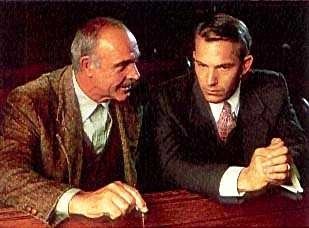
Malone: You said you wanted to get Capone. Do you really wanna get him? You see what I'm saying is, what are you prepared to do?
Eliot Ness: Anything and everything in my power.
Malone: And *then* what are you prepared to do? If you open the can on these worms you must be prepared to go all the way because they're not gonna give up the fight until one of you is dead.
Eliot Ness: How do you do it then?
Malone: You wanna know how you do it? Here's how, they pull a knife, you pull a gun. He sends one of yours to the hospital, you send one of his to the morgue. That's the Chicago way, and that's how you get Capone! Now do you want to do that? Are you ready to do that?
Eliot Ness: I have sworn to capture this man with all legal powers at my disposal and I will do so.
Malone: Well, the Lord hates a coward. Do you know what a blood oath is, Mr. Ness?
Eliot Ness: Yes.
Malone: Good, 'cause you just took one.
We live in a strange world. Michelle Malkin publishes the names of students who opposed allowing military recruiters on campus, causing some among her readership to respond to the students with death threats and other forms of harassment. Yet, it's the "left" that's "unhinged".
Nevertheless, it's counterproductive to complain or even point out, as many of my favorite bloggers have, that Malkin's behavior is "over the line" or beyond the pale, and that she should apologize. The Rush Limbaughs, Ann Coulters and Michelle Malkins of the world don't apologize. Calling for their apologies makes them stronger and more vitriolic. It makes them think we're weak. Nor is the corporate media or their political sponsors going to call them on anything they do, no matter how outrageous.
And we've seen this before. Remember the Swiftboaters? The first reaction of the Kerry campaign and many among the left was to call for the ads to be withdrawn and the sponsors to be refuted by decent figures on the political "right" (like John McCain).
That was effective, wasn't it?
There seems to be an assumption on the part of us leftists that the "right" is supposed to be playing by the rules, and they aren't.
Calls for apologies and even factual counter-presentations don't phase the "right's" pundits, screamers and hate-mongerers. It's sad to say, but there's only one language, one tactic that the "right" understands. It's action. There's only one place it recognizes, and that's the gutter.
The emergence of Daily Kos and other Democratic web-sites is proving to be an important force in shaping party politics. But I suspect that many of us are only beginning to understand the nature of the Republican underground, as represented by its talk radio hosts, web-bloggers, cable television networks, "family" advocacy councils, reconstructionist theorists, and anti-intellectual rabble rousers, which play such a large role in elevating or destroying GOP candidacies and cowing the corporate media.
So, as "Malone" might ask of us would-be-nation changers, "what are you prepared to do?...And *then* what are you prepared to do?" Many of us, I know, would rather not play this game, not stoop to the level of raunch politics specialized in by the Michelle Malkins of the world. We live in a democracy where we strive for the values of pluralism, education, and tolerance needed to support a civil society. We'd like to do our anti-war protests and democratic participation peacefully.
But our opponents are not going to let us do that. To even have a chance of turning back the nation's slide towards fascism--and that's where the Savages, Limbaughs, Coulters, and Malkins would lead us--we have to create an environment where liberal ideas can be heard. To do that, liberal groups, individuals, and leaders need to have the protection to act. The "right's" interest is in creating a climate of fear to make sure that we can't act. That's why the UC Santa Cruz group was targeted. As seemingly minor a group or effort as they appeared to be making, the "right" needs to make them an example. Creating fear on the part of the progressive community, or creating ridicule among the mass public for the left, is what the "right" has been specializing in for the last two decades. Even if the press release had not contained contact information, don't think the "right" would be beyond finding that information anyway.
So what am I saying? If we are going to take steps to turn back the tide of militarism and authoritarianism we need to recognize what the other side is prepared to do. And when the Michelle Malkins of the world step "over the line" we need to respond with action, not plaintative words or calls for apologies. We need to become actors, not reactors. We need to become the hunter instead of the hunted. When the Michelle Malkins of the world call for hate-male and death threats from their readers, their hosts need to wonder when and where the next horse's head is going show up under their bed-covers.
That's the Chicago Way.
Yeah, I don't know why either
The perfesser:
Blogger Michael Totten has been blogging from Iraq. The latest installment is here, with links to his earlier posts.
With his detailed first-person reports and excellent photos as he travels the area, Totten is offering a kind of reporting that Big Media seem not to be delivering. I'm not sure why that is, but his stuff -- supported entirely by reader donations -- is well worth your time.
Yeah, I don't know why the corporate media isn't doing his style of reporting either. But maybe this has something to do with it:
Police on Monday found 18 bodies in Baghdad, including a prominent Sunni politician's brother who had been missing about three weeks.
Taha Mutlaq, who disappeared in late March, had been shot several times in the head and appeared to have been tortured, police said.
His brother, Saleh Mutlaq, is the head of the National Dialogue Front, which won 11 seats in Iraq's parliament.
Police also found 17 unidentified bodies around the capital, all of them shot in the head and showing signs of torture.
Twelve of the bodies were discovered in Dora, a Sunni district in southern Baghdad.
Two other bodies were found in Khadhamiya, a Shiite area of northern Baghdad, and three turned up in the Shu'la neighborhood in northwestern Baghdad.
The discovery of bodies killed in similar fashion has been a regular occurrence in Baghdad since sectarian violence flared after an attack on a revered Shiite mosque February 22.
Of course, once Iraq is pacified, a unity government is formed, and the oil is flowing again, there's always Iran.
Blogger Michael Totten has been blogging from Iraq. The latest installment is here, with links to his earlier posts.
With his detailed first-person reports and excellent photos as he travels the area, Totten is offering a kind of reporting that Big Media seem not to be delivering. I'm not sure why that is, but his stuff -- supported entirely by reader donations -- is well worth your time.
Yeah, I don't know why the corporate media isn't doing his style of reporting either. But maybe this has something to do with it:
Police on Monday found 18 bodies in Baghdad, including a prominent Sunni politician's brother who had been missing about three weeks.
Taha Mutlaq, who disappeared in late March, had been shot several times in the head and appeared to have been tortured, police said.
His brother, Saleh Mutlaq, is the head of the National Dialogue Front, which won 11 seats in Iraq's parliament.
Police also found 17 unidentified bodies around the capital, all of them shot in the head and showing signs of torture.
Twelve of the bodies were discovered in Dora, a Sunni district in southern Baghdad.
Two other bodies were found in Khadhamiya, a Shiite area of northern Baghdad, and three turned up in the Shu'la neighborhood in northwestern Baghdad.
The discovery of bodies killed in similar fashion has been a regular occurrence in Baghdad since sectarian violence flared after an attack on a revered Shiite mosque February 22.
Of course, once Iraq is pacified, a unity government is formed, and the oil is flowing again, there's always Iran.
What a Surprise
Georgia Enacts a Tough Law on Immigrants
ATLANTA, April 17 -- Gov. Sonny Perdue signed a sweeping immigration bill on Monday that supporters and critics say gives Georgia some of the nation's toughest measures against illegal immigrants.
The law requires verification that adults who seek many state-administered benefits are in the United States legally. Employers who knowingly hire illegal immigrants face sanctions, and companies with state contracts must check employees' immigration status.
The law also requires that the police check the status of people they arrest.
Many of its provisions will not take effect until July 1, 2007.
The bill drew demonstrators on both sides at the Capitol here and prompted a daylong work stoppage by thousands of immigrants.
The regional counsel for the Mexican American Legal Defense and Educational Fund, Tisha Tallman, said she was studying potential legal challenges.
Governor Perdue, a Republican, said at the signing: "I want to make this clear -- we are not, Georgia's government is not, and this bill is not, anti-immigrant. We simply believe that everyone who lives in our state needs to abide by our laws."
The law will not affect emergency medical care and educational benefits for children in kindergarten through 12th grade. Federal courts have said those programs have to be provided regardless of immigration status.
Exemptions were added for other services like prenatal care and the treatment of communicable diseases.
Outside the Capitol, a few hundred supporters of the law applauded loudly when word came that Mr. Perdue was signing the measure.
The crowd waved American flags and cheered as State Representative Melvin Everson, a black Republican in the House, denounced illegal immigration as a cancer.
"The last time I checked," Mr. Everson said, "America was the land of English, not Spanish."
So the bill and the state are by no means "anti-immigrant" but one of the bill's supporters says (illegal) immigration is a "cancer" and that the last time he "checked", America was the land of the King's English, not Espanol.
Wanna know about "Mr. Everson"?
Melvin was born on September 24, 1957 to the late Northern & Willa Everson of Abbeville, Ga. He attended Wilcox High School and graduated in 1975. After high school he attended Albany State University and graduated in 1983 with a BS in Criminology. Melvin married Geraldine M. Everson and they have one son, Ricardo D. Everson who attended South Gwinnett High School and was an honor graduate. He is a recent graduate from UGA with a B.S. degree in social work. He is currently applying for Law School at UGA.
Melvin served 23 years in the military and just recently retired in 1999. He served 5 years on Snellville's Planning Commission before running a successful campaign to become a council member in 2000. He is a charter member of the Snellville Optimist Club, Associate Pastor of Salem Missionary Baptist Church in Lilburn, Ga., and served on the Take Pride in Snellville Committee. Everson served two terms as President of the South Gwinnett High School PTSA and two terms as Vice President.
Melvin was a fifteen-year employee with JCPenney Catalog as a Customer Relations Supervisor until the company ceased its Atlanta operations in July 2003. During fourteen of those years, Melvin served as the United Way Advisory Member for JCPenney for Clayton, Henry and Butts counties, and just recently completed his tenure as the 2003 campaign chair of United Way in Clayton County. Melvin is currently an Associate Pastor at Salem Missionary Baptist Church and a Probation Officer for Professional Probation Services.
So a black Republican in the South who thinks (illegal) immigration is a "cancer" and who says that the last time he "checked" America was the land of the King's English and not Espanol, although the issue of English-Espanol doesn't appear to have been at all relevant to the legislation at hand, also turns out to be an "associate pastor" of a Baptist church.
Charming. Who'd a thunk it? A Christian and a bigot. In a way, the Christian Right is "right"--it's awfully hard being a Christian these days, especially when we're represented by such fine spokesman as Mr. Everson.
You know what the sad thing is? I checked out Everson's bio because the fact that he was a black Republican in the South piqued my curiosity, and made me suspicious that the guy was probably a right-wing evangelical. And how about that? He is.
And while we're on the subject, what sort of pastor is it that doesn't appear to have anything resembling a religious education? I know I probably sound like some sort of snob, but the Bible was written in Hebrew (the O.T.) and Greek (the N.T.) with some Arabic thrown in for good measure. It usually helps if the pastor preaching the Word is familiar with the Biblical languages or at least has some awareness of the basics of theology. Guess that's not a condition for churches these days.
And what's with this guy's resume? He was born in 1957. He served in the military for 23 years. He was an employee at JC Penney for 15 years. I'm having a hard time with the math. He's 49 years old and has apparently worked for 38 years. Maybe that military career was part-time.
Anyway, it's be nice to hear, for once, of a bigot not being connected to Christianity.
ATLANTA, April 17 -- Gov. Sonny Perdue signed a sweeping immigration bill on Monday that supporters and critics say gives Georgia some of the nation's toughest measures against illegal immigrants.
The law requires verification that adults who seek many state-administered benefits are in the United States legally. Employers who knowingly hire illegal immigrants face sanctions, and companies with state contracts must check employees' immigration status.
The law also requires that the police check the status of people they arrest.
Many of its provisions will not take effect until July 1, 2007.
The bill drew demonstrators on both sides at the Capitol here and prompted a daylong work stoppage by thousands of immigrants.
The regional counsel for the Mexican American Legal Defense and Educational Fund, Tisha Tallman, said she was studying potential legal challenges.
Governor Perdue, a Republican, said at the signing: "I want to make this clear -- we are not, Georgia's government is not, and this bill is not, anti-immigrant. We simply believe that everyone who lives in our state needs to abide by our laws."
The law will not affect emergency medical care and educational benefits for children in kindergarten through 12th grade. Federal courts have said those programs have to be provided regardless of immigration status.
Exemptions were added for other services like prenatal care and the treatment of communicable diseases.
Outside the Capitol, a few hundred supporters of the law applauded loudly when word came that Mr. Perdue was signing the measure.
The crowd waved American flags and cheered as State Representative Melvin Everson, a black Republican in the House, denounced illegal immigration as a cancer.
"The last time I checked," Mr. Everson said, "America was the land of English, not Spanish."
So the bill and the state are by no means "anti-immigrant" but one of the bill's supporters says (illegal) immigration is a "cancer" and that the last time he "checked", America was the land of the King's English, not Espanol.
Wanna know about "Mr. Everson"?
Melvin was born on September 24, 1957 to the late Northern & Willa Everson of Abbeville, Ga. He attended Wilcox High School and graduated in 1975. After high school he attended Albany State University and graduated in 1983 with a BS in Criminology. Melvin married Geraldine M. Everson and they have one son, Ricardo D. Everson who attended South Gwinnett High School and was an honor graduate. He is a recent graduate from UGA with a B.S. degree in social work. He is currently applying for Law School at UGA.
Melvin served 23 years in the military and just recently retired in 1999. He served 5 years on Snellville's Planning Commission before running a successful campaign to become a council member in 2000. He is a charter member of the Snellville Optimist Club, Associate Pastor of Salem Missionary Baptist Church in Lilburn, Ga., and served on the Take Pride in Snellville Committee. Everson served two terms as President of the South Gwinnett High School PTSA and two terms as Vice President.
Melvin was a fifteen-year employee with JCPenney Catalog as a Customer Relations Supervisor until the company ceased its Atlanta operations in July 2003. During fourteen of those years, Melvin served as the United Way Advisory Member for JCPenney for Clayton, Henry and Butts counties, and just recently completed his tenure as the 2003 campaign chair of United Way in Clayton County. Melvin is currently an Associate Pastor at Salem Missionary Baptist Church and a Probation Officer for Professional Probation Services.
So a black Republican in the South who thinks (illegal) immigration is a "cancer" and who says that the last time he "checked" America was the land of the King's English and not Espanol, although the issue of English-Espanol doesn't appear to have been at all relevant to the legislation at hand, also turns out to be an "associate pastor" of a Baptist church.
Charming. Who'd a thunk it? A Christian and a bigot. In a way, the Christian Right is "right"--it's awfully hard being a Christian these days, especially when we're represented by such fine spokesman as Mr. Everson.
You know what the sad thing is? I checked out Everson's bio because the fact that he was a black Republican in the South piqued my curiosity, and made me suspicious that the guy was probably a right-wing evangelical. And how about that? He is.
And while we're on the subject, what sort of pastor is it that doesn't appear to have anything resembling a religious education? I know I probably sound like some sort of snob, but the Bible was written in Hebrew (the O.T.) and Greek (the N.T.) with some Arabic thrown in for good measure. It usually helps if the pastor preaching the Word is familiar with the Biblical languages or at least has some awareness of the basics of theology. Guess that's not a condition for churches these days.
And what's with this guy's resume? He was born in 1957. He served in the military for 23 years. He was an employee at JC Penney for 15 years. I'm having a hard time with the math. He's 49 years old and has apparently worked for 38 years. Maybe that military career was part-time.
Anyway, it's be nice to hear, for once, of a bigot not being connected to Christianity.
Sunday, April 16, 2006
Iran?
I'll admit I'm having a strange reaction to the "wild speculation" about Iran and whether there will soon be "wars and rumors of wars" again in the Middle East.
The strange reaction I'm having is I just don't buy it. Maybe I'm naive or deluded, I don't know which. I just don't think the administration can afford to go there, literally or figuratively. I know they're messianical and inept, but I don't think they're this crazy. Don't get me wrong, the reality based community is well within its rights to begin spreading the alarm, given the snow-balling we got between 9-11 and March 2003. But the administration, someone in the administration, has to know or at least highly suspect what some of the implications would be of an Iran war.
But maybe the administration hasn't yet learned the lesson from Iraq that history is starting to write. Maybe America's power elite thinks Iran will look like Afghanistan and the first few weeks of Gulf War II.
Someone, someday will probably go back and write a very interesting book about the wars America waged between 1981 and 2006. They will write about how after the national trauma delivered by Vietnam, America's military was seemingly resurrected, aided by new technology and the capture of the government by a new conservative elite, dedicated to recreating America as a militant, faux-Christian "City on a Hill" ruled by uncompromising patriots and inhabited by loyally unquestioning citizens.
When they inquire as to America's military excursions in the Reagan era and beyond, they'll no doubt highlight our trampling of Grenada, our clandestine support for right-wing dictatorships in El Salvador, Nicaragua and elsewhere throughout Latin America, our one-time bombing of Libya, the invasion of Panama and capture and trial of Manuel Noriega, and the Reagan era's grand finale, Gulf War I, the route of Saddam Hussein's army and the liberation of Kuwait. This survey of the new American militarism might even include the air-war over Kosovo, leading to the ending of Serb atrocities, the capture of Slabodan Milosovic, and the stabilization of the Balkans by UN and NATO peacekeepers. Finally, the events of 9-11 and the soon to be unleashed invasion of Afghanistan will come under review, serving as the high-point of American triumphalism.
Then this history will turn to Operation Iraqi Freedom, known at the ground level as Cobra II. Before Iraq 2.0, and even in its early stages, the resurgence of America's military might appeared to be a fait accompli. The Reagan tough talk and defense build-up that's been credited in some quarters to the demise of Communism, the against-expectations quick roll-back of Saddam Hussein's invasion of Kuwait within a week's time and a scant loss of American military personnel, and the also relatively successful reconstituting of Afghanistan, where America's Cold War enemy had failed, seemed to all point to limitless possibilities for American military hegemony. New technology assured military victories would be short and relatively painless. Wars were no longer really wars. Not only was a draft or full societal war mobilization necessary, ground troops themselves might rarely be needed.
In a way, it's hard to fault the planners of Gulf War II. The peaceniks had been wrong about Gulf War I and Afghanistan. No chemical or biological weapons had been unleashed as a result of GWI, nor had our oil been shut off. American troops did not get bogged down in Afghanistan as had the Soviets. History had not been a valid guide for assessing just how thoroughly dominate the American military machine had become against third world foes.
In the lead-up to GWII, Defense Secretary Donald Rumsfeld no doubt typified the beliefs of neoconservatives everywhere when he spoke aboard the Intrepid, a WWII air craft carrier anchored in the Hudson river on February 14. His speech was entitled, "Beyond Nation Building". In it, he criticized the nation-building policies of the previous administration saying that in Kosovo, they had created a "culture of dependency". America's new strategy was perfectly illustrated by its Afghanistan campaign where the U.S. was "helping the Afghans build their own country." There was no need for significant troop deployments and nor would there be a long occupation. The Iraq campaign would be even more efficient Rumsfeld promised. Iraq was rich in oil and the administration had more time to prepare the postwar plan.*
But as the last three years have demonstrated, GWII would be the first black mark in America's new military era. Iraq has and is demonstrating that war cannot be fought on the cheap, with magical bombers that alleviate the need for "boots on the ground" and large-scale sacrifices at home. If there is an Iranian invasion, the 101st Fighting Keyboarders won't get to stay downstairs in the basement or on campus flying yellow ribbons at support the troop bake sales.
This is why I don't think there will be military action against Iran. I don't see it stopping or being limited to a few smart bombs against selected, well known targets. Air attacks on Iran would prompt a response, in Iraq and elsewhere, that would rise above the level anyone could write off as being liberal defeatism.
The neocon's military party is over. Iraq was the beginning of the end of it. If there is an Iran, the neoconservative agenda will be sent back to the stone-age.
And that book on 1981-2006 American military history will be quite a read. In the meantime, and for an alternative perspective, read what Billmon has to say.
*Taken from the book, Cobra II, by Michael R. Gordon and General Bernard E. Trainor, page 151.
The strange reaction I'm having is I just don't buy it. Maybe I'm naive or deluded, I don't know which. I just don't think the administration can afford to go there, literally or figuratively. I know they're messianical and inept, but I don't think they're this crazy. Don't get me wrong, the reality based community is well within its rights to begin spreading the alarm, given the snow-balling we got between 9-11 and March 2003. But the administration, someone in the administration, has to know or at least highly suspect what some of the implications would be of an Iran war.
But maybe the administration hasn't yet learned the lesson from Iraq that history is starting to write. Maybe America's power elite thinks Iran will look like Afghanistan and the first few weeks of Gulf War II.
Someone, someday will probably go back and write a very interesting book about the wars America waged between 1981 and 2006. They will write about how after the national trauma delivered by Vietnam, America's military was seemingly resurrected, aided by new technology and the capture of the government by a new conservative elite, dedicated to recreating America as a militant, faux-Christian "City on a Hill" ruled by uncompromising patriots and inhabited by loyally unquestioning citizens.
When they inquire as to America's military excursions in the Reagan era and beyond, they'll no doubt highlight our trampling of Grenada, our clandestine support for right-wing dictatorships in El Salvador, Nicaragua and elsewhere throughout Latin America, our one-time bombing of Libya, the invasion of Panama and capture and trial of Manuel Noriega, and the Reagan era's grand finale, Gulf War I, the route of Saddam Hussein's army and the liberation of Kuwait. This survey of the new American militarism might even include the air-war over Kosovo, leading to the ending of Serb atrocities, the capture of Slabodan Milosovic, and the stabilization of the Balkans by UN and NATO peacekeepers. Finally, the events of 9-11 and the soon to be unleashed invasion of Afghanistan will come under review, serving as the high-point of American triumphalism.
Then this history will turn to Operation Iraqi Freedom, known at the ground level as Cobra II. Before Iraq 2.0, and even in its early stages, the resurgence of America's military might appeared to be a fait accompli. The Reagan tough talk and defense build-up that's been credited in some quarters to the demise of Communism, the against-expectations quick roll-back of Saddam Hussein's invasion of Kuwait within a week's time and a scant loss of American military personnel, and the also relatively successful reconstituting of Afghanistan, where America's Cold War enemy had failed, seemed to all point to limitless possibilities for American military hegemony. New technology assured military victories would be short and relatively painless. Wars were no longer really wars. Not only was a draft or full societal war mobilization necessary, ground troops themselves might rarely be needed.
In a way, it's hard to fault the planners of Gulf War II. The peaceniks had been wrong about Gulf War I and Afghanistan. No chemical or biological weapons had been unleashed as a result of GWI, nor had our oil been shut off. American troops did not get bogged down in Afghanistan as had the Soviets. History had not been a valid guide for assessing just how thoroughly dominate the American military machine had become against third world foes.
In the lead-up to GWII, Defense Secretary Donald Rumsfeld no doubt typified the beliefs of neoconservatives everywhere when he spoke aboard the Intrepid, a WWII air craft carrier anchored in the Hudson river on February 14. His speech was entitled, "Beyond Nation Building". In it, he criticized the nation-building policies of the previous administration saying that in Kosovo, they had created a "culture of dependency". America's new strategy was perfectly illustrated by its Afghanistan campaign where the U.S. was "helping the Afghans build their own country." There was no need for significant troop deployments and nor would there be a long occupation. The Iraq campaign would be even more efficient Rumsfeld promised. Iraq was rich in oil and the administration had more time to prepare the postwar plan.*
But as the last three years have demonstrated, GWII would be the first black mark in America's new military era. Iraq has and is demonstrating that war cannot be fought on the cheap, with magical bombers that alleviate the need for "boots on the ground" and large-scale sacrifices at home. If there is an Iranian invasion, the 101st Fighting Keyboarders won't get to stay downstairs in the basement or on campus flying yellow ribbons at support the troop bake sales.
This is why I don't think there will be military action against Iran. I don't see it stopping or being limited to a few smart bombs against selected, well known targets. Air attacks on Iran would prompt a response, in Iraq and elsewhere, that would rise above the level anyone could write off as being liberal defeatism.
The neocon's military party is over. Iraq was the beginning of the end of it. If there is an Iran, the neoconservative agenda will be sent back to the stone-age.
And that book on 1981-2006 American military history will be quite a read. In the meantime, and for an alternative perspective, read what Billmon has to say.
*Taken from the book, Cobra II, by Michael R. Gordon and General Bernard E. Trainor, page 151.
Thursday, April 13, 2006
What I Wanna Know Is
We've probably all read by now yesterday's Wash Post article on the Defense Intelligence Agency's group of British and American volunteers that went to Baghdad in May of 2003 to check out the story about the "mobile biological weapons labs" the invaders thought they found.
Although the nine members of scientific experts quickly determined the "labs" lacked the essential instruments and capabilities for producing biological weapons, and faxed a report saying the same back to headquarters, the president nonetheless went out two days later and announced that "we found the WMD", meaning the mobile labs.
Well, the Post story created a ruckus at the White House briefing where Scotty responded to questions on it by going off like a banshee and demanding that the reporters apologize for mentioning it. Scotty gave a couple of evasive, non-answers to the juxtaposition between the report's submission and the president's contrary, and soon to be determined, totally wrong statement about what the mobile labs really were. First, he says we all know now how wrong the intelligence agencies were before the war, this is old business, waddya waddya waddya, and failing that, said, well, there were other teams that investigated the labs and thought they were legit WMD, and gee, that's what we went with.
The first point is naturally just bupkis, because what the Senate's "investigation" into the pre-war case for war said was "the intelligence agencies got it all wrong" before the war, and the WH was just objectively following their evidence and so really wasn't at fault for the war shenanigans, before the war. But the matter of the mobile biological labs was clearly after the war. And the implication is the WH was as equally mendacious after the war as before.
But it's the second point that intrigues me. The Post article suggested the labs had been examined by other investigators, but didn't specify how. Scotty says the WH ain't in the intelligence gathering business (ain't that the truth) and that we should all check with the CIA.
OK, where's the CIA document?
In today's Post it mentions that in the aftermath of yesterday's revelation, the WH sent out a blitz of Setting the Record Straight emails or faxes to the press providing what I think is crucial information.
In the statements, the White House does not deny the existence of the technical team's report but portrays it as a preliminary finding, contrasting that report with a public white paper put out by the CIA on May 28, 2003. The CIA paper described the trailers as the "strongest evidence to date that Iraq was hiding a biological warfare program."
The White House provided a "link" to a CIA Web site where the white paper is still posted, nearly 18 months after its conclusions were refuted by the Iraq Survey Group.
I've checked the CIA site but can't locate the document in question. It would be important to find this document and read it because even if the DIA document isn't declassified, we could tell what the basis was for the offsetting, but wrong, CIA report upon which the president stated that "we found the weapons of mass destruction", meaning the mobile labs.
What I Wanna Know Is, A, where is this document? Has anyone tracked it down? B, how did the CIA come to believe the labs were the real deal? Were they relying on pictures or Curveball's analysis? Or did they actually go out to Baghdad and look at the things? If they actually saw the things up close, how did they goof, and make something out of nothing? It sounds as if either the CIA and the intelligence apparatus is either more stunningly incompetent than we thought, that this incompetence extended beyond the start of the war, or that their analysis was flat out sloppy, and thus also, incompetent.
Where's the document and what's the story?
Update I: the document is here. I'll be back later with a summary, or something.
Update II: Well, I read the document. And I'm embarassed I made such a fuss over it. The total document is ten pages long, but one page is the title page, two pages are essentially blank, and two more pages are basically pictures or graphical depictions of the labs. Only five pages contain words that could be construed as explaining the nature of the items in question. And of those words, a good deal basically say "well, we showed these pics to our source (Curveball) and he said they looked like them." Towards the end of the White Paper the report says "we're now going to conduct a CSI-like examination of the trailer's materials, but we don't expect to find anything because Saddam had his goons pour bleach over everything...sure enough, we conducted a bio-chemical analysis of the trailers and nothing turned up...see, Saddam screwed us by destroying all the evidence."
So much for the document Scotty says the president, and later his vice-president used as the basis for declaring that the trailers we found were evidence of WMD or WMD related program activities.
And maybe everything would be fine if we just left it at that. I don't know why the DIA would send a team to Iraq to inspect the trailers and then a day after getting a report from the team, allow a CIA White Paper concluding the opposite to go out with the DIA logo on it. And I'm perfectly willing to believe that the president was poorly served by his subordinates in this case and was genuinely unaware of the DIA report. No harm, no foul.
But as they say, it's not the original misdeed that gets you, it's the cover-up.
On their webpage, the WH launches a diatribe against the Washington Post, ABC news, and seemingly anyone that would question the administration about the report or its motives. And then they include what seems to me a shockingly absurd statement about the DIA report:
But The Defense Department Field Report Was A "Preliminary Finding"
U.S. Intelligence Official: "You Don't Change A Report That Has Been Coordinated In The [Intelligence] Community Based On A Field Report.""A U.S. intelligence official, speaking to Reuters on condition of anonymity, confirmed the existence of the field report cited by the Post, but said it was a preliminary finding that had to be evaluated. 'You don't change a report that has been coordinated in the [intelligence] community based on a field report,' the official said. 'It's a preliminary report. No matter how strongly the individual may feel about the subject matter.'" ("White House Hotly Denies Report On Iraq WMD," Reuters, 4/12/06)
You don't change a report based on a field report? Does anybody know what this is supposed to mean? Isn't a field report supposed to, you know, inform the people coordinating our intelligence reports? How else is an intelligence report supposed to be coordinated?
As I've mentioned, I can't imagine why the DIA would send a team out to Baghdad to clear up any confusion about what the trailers were or were not, and then go ahead a day after getting their report and sign on to a completely contradictory report that doesn't mention the DIA's special team report at all.
Although the nine members of scientific experts quickly determined the "labs" lacked the essential instruments and capabilities for producing biological weapons, and faxed a report saying the same back to headquarters, the president nonetheless went out two days later and announced that "we found the WMD", meaning the mobile labs.
Well, the Post story created a ruckus at the White House briefing where Scotty responded to questions on it by going off like a banshee and demanding that the reporters apologize for mentioning it. Scotty gave a couple of evasive, non-answers to the juxtaposition between the report's submission and the president's contrary, and soon to be determined, totally wrong statement about what the mobile labs really were. First, he says we all know now how wrong the intelligence agencies were before the war, this is old business, waddya waddya waddya, and failing that, said, well, there were other teams that investigated the labs and thought they were legit WMD, and gee, that's what we went with.
The first point is naturally just bupkis, because what the Senate's "investigation" into the pre-war case for war said was "the intelligence agencies got it all wrong" before the war, and the WH was just objectively following their evidence and so really wasn't at fault for the war shenanigans, before the war. But the matter of the mobile biological labs was clearly after the war. And the implication is the WH was as equally mendacious after the war as before.
But it's the second point that intrigues me. The Post article suggested the labs had been examined by other investigators, but didn't specify how. Scotty says the WH ain't in the intelligence gathering business (ain't that the truth) and that we should all check with the CIA.
OK, where's the CIA document?
In today's Post it mentions that in the aftermath of yesterday's revelation, the WH sent out a blitz of Setting the Record Straight emails or faxes to the press providing what I think is crucial information.
In the statements, the White House does not deny the existence of the technical team's report but portrays it as a preliminary finding, contrasting that report with a public white paper put out by the CIA on May 28, 2003. The CIA paper described the trailers as the "strongest evidence to date that Iraq was hiding a biological warfare program."
The White House provided a "link" to a CIA Web site where the white paper is still posted, nearly 18 months after its conclusions were refuted by the Iraq Survey Group.
I've checked the CIA site but can't locate the document in question. It would be important to find this document and read it because even if the DIA document isn't declassified, we could tell what the basis was for the offsetting, but wrong, CIA report upon which the president stated that "we found the weapons of mass destruction", meaning the mobile labs.
What I Wanna Know Is, A, where is this document? Has anyone tracked it down? B, how did the CIA come to believe the labs were the real deal? Were they relying on pictures or Curveball's analysis? Or did they actually go out to Baghdad and look at the things? If they actually saw the things up close, how did they goof, and make something out of nothing? It sounds as if either the CIA and the intelligence apparatus is either more stunningly incompetent than we thought, that this incompetence extended beyond the start of the war, or that their analysis was flat out sloppy, and thus also, incompetent.
Where's the document and what's the story?
Update I: the document is here. I'll be back later with a summary, or something.
Update II: Well, I read the document. And I'm embarassed I made such a fuss over it. The total document is ten pages long, but one page is the title page, two pages are essentially blank, and two more pages are basically pictures or graphical depictions of the labs. Only five pages contain words that could be construed as explaining the nature of the items in question. And of those words, a good deal basically say "well, we showed these pics to our source (Curveball) and he said they looked like them." Towards the end of the White Paper the report says "we're now going to conduct a CSI-like examination of the trailer's materials, but we don't expect to find anything because Saddam had his goons pour bleach over everything...sure enough, we conducted a bio-chemical analysis of the trailers and nothing turned up...see, Saddam screwed us by destroying all the evidence."
So much for the document Scotty says the president, and later his vice-president used as the basis for declaring that the trailers we found were evidence of WMD or WMD related program activities.
And maybe everything would be fine if we just left it at that. I don't know why the DIA would send a team to Iraq to inspect the trailers and then a day after getting a report from the team, allow a CIA White Paper concluding the opposite to go out with the DIA logo on it. And I'm perfectly willing to believe that the president was poorly served by his subordinates in this case and was genuinely unaware of the DIA report. No harm, no foul.
But as they say, it's not the original misdeed that gets you, it's the cover-up.
On their webpage, the WH launches a diatribe against the Washington Post, ABC news, and seemingly anyone that would question the administration about the report or its motives. And then they include what seems to me a shockingly absurd statement about the DIA report:
But The Defense Department Field Report Was A "Preliminary Finding"
U.S. Intelligence Official: "You Don't Change A Report That Has Been Coordinated In The [Intelligence] Community Based On A Field Report.""A U.S. intelligence official, speaking to Reuters on condition of anonymity, confirmed the existence of the field report cited by the Post, but said it was a preliminary finding that had to be evaluated. 'You don't change a report that has been coordinated in the [intelligence] community based on a field report,' the official said. 'It's a preliminary report. No matter how strongly the individual may feel about the subject matter.'" ("White House Hotly Denies Report On Iraq WMD," Reuters, 4/12/06)
You don't change a report based on a field report? Does anybody know what this is supposed to mean? Isn't a field report supposed to, you know, inform the people coordinating our intelligence reports? How else is an intelligence report supposed to be coordinated?
As I've mentioned, I can't imagine why the DIA would send a team out to Baghdad to clear up any confusion about what the trailers were or were not, and then go ahead a day after getting their report and sign on to a completely contradictory report that doesn't mention the DIA's special team report at all.
Tuesday, April 11, 2006
Paging Steven Spielberg
The self-described America's Newspaper, otherwise known around these parts as the Moonie paper, and D.C.'s reigning "pro-life" organ to boot, took a gander at yesterday's immigrant rally and opined:
More Than a Million Rally for Aliens
Aliens? Is this the War of the Worlds?
Elsewhere, an Arizona state rep had this to say:
The question is, when do we stop this activity of illegal immigration?" he said into a battery of cameras. "Right now, it's like Groundhog Day. You wake up every day and there's more of them. It will be this way until we have a closed border."
Them. The brown folks. From there.
And not to be outdone:
Brit Hume, the news anchor on Fox News, described the marchers, particularly those carrying Mexican flags, as "a repellent spectacle."
Repellent. A spectacle.
Meanwhile:
Rich Lowry, the editor of National Review, described the protests with marchers carrying foreign flags as "ominous" in "their hint of a large, unassimilated population existing outside America's laws and exhibiting absolutely no sheepishness about it."
Ominous. A large, unassimilated population existing outside America's laws...
A few weeks ago, when the anti-immigrant forces were feeling their oats, Republicans in Congress and the media felt free to let loose on Roger Mahony, Roman Catholic Archbishop of Los Angeles, and an ally on the abortion debate, for rising above his station to oppose them and the Republican leadership on immigration. Mahony stated that if H.R. 4437 passed, he would call on his priests and staff to ignore the law's draconian threats to imprison anyone found to be aiding and abetting illegal immigrants, even if the form of aid consisted of providing food and shelter. But for the Republican Party, the Roman Catholic church should "not call--we'll call you. When we need you. If we don't need you, just shut up. "
In February, Representative Tom Tancredo, a Colorado Republican who opposes illegal immigration, took issue with Catholic bishops, among other religious leaders, ''for invoking God when arguing for a blanket amnesty'' for illegal immigrants. This month, two powerful Republican representatives, Peter King of New York and F. James Sensenbrenner of Wisconsin, the co-sponsors of the border security bill, criticized the church leadership on ''The O'Reilly Factor'' on Fox News Channel, particularly Cardinal Roger Mahony of Los Angeles, who has said he would instruct his priests and parishioners to defy the legislation if it ever became law.
Meanwhile, cable news commentators Tucker Carlson and Lou Dobbs have questioned whether the church should maintain its tax-exempt status, given its political activism on immigration. And in an interview, Mr. King accused church leaders of ''committing the sin of hypocrisy'' in their campaign to sway Congress and Catholic voters.
''This is the left wing of the Catholic Church -- these are the frustrated social workers,'' said Mr. King, who described himself as a practicing Catholic. ''They're giving an incentive for more illegals to come here. I don't think it's right.''
So, members and leaders of the Catholic church who disagree with Rep. King on immigration can be dismissed, even when they're the archbishops of L.A. and Washington, respectively, and even though they oppose abortion, because they're really just "the left wing of the Catholic church" and are "frustrated social workers"? And these bishops are moreover "committing the sin of hypocrisy"?
Man, that's good stuff. Bet these bishops will just LOVE you guys when you come around next time asking for their support on some other issue or during the next election.
It occurs to me that I don't think I've ever heard any pro-choice Democrat speak as disrespectfully of the Catholic hierarchy or its teachings (consider the rather gentile statement signed by 55 of the House Democrats earlier this year) as the Republican members are doing now. That may tell you something about the character of the respective parties in Congress.
But back to our story:
"...some analysts warn that Republicans need to tread carefully when they criticize the church and illegal immigrants. ''The danger of this situation politically is that you'll have an entire season in which Republican politicians are saying critical things about the Catholic hierarchy,'' said Deal Hudson, the Republican architect of the effort to court Catholic voters in 2004. ''That's not going to be helpful in terms of keeping the coalition together.''
Leo Anchondo, who directs the immigrant campaign on behalf of the Catholic Conference of Bishops, said the cardinals and bishops were not surprised there was a backlash against such efforts.
''Immigration has unfortunately become a very controversial topic,'' he said.
But Cardinal Theodore E. McCarrick of Washington said he and other leaders decided they could not stay silent after witnessing the hardships endured by illegal immigrants, particularly as the wave from Latin America has surged. ''This is a justice issue,'' he said. ''We feel you have to take care of people.''
And just because the church sides with the GOP on abortion doesn't mean its vote is "in the bank":
Mahony seemed to agree when, in the interview, he married the church's position on immigrant rights to its antiabortion stance.
"People unfortunately always want to place the pro-life agenda in two boxes: abortion and euthanasia," he said, speaking of two issues opposed by most Republicans. "But our pro-life agenda encompasses a broad spectrum of issues, and [immigration] is one of them." Another aspect of that agenda is the church's opposition to capital punishment. In March 2005, the U.S. Conference of Catholic Bishops, for the first time in 25 years, launched a campaign against the death penalty -- another issue where it and many Republicans diverge.
Referring to a segment of society critical for maintaining your majority, Hispanics, as "aliens" and "them", calling their marches a "repellent spectacle" and "ominous", and attacking the Roman Catholic church, another seemingly important ally, guys, way to go. Real smart. And oh yeah, behind the electoral stupidity of it, you're on the wrong side of decency and keeping families together. Unless of course, you don't care about that.
More Than a Million Rally for Aliens
Aliens? Is this the War of the Worlds?
Elsewhere, an Arizona state rep had this to say:
The question is, when do we stop this activity of illegal immigration?" he said into a battery of cameras. "Right now, it's like Groundhog Day. You wake up every day and there's more of them. It will be this way until we have a closed border."
Them. The brown folks. From there.
And not to be outdone:
Brit Hume, the news anchor on Fox News, described the marchers, particularly those carrying Mexican flags, as "a repellent spectacle."
Repellent. A spectacle.
Meanwhile:
Rich Lowry, the editor of National Review, described the protests with marchers carrying foreign flags as "ominous" in "their hint of a large, unassimilated population existing outside America's laws and exhibiting absolutely no sheepishness about it."
Ominous. A large, unassimilated population existing outside America's laws...
A few weeks ago, when the anti-immigrant forces were feeling their oats, Republicans in Congress and the media felt free to let loose on Roger Mahony, Roman Catholic Archbishop of Los Angeles, and an ally on the abortion debate, for rising above his station to oppose them and the Republican leadership on immigration. Mahony stated that if H.R. 4437 passed, he would call on his priests and staff to ignore the law's draconian threats to imprison anyone found to be aiding and abetting illegal immigrants, even if the form of aid consisted of providing food and shelter. But for the Republican Party, the Roman Catholic church should "not call--we'll call you. When we need you. If we don't need you, just shut up. "
In February, Representative Tom Tancredo, a Colorado Republican who opposes illegal immigration, took issue with Catholic bishops, among other religious leaders, ''for invoking God when arguing for a blanket amnesty'' for illegal immigrants. This month, two powerful Republican representatives, Peter King of New York and F. James Sensenbrenner of Wisconsin, the co-sponsors of the border security bill, criticized the church leadership on ''The O'Reilly Factor'' on Fox News Channel, particularly Cardinal Roger Mahony of Los Angeles, who has said he would instruct his priests and parishioners to defy the legislation if it ever became law.
Meanwhile, cable news commentators Tucker Carlson and Lou Dobbs have questioned whether the church should maintain its tax-exempt status, given its political activism on immigration. And in an interview, Mr. King accused church leaders of ''committing the sin of hypocrisy'' in their campaign to sway Congress and Catholic voters.
''This is the left wing of the Catholic Church -- these are the frustrated social workers,'' said Mr. King, who described himself as a practicing Catholic. ''They're giving an incentive for more illegals to come here. I don't think it's right.''
So, members and leaders of the Catholic church who disagree with Rep. King on immigration can be dismissed, even when they're the archbishops of L.A. and Washington, respectively, and even though they oppose abortion, because they're really just "the left wing of the Catholic church" and are "frustrated social workers"? And these bishops are moreover "committing the sin of hypocrisy"?
Man, that's good stuff. Bet these bishops will just LOVE you guys when you come around next time asking for their support on some other issue or during the next election.
It occurs to me that I don't think I've ever heard any pro-choice Democrat speak as disrespectfully of the Catholic hierarchy or its teachings (consider the rather gentile statement signed by 55 of the House Democrats earlier this year) as the Republican members are doing now. That may tell you something about the character of the respective parties in Congress.
But back to our story:
"...some analysts warn that Republicans need to tread carefully when they criticize the church and illegal immigrants. ''The danger of this situation politically is that you'll have an entire season in which Republican politicians are saying critical things about the Catholic hierarchy,'' said Deal Hudson, the Republican architect of the effort to court Catholic voters in 2004. ''That's not going to be helpful in terms of keeping the coalition together.''
Leo Anchondo, who directs the immigrant campaign on behalf of the Catholic Conference of Bishops, said the cardinals and bishops were not surprised there was a backlash against such efforts.
''Immigration has unfortunately become a very controversial topic,'' he said.
But Cardinal Theodore E. McCarrick of Washington said he and other leaders decided they could not stay silent after witnessing the hardships endured by illegal immigrants, particularly as the wave from Latin America has surged. ''This is a justice issue,'' he said. ''We feel you have to take care of people.''
And just because the church sides with the GOP on abortion doesn't mean its vote is "in the bank":
Mahony seemed to agree when, in the interview, he married the church's position on immigrant rights to its antiabortion stance.
"People unfortunately always want to place the pro-life agenda in two boxes: abortion and euthanasia," he said, speaking of two issues opposed by most Republicans. "But our pro-life agenda encompasses a broad spectrum of issues, and [immigration] is one of them." Another aspect of that agenda is the church's opposition to capital punishment. In March 2005, the U.S. Conference of Catholic Bishops, for the first time in 25 years, launched a campaign against the death penalty -- another issue where it and many Republicans diverge.
Referring to a segment of society critical for maintaining your majority, Hispanics, as "aliens" and "them", calling their marches a "repellent spectacle" and "ominous", and attacking the Roman Catholic church, another seemingly important ally, guys, way to go. Real smart. And oh yeah, behind the electoral stupidity of it, you're on the wrong side of decency and keeping families together. Unless of course, you don't care about that.
Sunday, April 09, 2006
Christ Among the Partisans
A very excellent op-ed in today's NYT by the historian Garry Wills, perhaps the foremost commentator on religion and politics today:
Christ Among the Partisans
By GARRY WILLS
Published: April 9, 2006
Chicago
THERE is no such thing as a "Christian politics." If it is a politics, it cannot be Christian. Jesus told Pilate: "My reign is not of this present order. If my reign were of this present order, my supporters would have fought against my being turned over to the Jews. But my reign is not here" (John 18:36). Jesus brought no political message or program.
This is a truth that needs emphasis at a time when some Democrats, fearing that the Republicans have advanced over them by the use of religion, want to respond with a claim that Jesus is really on their side. He is not. He avoided those who would trap him into taking sides for or against the Roman occupation of Judea. He paid his taxes to the occupying power but said only, "Let Caesar have what belongs to him, and God have what belongs to him" (Matthew 22:21). He was the original proponent of a separation of church and state.
Those who want the state to engage in public worship, or even to have prayer in schools, are defying his injunction: "When you pray, be not like the pretenders, who prefer to pray in the synagogues and in the public square, in the sight of others. In truth I tell you, that is all the profit they will have. But you, when you pray, go into your inner chamber and, locking the door, pray there in hiding to your Father, and your Father who sees you in hiding will reward you" (Matthew 6:5-6). He shocked people by his repeated violation of the external holiness code of his time, emphasizing that his religion was an internal matter of the heart.
But doesn't Jesus say to care for the poor? Repeatedly and insistently, but what he says goes far beyond politics and is of a different order. He declares that only one test will determine who will come into his reign: whether one has treated the poor, the hungry, the homeless and the imprisoned as one would Jesus himself. "Whenever you did these things to the lowliest of my brothers, you were doing it to me" (Matthew 25:40). No government can propose that as its program. Theocracy itself never went so far, nor could it.
The state cannot indulge in self-sacrifice. If it is to treat the poor well, it must do so on grounds of justice, appealing to arguments that will convince people who are not followers of Jesus or of any other religion. The norms of justice will fall short of the demands of love that Jesus imposes. A Christian may adopt just political measures from his or her own motive of love, but that is not the argument that will define justice for state purposes.
To claim that the state's burden of justice, which falls short of the supreme test Jesus imposes, is actually what he wills — that would be to substitute some lesser and false religion for what Jesus brought from the Father. Of course, Christians who do not meet the lower standard of state justice to the poor will, a fortiori, fail to pass the higher test.
The Romans did not believe Jesus when he said he had no political ambitions. That is why the soldiers mocked him as a failed king, giving him a robe and scepter and bowing in fake obedience (John 19:1-3). Those who today say that they are creating or following a "Christian politics" continue the work of those soldiers, disregarding the words of Jesus that his reign is not of this order.
Some people want to display and honor the Ten Commandments as a political commitment enjoined by the religion of Jesus. That very act is a violation of the First and Second Commandments. By erecting a false religion — imposing a reign of Jesus in this order — they are worshiping a false god. They commit idolatry. They also take the Lord's name in vain.
Some may think that removing Jesus from politics would mean removing morality from politics. They think we would all be better off if we took up the slogan "What would Jesus do?"
That is not a question his disciples ask in the Gospels. They never knew what Jesus was going to do next. He could round on Peter and call him "Satan." He could refuse to receive his mother when she asked to see him. He might tell his followers that they are unworthy of him if they do not hate their mother and their father. He might kill pigs by the hundreds. He might whip people out of church precincts.
The Jesus of the Gospels is not a great ethical teacher like Socrates, our leading humanitarian. He is an apocalyptic figure who steps outside the boundaries of normal morality to signal that the Father's judgment is breaking into history. His miracles were not acts of charity but eschatological signs — accepting the unclean, promising heavenly rewards, making last things first.
He is more a higher Nietzsche, beyond good and evil, than a higher Socrates. No politician is going to tell the lustful that they must pluck out their right eye. We cannot do what Jesus would do because we are not divine.
It was blasphemous to say, as the deputy under secretary of defense, Lt. Gen. William Boykin, repeatedly did, that God made George Bush president in 2000, when a majority of Americans did not vote for him. It would not remove the blasphemy for Democrats to imply that God wants Bush not to be president. Jesus should not be recruited as a campaign aide. To trivialize the mystery of Jesus is not to serve the Gospels.
The Gospels are scary, dark and demanding. It is not surprising that people want to tame them, dilute them, make them into generic encouragements to be loving and peaceful and fair. If that is all they are, then we may as well make Socrates our redeemer.
It is true that the tamed Gospels can be put to humanitarian purposes, and religious institutions have long done this, in defiance of what Jesus said in the Gospels.
Jesus was the victim of every institutional authority in his life and death. He said: "Do not be called Rabbi, since you have only one teacher, and you are all brothers. And call no one on earth your father, since you have only one Father, the one in heaven. And do not be called leaders, since you have only one leader, the Messiah" (Matthew 23:8-10).
If Democrats want to fight Republicans for the support of an institutional Jesus, they will have to give up the person who said those words. They will have to turn away from what Flannery O'Connor described as "the bleeding stinking mad shadow of Jesus" and "a wild ragged figure" who flits "from tree to tree in the back" of the mind.
He was never that thing that all politicians wish to be esteemed — respectable. At various times in the Gospels, Jesus is called a devil, the devil's agent, irreligious, unclean, a mocker of Jewish law, a drunkard, a glutton, a promoter of immorality.
The institutional Jesus of the Republicans has no similarity to the Gospel figure. Neither will any institutional Jesus of the Democrats.
Garry Wills is professor emeritus of history at Northwestern University and the author, most recently, of "What Jesus Meant."
Christ Among the Partisans
By GARRY WILLS
Published: April 9, 2006
Chicago
THERE is no such thing as a "Christian politics." If it is a politics, it cannot be Christian. Jesus told Pilate: "My reign is not of this present order. If my reign were of this present order, my supporters would have fought against my being turned over to the Jews. But my reign is not here" (John 18:36). Jesus brought no political message or program.
This is a truth that needs emphasis at a time when some Democrats, fearing that the Republicans have advanced over them by the use of religion, want to respond with a claim that Jesus is really on their side. He is not. He avoided those who would trap him into taking sides for or against the Roman occupation of Judea. He paid his taxes to the occupying power but said only, "Let Caesar have what belongs to him, and God have what belongs to him" (Matthew 22:21). He was the original proponent of a separation of church and state.
Those who want the state to engage in public worship, or even to have prayer in schools, are defying his injunction: "When you pray, be not like the pretenders, who prefer to pray in the synagogues and in the public square, in the sight of others. In truth I tell you, that is all the profit they will have. But you, when you pray, go into your inner chamber and, locking the door, pray there in hiding to your Father, and your Father who sees you in hiding will reward you" (Matthew 6:5-6). He shocked people by his repeated violation of the external holiness code of his time, emphasizing that his religion was an internal matter of the heart.
But doesn't Jesus say to care for the poor? Repeatedly and insistently, but what he says goes far beyond politics and is of a different order. He declares that only one test will determine who will come into his reign: whether one has treated the poor, the hungry, the homeless and the imprisoned as one would Jesus himself. "Whenever you did these things to the lowliest of my brothers, you were doing it to me" (Matthew 25:40). No government can propose that as its program. Theocracy itself never went so far, nor could it.
The state cannot indulge in self-sacrifice. If it is to treat the poor well, it must do so on grounds of justice, appealing to arguments that will convince people who are not followers of Jesus or of any other religion. The norms of justice will fall short of the demands of love that Jesus imposes. A Christian may adopt just political measures from his or her own motive of love, but that is not the argument that will define justice for state purposes.
To claim that the state's burden of justice, which falls short of the supreme test Jesus imposes, is actually what he wills — that would be to substitute some lesser and false religion for what Jesus brought from the Father. Of course, Christians who do not meet the lower standard of state justice to the poor will, a fortiori, fail to pass the higher test.
The Romans did not believe Jesus when he said he had no political ambitions. That is why the soldiers mocked him as a failed king, giving him a robe and scepter and bowing in fake obedience (John 19:1-3). Those who today say that they are creating or following a "Christian politics" continue the work of those soldiers, disregarding the words of Jesus that his reign is not of this order.
Some people want to display and honor the Ten Commandments as a political commitment enjoined by the religion of Jesus. That very act is a violation of the First and Second Commandments. By erecting a false religion — imposing a reign of Jesus in this order — they are worshiping a false god. They commit idolatry. They also take the Lord's name in vain.
Some may think that removing Jesus from politics would mean removing morality from politics. They think we would all be better off if we took up the slogan "What would Jesus do?"
That is not a question his disciples ask in the Gospels. They never knew what Jesus was going to do next. He could round on Peter and call him "Satan." He could refuse to receive his mother when she asked to see him. He might tell his followers that they are unworthy of him if they do not hate their mother and their father. He might kill pigs by the hundreds. He might whip people out of church precincts.
The Jesus of the Gospels is not a great ethical teacher like Socrates, our leading humanitarian. He is an apocalyptic figure who steps outside the boundaries of normal morality to signal that the Father's judgment is breaking into history. His miracles were not acts of charity but eschatological signs — accepting the unclean, promising heavenly rewards, making last things first.
He is more a higher Nietzsche, beyond good and evil, than a higher Socrates. No politician is going to tell the lustful that they must pluck out their right eye. We cannot do what Jesus would do because we are not divine.
It was blasphemous to say, as the deputy under secretary of defense, Lt. Gen. William Boykin, repeatedly did, that God made George Bush president in 2000, when a majority of Americans did not vote for him. It would not remove the blasphemy for Democrats to imply that God wants Bush not to be president. Jesus should not be recruited as a campaign aide. To trivialize the mystery of Jesus is not to serve the Gospels.
The Gospels are scary, dark and demanding. It is not surprising that people want to tame them, dilute them, make them into generic encouragements to be loving and peaceful and fair. If that is all they are, then we may as well make Socrates our redeemer.
It is true that the tamed Gospels can be put to humanitarian purposes, and religious institutions have long done this, in defiance of what Jesus said in the Gospels.
Jesus was the victim of every institutional authority in his life and death. He said: "Do not be called Rabbi, since you have only one teacher, and you are all brothers. And call no one on earth your father, since you have only one Father, the one in heaven. And do not be called leaders, since you have only one leader, the Messiah" (Matthew 23:8-10).
If Democrats want to fight Republicans for the support of an institutional Jesus, they will have to give up the person who said those words. They will have to turn away from what Flannery O'Connor described as "the bleeding stinking mad shadow of Jesus" and "a wild ragged figure" who flits "from tree to tree in the back" of the mind.
He was never that thing that all politicians wish to be esteemed — respectable. At various times in the Gospels, Jesus is called a devil, the devil's agent, irreligious, unclean, a mocker of Jewish law, a drunkard, a glutton, a promoter of immorality.
The institutional Jesus of the Republicans has no similarity to the Gospel figure. Neither will any institutional Jesus of the Democrats.
Garry Wills is professor emeritus of history at Northwestern University and the author, most recently, of "What Jesus Meant."
Civil War in Iraq? No Problem
The Wash Post has attracted attention today because of the blatant disconnect between it's front page reporting and editorial page ruminations regarding Joe Wilson and the administration's selective leak campaign against him.
But what I found interesting in today's Outlook was, first, an opinion piece by somebody named Caleb Carr, with the headline, Let Them Have Their Civil War. The piece basically argues that while the genocidal results of an Iraqi civil war would certainly be bad, and we shouldn't encourage a civil war or condone genocide, mind you, a civil war in Iraq really wouldn't be so bad; in fact, given the outpouring of violence that's been allowed to occur already, it might be unjust of us to try to stop it. After all, the Shiites and Kurds deserve an opportunity to exact some revenge on the Sunnis from all those years of Baathist rule, not to mention the insurgent attacks since the American occupation that really haven't been addressed by the non-existent political system in Baghdad.
Now, largely because a civil war both seems inevitable as well as beyond the American military's capability to stop, Carr may have a somewhat valid point.
But there are at least two problems, as far as I can see: one, THIS ISN'T WHAT WE WERE TOLD WOULD HAPPEN IN IRAQ. We were going to liberate the Iraqis, they'd love us and set up a peaceful Democracy, eradicating the years of oppression and bloodshed they endured under Saddam Hussein. The country wasn't told a civil war was likely, and Iraq's ethnic and religious cultures fought it out for supremacy;
And two, wasn't a primary goal of the Iraqi invasion to set up a friendly, secure state that would act as a bulwork against terrorism in the Middle East? If Iraq remains a violence-racked, failed state for an indeterminate amount of time, doesn't this, you know, kind of provide an obstacle to fighting terrorism in Iraq or elsewhere? If the state is essentially out of control, with unknown numbers of Shiite militia groups (some perhaps friendly with the Islamic regime in Iran) and Sunni insurgent groups (aided in part by Zarqawi) roaming the country, or hiding out, does this mean that we're better or worse off than we were before in regards to the "war on terrorism"?
The second opinion piece, just above it in today's Outlook is from somebody named Robert Killebrew, who argues that while the scenes being played out in Baghdad aren't for the moment especially comforting, we should remember how many American lives were lost, how much destruction occured, and how long it took for American and allied forces to secure South Korea, helping it to become the rapidly growing economy and democracy it is today.
Like Carr, Killebrew may have a point; in ten, twenty, thirty years time, maybe Iraq will resemble South Korea more than South Vietnam. But again, this isn't what we were told would happen in Iraq. The country was sold on the notion that the war would be short and awesome. Not long, drawn out, and ugly.
Both articles make the same implication that the violent mess in Iraq really isn't so bad and may in fact really be just one of many alternative paths that our liberation of that country will take. See, the fact that the country has desolved into civil war really does illustrate how much we've truly done to liberate them.
I expect this to be an increasingly popular meme in the right-wing's playbook as the 2006 election approaches.
But whether Americans have been conditioned to accept something less than certain and immediate victory, is another matter.
As Killebrew recognizes:
Truman immediately saw the North Korean invasion of South Korea as a sinister attempt by Joseph Stalin to turn the West's flank, and the war was generally accepted as the price of containing communist expansion. Truman led a nation that, though war-weary, had been through the crucible of World War II and accepted presidential leadership beyond the water's edge...In 2006, President Bush leads a much more skeptical, more networked nation that, though enraged by the events of 9/11, is less inclined to obey than in 1950.
But what I found interesting in today's Outlook was, first, an opinion piece by somebody named Caleb Carr, with the headline, Let Them Have Their Civil War. The piece basically argues that while the genocidal results of an Iraqi civil war would certainly be bad, and we shouldn't encourage a civil war or condone genocide, mind you, a civil war in Iraq really wouldn't be so bad; in fact, given the outpouring of violence that's been allowed to occur already, it might be unjust of us to try to stop it. After all, the Shiites and Kurds deserve an opportunity to exact some revenge on the Sunnis from all those years of Baathist rule, not to mention the insurgent attacks since the American occupation that really haven't been addressed by the non-existent political system in Baghdad.
Now, largely because a civil war both seems inevitable as well as beyond the American military's capability to stop, Carr may have a somewhat valid point.
But there are at least two problems, as far as I can see: one, THIS ISN'T WHAT WE WERE TOLD WOULD HAPPEN IN IRAQ. We were going to liberate the Iraqis, they'd love us and set up a peaceful Democracy, eradicating the years of oppression and bloodshed they endured under Saddam Hussein. The country wasn't told a civil war was likely, and Iraq's ethnic and religious cultures fought it out for supremacy;
And two, wasn't a primary goal of the Iraqi invasion to set up a friendly, secure state that would act as a bulwork against terrorism in the Middle East? If Iraq remains a violence-racked, failed state for an indeterminate amount of time, doesn't this, you know, kind of provide an obstacle to fighting terrorism in Iraq or elsewhere? If the state is essentially out of control, with unknown numbers of Shiite militia groups (some perhaps friendly with the Islamic regime in Iran) and Sunni insurgent groups (aided in part by Zarqawi) roaming the country, or hiding out, does this mean that we're better or worse off than we were before in regards to the "war on terrorism"?
The second opinion piece, just above it in today's Outlook is from somebody named Robert Killebrew, who argues that while the scenes being played out in Baghdad aren't for the moment especially comforting, we should remember how many American lives were lost, how much destruction occured, and how long it took for American and allied forces to secure South Korea, helping it to become the rapidly growing economy and democracy it is today.
Like Carr, Killebrew may have a point; in ten, twenty, thirty years time, maybe Iraq will resemble South Korea more than South Vietnam. But again, this isn't what we were told would happen in Iraq. The country was sold on the notion that the war would be short and awesome. Not long, drawn out, and ugly.
Both articles make the same implication that the violent mess in Iraq really isn't so bad and may in fact really be just one of many alternative paths that our liberation of that country will take. See, the fact that the country has desolved into civil war really does illustrate how much we've truly done to liberate them.
I expect this to be an increasingly popular meme in the right-wing's playbook as the 2006 election approaches.
But whether Americans have been conditioned to accept something less than certain and immediate victory, is another matter.
As Killebrew recognizes:
Truman immediately saw the North Korean invasion of South Korea as a sinister attempt by Joseph Stalin to turn the West's flank, and the war was generally accepted as the price of containing communist expansion. Truman led a nation that, though war-weary, had been through the crucible of World War II and accepted presidential leadership beyond the water's edge...In 2006, President Bush leads a much more skeptical, more networked nation that, though enraged by the events of 9/11, is less inclined to obey than in 1950.
Leap of Faith
I added HBO to my digital-cable package a few weeks ago, and am glad I did. It's not like the old days when one pay-station cost you another $10 per month. I think I pay another $13 or so for about nine or ten HBO stations, including an HBO-on-demand option which basically allows me to play, free of any additional charges, any movie or special currently running, at the time of my choosing.
Anyway, today provided two of my favorite Steve Martin movies, the comedy My Blue Heaven, with Rick Moranis, and the drama-ish Leap of Faith.
Leap of Faith in particular I regard as one of the most under-rated pics of the last couple of decades. Along with Groundhog Day, it's also very spiritual in the broad sense of the word. That it includes the beautiful Debra Winger and Lolita Davidovich doesn't hurt. But the movie provides a twist of the stereotypical schiester minister, playing the Bible for bucks. In one particularly poignant scene, Steve Martin's character has been Benny Hinning the crowd, appearing to heal, or at least "bless" several people hand-picked from the audience by Martin's roadies. But a crippled Lukas Haas, walking with braces, also comes forward for healing. After initially rebuffing him, Martin is called back out onto the stage by the crowd to heal him, too. The Martin character, recognizing his bind, shrewdly emphasizes the need for faith to generate the boy's healing, and points to a known skeptic in the crowd, the sheriff played by Liam Neeson, as being the barrier for the boy's miracle. Except Haas steps gingerly up to the Jesus statute, touches its feet, and slowly begins to actually walk, discarding his braces along the way, to the shock and awe of the crowd.
Meanwhile, the Debra Winger character, who has struck up a friendship with the small-town Kansas sheriff, begins to see in the town and in Neeson a place to settle down, abandoning Martin's spiritual road show for a life of gentile, small-town America.
Martin, meanwhile, is prepared to use the Haas miracle as an additional spectacle for his traveling parade but amidst his cynicism, wanders among the townees and out of towners who've been lured to Martin's tent-revival but who are now seemingly joined together around the tent in groups of community, laughing, eating, studying scripture and so on. Martin seems genuinely affected by the mood, faith, optimism, and hope among the groups, who among other things, are desperately in need of rain for the crops.
The movie ends with Martin riding off, literally, into the sunset, hiching a ride with a trucker bound for Pensacola, FL, but devoid of his band and spiritual-circus entrapments. It's ambigious as to whether Martin is going to continue a life of chicanery, which adds to the movie's appeal and mystery, but as the truck pulls out of town, the much desired rain begins to fall, leading the community to celebrate in unity.
The 1992 movie continues to strike a cord for obvious reasons today; the world of faith continues to affect our relationships and politics, mostly, it seems, for the worse.
But the movie at least offers a glimpse of what a different, more positive spirituality could look like, devoid of political manipulations and denominational hierarchies. That Haas' character is healed despite Martin's blatant trickery suggests that one's spiritual experience is not dependent upon the machinations of others.
All of this to seguay to Paul Waldman's column here.
I largely agree with Waldman in that I think this is a potentially promising development--the introduction of comparative religion courses in high schools. These first two are in the south, naturally, but I suspect other jurisdications may begin to implement them as well.
For one thing, I've come to believe that one of the unfortunate side-effects of a more stringent "establishment clause" policy on the part of the federal government has been that it has resulted in faith becoming more politicized. It has allowed opportunistic church leaders to portray themselves and their faith as being "persecuted", helping them to rake in the dollars and inflame people's passions. It's also meant that a knowledge of religious things has been relegated to the churches, who are doing it badly.
Although more secular folks will undoubtedly be put-off by any apparent blurring of the line between church and state--a worry I share, it's worth considering for liberals as to whether the state has a legitimate interest in educating its citizens about different religions, instead of leaving it totally to a field of demagogic pastors.
As Waldman suggests, students would be made aware not just of the Bible's condemnations of homosexuality, but about other Biblically-defined "abominations" as well.
In short, such a course offers the opportunity for taking the Bible and religion out of the closet into which right-wing ministers have shoved it. They're monopolicy over defining religion would begin to shrink. And maybe such courses would lead to people asking questions about holy writ that many conservative evangelicals would rather avoid.
What are the drawbacks? Waldman doesn't really allude to any, but it's certainly possible, maybe even likely, that such courses would be abused, used by religious advocates to try to indocrinate students into one particular point of view--turning an educational experience into a worship experience.
This may be unavoidable in some locales, but one way to minimize it would be to ensure that standardized tests include factual questions about other religions students would be expected to know.
Another drawback is that rather than serving to dampen religious fundamentalism, it may only spur it, by causing religious leaders to latch onto other, even more divisive cultural wedge issues, feeling buttressed by the fact that religion has been let back in the public schools as a first step.
Meanwhile, a drawback for Christians is the degree to which religion becomes only more politicized as a result. One of the rationales for the separation of church and state, after all, is not only to protect the state from religion, but to protect religion from the state. Would exposing religion to greater public scrutiny lead to a greater crisis of doubt?
Perhaps. But for both seculars and people of faith, neither group has been well-served by the sheltering of faith and right-wing monopolization of the same that has grown over the past several decades. Given the contentious nature of the culture wars today, and the vast array of misinformation that exists of and in the religious world, more information and better forms of education certainly can't hurt.
Anyway, today provided two of my favorite Steve Martin movies, the comedy My Blue Heaven, with Rick Moranis, and the drama-ish Leap of Faith.
Leap of Faith in particular I regard as one of the most under-rated pics of the last couple of decades. Along with Groundhog Day, it's also very spiritual in the broad sense of the word. That it includes the beautiful Debra Winger and Lolita Davidovich doesn't hurt. But the movie provides a twist of the stereotypical schiester minister, playing the Bible for bucks. In one particularly poignant scene, Steve Martin's character has been Benny Hinning the crowd, appearing to heal, or at least "bless" several people hand-picked from the audience by Martin's roadies. But a crippled Lukas Haas, walking with braces, also comes forward for healing. After initially rebuffing him, Martin is called back out onto the stage by the crowd to heal him, too. The Martin character, recognizing his bind, shrewdly emphasizes the need for faith to generate the boy's healing, and points to a known skeptic in the crowd, the sheriff played by Liam Neeson, as being the barrier for the boy's miracle. Except Haas steps gingerly up to the Jesus statute, touches its feet, and slowly begins to actually walk, discarding his braces along the way, to the shock and awe of the crowd.
Meanwhile, the Debra Winger character, who has struck up a friendship with the small-town Kansas sheriff, begins to see in the town and in Neeson a place to settle down, abandoning Martin's spiritual road show for a life of gentile, small-town America.
Martin, meanwhile, is prepared to use the Haas miracle as an additional spectacle for his traveling parade but amidst his cynicism, wanders among the townees and out of towners who've been lured to Martin's tent-revival but who are now seemingly joined together around the tent in groups of community, laughing, eating, studying scripture and so on. Martin seems genuinely affected by the mood, faith, optimism, and hope among the groups, who among other things, are desperately in need of rain for the crops.
The movie ends with Martin riding off, literally, into the sunset, hiching a ride with a trucker bound for Pensacola, FL, but devoid of his band and spiritual-circus entrapments. It's ambigious as to whether Martin is going to continue a life of chicanery, which adds to the movie's appeal and mystery, but as the truck pulls out of town, the much desired rain begins to fall, leading the community to celebrate in unity.
The 1992 movie continues to strike a cord for obvious reasons today; the world of faith continues to affect our relationships and politics, mostly, it seems, for the worse.
But the movie at least offers a glimpse of what a different, more positive spirituality could look like, devoid of political manipulations and denominational hierarchies. That Haas' character is healed despite Martin's blatant trickery suggests that one's spiritual experience is not dependent upon the machinations of others.
All of this to seguay to Paul Waldman's column here.
I largely agree with Waldman in that I think this is a potentially promising development--the introduction of comparative religion courses in high schools. These first two are in the south, naturally, but I suspect other jurisdications may begin to implement them as well.
For one thing, I've come to believe that one of the unfortunate side-effects of a more stringent "establishment clause" policy on the part of the federal government has been that it has resulted in faith becoming more politicized. It has allowed opportunistic church leaders to portray themselves and their faith as being "persecuted", helping them to rake in the dollars and inflame people's passions. It's also meant that a knowledge of religious things has been relegated to the churches, who are doing it badly.
Although more secular folks will undoubtedly be put-off by any apparent blurring of the line between church and state--a worry I share, it's worth considering for liberals as to whether the state has a legitimate interest in educating its citizens about different religions, instead of leaving it totally to a field of demagogic pastors.
As Waldman suggests, students would be made aware not just of the Bible's condemnations of homosexuality, but about other Biblically-defined "abominations" as well.
In short, such a course offers the opportunity for taking the Bible and religion out of the closet into which right-wing ministers have shoved it. They're monopolicy over defining religion would begin to shrink. And maybe such courses would lead to people asking questions about holy writ that many conservative evangelicals would rather avoid.
What are the drawbacks? Waldman doesn't really allude to any, but it's certainly possible, maybe even likely, that such courses would be abused, used by religious advocates to try to indocrinate students into one particular point of view--turning an educational experience into a worship experience.
This may be unavoidable in some locales, but one way to minimize it would be to ensure that standardized tests include factual questions about other religions students would be expected to know.
Another drawback is that rather than serving to dampen religious fundamentalism, it may only spur it, by causing religious leaders to latch onto other, even more divisive cultural wedge issues, feeling buttressed by the fact that religion has been let back in the public schools as a first step.
Meanwhile, a drawback for Christians is the degree to which religion becomes only more politicized as a result. One of the rationales for the separation of church and state, after all, is not only to protect the state from religion, but to protect religion from the state. Would exposing religion to greater public scrutiny lead to a greater crisis of doubt?
Perhaps. But for both seculars and people of faith, neither group has been well-served by the sheltering of faith and right-wing monopolization of the same that has grown over the past several decades. Given the contentious nature of the culture wars today, and the vast array of misinformation that exists of and in the religious world, more information and better forms of education certainly can't hurt.
Friday, April 07, 2006
But the Iraqis are better off without Saddam Hussein
Well, maybe not this guy.
Or these people.
At least 50 killed in attack on Baghdad mosque; U.S. Envoy warns of sectarianism
Update: Death toll up to 74.
And while we're on the subject of Iraq, here's what I wanna know. What I wanna know is, if war supporters insist that the networks, newspapers and cable stations need to report "positive" news out of Iraq, why don't they call for deconstructing the Green Zone? That would be a sign of progress, right?
Next time you hear a war supporter or war booster complaining on cable TV about the coverage of the war ask them when we can expect the Green Zone to be torn down.
Update II: This latest bombing leaves the freepers at Slave Republic with mixed emotions. Let's read a few: (note: estimated translations in brackets)
I don't mind in the least there [their] blowing theirselves [themselves] up but really hate it that they take innoncents [innocents] along with themselves...
This to me is like the eastern front in WW2. The Nazis and the Communists were killing each other off. Muslims killing muslims. Let them fight...
Someone PLEASE turn the USMC loose on the insurgents!...
Who loves to talk smack about using suicide terrorism as a primary weapon of war? Iran's leadership, that's who. One more reason they have to go...
I don't get it. Islam is the religion of piece [peace] and love. They, in their way of thinking is that the faith of Mohamed is perfect. So why is life so cheap to them?...
If the Sunni or any other "trouble maker" REALLY wanted to ignite an all out "Civil War" in Iraq, wouldn't they have murdered the #1 leader of the Shi'ite militants - fat Sadr? So long as fat Sadr lives, the killing is simply the area lunatics acting out...
Ah, yes, this from the group that has a special "pro-life" section on its website.
Thursday, April 06, 2006
What's Happened to Judge Roy Moore?
I thought he'd be a shoo-in down in Alabama, challenging a Republican governor who tried to raise taxes. Then he could run for Prez in 2008 or 2012 promising to bust down the wall of separation between church and state. I figured everyone down there loved him. And they did, apparently at first.
But he's dropped in the polls, big-time.
Feb 2006 Moore 28% Riley 56%
Oct 2005 Moore 25% Riley 44%
Jan 2005 Moore 43% Riley 35%
Guess his act has worn thin even down there.
The primary is June 6.
But he's dropped in the polls, big-time.
Feb 2006 Moore 28% Riley 56%
Oct 2005 Moore 25% Riley 44%
Jan 2005 Moore 43% Riley 35%
Guess his act has worn thin even down there.
The primary is June 6.
Tuesday, April 04, 2006
"Howling Chaos"
From Newsweek's Michael Hirsh:
April 3, 2006 - There's nothing like roaring into Baghdad aboard a Rhino. A Rhino is a giant, heavily-armored bus that can withstand IEDs (small ones), and it is now the favored means of keeping Western visitors from getting blown to bits by these homemade bombs on the dangerous road between Baghdad International Airport and the secure Green Zone at the city's center. "Rhino" is an appropriately Disney-ish name for these wheeled monstrosities, adding to the surreal feeling one gets in moving from the howling chaos outside the Green Zone into the theme park-like confines within. You drive through several checkpoints, leaving behind tracts of litter and rubble and the desperate, dark faces of ordinary Iraqis trying to earn a few dinars. There, behind high concrete blast walls and razor wire, you find quiet streets and the heart of the American occupation: a double-sized Olympic pool with a palm-fretted patio restaurant, food courts and a giant coffee lounge where lessons in belly dancing and martial arts are offered. All these are huge improvements from the last time I was in Baghdad, two years ago. And all are intended for the Westerners who dwell in increasing comfort here.
The Green Zone, a vast secure, American area plunked down in the heart of the Baghdad (imagine foreign occupiers taking over the Mall in Washington, D. C.), was supposed to have been temporary. Like the occupation itself, it was an interim phase, a set of training wheels for the New Iraq. But as those of us who accompanied Condoleezza Rice on her surprise visit to Iraq learned this week, the lines between the real and surreal in Iraq--between what's happening outside the Green Zone and within--are only hardening. They are getting bolder and clearer, rather than more blurred. Outside the Green Zone the sectarian violence is worsening--ensuring future dysfunction, if perhaps not outright civil war or breakup of the country. Inside the Green Zone a few Iraqi politicians live in splendor and permanent American structures are going up--including a new U.S. embassy that did not await the OK of the new government-to-come--and it's hard to find an ordinary Iraqi anywhere. In fact, several people remarked that speaking Spanish is more useful than Arabic when making one's way through the palatial embassy grounds.
Secretary of State Rice came here to bring the surreal and the real closer into contact. Acting on the orders of an increasingly anxious George W. Bush (so she admitted under questioning), she and British Foreign Secretary Jack Straw spent a day reading the riot act to the bickering Iraqi politicians and telling them to "get governing," as Bush put it. She and Straw, sensing like everyone that their historical reputations are on the line (as are those of Bush and Prime Minister Tony Blair), are hoping to break the stalemate that has kept the leading Iraqi political parties from forming a unity government for nearly four months. But again, reflecting the Green Zone prism, Rice and Straw seemed not to understand that a genteel coalition government, as designed by U.S. authorities, may not be what Iraq needs right now. What Iraq needs is strong leadership.
For Washington, the biggest problem is that despite increasing American desperation to pull out, the U.S. presence is gradually getting woven into the very fabric of the new Iraq, much as the Green Zone (now euphemistically called the "international zone") is getting a permanent look. Picture NATO troops in Bosnia--there more than a decade and counting--and then multiply that pathological dependence several times over. So terrified are most Shia leaders of Sunni insurgents that they regularly blanch when faced with the prospect of U.S. withdrawal. So terrified are the Sunnis of Shiite militias that they insist on having Americans accompany any Iraqi military units that move into their towns. Absent U.S. guidance and advisors, the Iraqi army will become a Shiite Army, and the Sunni community will become a sea for the insurgency to swim in once again. When the war started, some observers worried that Iraq might become America's "51st state," a virtual protectorate of Washington's. Today the worry is that America has become Iraq's 19th province--and the most important one in the country.
Again, the Americans don't seem to fully understand this. A Western intelligence expert who recently sat in on briefings by U.S. and Iraqi military officers in Baghdad described a disconnect between U.S. occupation authorities and Iraqi officials that was just as wide as what lies between the Green Zone and the rest of Iraq. The American officers, he said, spent an hour triumphantly describing how they had finally gotten the better of the insurgency while the Iraqis present doodled on their pads, their eyes glazing over. Then the Iraqis got up and described their nation's growing sectarian conflict in urgent terms while the Americans barely paid attention. The two teams, nominally allies, were simply talking past each other, he said.
Let us not forget that the great planner of this war, Donald Rumsfeld, once warned us about all this. (It was one of the few things he managed to anticipate.) In February of 2003--a month before the Iraq invasion—the Defense secretary outlined his theory of occupation. "When foreigners come in with international solutions to local problems, it can create a dependency," he said in a speech called "Beyond Nation Building." His remarks were scornful of previous United Nations efforts in Bosnia, Kosovo and East Timor. "A long-term foreign presence in a country can be unnatural. It is much like a broken bone. If it is not set properly at the outset, eventually, the muscles and tendons will grow around the break, and the body will adjust to the abnormal condition. This is what has happened in a number of places with a large foreign presence. Economies remain unreformed, distorted and dependent. Educated young people make more money as drivers for foreign workers, than as doctors or civil servants."
This describes Iraq today. Rumsfeld, through fecklessness and arrogance, created the very problem that he criticized. Perhaps he doesn't really mind. One idea behind the war, it is clear, was to give America a big say in the future of this oil-flush nation. And, after all, we've never completely pulled our troops out of Germany or Japan either. Sixty years after occupation, that has worked fairly well for international peace. Rice, in a speech in Britain last week, laid out an eloquent vision of how she and Bush see their legacy. "Someday, people in Baghdad and Beirut and Cairo and, yes, in Tehran...will wonder how anyone could ever have doubted the future of liberal democracy in their countries. But most of all, they will remember fondly those fellow democracies, like Britain and the United States...who stood with them in their time of need."
Whether fondly or not, the Iraqis won't have too much trouble remembering that the Americans were there. Why? Probably because the Americans won't have left yet.
Wow. Wait'll the wingnuts get a load of this. Pretty hard-hitting. Some might call it hyperbole. But unless the Green Zone walls come down and unless a large portion of U.S. troops come home and stay home, this will be the reality transcribed by journalists who stick around to cover our dignitaries' "surprise" visits.
April 3, 2006 - There's nothing like roaring into Baghdad aboard a Rhino. A Rhino is a giant, heavily-armored bus that can withstand IEDs (small ones), and it is now the favored means of keeping Western visitors from getting blown to bits by these homemade bombs on the dangerous road between Baghdad International Airport and the secure Green Zone at the city's center. "Rhino" is an appropriately Disney-ish name for these wheeled monstrosities, adding to the surreal feeling one gets in moving from the howling chaos outside the Green Zone into the theme park-like confines within. You drive through several checkpoints, leaving behind tracts of litter and rubble and the desperate, dark faces of ordinary Iraqis trying to earn a few dinars. There, behind high concrete blast walls and razor wire, you find quiet streets and the heart of the American occupation: a double-sized Olympic pool with a palm-fretted patio restaurant, food courts and a giant coffee lounge where lessons in belly dancing and martial arts are offered. All these are huge improvements from the last time I was in Baghdad, two years ago. And all are intended for the Westerners who dwell in increasing comfort here.
The Green Zone, a vast secure, American area plunked down in the heart of the Baghdad (imagine foreign occupiers taking over the Mall in Washington, D. C.), was supposed to have been temporary. Like the occupation itself, it was an interim phase, a set of training wheels for the New Iraq. But as those of us who accompanied Condoleezza Rice on her surprise visit to Iraq learned this week, the lines between the real and surreal in Iraq--between what's happening outside the Green Zone and within--are only hardening. They are getting bolder and clearer, rather than more blurred. Outside the Green Zone the sectarian violence is worsening--ensuring future dysfunction, if perhaps not outright civil war or breakup of the country. Inside the Green Zone a few Iraqi politicians live in splendor and permanent American structures are going up--including a new U.S. embassy that did not await the OK of the new government-to-come--and it's hard to find an ordinary Iraqi anywhere. In fact, several people remarked that speaking Spanish is more useful than Arabic when making one's way through the palatial embassy grounds.
Secretary of State Rice came here to bring the surreal and the real closer into contact. Acting on the orders of an increasingly anxious George W. Bush (so she admitted under questioning), she and British Foreign Secretary Jack Straw spent a day reading the riot act to the bickering Iraqi politicians and telling them to "get governing," as Bush put it. She and Straw, sensing like everyone that their historical reputations are on the line (as are those of Bush and Prime Minister Tony Blair), are hoping to break the stalemate that has kept the leading Iraqi political parties from forming a unity government for nearly four months. But again, reflecting the Green Zone prism, Rice and Straw seemed not to understand that a genteel coalition government, as designed by U.S. authorities, may not be what Iraq needs right now. What Iraq needs is strong leadership.
For Washington, the biggest problem is that despite increasing American desperation to pull out, the U.S. presence is gradually getting woven into the very fabric of the new Iraq, much as the Green Zone (now euphemistically called the "international zone") is getting a permanent look. Picture NATO troops in Bosnia--there more than a decade and counting--and then multiply that pathological dependence several times over. So terrified are most Shia leaders of Sunni insurgents that they regularly blanch when faced with the prospect of U.S. withdrawal. So terrified are the Sunnis of Shiite militias that they insist on having Americans accompany any Iraqi military units that move into their towns. Absent U.S. guidance and advisors, the Iraqi army will become a Shiite Army, and the Sunni community will become a sea for the insurgency to swim in once again. When the war started, some observers worried that Iraq might become America's "51st state," a virtual protectorate of Washington's. Today the worry is that America has become Iraq's 19th province--and the most important one in the country.
Again, the Americans don't seem to fully understand this. A Western intelligence expert who recently sat in on briefings by U.S. and Iraqi military officers in Baghdad described a disconnect between U.S. occupation authorities and Iraqi officials that was just as wide as what lies between the Green Zone and the rest of Iraq. The American officers, he said, spent an hour triumphantly describing how they had finally gotten the better of the insurgency while the Iraqis present doodled on their pads, their eyes glazing over. Then the Iraqis got up and described their nation's growing sectarian conflict in urgent terms while the Americans barely paid attention. The two teams, nominally allies, were simply talking past each other, he said.
Let us not forget that the great planner of this war, Donald Rumsfeld, once warned us about all this. (It was one of the few things he managed to anticipate.) In February of 2003--a month before the Iraq invasion—the Defense secretary outlined his theory of occupation. "When foreigners come in with international solutions to local problems, it can create a dependency," he said in a speech called "Beyond Nation Building." His remarks were scornful of previous United Nations efforts in Bosnia, Kosovo and East Timor. "A long-term foreign presence in a country can be unnatural. It is much like a broken bone. If it is not set properly at the outset, eventually, the muscles and tendons will grow around the break, and the body will adjust to the abnormal condition. This is what has happened in a number of places with a large foreign presence. Economies remain unreformed, distorted and dependent. Educated young people make more money as drivers for foreign workers, than as doctors or civil servants."
This describes Iraq today. Rumsfeld, through fecklessness and arrogance, created the very problem that he criticized. Perhaps he doesn't really mind. One idea behind the war, it is clear, was to give America a big say in the future of this oil-flush nation. And, after all, we've never completely pulled our troops out of Germany or Japan either. Sixty years after occupation, that has worked fairly well for international peace. Rice, in a speech in Britain last week, laid out an eloquent vision of how she and Bush see their legacy. "Someday, people in Baghdad and Beirut and Cairo and, yes, in Tehran...will wonder how anyone could ever have doubted the future of liberal democracy in their countries. But most of all, they will remember fondly those fellow democracies, like Britain and the United States...who stood with them in their time of need."
Whether fondly or not, the Iraqis won't have too much trouble remembering that the Americans were there. Why? Probably because the Americans won't have left yet.
Wow. Wait'll the wingnuts get a load of this. Pretty hard-hitting. Some might call it hyperbole. But unless the Green Zone walls come down and unless a large portion of U.S. troops come home and stay home, this will be the reality transcribed by journalists who stick around to cover our dignitaries' "surprise" visits.
Tracking the Radical Religious Right
The Carpetbagger Report links to two important pieces on the Christian Right: The most recent is a commentary on the "War on Christians" conference sponsored by Rick Scarborough of Vision America, recently held in Washington, D.C. and a link to the People For the American Way's coverage of the "event". The PFAW link is a very good read. The War on Christians meme has been flogged by the right wing media establishment over the last couple of years and many of the actors active in it are probably familiar to you.
But an earlier posting deserves even more attention. It concerns a leading demogogue on the Christian right who has largely flown under the radar, but who I suspect may prove to be an influential figure in the days and months to come. For reasons that I think will be apparent in the Carpetbagger's link to the New Republic article, conservative Roman Catholic "Father" Richard John Neuhaus may be, if possible, the scariest of the theocons. The New Republic article is long, and you will have to register for it on the magazine's website (the registration is free), but it is well worth a thoughtful read.
In addition to his work at the conservative journal First Things, Neuhaus also appears on the conservative Roman Catholic cable television station EWTN. Neuhaus, along with another RC theocon, George Weigel, is a regular on EWTN's The World Over, a "700 Club"-like survey of "world news" shown every Friday night. So Neuhaus's influence extends beyond the fishbowl of conservative think tanks and into the world of something approaching regular media. On a side note, First Things was the host of a 2002 gathering on Christianity and the public square that included none other than Justice Scalia, who basically argued that applying the death penalty is a society's right and obligation BECAUSE all governments derive their sovereignty from God and serve as the Arm of the Lord on earth. Americans who think that the U.S. Constitution reflects popular sovereignty might be curious and alarmed about this reasoning.
Neuhaus, a former Lutheran, has also reached across the denominational divide to partner with former Watergate felon, Charles Colson, in bringing likeminded Roman Catholics and evangelical Christians together for the cause of purging the country of "secularism". They formed an association and put out a book entitled Evanglicals and Catholics Together: Toward a Common Mission, a document which is pretty much the "other" bible among cultural warriors.
Ultimately, Neuhaus is important because as the New Republic article author points out, he is apparently a believer in, and has attempted to fuse together, a theory of religious-political domination, based not on the relatively narrower realms of conservative evangelicalism, but rather on 13th century Natural Law constructs. For Neuhaus, his society's patron saint isn't Thomas Jefferson, James Madison, Alexander Hamilton or Andrew Jackson. It is rather, the 13th century saint-philosopher, Thomas Acquinas. In the words of Ving Rhames' character in Pulp Fiction, Neuhaus wants to get Medieval on us. As The Rogue Progressive might say, Neuhaus is a leading Feudalist-regressive among us.
Anyway, Senator Bulworth says read both pieces by the PFAW and the New Republic. And thanks to the Carpetbagger Report for the links.
But an earlier posting deserves even more attention. It concerns a leading demogogue on the Christian right who has largely flown under the radar, but who I suspect may prove to be an influential figure in the days and months to come. For reasons that I think will be apparent in the Carpetbagger's link to the New Republic article, conservative Roman Catholic "Father" Richard John Neuhaus may be, if possible, the scariest of the theocons. The New Republic article is long, and you will have to register for it on the magazine's website (the registration is free), but it is well worth a thoughtful read.
In addition to his work at the conservative journal First Things, Neuhaus also appears on the conservative Roman Catholic cable television station EWTN. Neuhaus, along with another RC theocon, George Weigel, is a regular on EWTN's The World Over, a "700 Club"-like survey of "world news" shown every Friday night. So Neuhaus's influence extends beyond the fishbowl of conservative think tanks and into the world of something approaching regular media. On a side note, First Things was the host of a 2002 gathering on Christianity and the public square that included none other than Justice Scalia, who basically argued that applying the death penalty is a society's right and obligation BECAUSE all governments derive their sovereignty from God and serve as the Arm of the Lord on earth. Americans who think that the U.S. Constitution reflects popular sovereignty might be curious and alarmed about this reasoning.
Neuhaus, a former Lutheran, has also reached across the denominational divide to partner with former Watergate felon, Charles Colson, in bringing likeminded Roman Catholics and evangelical Christians together for the cause of purging the country of "secularism". They formed an association and put out a book entitled Evanglicals and Catholics Together: Toward a Common Mission, a document which is pretty much the "other" bible among cultural warriors.
Ultimately, Neuhaus is important because as the New Republic article author points out, he is apparently a believer in, and has attempted to fuse together, a theory of religious-political domination, based not on the relatively narrower realms of conservative evangelicalism, but rather on 13th century Natural Law constructs. For Neuhaus, his society's patron saint isn't Thomas Jefferson, James Madison, Alexander Hamilton or Andrew Jackson. It is rather, the 13th century saint-philosopher, Thomas Acquinas. In the words of Ving Rhames' character in Pulp Fiction, Neuhaus wants to get Medieval on us. As The Rogue Progressive might say, Neuhaus is a leading Feudalist-regressive among us.
Anyway, Senator Bulworth says read both pieces by the PFAW and the New Republic. And thanks to the Carpetbagger Report for the links.
Thursday, March 30, 2006
Cart, meet Horse
The NYT:
A prominent Republican in Washington who consults often with the White House said Mr. Bolten, who is to assume his duties next month, wants Mr. Bush to replace the Treasury secretary, John W. Snow, with someone who can more forcefully communicate the administration's message that the economy is strong.
(snip)
Republicans said that if Mr. Bush turned to Wall Street for a new Treasury secretary, it could help reassure financial markets, which are increasingly worried about record-high budget and trade deficits.
So, the need is for someone to sell us all on how great the economy is doing, not for someone to develop a plan for eradicating the "record-high budget and trade deficits." And come to think of it, the selling and communicating skills being sought for the new Treasury Post remind me of um, oh yeah, the LAST change-over in the economic "team" by this White House.
At last the Bush economic trifecta is complete. John Snow, William Donaldson and Stephen Friedman will now settle into their new jobs, with their first assignment clear: Put out the Administration's tax cut message. The White House wants to make permanent its 2001 tax break, which totaled just over $1.3 trillion. So rather than expire in 2010, as it is currently scheduled to do, the tax cut will live on into perpetuity — or at least until another administration comes in and orders its reversal.
Snow, Donaldson and Friedman are being prepped to tell the American public two things: 1. Tax cuts will jump-start the nation's sluggish economy. And 2. Said tax cut is worth it, even if it happens to drag us into a deficit. Both these messages need to sanded, finished and lacquered for public consumption by the middle of January, when President Bush will deliver his State of the Union address — the domestic cornerstone of which is expected to be economic revitalization. And so, as the new keys to the Bush economic message, Snow, Donaldson and Friedman are our People of the Week.
Will the three deliver believable sound bites? If they don't, they risk a similar fate to that of Paul O'Neill and Larry Lindsay, neither of whom proved capable of selling tax cuts to a wary Capitol Hill. Both men were asked to leave the administration last week in a bout of epic housecleaning.
A prominent Republican in Washington who consults often with the White House said Mr. Bolten, who is to assume his duties next month, wants Mr. Bush to replace the Treasury secretary, John W. Snow, with someone who can more forcefully communicate the administration's message that the economy is strong.
(snip)
Republicans said that if Mr. Bush turned to Wall Street for a new Treasury secretary, it could help reassure financial markets, which are increasingly worried about record-high budget and trade deficits.
So, the need is for someone to sell us all on how great the economy is doing, not for someone to develop a plan for eradicating the "record-high budget and trade deficits." And come to think of it, the selling and communicating skills being sought for the new Treasury Post remind me of um, oh yeah, the LAST change-over in the economic "team" by this White House.
At last the Bush economic trifecta is complete. John Snow, William Donaldson and Stephen Friedman will now settle into their new jobs, with their first assignment clear: Put out the Administration's tax cut message. The White House wants to make permanent its 2001 tax break, which totaled just over $1.3 trillion. So rather than expire in 2010, as it is currently scheduled to do, the tax cut will live on into perpetuity — or at least until another administration comes in and orders its reversal.
Snow, Donaldson and Friedman are being prepped to tell the American public two things: 1. Tax cuts will jump-start the nation's sluggish economy. And 2. Said tax cut is worth it, even if it happens to drag us into a deficit. Both these messages need to sanded, finished and lacquered for public consumption by the middle of January, when President Bush will deliver his State of the Union address — the domestic cornerstone of which is expected to be economic revitalization. And so, as the new keys to the Bush economic message, Snow, Donaldson and Friedman are our People of the Week.
Will the three deliver believable sound bites? If they don't, they risk a similar fate to that of Paul O'Neill and Larry Lindsay, neither of whom proved capable of selling tax cuts to a wary Capitol Hill. Both men were asked to leave the administration last week in a bout of epic housecleaning.
Monday, March 27, 2006
Give Thanks

She's a Dem consultant. They have Ann Coulter and Laura Ingraham. We have Flavia. Any questions?
Senator Bulworth Hearts Lara Logan
CBS's Lara Logan layeth the smacketh down to conservative complaints about the media's coverage of Operation Occupy Iraq.
Logan: Laura Ingraham should spend some time over here in Iraq instead of critiquing the media's coverage from the comfort of her studio.
Kurtz: Actually Ingraham was in Iraq recently for eight days.
Logan: Eight days?!
Watch the whole thing.
Subscribe to:
Posts (Atom)